










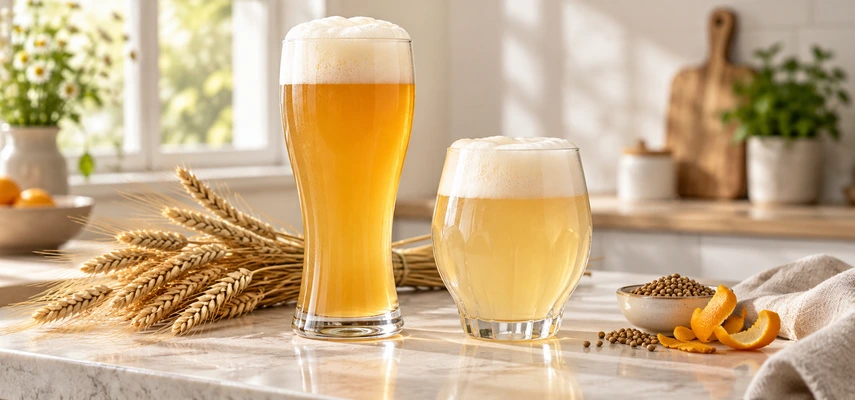

Wheat beers explained only as cloudy drinks miss the best part. A Weissbier can suggest banana and clove without either being added. A Witbier can bring citrus and spice partly through actual additions. They may look like close relatives while reaching their characteristic aromas by different routes.
The shared grain is useful, but it doesn’t dictate every flavor. Wheat choice, yeast, other ingredients and process all matter. This chapter compares the two prescribed styles without turning every wheat beer into a copy of the same glass.
Wheat supplies a foundation, not a complete flavor profile
Brewers can use wheat in malted or unmalted form, depending on the recipe. It contributes material to the beer and can influence body, foam and appearance. However, wheat alone doesn’t explain the characteristic fermentation aroma of every wheat-beer tradition.
The American Homebrewers Association ingredient introduction places grains alongside yeast and other brewing materials. The connection matters here: an ingredient helps create possibilities, while a particular fermentation can add a separate sensory signature. Keeping both in view prevents grain and microorganism roles from being confused.
The official Level 1 specification places Weissbier and Witbier among yeast-driven styles. In the real sensory picture, Witbier’s added spice can be especially important too. Educational categories organize the comparison; they do not erase contributions from other ingredients.
Weissbier: pale wheat beer with a fermentation signature
The familiar pale Weissbier appearance runs from straw to gold, commonly hazy, with a substantial white head. Light passing through the glass can create a soft glowing appearance. Filtered versions also exist, so haze is a common presentation rather than a universal biological requirement of wheat itself.
Aroma often emphasizes banana-like fruit and clove-like spice, supported by bread, dough or grain. Those are sensory associations created importantly through the yeast and fermentation. A reader should not translate the tasting note into a recipe containing mashed banana and cloves without separate evidence.
Flavor commonly repeats the banana-and-clove direction with soft wheat or bread-like malt support. Hop bitterness is low and hop aroma is generally a background contribution. Sweetness is restrained in a relatively dry finish, even when soft malt character makes the beer feel approachable.
Body is often medium-light to medium, with a fluffy or rounded sensation rather than heaviness. High carbonation gives lift and a lively finish. The BJCP Weissbier reference describes this combination of yeast character, modest hop influence and effervescence. None of those features can be established by looking at haze alone.
Why Weissbier can smell of banana and clove
Particular wheat-beer yeasts can produce fruit-like and spicy aroma compounds during fermentation. Banana-like character is commonly associated with certain esters, while clove-like character relates to certain phenolic compounds. The technical names are less important here than recognizing the microbial source.
Fermentation choices influence how those characteristics appear. Changing the organism or its conditions can change the balance, which is why every bottle doesn’t show equal banana and clove intensity. A useful note might say banana-led, clove-led or comparatively balanced rather than forcing identical descriptors onto all examples.
Characteristic ingredients include malted wheat with a pale barley-malt contribution and suitable wheat-beer yeast. Pale grain choices support the light color; yeast supplies much of the distinctive aroma. Hops help the recipe without taking over the identity in the way they do in a strongly hop-led IPA.
For comparison, an American wheat beer made with a more neutral fermentation profile need not show the same banana-and-clove signature. The grain overlap doesn’t make the styles identical. This is a practical demonstration of why changing yeast can change a beer even when a familiar grain remains in the recipe.
Witbier: citrus and spice by another route
Witbier commonly appears very pale straw to yellow, often conspicuously cloudy with a whitish glow and white foam. Its pale appearance reflects the grain choices, while suspended material can affect clarity. The color is useful, but it doesn’t reveal the exact amount or kind of spice in the recipe.
Aroma can combine soft grain or bread with citrus, particularly orange-like associations, and a fragrant spice impression. Coriander is an important traditional example, often providing citrusy or herbal-spicy character. Mild fruity or spicy fermentation character can join those actual ingredient contributions.
Flavor is generally refreshing, with gentle grain, citrus and balanced spice rather than an aggressive bitter finish. Bitterness is low to medium-low, sweetness restrained, and the finish relatively dry. A soft grain impression should not be mistaken for a compulsory high sugar level.
Body is commonly medium-light to medium, sometimes smooth or lightly creamy, while high carbonation adds lift. The BJCP Witbier reference distinguishes balanced spicing and a drinkable finish from something thick or overwhelmingly perfumed. Cloudiness does not require a heavy texture.
Witbier ingredients explain the contrast
Traditional recipes commonly combine unmalted wheat with pale barley malt, sometimes including other grains. Coriander seed and dried orange peel are familiar additions. A suitable Belgian-style yeast provides its own contribution, making the finished aroma a combination rather than a single-source effect.
This is where the comparison with Weissbier becomes especially memorable. The banana-and-clove pattern in Weissbier is importantly fermentation-derived. In Witbier, actual spice and peel additions can play a conspicuous role alongside fermentation. Two beers can share fruit-and-spice vocabulary without sharing the same causal story.
Do not turn a traditional pattern into a verified ingredient statement about an unknown brand. Recipes vary, and a producer may use different spices or other choices. For a specific suitability question, consult current producer information. A style description is a map of expectations, not a substitute for that product’s ingredient facts.
The most useful contrasts side by side
| Feature | Weissbier | Witbier |
|---|---|---|
| Familiar origin context | German wheat-beer tradition | Belgian wheat-beer tradition |
| Usual appearance | Hazy straw to gold | Very pale and cloudy |
| Aroma clue | Banana and clove | Citrus and fragrant spice |
| Major explanatory influence | Particular yeast fermentation | Yeast plus traditional peel and spice additions |
| Grain clue | Malted wheat important | Unmalted wheat commonly important |
| Hop emphasis | Low | Low |
The shared low hop emphasis is as useful as the aroma contrast. Neither style should be identified by expecting the firm citrus-hop bitterness of American IPA. Citrus-like aroma in Witbier and citrus-like hops in IPA may use a similar word while sitting in very different balances.
For an examination comparison, combine several clues. Pale cloudy beer with coriander and orange-peel additions suggests a different route from golden wheat beer with yeast-derived banana and clove. Grain, organism and added flavorings should reinforce one another in the explanation.
Avoid the haze and sourness traps
Cloudy beer is not automatically faulty, because haze can be expected in appropriate styles. Conversely, cloudiness alone doesn’t establish that a beer belongs to either of these two styles. Hazy IPA and some sour wheat beers provide obvious reminders that similar appearances can accompany very different flavor structures.
Wheat beer is also not automatically sour. Berliner weisse belongs in a different prescribed group because acidity is central to its profile. A wheat ingredient doesn’t make its microbial approach identical to Weissbier or Witbier, and a little refreshing sharpness should not be confused with the full sour-style comparison.
These distinctions show why one clue is rarely enough. A style conclusion should emerge from the combination of appearance, aroma, taste and known production rather than from a word such as wheat, cloudy or white on its own.
An optional reference exercise
Without alcohol, compare the aroma of familiar banana, cloves, orange peel and coriander separately, if those items are suitable for you to handle. The aim is to build vocabulary, not reproduce a beer recipe in a kitchen. Different people may notice different associations in the same reference.
Then read a producer description of each style and classify the stated sources: grain, yeast, hops or added spice. If the source isn’t known, mark it uncertain instead of inventing it. This exercise develops better explanations than memorizing a list of fruit words without understanding how they arise.
Voluntary tasting can use small samples under similar conditions and local age rules. Compare aroma first, then bitterness, body and carbonation. The activity is educational rather than a separately graded examination requirement; consuming alcohol is unnecessary for learning the distinctions.
Try explaining the distinction to a beginner in two sentences: name the shared grain, then explain the different sources of fruit and spice. If the explanation says wheat itself creates every banana aroma, revisit the ingredient and yeast roles before moving on.
One-page revision summary
Weissbier commonly combines pale wheat-beer appearance, banana-and-clove fermentation character, low bitterness and lively carbonation. Witbier commonly offers a very pale cloudy appearance, gentle grain, citrus and fragrant spice, with traditional orange peel and coriander helping explain its character.
Both can be refreshing without being thin, and softly rounded without being sugary. Remember the cause behind the resemblance: a shared grain does not guarantee a shared yeast signature, and similar aroma words do not guarantee identical ingredients. That distinction connects style study directly with the earlier production lessons.
Knowledge check: 10 original practice questions
Independent TFE questions, not official WSET examination items. Choose one answer per question; explanations follow separately.
1. Which aroma pair is a familiar Weissbier clue?
- Coffee and burnt grain
- Banana and clove
- Only intense pine resin
- Only sharp vinegar
2. Do banana-like and clove-like aromas prove those ingredients were added?
- No, fermentation can create the resemblance
- Yes, every Weissbier contains banana pulp
- Yes, clove aroma cannot be yeast-derived
- Only if the glass is cloudy
3. Which additions are traditional Witbier reference points?
- Coffee beans and roast barley in every example
- Only pine needles
- Grape skins and brandy
- Coriander seed and dried orange peel
4. Which wheat form is especially useful in the Witbier comparison?
- Only roasted wheat
- Only wheat already fermented into wine
- Unmalted wheat
- No wheat is used
5. What is generally shared by these styles?
- Mandatory very high alcohol
- Relatively low hop bitterness
- A defining coffee roast
- Identical recipes and yeast
6. What does haze alone establish?
- An appearance observation
- The exact style
- A fault in every case
- The alcohol percentage
7. Which statement about wheat beers is accurate?
- All taste of banana
- All are spontaneously fermented
- All are intensely sour
- Their yeast characteristics can differ substantially
8. Which note best supports Witbier?
- Black, strongly roasted and dry
- Clear amber with firm resinous hops
- Very pale, cloudy, citrus-spice, low bitterness
- Dark brown with high warming alcohol
9. Why can Weissbier feel lively without being heavy?
- Haze always means no body
- Carbonation and body are separate features
- Only alcohol creates fizz
- Every wheat beer is thick
10. What distinguishes Berliner weisse from these general comparisons?
- Acidity is central to its sour-style profile
- Wheat cannot appear in it
- It is always a dark roasted lager
- It contains no microorganisms
Answers and explanations
1. B — Banana and clove. Particular wheat-beer yeast fermentation commonly creates banana-like fruit and clove-like spice. Mapping: LO2.
2. A — No, fermentation can create the resemblance. Sensory associations and actual ingredients are different claims that require different evidence. Mapping: LO2.
3. D — Coriander seed and dried orange peel. Witbier often combines these additions with wheat, pale malt and suitable yeast. Mapping: LO2.
4. C — Unmalted wheat. Traditional Witbier commonly uses unmalted wheat alongside barley malt, contrasting with the malted-wheat emphasis in Weissbier. Mapping: LO2.
5. B — Relatively low hop bitterness. Both usually leave hops in a supporting role while grain, fermentation and sometimes spice shape identity. Mapping: LO2.
6. A — An appearance observation. Several intended styles can be hazy, so appearance needs support from other sensory and production clues. Mapping: LO2.
7. D — Their yeast characteristics can differ substantially. Wheat is one ingredient; different yeasts and production approaches create different finished profiles. Mapping: LO2.
8. C — Very pale, cloudy, citrus-spice, low bitterness. The combination fits the gentle grain, citrus and spice pattern better than the unrelated alternatives. Mapping: LO2.
9. B — Carbonation and body are separate features. High carbonation can accompany medium-light or medium body; a cloudy appearance does not measure weight. Mapping: LO2.
10. A — Acidity is central to its sour-style profile. A shared wheat ingredient does not erase the different sensory emphasis and microbial production context. Mapping: LO2.












