











The brewery can get every production decision right and still lose the argument at a warm shop window or a greasy glass. Beer storage and service are about protecting what was made, then presenting it under conditions that let its intended character appear.
The core storage principles are refreshingly practical: drink most beer fresh, keep it cool, protect it from light and keep it sealed. Service adds suitable clean glassware, appropriate temperature and careful opening and pouring. Each instruction has a reason, which makes it easier to remember than a list of rituals.
Freshness is the default starting point
Most beer is released ready to enjoy rather than needing years of development. Hop aroma and other fresh characteristics can change with time. Some styles can develop interestingly under appropriate conditions, but that exception should not turn every lager or IPA into a cellar experiment.
Check a producer’s date information and understand what the code means. A packaged-on date and a best-before date answer different questions. If the meaning is unclear, seek the producer’s explanation rather than confidently interpreting an unfamiliar number string.
Rotate stock so appropriate older stock is used before newer stock, while respecting the producer’s guidance and product condition. The Cicerone service syllabus discusses freshness and stock rotation as practical service knowledge. Its advanced technical detail is supporting context here, not an additional Level 1 examination syllabus.
Keep beer chilled to slow change
Refrigerated storage helps protect freshness by slowing unwanted changes. A sealed bottle left in a hot environment doesn’t receive protection merely because nobody has opened it. Temperature and package integrity are separate controls, and both matter.
For most everyday storage, refrigeration is a useful choice where appropriate for the product. Follow the producer’s recommendations for particular beers and avoid unnecessary heat exposure during transport or display. The goal is consistent suitable handling, not simply chilling a damaged beer immediately before serving it.
Cooling later cannot reliably reverse flavor deterioration that has already occurred. This is a useful examination connection: storage advice is preventive. It does not promise that the original hop aroma will return after a neglected package spends an hour in the refrigerator.
Protect beer from light
Light can trigger reactions involving certain hop-derived compounds and create a light-struck or skunky character. Packaging offers different degrees of protection, but keeping beer away from strong light remains the straightforward prevention principle. A shop’s sunny window is a display choice with sensory consequences.
Brown glass generally offers better protection than clear or green glass, while opaque cans block light. However, don’t treat any package as protection against every other problem. A can can protect from light while still being badly handled in excessive heat.
The faults chapter explains the mechanism and sensory effect more fully. Here the job is practical: store protected from light, and remember that artificial display lighting can also matter. Sunshine is not the only possible source of exposure.
Keep the package sealed
An intact seal helps preserve carbonation and limit unwanted exposure. Once opened, beer can lose gas and change through contact with air. Reclosing a bottle may help in some circumstances, but it is not equivalent to the original controlled packaging conditions.
Before service, inspect for leakage, damage or a compromised closure. Don’t turn a suspect package into a tasting challenge. Handle it through the appropriate product or service procedure. Quality assessment starts before the liquid reaches the glass.
Keep bottle-conditioned beer appropriately stored and handled so sediment can settle when the intended presentation calls for a clear pour. Upright storage is often useful for that purpose. Sediment is not automatically a fault, but uncontrolled disturbance can change the presentation.
Glassware is functional equipment
A glass gives access to aroma as well as showing color, clarity and foam. The Cicerone discussion of pouring into a glass explains that sensory access. Shape and size can also influence handling and presentation, but a famous logo isn’t necessary for a useful beginner comparison.
Choose suitable glassware with enough room for the intended serving and head. A delicate aroma-focused beer and a large casual serving may call for different shapes or capacities. Follow the producer or establishment’s appropriate guidance rather than assuming one glass is ideal for everything.
Handle clean glassware by the base or lower portion, keeping fingers away from the drinking surface. That habit serves hygiene and presentation together. A polished stem doesn’t help if the rim has just been handled carelessly.
Beer-clean means more than looking transparent
Grease, detergent residue and other contamination can interfere with foam and presentation. A glass may look clear while still not being properly beer-clean. Cleaning, rinsing and storage should therefore follow suitable procedures rather than relying on a quick visual glance.
Water behavior can provide useful checks, and persistent bubbles stuck in patches to the inside of a filled glass can indicate dirty surfaces. Foam behavior offers clues too, but one weak head alone doesn’t diagnose every possible cleaning problem. Beer composition and pouring also influence foam.
The Brewers Association Draught Beer Quality Manual describes glass cleanliness and handling in detail. At this level, remember the purpose: give the beer a clean surface and avoid residues that change the sensory result. Don’t rinse a previously used dirty glass and treat that as a complete cleaning cycle.
Pouring keg beer
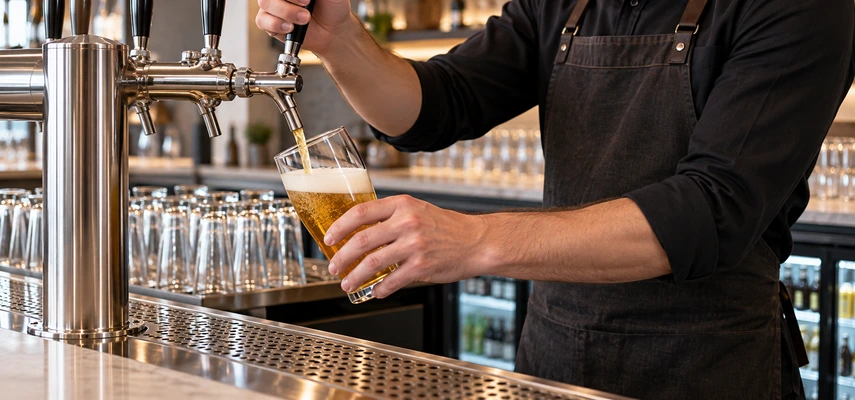
Begin with suitable clean glassware and a correctly maintained dispensing system. Hold the glass at an angle near the faucet without touching the rim to it. Open the faucet fully for normal free-flow service rather than partly opening it and creating unnecessary turbulence.
Direct the stream onto the side initially, then straighten the glass as appropriate to develop the desired head. Keep the faucet out of the beer. Close it cleanly when the serving is complete. Technique should suit the system and product rather than applying a rigid foam target to every beer.
If beer pours persistently badly, investigate the system and handling rather than compensating endlessly with the glass. Temperature, gas balance and cleanliness can all matter. Adjusting pressured equipment or cleaning chemicals belongs with trained staff and the relevant procedures, not guesswork during a busy pour.
Opening crown-cap bottles
Check that the bottle and closure are sound and the beer is at a suitable temperature. Use a proper opener for a crown cap, keeping control of the bottle and avoiding damage to the neck. The cap is a closure to remove, not a tool to prise against the glass rim.
Wipe or clean the opening as appropriate to the service setting and inspect it before pouring. Avoid touching the drinking surface or putting the bottle neck into the beer. Good handling prevents the opening operation from introducing a problem the brewer had already avoided.
The instruction is specific to crown-cap bottles. Corked or otherwise closed packages need their own suitable opening procedures. A learner shouldn’t assume every beer container opens through the same action simply because all are bottles.
Pouring bottled beer
Pour steadily into a suitable glass, often beginning with the glass tilted and then straightening to form an appropriate head. The exact approach depends on the beer’s carbonation and intended presentation. A highly sparkling product may need more care than a gently carbonated one.
If the bottle contains sediment, follow the intended serving method. Some beers are poured to leave sediment behind; some styles or producer guidance allow yeast to be included. Don’t automatically shake every bottle or automatically condemn every visible deposit.
The purpose is control. Observe how the beer behaves and stop before unwanted sediment or excess foam spoils the intended presentation. Careful pouring is an application of style knowledge, not a theatrical test of how fast the bottle can be emptied.
Service temperature changes the experience
Coldness can suppress aroma and alter the perception of flavor and texture. Excessive warmth can make a beer feel different again and affect the way gas behaves during service. Appropriate temperature therefore supports the intended experience rather than following a universal ice-cold rule.
Lighter refreshing beers are commonly served cooler than some richer or stronger beers, but follow product guidance and the serving system. Storage temperature and the best temperature in the glass need not be the same question. Keep the stock protected, then serve appropriately.
For an alcohol-free exercise, make a checklist from receipt to service and identify the purpose of each control. Mark where refrigerated storage, light protection, seal integrity, clean glassware and pouring technique intervene. The exercise reveals that good service begins long before opening the bottle.
One-page revision summary
Protect freshness with suitable refrigerated storage, light protection and intact seals. Use clean appropriate glassware and respect the intended service temperature. Pour keg beer with the faucet fully open for normal flow, avoiding contact with the rim or beer. Open crown caps with a proper opener and pour bottles with control over foam and sediment.
The official specification requires these storage and service principles within LO3. Remember their causes and purposes: prevent deterioration, preserve gas, avoid contamination and present the intended sensory profile. Good service makes those controls look uneventful, which is exactly the point.
Knowledge check: 10 original practice questions
Independent TFE questions, not official WSET examination items. Choose one answer per question; explanations follow separately.
1. What is the normal starting approach for most beer?
- Age every bottle for years
- Enjoy it fresh under suitable storage conditions
- Keep it warm before chilling
- Leave it open to develop aroma
2. Why keep beer chilled?
- To slow unwanted changes and protect freshness
- To reverse every existing fault
- To create alcohol after opening
- To replace proper seals
3. Which storage practice helps prevent light strike?
- Displaying clear bottles in sunlight
- Opening the package repeatedly
- Keeping every beer warm
- Protecting the beer from strong light
4. Why keep beer sealed?
- To make dark beer pale
- To create all yeast aromas
- To help preserve carbonation and limit exposure
- To replace refrigeration in every case
5. Which is the best description of suitable glassware?
- Any glass that looks transparent
- Appropriate in shape and capacity, and beer-clean
- Only a branded glass regardless of residue
- A used glass briefly rinsed between customers
6. What should be avoided during keg pouring?
- Submerging the faucet in the beer
- Using a clean glass
- Opening the faucet fully for normal flow
- Adjusting glass angle appropriately
7. What tool suits a standard crown cap?
- The rim of the serving glass
- A grain mill
- A keg coupler
- A proper bottle opener
8. How should bottle sediment be handled?
- Always shaken into every beer
- Always treated as proof of spoilage
- According to the intended beer presentation and producer guidance
- Ignored while pouring as fast as possible
9. Is one ice-cold serving temperature ideal for every beer?
- Yes, aroma is unaffected by temperature
- No, appropriate temperature depends on the product and intended experience
- Yes, all styles have identical texture
- Only the glass logo determines temperature
10. What should persistent poor draft pouring prompt?
- Investigation of the system and handling by suitable staff
- Endless compensation while ignoring causes
- Immersing the faucet to stop foam
- Assuming every keg is a sour style
Answers and explanations
1. B — Enjoy it fresh under suitable storage conditions. Most beer is released ready to enjoy; exceptions for development need product-specific guidance. Mapping: LO3.
2. A — To slow unwanted changes and protect freshness. Refrigerated storage is preventive and cannot reliably undo damage that has already happened. Mapping: LO3.
3. D — Protecting the beer from strong light. Light exposure can trigger undesirable reactions; darkness addresses that mechanism directly. Mapping: LO3.
4. C — To help preserve carbonation and limit exposure. An intact closure helps preserve the intended condition, but works alongside other storage controls. Mapping: LO3.
5. B — Appropriate in shape and capacity, and beer-clean. Function, cleanliness and handling matter more than branding or appearance alone. Mapping: LO3.
6. A — Submerging the faucet in the beer. Keeping the faucet outside the liquid and away from the rim supports hygienic controlled service. Mapping: LO3.
7. D — A proper bottle opener. A suitable opener removes the closure while reducing the risk of damaging the bottle neck. Mapping: LO3.
8. C — According to the intended beer presentation and producer guidance. Some intended presentations leave sediment behind, while others may include it; context matters. Mapping: LO3.
9. B — No, appropriate temperature depends on the product and intended experience. Temperature influences aroma and gas behavior, so suitable guidance matters more than a universal extreme. Mapping: LO3.
10. A — Investigation of the system and handling by suitable staff. Temperature, balance and cleanliness can cause pouring problems that technique alone cannot resolve. Mapping: LO3.












