










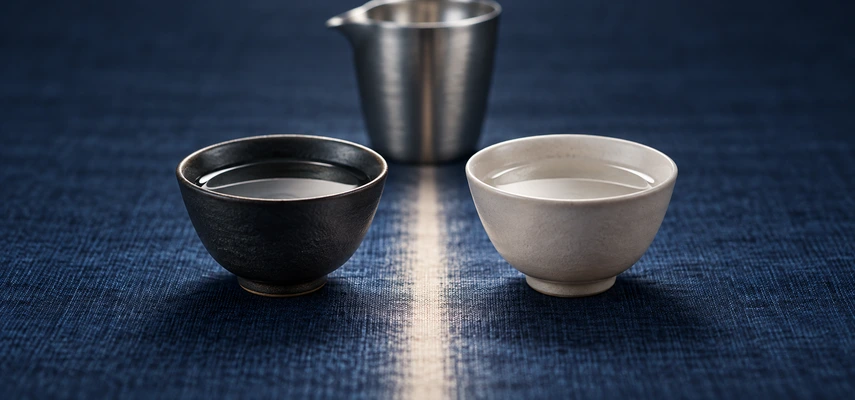

Junmai sounds reassuringly simple: pure rice. Yet the sake contains water, it relies on kōji and yeast, and it certainly contains alcohol. The phrase is useful only when its intended meaning is clear. It excludes added distilled alcohol; it does not deny the ingredients and fermentation that make the drink possible.
Honjōzō sits on the other side of that ingredient distinction. A permitted alcohol addition can help shape aroma and balance, while its rice must meet a polishing requirement. Neither name is a shorthand for good versus bad. The interesting question is what each production choice allows the brewer to achieve.
Junmai means no added distilled alcohol
For this course, junmai identifies sake made without the addition of high-strength distilled alcohol. Rice supplies starch, kōji supplies enzymes, yeast carries out alcoholic fermentation, and water supports production. The alcohol in the finished junmai comes from fermentation rather than a separate distilled-alcohol addition.
Pure rice is therefore a category expression, not a literal inventory containing one item. A useful comparison is a phrase such as whole-grain bread: it identifies a meaningful ingredient distinction without claiming that flour is the only substance involved. Read the term in its production context.
Junmai is also not a claim that no processing took place. Rice is prepared, kōji is cultivated, fermentation is managed, liquid is separated and finishing decisions are made. Omitting one permitted addition still leaves an intricate brewing process. Simplicity in a label does not mean absence of skill.
Honjōzō allows a controlled alcohol addition
Honjōzō is a premium sake grade using rice polished to 70% or less. High-strength distilled alcohol is permitted under the relevant conditions. In production descriptions, it is commonly added near the end of fermentation before the liquid is separated from mash solids.
The addition can help release and express aroma compounds and influence balance. Its purpose in premium sake is not adequately described as making more cheap alcohol. A technique can be legitimate even when it uses an ingredient that another category excludes. The category distinction tells you how the drink is made.
The NRIB classification resource provides the fuller context. The beginner summary uses permitted versus prohibited to separate the branches; it should not be inflated into a claim that all non-junmai sake must follow an identical addition recipe.
Both are fermented sake
Junmai and honjōzō begin with the same central partnership: kōji enzymes release sugars from rice starch, and yeast ferments available sugars. A distilled-alcohol addition in an eligible style does not mean the sake itself has been distilled. The base beverage remains the result of brewing.
This matters when a restaurant guest asks whether sake is a spirit. Clear appearance does not settle the answer. Nor does one ingredient’s production history replace the production history of the entire drink. Explain the fermented base and, where relevant, the permitted addition as separate facts.
The comparison also prevents a misleading purity narrative. Junmai is not more fermented in a way that makes honjōzō unfermented. Both depend on successful starch conversion, yeast activity and careful handling. Their category difference belongs inside the same brewing family.
Polishing: the two rules are not identical
Honjōzō has a remaining-rice polishing ratio of 70% or less. Starting with 100 kilograms of brown rice, that ceiling means at most 70 kilograms remain after polishing. More polishing can produce a lower number, but the percentage always describes what remains.
Plain junmai has no fixed compulsory 70% ceiling. The Level 1 specification expresses its ratio as 100% or less and notes that it is typically 70% or less. Typical practice must not be substituted for the requirement.
This creates a useful examination trap. A statement that junmai is always polished to 70% or less sounds familiar because many examples are. It is still inaccurate as a universal rule. Memorize the qualifier typically alongside the number, rather than dropping it during revision.
When junmai combines with ginjō
Junmai can appear as a grade alone or as part of junmai ginjō and junmai daiginjō. The added term brings its own polishing ceiling: 60% or less for ginjō, 50% or less for daiginjō. The no-added-alcohol restriction remains in both combinations.
Do not transfer plain junmai’s lack of a fixed ceiling to the combined grades. Junmai daiginjō cannot ignore the daiginjō polishing condition simply because its name begins with junmai. Read the complete designation as a set of connected requirements.
Equally, do not assume junmai always means an earthy, heavy style. Junmai ginjō can be fragrant and delicate. The word junmai answers the ingredient question, while the rest of the name and the producer’s approach provide further style context. One accurate rule can coexist with a wide sensory range.
Typical junmai character
Plain junmai is often described as relatively rounded, savory and rice-derived, sometimes with more noticeable acidity or fuller flavor. These are broad tendencies. The NTA’s component discussion offers analytical context, but averages from groups do not prescribe every individual bottle.
Grain, steamed-rice or lactic associations may be useful descriptions for some examples. They are sensory comparisons, not proof that cooked rice or dairy was added after fermentation. Describe the actual sample rather than forcing it to match a remembered paragraph.
Sweetness also varies. Junmai does not mean dry, and it does not mean sweet. A savory impression can occur with different sugar levels and textures. First identify sweetness, acidity, umami and weight separately; then describe how those impressions work together.
Typical honjōzō character
Honjōzō often presents a relatively light, clean and approachable style, with restrained aroma and a smooth finish. A permitted alcohol addition can contribute to that overall design. Yet the category does not guarantee an identical palate or the absence of grain-derived flavor.
A lighter impression should not be mistaken for lack of care. Precision can mean removing distractions and achieving balance rather than increasing intensity. A quiet musical passage is not a failed loud one. The brewer may be seeking a drink that sits comfortably beside food without dominating it.
Serving temperature and the particular bottle also matter. Some examples work well warmed; others are enjoyable chilled or at room temperature. The label provides a starting point, while producer guidance and personal preference help refine the decision. Grade alone does not dictate one universal serving temperature.
Added alcohol does not establish bottled strength
The ingredient is described as high-strength distilled alcohol, but that does not mean honjōzō is bottled at spirit strength. Quantity and later dilution affect final alcohol concentration. Junmai can also finish at a substantial concentration through fermentation alone.
Read the alcohol percentage printed on the actual bottle when strength matters. Do not replace it with an assumption based on the grade. A drink with an addition can have a similar or lower bottled percentage than another drink without one, depending on the full production design.
This is another example of separating cause from the wrong conclusion. Addition changes composition and can influence aroma extraction. The bottled number measures the resulting mixture. Knowing one operation occurred does not supply every measurement of the final product.
Compare two hypothetical bottles fairly
Imagine Bottle A is a junmai with savory grain notes, moderate acidity and a rounded palate. Bottle B is a honjōzō with restrained aroma, lighter texture and a clean finish. These are invented teaching profiles, not producer claims. They illustrate plausible differences without defining compulsory templates.
With a delicately seasoned dish, Bottle B might provide the balance a particular diner wants. With a fuller savory dish, Bottle A might feel more satisfying. Another person could prefer the reverse. Food intensity and individual preference make the decision useful, rather than a contest over which label sounds purer.
Now change the examples: Bottle A is a delicate junmai ginjō, while Bottle B is a characterful honjōzō. The category rules still hold even though the sensory contrast changes. That is why a rule should survive counterexamples to a stereotype.
Read labels as information, not verdicts
Look for 純米, the characters for junmai, and 本醸造, honjōzō. Character recognition is taught more fully in the label lesson, but connecting the words with their production meaning now gives the symbols something to attach to.
Then check the full designation, polishing ratio where supplied, alcohol percentage and any specialty term. Nama tells you about pasteurisation, not whether the drink belongs to the junmai branch. Nigori tells you about retained fine rice material, not a compulsory sugar level. Label literacy grows by assigning each term its own job. If information is missing, ask the producer or retailer rather than inferring an ingredient rule from the illustration or price.
One-page revision summary
Junmai prohibits added distilled alcohol and does not mean alcohol-free. Plain junmai has no compulsory 70% polishing ceiling, although that ratio or lower is typical. Honjōzō is premium sake with a 70% or lower ratio and a permitted controlled alcohol addition. Both are fermented beverages. Rounded junmai and lighter honjōzō are tendencies, not guarantees. Use the actual bottle’s strength, sensory profile and intended meal to make a preference decision.
Continue your sake studies
- Start with sake and sensory description
- Review the six-grade classification
- Practice Japanese label recognition
- Plan food pairings
Knowledge check: 10 original practice questions
Independent TFE questions, not official WSET examination items. Choose one answer per question; explanations follow separately.
1. What does junmai exclude?
- Added high-strength distilled alcohol
- Water
- Yeast fermentation
- Rice preparation
2. Where does alcohol in junmai originate?
- The bottle glass
- Fermentation
- Mandatory distillation
- The label ink
3. What polishing ceiling applies to honjōzō?
- 90%
- 80%
- 70%
- 100% exactly
4. Which statement about plain junmai is correct?
- 70% is compulsory
- 50% is compulsory
- It cannot be premium
- It has no fixed compulsory 70% ceiling
5. What can a premium alcohol addition influence?
- Aroma expression and balance
- The rice ratio retroactively
- The examination duration
- Whether water exists
6. Does honjōzō necessarily have higher bottled alcohol than junmai?
- Always
- No; final concentration depends on the whole process
- Only in winter
- Yes because junmai is alcohol-free
7. Which statement describes junmai ginjō?
- No polishing ceiling applies
- Water is prohibited
- No added alcohol and a 60% polishing ceiling
- It must be cloudy
8. What does a savory, rounded description of junmai represent?
- A compulsory aroma law
- Proof of high sugar
- Proof of nuts added
- A common tendency with variation
9. Why is honjōzō still a fermented drink?
- Its base is produced through yeast fermentation
- Added alcohol turns into rice
- It contains no alcohol
- The bottle is opaque
10. Which label characters indicate junmai?
- 本醸造
- 純米
- 大吟醸
- 吟醸
Answers and explanations
1. A — Added high-strength distilled alcohol. Junmai concerns the prohibition of a distilled-alcohol addition, not the absence of fermentation. Mapping: LO2.
2. B — Fermentation. Yeast produces alcohol from sugars supplied through rice-starch conversion. Mapping: LO2.
3. C — 70%. Honjōzō uses rice at a remaining-rice ratio of 70% or less. Mapping: LO2.
4. D — It has no fixed compulsory 70% ceiling. Typical polishing of 70% or less must not be mistaken for a universal legal threshold. Mapping: LO2.
5. A — Aroma expression and balance. A permitted addition can be a stylistic tool rather than proof of inferior production. Mapping: LO2.
6. B — No; final concentration depends on the whole process. The amount added and any water dilution affect final strength; check the actual label. Mapping: LO2.
7. C — No added alcohol and a 60% polishing ceiling. The combined name retains the junmai restriction and adds the ginjō polishing requirement. Mapping: LO2.
8. D — A common tendency with variation. Sensory expectations are useful patterns but do not override differences among bottles. Mapping: LO2.
9. A — Its base is produced through yeast fermentation. A permitted ingredient addition does not mean the entire sake was distilled. Mapping: LO2.
10. B — 純米. 純米 identifies the junmai term and its no-added-distilled-alcohol distinction. Mapping: LO2.












