










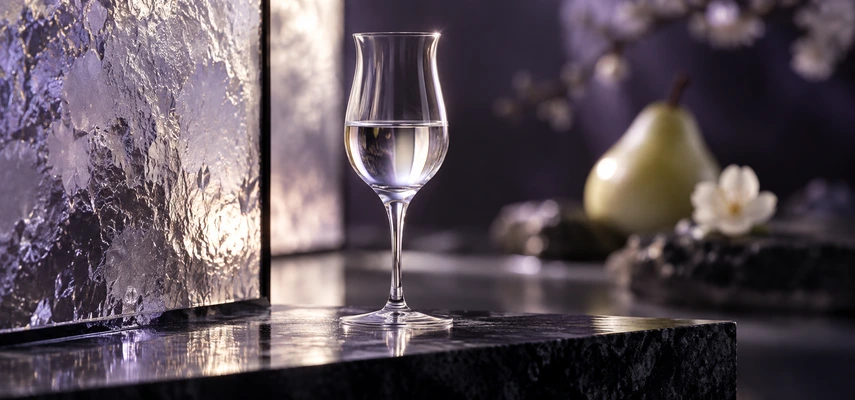

A rice number can tell you how much grain remained, but it cannot promise the smell of a pear. Ginjō and daiginjō premium styles connect extensive polishing with carefully managed brewing, often producing fruity and floral impressions from ingredients that contain no fruit or flowers.
The names can look like a vocabulary test until their structure becomes visible. Ginjō and daiginjō identify two related levels of polishing and production style. Junmai tells you whether distilled alcohol is excluded. Four names emerge from combining those two dimensions, not from four unrelated brewing universes.
A grid for four premium styles
Ginjō and junmai ginjō share a polishing ceiling of 60% or less. Daiginjō and junmai daiginjō share 50% or less. In each pair, the junmai version prohibits added distilled alcohol. The non-junmai branch permits the controlled addition within the beginner classification framework.
| Category | Remaining-rice ratio | Added distilled alcohol |
|---|---|---|
| Ginjō | 60% or less | Permitted |
| Junmai ginjō | 60% or less | Prohibited |
| Daiginjō | 50% or less | Permitted |
| Junmai daiginjō | 50% or less | Prohibited |
This is a Level 1 summary, not every condition of Japanese special-designation law. The official specification supplies the relevant syllabus requirements. Other production and quality conditions matter, so passing a numerical ceiling alone does not prove the complete designation.
Ginjō: the 60% ceiling
At a 60% ratio, 60% of the original brown-rice weight remains after polishing. Forty percent has been removed. At 55%, the rice is also within the ginjō ceiling. The words or less refer to the remaining ratio, not the amount removed.
Ginjō-style brewing commonly combines highly polished rice with careful fermentation management, often relatively cool and slow. These decisions help support a delicate style with fruity or floral expression. The result does not follow from polishing in isolation; the other production choices cooperate with it.
The non-junmai ginjō branch permits added distilled alcohol under the relevant conditions. It is not correct to teach that every use of the word ginjō means alcohol must have been added, because junmai ginjō explicitly excludes it. Read the full name rather than extracting one word and ignoring the rest.
Junmai ginjō: same ceiling, different ingredient restriction
Junmai ginjō retains the 60% or lower ratio while prohibiting added distilled alcohol. Its alcohol arises through fermentation. Rice, kōji, yeast and water remain part of the process; pure rice does not mean a one-ingredient drink or an alcohol-free one.
Sensory character can range. A junmai ginjō might combine fruity aroma with a rounded or savory palate, but it might also feel relatively light. The ingredient distinction is reliable classification information. A universal promise of greater body than every non-junmai ginjō would be unreliable.
This is a useful place to separate a comparison within one producer’s range from a claim about all bottles. Two carefully matched examples can reveal a stylistic contrast. Two names alone cannot guarantee that the same contrast will appear across every brewery, vintage or serving condition.
Daiginjō: the 50% ceiling
Daiginjō requires rice polished to 50% or less for the relevant Level 1 table. At 50%, half the original weight remains. At 40%, 60% was removed. More extensive polishing reduces the available grain and can increase cost and handling demands.
Typical descriptions emphasize delicate, fragrant and refined character. These are useful expectations, yet daiginjō is not a legal promise of one exact fruit aroma. Nor does its name settle sweetness, texture or length of finish. A detailed tasting note still needs observations in several dimensions.
The permitted distilled-alcohol addition can help express aroma and influence balance. It does not mean the sake was distilled as a whole. Keep the fermented base and the optional permitted ingredient distinction separate, just as the earlier production lessons do.
Junmai daiginjō combines both conditions
Junmai daiginjō uses a ratio of 50% or less and prohibits added distilled alcohol. Neither half of the name cancels the other. Junmai supplies the ingredient restriction; daiginjō supplies the relevant polishing and brewing-category information.
One common revision error is to remember plain junmai’s lack of a fixed polishing ceiling and apply it here. That does not work. The full designation includes daiginjō, so the 50% ceiling remains. Always interpret a combined label as combined information.
Another error is to rank junmai daiginjō automatically above daiginjō for every drinker. Both can be accomplished premium expressions. Preference may depend on aroma, palate balance, food and occasion. The absence of an addition describes a method, not an instruction about what everyone must enjoy.
Why polishing can support delicacy
Rice’s outer portions contain relatively more protein and fat than the starchy interior. Removing more changes the material available to brewing. That can help support a lighter, cleaner expression alongside appropriate cultivation and fermentation choices.
It does not follow that the grain becomes a perfect sphere of pure starch or that every flavor-producing component disappears. The comparison is about changing proportions. The brewer still has to prepare, cultivate, ferment and finish that material competently.
The JSS professional brewing guide connects polishing decisions with style while warning against using the percentage as a simple quality score. A lower remaining-rice ratio describes more processing, but a different desired style may reasonably use less polishing.
Cool fermentation helps explain aroma
Yeast creates aroma-related compounds during fermentation. Relatively cool, carefully managed fermentation is commonly associated with ginjō production and delicate fruity expression. This is why rice can become a drink that recalls pear, melon, apple or banana without those foods being added.
The aromas are comparisons, not ingredient declarations. A floral note does not establish flower infusion. Likewise, a banana-like aroma does not measure sweetness. A fragrant sake can be fairly dry on the palate, because aroma compounds and remaining sugar provide different sensory information.
The NRIB account of these varieties describes the connection with slow, low-temperature brewing. Avoid replacing that broad relationship with an invented universal temperature. Different breweries manage their cultures and equipment differently while pursuing the intended style.
Four observations beat one prestige word
If tasting is appropriate, first record clarity and color. Then describe aroma family and intensity. On the palate, separate sweetness, acidity, umami and texture. Finally note the character and persistence of the finish. Fragrant alone cannot replace the whole description.
Imagine a hypothetical sake with pronounced pear-like aroma, slight sweetness, light texture and a clean finish. Another has gentler floral aroma, moderate savoriness and a rounder palate. Either could belong within this broad premium group. The notes are examples for learning, not a shortcut to legally identifying a grade blind.
If not tasting alcohol, use the same distinctions with written profiles or familiar food aromas. Compare how a pear smells with how sweet it tastes, or how a light broth can seem savory without being sugary. Those exercises develop vocabulary without creating an additional assessment requirement.
Serving and food should protect the intended balance
Chilled service is a sensible starting point for many delicate ginjō and daiginjō styles because it helps preserve their fresh aromatic balance. Follow the producer’s recommendation and avoid assuming that colder always means better. Excessive chilling can make aromas harder to notice.
Strongly flavored food can overwhelm a delicate sake, even when the bottle is expensive. Match the intensity of the actual dish and drink rather than the prestige of the label. A subtle seafood preparation and a strongly glazed grilled dish ask different things of a beverage.
Personal preference remains part of the decision. Some people prioritize fragrance, others savoriness or texture. A well-chosen less highly polished sake may fit a meal better than a delicate daiginjō. The purpose of learning grades is to make informed choices, not to remove taste from the conversation.
Work a label example from both directions
Suppose a producer identifies a bottle as junmai ginjō with a 55% ratio. The ratio meets the 60% ceiling, and the junmai term excludes added distilled alcohol. Fifty-five percent remains; 45% was removed. The label still does not tell you a mandatory sweetness level.
Now suppose a bottle is daiginjō at 45%. The number meets the 50% ceiling and the non-junmai branch permits a controlled addition. Do not infer a higher bottled alcohol percentage than the first example. Final strength depends on the full production design, including possible dilution.
Finally, if only 45% appears without a designation, you cannot safely invent the complete grade. The ratio is evidence about one production condition. It is not a replacement for the full label, producer information or the other applicable requirements. Check the producer’s description when the name or translated label is incomplete.
One-page revision summary
Ginjō and junmai ginjō use 60% or less; daiginjō and junmai daiginjō use 50% or less. Junmai versions prohibit added distilled alcohol. More polishing and cool fermentation can support delicate fruity or floral expression, but no grade guarantees identical aromas, sweetness or body. Read the complete name, distinguish production facts from sensory tendencies, and choose service and food around the actual bottle.
Continue your sake studies
- Understand rice preparation
- Follow kōji cultivation
- Review the six-grade classification
- Practice Japanese label recognition
Knowledge check: 10 original practice questions
Independent TFE questions, not official WSET examination items. Choose one answer per question; explanations follow separately.
1. Which ceiling applies to both ginjō categories?
- 60% or less
- 70% exactly
- 80% or less
- 100% exactly
2. Which ceiling applies to both daiginjō categories?
- 70%
- 50% or less
- 90%
- 60% exactly
3. What does junmai add to junmai daiginjō?
- Mandatory bubbles
- Mandatory sweetness
- No added distilled alcohol
- No water
4. What is a typical ginjō aroma family?
- Only burnt rubber
- Only vinegar
- Always dairy
- Fruity or floral
5. How much was removed at a 40% ratio?
- 60%
- 40%
- 20%
- None
6. Does a pear-like aroma prove added pear?
- Yes
- No; fermentation can produce that aroma resemblance
- Only at 50%
- Only in junmai
7. Which production approach is commonly associated with ginjō?
- Boiling finished sake until distilled
- Skipping yeast
- Careful relatively cool fermentation
- Removing all kōji enzymes first
8. Which statement about a 45% ratio is sound?
- It alone proves junmai daiginjō
- It means 45% removed
- It means 45% alcohol
- It meets the daiginjō numerical ceiling but other requirements matter
9. What service is a sensible starting point for many delicate examples?
- Chilled, following producer guidance
- Always boiling
- Always frozen solid
- Only from a heated wooden box
10. Which statement about preference is accurate?
- Daiginjō must be everyone’s favorite
- The actual style and meal matter alongside grade
- Junmai always has more aroma
- Lower ratios guarantee a better pairing
Answers and explanations
1. A — 60% or less. Ginjō and junmai ginjō share the same 60% remaining-rice ceiling. Mapping: LO2.
2. B — 50% or less. Daiginjō and junmai daiginjō require a ratio of 50% or less. Mapping: LO2.
3. C — No added distilled alcohol. Junmai supplies the ingredient restriction while daiginjō retains its polishing ceiling. Mapping: LO2.
4. D — Fruity or floral. Fruity/floral expression is a common tendency, not a required identical aroma in every example. Mapping: LO2.
5. A — 60%. Forty percent remains, so 60% of the original rice weight was removed. Mapping: LO2.
6. B — No; fermentation can produce that aroma resemblance. Aroma descriptors compare sensations and do not establish ingredient additions. Mapping: LO2.
7. C — Careful relatively cool fermentation. Cool, slow fermentation commonly supports the delicate aromatic style. Mapping: LO2.
8. D — It meets the daiginjō numerical ceiling but other requirements matter. Polishing is one condition; the full designation also depends on other controlled facts. Mapping: LO2.
9. A — Chilled, following producer guidance. Chilled service often supports delicate aromatics, though producer advice and preference matter. Mapping: LO3.
10. B — The actual style and meal matter alongside grade. Production categories inform choices without replacing sensory balance and personal enjoyment. Mapping: LO2.











