










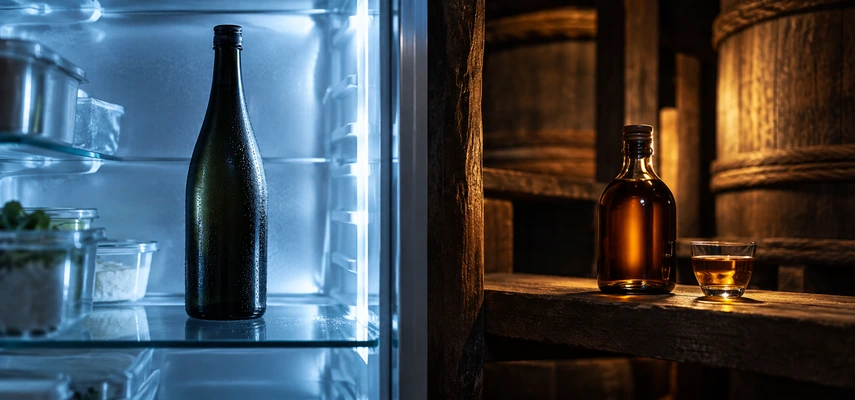

A fresh bottle can become tired, and an old bottle can be exactly what its maker intended. Nama and koshu explain why age alone is a poor guide to sake. Nama tells you pasteurisation was omitted. Koshu tells you maturation is part of the style. Both require context before their aromas make sense.
These are two of the four specialty styles prescribed for Level 1. They do not replace the premium-grade system. A sake can be junmai and nama, or carry a premium designation and be deliberately matured. Learn what each term answers, then combine the information rather than forcing every bottle into one exclusive box.
Nama means unpasteurised
Nama is sake that has not been pasteurised. Pasteurisation is a controlled heat treatment used to improve stability by managing microorganisms and enzyme activity. Omitting it leaves a product with different handling requirements and can preserve a distinctive fresh expression.
Unpasteurised does not mean unfermented. Yeast has already converted sugars into alcohol during brewing. Nor does it mean the sake must be cloudy or sparkling. Those characteristics concern retained particles and carbon dioxide, which are separate dimensions.
The official specification identifies no pasteurisation as the controlled production point for nama. Keep that definition direct. Fresh, lively or youthful can help describe a typical impression, but none is as precise as stating the omitted treatment.
Why pasteurisation matters
Sake production leaves more than water and alcohol in the liquid. Enzymes and biological material are part of the wider production story. Controlled heating helps stabilize the drink by reducing activity that could otherwise change its condition during storage and distribution.
This is not distillation. Pasteurisation does not mean boiling the sake and collecting a concentrated spirit elsewhere. It is a heat treatment applied to the drink for stability. Confusing the two obscures both the purpose of the operation and the defining feature of nama.
There are several possible heat-treatment arrangements in commercial production. For Level 1, avoid assuming that every pasteurised sake receives an identical schedule. The reliable contrast is between a fully unpasteurised nama and sake that has received stabilizing heat treatment.
Nama’s typical character needs qualifiers
Nama may seem lively, fresh and expressive. Some examples show pronounced fruit or youthful grain character. Others are richer or more savory. There is no requirement that every nama be delicate, sweet, fizzy or made at a particular premium grade.
Compare like with like when exploring the effect of heat treatment. Two unrelated bottles can differ in polishing, yeast, sweetness and production history as well as pasteurisation. If one smells fruitier, the comparison alone cannot prove that omitting heat caused every difference.
A useful hypothetical exercise compares two versions of a producer’s broadly similar sake, one pasteurised and one unpasteurised. The producer’s information helps identify the actual process difference. Even then, describe the samples before assigning a causal story to each individual aroma.
Refrigeration is especially important for nama
Follow the producer’s storage instructions and keep nama refrigerated. Cool storage slows unwanted change and helps preserve the intended character. An appealing fresh-style label does not protect a bottle left warm in a sunny room.
The NRIB storage guide gives particularly low-temperature guidance for nama and other delicate styles. The practical lesson is not to treat unpasteurised sake as indifferent to temperature. Transport, retail display and home storage are all parts of the handling chain.
Once opened, reseal promptly, refrigerate and use reasonably soon according to the product’s advice. There is no single universal deadline appropriate to every style and storage history. A bottle that looks attractive on a counter can still lose the freshness that made it interesting.
Nama-hine is not the same as youthful character
Nama-hine is an unwanted deterioration associated with unpasteurised sake during storage. It can give unpleasant stale, malty, meaty or vegetal impressions instead of the intended fresh expression. Temperature control is an important practical defense.
This is not simply a synonym for oxidation, nor a description of every savory note in nama. The NRIB preservation resource distinguishes the storage off-odor from other aging-related processes. Level 1 students need the context and consequence without reducing a complex mechanism to one invented cause.
If a bottle seems wrong, compare its condition with the intended style and consult the seller or producer. Do not assume that an unfamiliar aroma is either a prestigious feature or definite contamination. Sensory context and handling history matter, particularly when a product deliberately omits a stabilizing treatment.
Koshu means matured sake
Koshu refers to sake that has been matured. Time becomes part of the producer’s intended style rather than merely an accident in the back of a cupboard. Maturation can change color, aroma, flavor and texture, producing expressions unlike a fresh, delicate bottle.
Do not turn one published aging period into a universal Level 1 legal minimum. The specification prescribes maturation, not a fixed number of years to memorize for every use of koshu. Producers and industry descriptions can use more particular definitions for their own products or associations.
The important distinction is intention and management. A producer selecting a sake for maturation, controlling conditions and assessing its development is doing something different from forgetting a fresh bottle near a radiator. Both involve time, but time alone does not explain the resulting quality.
What maturation can change
Some matured sakes develop deeper yellow, gold or amber color. Aromas may recall nuts, caramel, dried fruit or spice, with a richer or more integrated palate. These are common possibilities, not compulsory features in every matured example.
Storage temperature, duration and the sake’s original composition affect development. A carefully cold-matured style may remain relatively pale and retain more youthful character. Therefore a pale appearance does not automatically disprove maturation, just as a deep color does not prove a bottle was well aged.
The NRIB varieties resource describes changes that can occur during maturation. Use the range to understand possibilities, rather than constructing a rule that all koshu must be brown, sweet or nutty. Real products deserve more flexible observation.
Intentional maturation versus deterioration
The general storage advice is to drink sake young. Koshu is an intentional exception to that broad recommendation. It does not authorize treating every sake as a long-term aging project. A delicate aromatic bottle can lose its intended appeal without becoming a successful koshu.
Faulty aging may involve tired aromas, loss of freshness and an unbalanced impression. Intentional maturation can involve complexity and a coherent developed style. Some descriptors overlap, so one word such as caramel cannot independently diagnose either success or failure.
Ask what the product was designed to be. A fresh ginjō losing its fruit and becoming stale is not automatically improved because a matured sake can have different aromas. The relevant comparison is with the producer’s intended style, not an assumption that older must mean better.
Grade and specialty style remain separate
Junmai excludes added distilled alcohol. Ginjō and daiginjō bring polishing and related production information. Nama omits pasteurisation, while koshu concerns maturation. These statements operate at different levels and can be combined where the actual production supports them.
A junmai nama is therefore entirely coherent. The ingredient restriction does not require pasteurisation. Similarly, a premium sake can be intentionally matured; polishing does not freeze the drink’s character in time. Read the complete designation and producer description to understand the particular bottle.
For revision, use a question-and-answer map. Was distilled alcohol added? Look to junmai information. Was it pasteurised? Look to nama information. Was maturation intended? Look to koshu and producer information. One familiar term should not be forced to answer all three questions.
Service and food depend on the actual expression
Chilled service often suits a fresh nama style and supports its intended freshness. Matured sake may offer different possibilities, including room-temperature or gentle warm service where the producer recommends it. Do not apply a single serving rule to every matured bottle.
Match food with flavor intensity and sweetness rather than age alone. A rich, nutty koshu may work beside a strong savory dish, while a lighter cold-matured example could need something gentler. These are possible applications, not universal pairing laws.
Readers who avoid alcohol can still compare these concepts through written product descriptions and familiar aromas. The qualification has no separately assessed tasting examination. What matters for the theory is understanding the treatment, its consequences and the relevant storage distinctions.
One useful revision task is to explain why the same warm cupboard is unsuitable for a fresh nama and cannot be assumed suitable for making koshu. In the first case it risks deterioration; in the second it lacks the producer’s selection and controlled maturation plan. The setting does not become appropriate simply by waiting longer.
One-page revision summary
Nama is unpasteurised sake and needs especially careful cold storage. Its fresh character is a tendency, not a promise of sweetness, bubbles or one grade. Nama-hine is unwanted storage deterioration, not a synonym for every aging process. Koshu is matured sake, with possible developed color and nutty or caramel-like complexity. Maturation is intentional and managed; neglect is not a substitute. Grade, heat treatment and maturation provide different, potentially overlapping information.
Continue your sake studies
Knowledge check: 10 original practice questions
Independent TFE questions, not official WSET examination items. Choose one answer per question; explanations follow separately.
1. What defines nama?
- No pasteurisation
- No fermentation
- No alcohol
- Exactly 50% polishing
2. What defines koshu in the prescribed scope?
- Mandatory cloudiness
- Maturation
- Mandatory carbonation
- No yeast
3. Which storage is especially important for nama?
- Bright warm window
- Beside a cooker
- Refrigeration following producer guidance
- An open bowl on a counter
4. What does pasteurisation do?
- Polish rice
- Distil the whole beverage
- Introduce fruit
- Apply heat for stability
5. Can sake be both junmai and nama?
- Yes, the terms describe different production conditions
- No, junmai requires pasteurisation
- Only without water
- Only if sparkling
6. Which is a possible matured character?
- Mandatory fresh grape juice
- Nutty or caramel-like development
- A required milky appearance
- A guaranteed lack of flavor
7. What does nama-hine describe?
- A serving cup
- A polishing ratio
- Unwanted deterioration in unpasteurised sake
- Every pleasant savory aroma
8. Which aging statement is accurate?
- All sake improves forever
- All old sake is faulty
- Amber color proves successful maturation
- Intentional koshu maturation differs from accidental neglect
9. Does nama guarantee one aroma profile?
- No, its defining fact is omitted pasteurisation
- Yes, always banana
- Yes, always flowers
- Yes, always caramel
10. What should guide a koshu service decision?
- Age alone regardless of style
- The actual expression and producer advice
- Always frozen
- Always boiling
Answers and explanations
1. A — No pasteurisation. Nama is the unpasteurised specialty style rather than a premium grade. Mapping: LO2.
2. B — Maturation. Koshu refers to matured sake, with time deliberately influencing the style. Mapping: LO2.
3. C — Refrigeration following producer guidance. Cold handling helps preserve the intended condition of unpasteurised sake. Mapping: LO3.
4. D — Apply heat for stability. Pasteurisation manages biological and enzymatic activity rather than collecting distilled spirit. Mapping: LO1.
5. A — Yes, the terms describe different production conditions. No added distilled alcohol and no pasteurisation are compatible statements. Mapping: LO2.
6. B — Nutty or caramel-like development. Maturation can create developed aromas, though not every koshu has an identical profile. Mapping: LO2.
7. C — Unwanted deterioration in unpasteurised sake. It is an undesirable storage-related change, distinct from simply being fresh or savory. Mapping: LO3.
8. D — Intentional koshu maturation differs from accidental neglect. Time must be understood in relation to product design and controlled storage. Mapping: LO2.
9. A — No, its defining fact is omitted pasteurisation. Freshness and aroma tendencies vary across producers and premium categories. Mapping: LO2.
10. B — The actual expression and producer advice. Matured sake varies, so one serving temperature cannot be imposed on every bottle. Mapping: LO3.











