










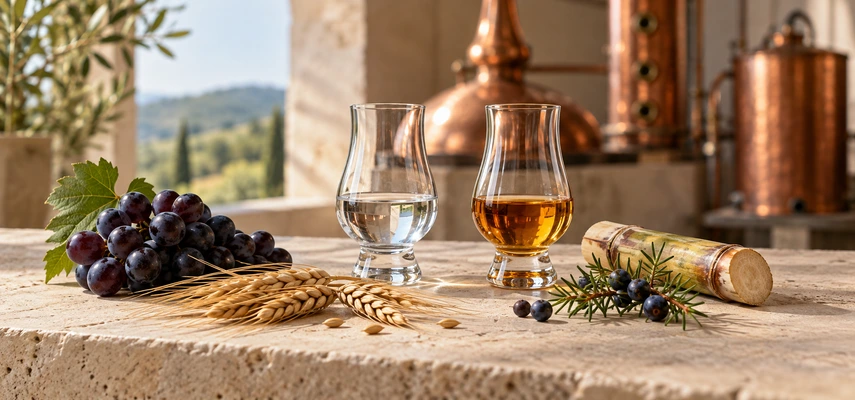

Put a clear vodka beside an amber whisky and a fragrant gin. They share an essential piece of machinery: somewhere in their story, a still concentrated alcohol from a fermented liquid. Yet one may seem restrained, another smell of vanilla and toast, and the third announce itself with juniper. How can the same basic process produce such different results?
The answer is a chain of decisions. The starting material matters, but so do the yeast, the way the still operates, and what happens afterwards. A spirit is more than a distilled ingredient. It carries the consequences of choices made from field to bottle.
This guide introduces the vocabulary needed to understand and describe spirits without memorising a shelf full of labels. It also explains how those ideas fit the WSET Level 1 Award in Spirits. TFE’s guide is an independent educational resource, with original practice questions; it isn’t affiliated with or endorsed by WSET.
Follow the drink backwards
Start with this framework: Raw material → Fermentation → Distillation → Finishing → Spirit characteristics. For a closer production map, split that first step into preparing a sugary liquid and fermenting it. That gives the four stages used in the Level 1 syllabus: raw-material processing, alcoholic fermentation, distillation, and post-distillation operations.
Each stage answers a different question. Where does the fermentable sugar come from? How is alcohol produced? How is it concentrated? What changes before bottling? Keeping those questions separate prevents several common misunderstandings. A still doesn’t turn water into alcohol, and a barrel doesn’t explain every aroma in an aged spirit.
Consider grapes and barley. Grapes provide sugar in their juice. Barley stores much of its potential fermentable material as starch, which needs converting into sugar. Both routes can feed yeast, but they begin with different materials and processing choices. The Scotch Whisky Association’s production account follows this grain-to-spirit journey in a familiar category.
During alcoholic fermentation, yeast converts fermentable sugars into ethanol and carbon dioxide. Ethanol is the alcohol measured on a drinks label. Fermentation also helps establish aroma. It produces an alcoholic liquid before distillation begins; grape-based spirit starts with a wine, while grain-based spirit starts with a different fermented base.
Distillation then concentrates alcohol and selects a mixture of volatile compounds. Imagine editing a crowded recording rather than creating a new song from silence. The still changes the balance of material already present. The analogy has limits, but it captures the essential point: what goes into the still matters, and so does what the distiller carries through.
Two stills, more than two personalities
A pot still works in batches. The producer fills it, distils a charge, and prepares it for another run. In the introductory syllabus, lower-strength pot distillation is associated with medium to pronounced aroma intensity. It can preserve a noticeable connection with the fermented raw material.
A column still can operate continuously. Its internal arrangement allows repeated contact between rising vapour and descending liquid. Depending on its operation and configuration, it can make a characterful lower-strength spirit or a much lighter high-strength one. Calling every column-distilled spirit flavourless would leave a large part of the spirits shelf looking understandably offended.
Distillation strength is therefore a useful clue, not a verdict on quality. Distilling to a high alcoholic strength tends to reduce the concentration of many aroma compounds carried from fermentation. Lower-strength distillation generally retains more of that character. Light and pronounced styles serve different purposes; neither automatically wins.
Finishing changes the conversation
Newly distilled spirit can be bottled after suitable preparation or shaped by further operations. Finishing, as used in this guide’s broad framework, includes maturation, blending, flavouring, sweetening and dilution. In whisky discussions, the same word sometimes refers more narrowly to an additional period in a different cask. Context tells you which meaning applies.
Oak ageing can add colour and aromas while the spirit develops in the barrel. New oak generally has more readily available wood-derived material to contribute than a repeatedly used cask. Vanilla, toast and spice associations can help describe the result, but they don’t mean someone added a vanilla pod or a spice packet.
Blending combines suitable components to reach a desired result. The purpose may be consistency, complexity, or both. Flavouring can bring another set of changes: juniper and other botanicals help define gin, for instance. Added sugar changes sweetness, while water adjusts alcoholic strength and can change aroma perception. Category rules determine which operations are allowed.
Describe what is there before guessing why
A useful description separates appearance, aroma, sweetness and alcoholic strength. These features interact, but they aren’t interchangeable. Begin with observations, then connect them cautiously to production. That is more dependable than deciding what a drink must taste like because its label looks expensive.
Colour is an observation: colourless, pale gold or deeper amber, for example. It can offer clues about maturation or colouring, but it cannot reliably tell you age. Oak may contribute colour, while permitted caramel colouring may also affect appearance. Two similarly coloured spirits can have very different production histories.
Aroma concerns what you smell. Start broadly: fruity, floral, herbal, spicy, smoky or woody. Then become more specific where the evidence supports it. “Citrus” is useful; “lemon peel” is more precise when that is the impression. A description doesn’t become better merely because it contains more nouns.
Aroma intensity means how noticeable the aromas are, not how many you can name. A clear juniper impression may be pronounced even if the description is short. Complexity is a separate idea involving the range and interaction of characteristics. An intense spirit needn’t be especially complex, and subtlety needn’t mean absence.
Sweetness concerns taste. A vanilla-like aroma can suggest something sweet without proving that sugar was added. Think of the difference between smelling vanilla and tasting sugar. For an examination question, identify whether the wording concerns an aroma association, an actual sweetening operation, or a category requirement.
Alcohol by volume, usually shortened to ABV, expresses the proportion of ethanol by volume. A drink labelled 40% ABV contains 40% alcohol by volume under the measurement conditions used for the label. That is different from aroma intensity: a strongly aromatic drink needn’t have a higher ABV than a quiet-smelling one.
If you choose to smell spirits, approach gently rather than taking a deep breath over the glass. Alcohol vapour can overwhelm delicate impressions. Tasting is optional for learning from this series. Readers who don’t drink can still work through production diagrams, descriptions, label comparisons and practice questions.
A small vocabulary for a large shelf
The Level 1 categories become easier to remember when attached to raw material and production. Cognac is a grape-based brandy from a defined French origin, shaped by its required production and oak maturation. Vodka is associated with high-strength distillation and a light or relatively neutral character; grains and potatoes are traditional starting materials, not the only possibilities.
Whisky or whiskey begins with grains. Different categories set different requirements for ingredients, origin, distillation and maturation. Scotch, Bourbon, Tennessee and American rye belong in that wider conversation, alongside Irish, Canadian and Japanese whiskies. The spelling alone won’t explain the drink’s character.
Rum begins with sugar cane products, including juice or molasses. Its range makes it especially useful for challenging shortcuts: rum isn’t always dark, and it isn’t always sweetened. Tequila starts with blue agave within its defined origin and production framework. These ingredients provide a starting point, not a complete sensory description.
Among flavoured spirits, gin requires juniper to predominate. Flavoured vodka, spiced rum, bitter spirits and concentrated cocktail bitters have their own roles. Liqueurs must be sweetened and may use a neutral or characterful spirit base. Cream liqueurs add another familiar variation within that group.
Vermouth belongs to aromatised wine, rather than being another distilled-spirit category. Its base is wine, with added spirit and flavourings among its production elements. That distinction matters in cocktails as well as classification. A bottle can live beside gin in a bar without belonging to the same beverage family.
What the examination actually asks
The official WSET specification, Issue 2.1 (2022), sets three learning outcomes. LO1 concerns production processes and stills. LO2 concerns principal spirit and aromatised-wine categories, their defining characteristics and labels. LO3 concerns cocktail balance and core cocktail families.
The examination has 30 multiple-choice questions in 45 minutes, under closed-book conditions. Each question has one correct answer, worth one mark; incorrect answers don’t lose marks. The passing requirement is 70%, equivalent to 21 correct answers out of 30. There is no separately assessed tasting examination.
The question distribution is 5/20/5: five on LO1, twenty on LO2 and five on LO3. That makes category knowledge a large part of revision, but understanding production helps make those category facts stick. Later lessons introduce cocktail balance through strong versus weak and bitter and/or sour versus sweet, before exploring the four prescribed families.
Follow the framework through raw materials and fermentation and pot and column distillation.
What to remember
Try explaining a spirit through a short chain: ingredient, fermentation, distillation, then later adjustments. Next, separate what you observe from what you infer. Amber is an appearance; oak maturation is one possible explanation. Vanilla is an aroma association; added sugar is a production choice. Keeping those distinctions clear turns a list of unfamiliar drinks into a system you can reason about.
For revision, practise one category at a time and ask which decisions define it. Detailed rules and age labels come later in the series. For now, the useful achievement is recognising how the stages connect—and knowing which question to ask next.
Knowledge check: 12 original practice questions
Independent TFE questions, not official WSET examination items. Choose one answer per question; explanations follow separately.
1. Which raw-material pairing is correct?
- Rum and sugar cane
- Cognac and barley
- Tequila and grapes
- Scotch and blue agave
2. Which category requires juniper to provide the predominant flavour?
- Vodka
- Gin
- Vermouth
- Cognac
3. Which statement correctly describes column stills?
- They can produce either characterful or relatively neutral spirit
- They always remove every aroma
- They create ethanol without fermentation
- They can only operate as pot-still batches
4. What does a vanilla-like aroma prove?
- Sugar was added
- A ten-year maturation
- Cream is present
- A vanilla-like sensory association
5. What produces ethanol before spirits distillation?
- Oak maturation
- Alcoholic fermentation
- Caramel colouring
- Blending
6. Which production stage prepares starch-rich material for yeast?
- Colour adjustment
- Bottle ageing
- Conversion to a sugary liquid
- Final blending
7. Which balance pair belongs to the Level 1 cocktail framework?
- Strong versus weak
- Old versus young
- Clear versus amber
- Single versus blended
8. Which beverage belongs to aromatised wine?
- Bourbon
- Tequila
- Vermouth
- Vodka
9. What does 40% ABV describe?
- The aroma intensity
- Alcohol as a proportion by volume
- The proportion of oak extract
- A practice examination score
10. Which production requirement applies to liqueurs?
- They must be unsweetened
- They must use a wine base
- They must be sweetened
- They must be made from grains
11. What does an amber colour establish on its own?
- A minimum ten-year age
- A sweetened recipe
- Pot distillation
- An appearance rather than a reliable age
12. Which learning outcome receives twenty questions in the official examination?
- Production processes only
- Cocktail families only
- Practical blind tasting
- Spirit and aromatised-wine categories
Answers and explanations
1. A — Rum and sugar cane. Rum uses sugar cane products, including juice or molasses; the other pairings misidentify their categories. Mapping: LO2.
2. B — Gin. Juniper is the defining predominant flavour of gin, although other botanicals may contribute. Mapping: LO2.
3. A — They can produce either characterful or relatively neutral spirit. Column stills can produce lower-strength characterful spirit or high-strength lighter spirit, depending on operation. Mapping: LO1.
4. D — A vanilla-like sensory association. An aroma association does not establish an ingredient addition, sweetness level or exact maturation time. Mapping: LO1.
5. B — Alcoholic fermentation. Yeast fermentation produces ethanol from fermentable sugar; distillation subsequently concentrates it. Mapping: LO1.
6. C — Conversion to a sugary liquid. Starch needs conversion into fermentable sugars before yeast can use that material effectively. Mapping: LO1.
7. A — Strong versus weak. Strong versus weak is one of the two scales, alongside bitter and/or sour versus sweet. Mapping: LO3.
8. C — Vermouth. Vermouth has a wine base; its classification differs from that of the distilled spirits listed. Mapping: LO2.
9. B — Alcohol as a proportion by volume. ABV means alcohol by volume and expresses the alcoholic proportion, not aroma intensity. Mapping: LO1.
10. C — They must be sweetened. Sweetening is required for liqueurs, which can use either neutral or characterful spirit bases. Mapping: LO2.
11. D — An appearance rather than a reliable age. Oak and permitted colouring can both affect appearance, so colour alone cannot reliably establish age. Mapping: LO1.
12. D — Spirit and aromatised-wine categories. LO2 receives twenty questions; LO1 and LO3 receive five each, giving the required 5/20/5 weighting. Mapping: LO2.











