










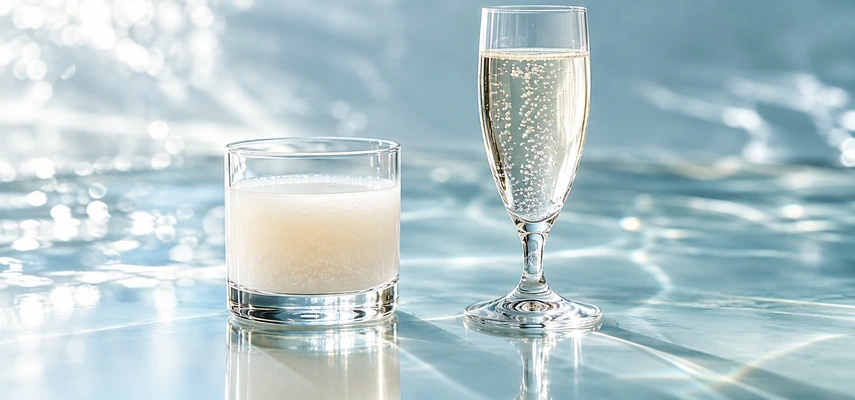

One sake looks milky. Another sends a stream of bubbles up the glass. Neither observation tells you how sweet the drink must be. Nigori and sparkling sake make an excellent lesson in keeping appearance, texture and taste separate, even when the first glance is unusually memorable.
Nigori concerns fine rice material left in the drink after coarser separation. Sparkling sake concerns carbon dioxide and its bubbles. These are specialty styles, not two additional premium grades. They can coexist with other classification information and, in some bottles, with each other.
Nigori: cloudiness with a cause
Nigori is cloudy sake. Its appearance comes from fine rice material retained after the mash undergoes a coarser separation than for a clear style. Larger solids are still separated. Calling it completely unfiltered can therefore hide the actual production decision.
Imagine using two different mesh sizes to strain a mixture. A finer mesh retains more small particles; a coarser one permits more through. This comparison explains the physical principle without pretending that brewery equipment is merely a kitchen sieve. The retained material changes what the liquid looks and feels like.
The Hyogo brewers’ description connects nigori’s cloudiness with looser filtration. Its defining visual feature is not a mysterious new ingredient or a failure to complete fermentation. It is an intended result of how the fermented mash is separated.
Rice particles change texture
Fine rice particles can give nigori a fuller, creamy or textured impression. The degree varies with the product. Some examples are lightly cloudy; others contain much more visible material. Do not expect every bottle to have the same density or mouthfeel.
Describe texture separately from flavor intensity. A creamy-feeling sake need not have pronounced aromas, and a strongly aromatic sake need not feel thick. Rice particles, dissolved components and other production decisions contribute different pieces of the experience.
Sediment can settle during storage. Follow the producer’s instructions about serving and gentle redistribution, rather than applying one universal shake-the-bottle rule. That caution becomes particularly important if the sake is also sparkling. Agitating a pressurized bottle can encourage foaming and sudden overflow.
Cloudy does not mean sweet
Many people encounter a sweet nigori early and assume the category means sweet rice sake. The definition does not establish a compulsory sugar level. A producer can make different sweetness balances while retaining fine rice material. Clarity and sweetness measure different things.
If tasting, first record the cloudiness. Then judge sweetness on the palate. Notice acidity and umami as well, because the balance of tastes affects the overall impression. A white appearance is not a substitute for any of those observations.
For an alcohol-free learning analogy, compare plain yogurt’s appearance with its tartness, or milk’s opacity with the sweetness of a sweetened drink. The useful point is that suspended material and sugar are not identical. These are comparisons for reasoning, not claims that nigori contains dairy.
Sparkling sake: carbon dioxide in the glass
Sparkling sake contains carbon dioxide that produces bubbles when pressure is released and the drink is poured. The gas can contribute a lively, prickling texture. It may form visible streams of small bubbles and a temporary surface foam, though appearance varies.
Yeast produces carbon dioxide during alcoholic fermentation, but most still sake does not retain it as a sparkling style. Packaging and production decisions determine whether a significant sparkling character reaches the consumer. The mere fact that fermentation produced gas does not make every sake sparkling.
Different production methods can supply the bubbles, including retaining fermentation-derived gas or introducing carbon dioxide. Level 1 does not require a detailed catalogue of every method. Learn the defining characteristic and avoid claiming that all sparkling sake uses one identical process.
Bubbles are texture, not a grade
Sparkling sake is not synonymous with ginjō, daiginjō or any one premium designation. A grade gives information about controlled production such as polishing and ingredient restrictions. Sparkling tells you about carbonation. The terms answer different questions.
The official Level 1 specification places nigori and sparkling sake among four specialty styles. The other two, nama and koshu, concern pasteurisation and maturation. This arrangement is a reminder that style information extends beyond the premium-grade table.
Similarly, bubbles do not establish alcohol strength. Some sparkling sakes are relatively low in alcohol, but the style name alone is not a reliable numerical measure. Check the bottle’s stated alcohol percentage instead of substituting an example remembered from a restaurant menu.
Sparkling does not mean one sweetness level
Sparkling sake can vary in sweetness, acidity and flavor. A sweet example with lively bubbles and a drier, crisper example can both belong to the broad style. Carbonation is the shared feature; it does not determine the entire palate.
The gas affects mouthfeel, while sweetness and acidity affect taste balance. They interact in the experience, yet should remain separate observations. Saying fizzy and sweet is more informative than assuming that fizzy automatically includes sweet.
This distinction matters for food pairing. A sweet dish may make a comparatively dry drink seem less generous, even when both are described as light. A sparkling sake’s suitability depends on its actual sweetness and intensity, not simply its festive appearance.
Nigori and sparkling can overlap
A sake can retain fine rice particles and contain bubbles. Cloudy sparkling sake is therefore not a contradiction. Think of two independent switches: retained material and carbonation. One can be on while the other is off, or both can be on together.
Now add grade information. A junmai designation can coexist with a specialty style because the no-added-distilled-alcohol condition does not prohibit all cloudiness or bubbles. Read complete producer information instead of treating each label word as a mutually exclusive box.
Overlapping styles also affect handling. A bottle containing sediment and pressure needs its own opening instructions. Do not vigorously shake it merely because a still nigori product was served after gentle mixing. Similar appearance does not guarantee identical packaging behavior.
Store and open with the intended style in mind
Keep sake cool and away from bright light, store bottles upright, and generally drink them young unless intentionally matured. For sparkling sake, chilled storage and service following producer guidance are especially useful. Cold handling also helps manage foaming on opening.
The NRIB storage guide gives additional practical guidance for delicate styles. Use the producer’s specific storage advice when available, particularly if the sake is unpasteurised as well as cloudy or sparkling.
Open a pressurized bottle carefully, directed away from faces and fragile objects. Follow its closure instructions and give it time if foaming begins. The goal is to enjoy the contents rather than turn the first pour into a demonstration of gas expansion across the table.
Choose vessels for observation and enjoyment
A clear wine glass makes clarity, color and bubbles easy to see and gives access to aroma. A small traditional cup may be pleasant for service, but an opaque vessel hides visual information. Neither vessel changes the legal grade of the sake.
For comparison, use modest portions and similar viewing conditions. Observe the nigori’s cloudiness before discussing its palate. Observe the sparkling example’s bubbles before judging whether its aroma is fruity or grain-derived. The sequence keeps a striking visual feature from taking over the entire description.
Readers who do not taste can compare producer descriptions and clearly labeled teaching examples. No separate tasting examination is required for Level 1. Understanding the production-to-character relationship does not depend on finishing a drink or purchasing a large collection of bottles.
A hypothetical comparison exercise
Sample A is cloudy white, with a creamy texture, moderate sweetness and gentle grain character. Sample B is clear and pale, with persistent bubbles, slight sweetness and delicate fruit aroma. These are invented notes, not claims about specific products.
The correct comparison identifies different clarity and texture, then separately compares sweetness and aroma. It does not conclude that Sample A is sweeter because it is cloudy or that Sample B belongs to a higher grade because it sparkles. The notes provide no verified polishing information at all.
Now imagine Sample C is both cloudy and sparkling, with a relatively dry palate. This example tests whether the categories have been understood as overlapping characteristics. If it seems impossible, revisit the distinction among particles, dissolved gas and sugar. Each comes from a different part of the production story.
For revision, assign each observation to its cause. Cloudiness points toward suspended material; a prickling sensation can reflect dissolved gas; perceived sweetness concerns the taste balance. A single sample can display all three without those causes becoming identical. This habit also helps explain why a change in one production decision need not change every dimension of the finished sake.
One-page revision summary
Nigori retains fine rice material after coarser separation, producing cloudiness and often a textured palate. It is not necessarily sweet and is not completely unseparated mash. Sparkling sake contains carbon dioxide, with bubbles and a lively mouthfeel; it does not identify one premium grade, sweetness or alcohol strength. Styles can overlap. Use the bottle’s instructions for storage, sediment handling and careful opening, then describe each sensory dimension on its own evidence.
Continue your sake studies
Knowledge check: 10 original practice questions
Independent TFE questions, not official WSET examination items. Choose one answer per question; explanations follow separately.
1. What produces nigori’s characteristic cloudiness?
- Fine retained rice material
- Mandatory milk addition
- Distillation vapour
- A 50% alcohol level
2. Which statement about nigori sweetness is accurate?
- It must always be very sweet
- It varies; cloudiness does not establish sugar level
- It can never be sweet
- It is determined only by the cup
3. What defines sparkling sake?
- A mandatory junmai daiginjō grade
- A compulsory 70% ratio
- Carbon dioxide and bubbles
- A complete absence of fermentation
4. Which statement about nigori separation is best?
- No material has ever been separated
- It is the same as raw rice porridge
- It must be distilled
- Coarser separation retains fine rice particles
5. Can one sake be cloudy and sparkling?
- Yes, particles and carbonation can coexist
- No, the terms legally cancel each other
- Only if alcohol-free
- Only if it contains milk
6. What can rice particles influence?
- The official examination duration
- Texture and cloudiness
- The number of premium grades
- The bottle’s printed language
7. Do bubbles prove a particular alcohol percentage?
- Always 5%
- Always 15%
- No; check the bottle’s alcohol statement
- Always spirit strength
8. What should guide sediment handling in a sparkling nigori?
- Always shake vigorously
- Always heat the closed bottle
- Ignore pressure
- Follow the producer’s specific instructions
9. Which vessel makes cloudiness and bubbles easiest to observe?
- A clear wine glass
- An opaque closed flask
- An unlit cardboard box
- A metal bucket with lid
10. Which comparison is best supported by tasting notes alone?
- The exact polishing ratio
- Clarity, texture, sweetness and aroma as separate observations
- Every legal production condition
- The named yeast strain
Answers and explanations
1. A — Fine retained rice material. Coarser separation allows fine rice particles to remain in the finished sake. Mapping: LO2.
2. B — It varies; cloudiness does not establish sugar level. Retained material affects appearance and texture, while sweetness must be assessed separately. Mapping: LO2.
3. C — Carbon dioxide and bubbles. Sparkling is a carbonation description, separate from the principal premium designations. Mapping: LO2.
4. D — Coarser separation retains fine rice particles. Nigori is not accurately reduced to completely unfiltered or unseparated mash. Mapping: LO2.
5. A — Yes, particles and carbonation can coexist. The two characteristics describe different production dimensions and can overlap. Mapping: LO2.
6. B — Texture and cloudiness. Fine material creates visual cloudiness and may contribute a creamy or fuller sensation. Mapping: LO2.
7. C — No; check the bottle’s alcohol statement. Sparkling sake varies; carbonation does not directly measure alcohol concentration. Mapping: LO2.
8. D — Follow the producer’s specific instructions. Agitation can encourage foaming, and combined styles need product-specific handling. Mapping: LO3.
9. A — A clear wine glass. Transparent glass permits visual assessment while also giving access to aroma. Mapping: LO3.
10. B — Clarity, texture, sweetness and aroma as separate observations. Sensory notes can describe dimensions without certifying undocumented production facts. Mapping: LO2.












