










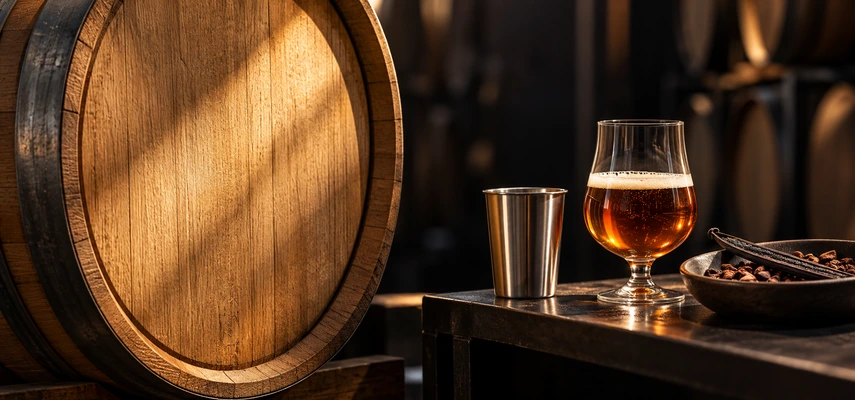

Specialty beers can look like a miscellaneous drawer until the organizing question becomes clear: what was the base beer, and what did the brewer change? A barrel-aged stout, a fruit beer and an alcohol-free pale ale have different goals. Calling them unusual explains very little about the liquid.
The WSET Level 2 Beer syllabus includes barrel ageing, flavorings and alternatives involving alcohol or gluten. This lesson connects each production decision with the result and the label. It also explains why one adjective rarely describes the whole product.
Begin with the base beer
A specialty description works best in two layers. First identify the underlying grain, hop, fermentation and strength profile. Then explain the extra process or ingredient. A coffee stout still has a stout base; a fruit wheat beer still has grain, fermentation and texture beneath the fruit.
For example, adding vanilla to a lean pale beer produces a different balance from adding it to a full dark imperial stout. The same aromatic material meets different sweetness, bitterness, alcohol and malt intensity. There is no single correct body or color for all flavored beer.
Therefore, assess integration rather than intensity alone. An addition should make sense within the intended product. A stronger smell is not automatically a more successful result, just as a more powerful loudspeaker does not automatically improve the song.
Wood supplies more than a storage address
Wood ageing can introduce vanilla-like, coconut-like, spicy or woody associations, depending on the wood and its preparation. Contact also can contribute tannin and a drying texture. The result depends on the vessel, contact time and the base beer.
Newer wood and well-used wood need not behave alike. A large old maturation vessel may contribute much less fresh wood aroma than a small recently prepared barrel. Oxygen exposure and the vessel’s microbial history can also matter, so wood does not identify one universal fermentation method.
Compared with an otherwise similar unwooded base, the aged version may show additional aroma, changed texture or a more developed profile. However, excessive wood or harsh dryness can overwhelm the beer. Time in a prestigious vessel is not a substitute for balance.
Previous barrel contents add another layer
A barrel previously used for whiskey, wine or another drink can contribute material associated with its former contents. Specialty wood-aged beer guidance distinguishes this added character from wood alone. A spirit association and an oak association are related but separate observations.
This helps explain why a bourbon-barrel stout can combine roast, vanilla, wood, spirit-like aroma and warming alcohol. Not every barrel-aged beer shares that combination. A lighter beer in a previously used wine barrel can have another balance, while a neutral old vessel can mainly support maturation.
Do not infer the exact final alcohol increase from the barrel name. Producer process and measured alcohol provide better evidence. Likewise, a spirit-like aroma does not prove that bottled spirits were poured directly into the finished beer.
Fruit changes several dimensions at once
Fruit can contribute aroma, color, acidity, tannin and fermentable sugars. The BJCP fruit-beer reference emphasizes the relationship between fruit and base. Fermented fruit can smell different from fresh fruit, so a finished beer need not resemble juice to contain a real fruit addition.
Timing matters. Sugars added while suitable organisms remain active can ferment, changing alcohol and dryness rather than remaining as sweetness. Later additions with appropriate stabilization can support a different balance. The producer has to manage the process rather than assume fruit is microbiologically inert.
Compared with the unfruited base, predict each dimension separately. Cherry can alter color and acidity as well as aroma; a pale fruit aroma need not deepen color greatly. Neither fruit name nor vivid appearance independently determines sweetness, body or strength.
Spices and other flavorings need proportion
Spices, herbs, coffee, cocoa and other additions can build on existing beer aromas. Coffee can echo roast, while citrus peel can meet hop or yeast-derived citrus associations. Those similarities are useful for integration but can make the ingredient source difficult to identify from aroma alone.
An aroma word is therefore an observation before it is an ingredient claim. Vanilla-like character might come from wood or a vanilla addition; clove-like character might come from fermentation or spice. Use recipe evidence when answering a production question.
Color, bitterness, sweetness, body, alcohol and carbonation still depend on the complete product. A cocoa-flavored beer need not contain the sugar and fat of a chocolate dessert. Avoid transferring the entire composition of an associated food into a beer simply because the aroma is familiar.
Low-alcohol brewing can limit alcohol formation
One route to lower alcohol begins before fermentation is complete. Wort design, controlled fermentation and selected cultures can limit how much fermentable material becomes ethanol. Lallemand’s low/no-alcohol brewing reference discusses this relationship between sugar composition and yeast capability.
Maltose-negative strains illustrate the principle: a culture unable to use important wort sugars can create less alcohol from that wort than a conventional culture able to use them. That does not mean no fermentation occurred or that every product will have identical residual sweetness.
The brewer must still build flavor and texture while managing remaining substrate. A weak base with little alcohol can taste thin, while an unsuitable restriction can leave an overly wort-like profile. The goal is an intentional finished balance rather than simply stopping a normal beer at an arbitrary moment.
Alcohol can also be removed afterward
Another route starts with fermentation and then reduces alcohol physically. Membrane separation and thermal approaches, including processes under vacuum, are relevant examples. GEA describes a reverse-osmosis system as one commercial membrane implementation.
Removing ethanol can change perceived weight, warmth and aroma balance, and processing can affect other compounds. Brewers may manage aroma recovery, blending or recipe design to achieve the intended result. Avoid assuming that every technique leaves an unchanged full-strength beer minus one isolated sensation.
Compare a lower-alcohol product with its intended style rather than requiring the warmth of a strong ale. Hop aroma, malt flavor and carbonation can remain important even when alcohol is small. The label describes strength; it does not measure flavor intensity by itself.
Alcohol-free does not supply one worldwide threshold
Low-alcohol, non-alcoholic and alcohol-free wording depends on the market and applicable rules. Read the stated alcohol and relevant local definition. Do not impose one country’s threshold on every imported product or assume every such phrase means absolutely zero ethanol.
Lower alcohol also changes the preservation problem. The Brewers Association’s draught discussion explains why these products require specific microbial and handling controls. The familiar protective factors in conventional beer cannot simply be assumed unchanged.
This is a production and service point, not a claim that every packaged alternative is unsafe. Follow the producer’s storage, shelf-life and dispense instructions. A verified package process is more informative than treating the broad marketing term as a complete safety specification.
Gluten-free and gluten-reduced need separate explanations
Barley and wheat are gluten-containing grains. A beer made with suitable alternative ingredients follows a different starting route from one made with conventional grains and subsequently treated to reduce gluten-related material. The two methods should not be casually renamed as each other.
Rules vary by jurisdiction. In the United States, the FDA’s gluten-free labeling guidance includes specific requirements for fermented products and evidence concerning the material before fermentation. This illustrates why a simple final-number claim is not the entire labeling question.
Gluten-reduced or processed-to-remove-gluten wording does not by itself establish medical suitability for someone with coeliac disease. For a dietary decision, use the actual regulated claim, producer information and appropriate clinical guidance. This lesson explains production distinctions rather than certifying an individual product.
Alternative grains still need a complete brewing plan
Gluten-free recipe development may use grains or other fermentable sources such as sorghum, rice or buckwheat, depending on the product. Their extract, enzyme potential and flavor differ, so replacing barley is not always a simple equal-weight substitution.
The brewer must consider conversion, fermentability, body, flavor and cross-contact control together. A product can be gluten-free and conventionally alcoholic, or low in alcohol without being gluten-free. These are independent properties rather than two names for a single category.
For revision, write a base-plus-change description for one barrel beer, one flavored beer and one lower-alcohol alternative. Then identify which facts remain unknown from the label. This preserves useful uncertainty and prevents confident guesses from becoming false production claims.
Compare like with like
For a useful thought experiment, hold the base recipe constant and change only the wood contact. Then hold the wood constant and change the base from pale ale to stout. The two comparisons answer different questions. This approach makes the contribution of a process easier to explain without claiming that a single ingredient controls every sensory dimension.
One-page revision summary
Specialty beers combine a base with purposeful changes. Wood, former barrel contents and flavorings can add aroma, texture and balance; limiting fermentation and removing alcohol are different lower-alcohol routes. Gluten-free ingredients and gluten-reduction treatment also describe different starting decisions.
Keep the sensory result, production evidence and regulated label separate. A barrel name does not dictate exact strength, fruit does not guarantee sweetness, and an alternative-product term does not replace the specific information needed to understand that beer.
Continue your beer studies
Explore the related lessons on brewing adjuncts alongside beer fermentation alongside lambic and geuze to extend the ingredient, process or sensory reasoning in this article.
Knowledge check: 10 original practice questions
Independent TFE questions, not official WSET examination items. Choose one answer per question; explanations follow separately.
1. What is the most useful starting point for explaining a specialty beer?
- Its package color
- The base beer and the deliberate modification
- Its price alone
- A fixed sensory profile for all specialty beer
2. Which can distinguish a previously used spirit barrel from wood alone?
- Mandatory black color
- Mandatory nitrogen
- Character associated with the former contents
- Mandatory sour fermentation
3. Why might added fruit fail to make a beer sweet?
- Its sugars can ferment
- Fruit has no sugar
- Fruit removes ethanol
- Fruit prevents yeast activity in every recipe
4. Which is a physical alcohol-reduction method?
- Changing the label
- Increasing original gravity
- Adding maltose-positive yeast
- Membrane separation after fermentation
5. What is the relevance of a maltose-negative culture?
- It cannot use an important wort sugar, limiting alcohol formation in a suitable process
- It removes gluten automatically
- It requires spirit barrels
- It prevents every microbial risk
6. What does alcohol-free wording establish worldwide?
- One identical legal threshold everywhere
- A claim that needs the applicable market definition and stated alcohol
- Mandatory gluten-free status
- Mandatory absence of fermentation
7. Which distinction is essential for gluten claims?
- Bottle versus can only
- Pale versus dark only
- Alternative gluten-free ingredients versus treatment of gluten-containing ingredients
- Hop aroma versus bitterness only
8. Why do low/no-alcohol products need specific preservation controls?
- They contain no water
- They are always sterile
- They cannot contain residual substrate
- Their protective factors differ from conventional beer
9. Which statement about vanilla-like aroma is most accurate?
- Wood or an addition can supply it, so recipe evidence matters
- It proves whole pods were used
- It proves the beer is sweet
- It proves a specific barrel volume
10. Which properties are independent?
- Wheat and grain
- Low alcohol and gluten-free status
- Wood and timber
- Fruit aroma and aroma
Answers and explanations
1. B — The base beer and the deliberate modification. The base supplies context for how an addition or process changes the final balance; the category has no single universal profile. Mapping: LO3 AC1/AC3.
2. C — Character associated with the former contents. Previous contents can contribute a separate aromatic layer; wood ageing alone does not require a spirit association. Mapping: LO3 AC3.
3. A — Its sugars can ferment. Active suitable organisms can consume fruit sugars, so aroma and color can remain while sweetness is low. Mapping: LO3 AC2/AC3.
4. D — Membrane separation after fermentation. Membrane technology can separate alcohol from fermented beer, unlike methods that limit its initial formation. Mapping: LO3 AC3.
5. A — It cannot use an important wort sugar, limiting alcohol formation in a suitable process. Sugar-use capability affects fermentation and alcohol; it is not a universal preservation or gluten-removal treatment. Mapping: LO3 AC3.
6. B — A claim that needs the applicable market definition and stated alcohol. Definitions vary, so an imported label should be interpreted in its regulatory context rather than assigned a universal threshold. Mapping: LO3 AC4.
7. C — Alternative gluten-free ingredients versus treatment of gluten-containing ingredients. The production starting material and treatment differ; gluten-reduced wording cannot simply be treated as identical to gluten-free. Mapping: LO3 AC2/AC4.
8. D — Their protective factors differ from conventional beer. Reduced alcohol can change microbial stability, requiring a process and handling plan appropriate to that product. Mapping: LO3 AC3.
9. A — Wood or an addition can supply it, so recipe evidence matters. A sensory association may have more than one source; the aroma alone cannot establish a precise production fact. Mapping: LO3 AC2/AC3.
10. B — Low alcohol and gluten-free status. A gluten-free recipe can produce conventional alcohol, while a low-alcohol barley beer can still contain gluten. Mapping: LO3 AC4.











