










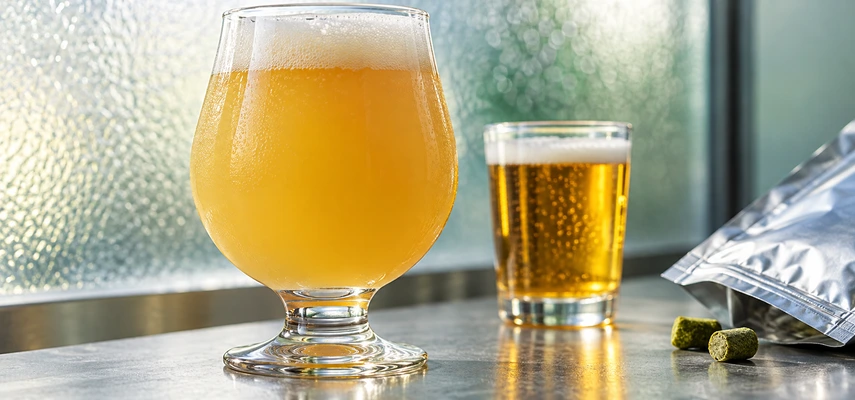

The first IPA looks clear and amber, then finishes crisply bitter. The second is pale and cloudy, smells intensely fruity and feels softer. With IPA explained as a family of production choices, these are related beers with different priorities rather than evidence that one label has become meaningless.
The Level 2 specification names American IPA with West Coast IPA, double IPA with imperial IPA, and hazy IPA with New England IPA or juicy IPA, plus other IPAs. Learn those relationships accurately, while recognizing that commercial labels and evolving regional usage are not perfectly standardized everywhere.
IPA puts hop expression at the center
India pale ale is a broad family whose modern members typically make hop aroma, flavor or bitterness defining features. That does not require identical malt, yeast, strength or appearance across every variation. A family resemblance is not the same as one recipe.
Start a comparison with separate observations for hop aroma and bitter taste. Citrus or tropical intensity can be high without the driest, most forceful bitter finish. Conversely, a clear bitter IPA can have a different aromatic pattern from the hazy beer beside it without being less deliberately hop-driven.
However, malt and fermentation remain important. They supply the material, body and environment in which hop compounds are perceived. Therefore, the brewer is balancing components, not merely adding more green matter until a beer qualifies for three letters on the tap list.
American IPA and the West Coast reference
American IPA commonly appears gold to amber, generally clear or only lightly hazy, with a white-to-off-white head. Hop aroma can be citrusy, piney, resinous, floral or fruit-rich depending on variety and process. Pale grain supports the hops, with caramel often restrained.
The palate has pronounced bitterness and a medium-dry to dry finish. Body is usually medium-light to medium, carbonation moderate to moderately high, and alcohol is stronger than in a typical APA but should remain integrated. Ale fermentation commonly avoids excessive yeast-derived distraction.
West Coast IPA is the familiar reference for a clear, dry and bitter expression within this comparison. Actual modern usage varies, and some examples emphasize contemporary fruit more than older pine-and-citrus stereotypes. The important production relationships are relatively fermentable wort, controlled fermentation and hopping that supports both aroma and bitter definition.
Compared with American pale ale, this territory generally raises hop intensity, bitter balance and alcohol. Compared with hazy IPA, it usually offers a leaner, sharper finish and less substantial haze. Do not reduce either comparison to a single mandatory hop cultivar.
Double IPA or imperial IPA
Double IPA, also called imperial IPA in the prescribed terminology, increases strength and hop intensity. Typical clear golden-to-copper versions have white foam, assertive hop aroma and a supportive pale-malt background. Hazy stronger interpretations also exist, so strength and clarity labels can overlap commercially.
Bitterness is usually high, body medium-light to medium and carbonation moderate to moderately high. Alcohol can provide smooth warmth, while an appropriately attenuated finish prevents the greater extract from becoming syrupy. More strength does not require a massive caramel body.
Higher starting extract supplies alcohol potential; appropriate yeast and process must complete the fermentation. Brewing sugars may help create strength without the same proportion of less-fermentable malt material. Large hop contributions still need sensible product and timing choices to create a coherent result.
Double does not mean exactly twice the alcohol or twice the bitterness of any other IPA. It is a style and strength signal rather than a multiplication formula. Compared with American barley wine, double IPA generally keeps a leaner malt foundation and makes hops more central to the overall identity.
Hazy IPA, New England IPA and juicy IPA
Hazy IPA generally appears pale straw to gold with substantial haze and white foam. Hop aroma is intense and often fruit-rich, with citrus, stone-fruit or tropical associations. The grain background commonly remains pale rather than strongly caramelized or roasted.
Perceived bitterness is typically softer than in the classic West Coast comparison, although the beer still needs balance. Body is often medium to medium-full with a smooth texture, carbonation moderate to moderately high, and alcohol can vary by the strength variant. A rounded impression does not mean every example must finish sweet.
Grain choices such as wheat or oats can influence protein and texture, while hop compounds, yeast and process contribute to haze and aroma. Later and dry-hop emphasis can help achieve the aromatic goal. No single ingredient is a universal explanation for every cloudy sample.
New England IPA is a common related label, and juicy IPA appears in the syllabus’s alias grouping. Juicy also has broader sensory or marketing use: it does not prove actual juice was added, a particular final sugar level or one legally fixed recipe. Haze and fruit aroma should be described, not mistaken for ingredient declarations.
Haze is an outcome to manage, not permission for instability
Intentional haze can be part of a style, but visible cloudiness alone cannot distinguish it from every other source of suspended material. Likewise, a beer does not become a successful hazy IPA simply because it contains unsettled yeast or excessive rough hop particles.
Nevertheless, the intended texture should feel integrated. Harsh astringency, an abrasive green impression or unwanted deterioration still deserve attention. A fashionable appearance is not a quality waiver, and an opaque glass should not stop the taster assessing aroma, sweetness and finish carefully.
Meanwhile, oxygen management is important for preserving delicate hop expression. A beer that has lost its intended bright aroma or changed through poor storage should not be used as the model for the style. Freshness matters even when the label is full of ambitious hop names.
Other IPAs: identify what the modifier changes
The official range includes other IPAs without supplying an exhaustive named list. Useful contextual examples include session versions, darker red or black interpretations, rye-based versions, and yeast-influenced variants. These illustrate production questions rather than adding invented compulsory WSET categories.
BJCP’s Specialty IPA material shows why modifiers need explanation. Session points toward lower strength; a red or black descriptor changes the grain/color expectation; rye signals an ingredient dimension; a yeast-related modifier can change fermentation expression. None removes the need for a coherent hop-forward identity.
However, some descriptions overlap several dimensions. A double hazy IPA combines a strength claim with a visual and sensory family. Treat those as separate pieces of information. Do not assume the strongest word on the can cancels every other part of the label.
Hop variety and timing remain different variables
Cascade, Chinook, Simcoe, Citra, Amarillo and Mosaic are prescribed American hop references, with Nelson Sauvin, Motueka and Galaxy adding southern-hemisphere possibilities. Primary grower descriptions provide useful aroma directions, but individual lots and process choices affect the result.
Early hot additions can establish bittering, later hot additions can shift aromatic retention, and dry hopping offers another extraction environment. Late does not mean zero bitterness, and dry hopping can affect perception and more than aroma alone. Article #7 supplies the process foundation.
As a result, a recipe cannot be understood from variety names alone. A hazy fruit-forward result and a dry bitter result can use overlapping hop lists while arranging dose, timing, wort and yeast differently. The process is doing as much explanatory work as the shopping list.
Compare bitterness, sweetness and body separately
By contrast, a fuller mouthfeel can soften the impression of bitterness without demonstrating low analytical bitter content. Aroma can suggest fruit sweetness before the palate confirms how sweet the beer actually is. Alcohol can add warmth without requiring a heavy body.
Therefore, record each property independently, then evaluate the combined balance. This prevents the common shortcuts that every hazy IPA is sweet, every clear IPA is brutally harsh, or every double IPA must be thick. A good comparison can describe tendencies without turning them into rules that real beers instantly disprove.
For a practical written exercise, use three reliable descriptions with the names hidden. Identify evidence for clear dry IPA, stronger IPA and haze-led fruit-rich IPA territory. Then state which missing production detail would most improve confidence in each interpretation.
Study without making consumption a requirement
Recipe notes, producer descriptions and ingredient data can support all these comparisons without drinking. Optional tasting for legally eligible readers should use modest samples and similar conditions, with freshness recorded. Different temperatures and ages can obscure the recipe relationship you are trying to learn.
When reviewing a question, look for the dimension being tested. Strength, appearance, bitterness, aroma and ingredient claims are related but different. A distractor often becomes plausible by replacing the correct dimension with another property that commonly occurs beside it.
One-page revision summary
American or West Coast IPA supplies the clear, dry bitter reference; double or imperial raises strength and intensity; hazy, New England or juicy territory emphasizes haze, fruit-rich aroma and a softer texture. Real labels and examples overlap, so use complete profiles rather than one visual cue.
Explain those profiles through starting extract, fermentability, grain, yeast and hop use. IPA is a family to reason through, not one bitterness setting or a claim that fruit aroma proves fruit was added.
Continue your beer studies
Explore the related lessons on brewing adjuncts alongside hops explained to extend the ingredient, process or sensory reasoning in this article.
Knowledge check: 10 original practice questions
Independent TFE questions, not official WSET examination items. Choose one answer per question; explanations follow separately.
1. Which comparison best distinguishes a typical West Coast IPA from a typical hazy IPA?
- West Coast must contain more residual sugar
- West Coast generally has a leaner dry bitter finish and less haze
- Hazy must contain fruit juice
- West Coast uses no pale malt
2. What does double IPA principally signal?
- Exactly twice every IPA’s bitterness
- Mandatory twice the serving volume
- A stronger, more intense hop-forward style territory
- Mandatory dark roast
3. Why may a brewer use fermentable brewing sugar in double IPA?
- To support alcohol potential without proportionally increasing less-fermentable malt material
- To guarantee a sweet finish
- To replace all hop aroma
- To make the beer spontaneously fermented
4. Which conclusion follows from juicy on a label alone?
- Orange juice was certainly added
- The beer has a fixed legal sugar content
- The yeast must be weizen
- It suggests a sensory or style direction but does not prove an ingredient addition
5. What can contribute to a hazy IPA’s texture and appearance?
- Interactions among grain, hops, yeast and process
- Only unfermented table sugar in every example
- Only the shape of the glass
- A mandatory infection
6. How does double IPA generally compare with American barley wine?
- It must have more caramel malt
- It generally has a leaner malt foundation and a more central hop identity
- Both must be identical
- Barley wine contains no hops
7. Which statement about late hot-side hop additions is accurate?
- They can never add bitterness
- They always remove aroma
- Their contribution still depends on temperature and contact time
- They define yeast species
8. What does a double hazy IPA label combine?
- Two identical words for color
- A mandatory fruit addition and barrel claim
- A legal guarantee of quality
- A strength modifier and a haze-led sensory family
9. Which is the most useful way to interpret other IPA modifiers?
- Identify whether the modifier concerns strength, grain, color or fermentation
- Assume all modifiers mean more alcohol
- Ignore the base beer entirely
- Treat every modifier as an official WSET mandatory category
10. Why is intentional haze not enough to establish good quality?
- All haze is necessarily faulty
- The beer still needs integrated flavor, texture and condition
- Only clear beers can be balanced
- Cloudiness proves correct fermentation
Answers and explanations
1. B — West Coast generally has a leaner dry bitter finish and less haze. The useful contrast concerns clarity, texture and perceived bitter balance. Haze and fruit aroma do not require juice or one fixed sweetness level. Mapping: LO3 AC1/AC3.
2. C — A stronger, more intense hop-forward style territory. Double or imperial describes strength and intensity, not an exact arithmetic ratio to another product’s alcohol or bitterness. Mapping: LO3 AC1.
3. A — To support alcohol potential without proportionally increasing less-fermentable malt material. A readily fermentable addition can help achieve strength and an attenuated balance. Actual outcome still depends on wort and yeast performance. Mapping: LO3 AC2/AC3.
4. D — It suggests a sensory or style direction but does not prove an ingredient addition. Juicy can describe fruit-rich hop expression or commercial positioning. Recipe evidence is needed to establish actual fruit or juice use. Mapping: LO3 AC1.
5. A — Interactions among grain, hops, yeast and process. Haze and mouthfeel can reflect several intentional production factors. No one ingredient or unwanted condition defines every example. Mapping: LO3 AC2/AC3.
6. B — It generally has a leaner malt foundation and a more central hop identity. Both can be strong and hoppy, but the typical malt depth and balance differ. The comparison should use the whole profile. Mapping: LO3 AC1.
7. C — Their contribution still depends on temperature and contact time. Late hot wort can still support bittering reactions while retaining a different aroma balance. Timing alone does not fix the result. Mapping: LO3 AC3.
8. D — A strength modifier and a haze-led sensory family. Double and hazy describe different dimensions that can coexist. Neither automatically settles sweetness, exact ingredients or quality. Mapping: LO3 AC1.
9. A — Identify whether the modifier concerns strength, grain, color or fermentation. Modifiers add different kinds of information. The syllabus’s broad other-IPAs range does not create an exhaustive compulsory list of every market term. Mapping: LO3 AC1/AC2.
10. B — The beer still needs integrated flavor, texture and condition. An intended visual trait does not excuse harshness, instability or poor balance. Evaluate the complete beer and its condition. Mapping: LO3 AC1 evaluation.












