










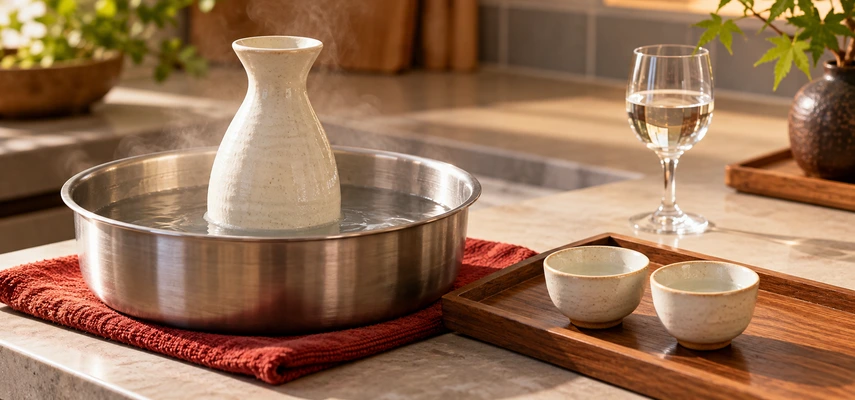

The same sake can feel like a different drink as its temperature changes. Learning to serve sake means choosing which parts of its character to bring forward, not automatically reaching for a heater. A delicate fragrant bottle and a rounded savory one may ask for different treatment.
Vessels add another layer. A wine glass helps reveal aroma, an o-choko is a small drinking cup, a tokkuri is a serving carafe, and a masu is a traditional box-shaped vessel. Understanding their jobs prevents a set of unfamiliar names from becoming a collection of interchangeable containers.
Serve sake according to the actual style
The prescribed temperature categories are chilled, room temperature, and warm or hot. They describe options, not a requirement that every sake be enjoyable at every setting. Begin with producer guidance and the intended style, then account for the drinker’s preference.
Aromatic ginjō and daiginjō often suit chilled service, which helps protect their delicate expression. Some rounded junmai and honjōzō can be enjoyable at room temperature or gently warmed. These are starting points rather than absolute rules for all examples.
The JSS service guide shows how temperature can change the experience. Do not assume hot service is needed to hide poor quality. Warm sake can be a deliberate way to enjoy a suitable, well-made product.
Chilled: freshness without freezing out aroma
Chilled service often emphasizes a fresh, light impression and is a sensible starting point for many fruity styles, nama and sparkling sake. Refrigeration before service brings the drink to an appropriate condition. Follow the label’s instructions, particularly for unpasteurised or pressurized products.
Too much chilling can make aromas harder to notice. If a suitable sake seems very closed immediately from the refrigerator, a small portion may become more expressive as it warms gently in the glass. That observation is not a reason to leave the whole bottle warm indefinitely.
JSS gives roughly 8–15°C as a practical chilled category. Treat it as service context, not a mandatory legal threshold or a universal storage recommendation. Storage aims to preserve the product over time; service aims to present it for immediate enjoyment. The two temperature decisions have different jobs.
Room temperature: a useful middle option
Room-temperature service avoids deliberate chilling or warming at the point of consumption. It can reveal a different balance of aroma, sweetness and texture. However, room temperature is not one fixed number: a pleasant dining room and a hot summer kitchen are different environments.
JSS illustrates a broad 15–25°C category. Again, that is contextual guidance rather than an instruction to store delicate sake permanently at the upper end. A refrigerated bottle can have a modest portion served at a different temperature while the remaining supply stays properly protected.
Try comparing the same suitable sake in small portions at two temperatures. Note the actual changes instead of assuming one must be better. The useful result might be that a floral aroma becomes more obvious, a texture seems rounder, or a particular preference becomes clearer.
Warm and hot: bring control to the process
Warming can make certain savory or grain-derived impressions more evident and change perceived texture. Some suitable styles feel more rounded or expressive. Yet excessive heat can lose delicate complexity and make alcohol seem more prominent. Hotter is not automatically more authentic or more enjoyable.
JSS provides approximately 40–50°C for a warmed category, while other service references describe related ranges. Level 1 requires the broad categories rather than memorization of a single universal ideal. The bottle’s style, producer advice and personal preference remain the more useful starting points.
Warm only what is needed. Repeatedly heating and cooling the entire bottle can compromise the intended character and complicate service. A modest measured amount in a suitable vessel is easier to manage, assess and pour than a whole bottle treated as a cooking experiment.
Water bath: gentle, indirect warming
A water bath warms sake through a suitable container surrounded by hot water. Put the sake into a clean heat-resistant serving vessel, such as an appropriate ceramic tokkuri. Keep the vessel upright so water cannot enter the sake, and ensure the setup is stable.
Heat the water, then manage the bath so it warms the sake gently rather than boiling it. Check the liquid temperature with a suitable clean thermometer when precision is needed. Remove the vessel carefully when the desired temperature is reached and dry the outside before pouring.
The method is indirect: the water transfers heat through the container. Container thickness, sake volume, starting temperature and bath temperature all affect the time required. There is no responsible universal instruction that every vessel needs exactly one minute. Observe the result rather than trusting an isolated timer number.
Microwave: convenient, with different precautions
A microwave is another prescribed warming method. Transfer a suitable portion to a microwave-safe vessel, with no metal trim, foil or sealed closure. Never put a closed pressurized bottle in a microwave. Use modest heating intervals rather than assuming one long burst will be evenly effective.
Microwaves can create uneven temperatures. Stir or gently mix the liquid as appropriate, allow a brief pause, and check carefully before serving. A warm-looking container does not certify a uniform liquid temperature, and a cool exterior does not guarantee that no hot spots exist.
The JSS warming guidance includes both methods. Neither is universally preferred for every situation. Microwave power, volume and vessel shape change the result, so a short published time is an example, not a rule to apply unchanged to all equipment.
Wine glasses: see and smell the sake
Wine glasses work well for many premium sakes, especially aromatic styles. A suitable tulip shape gives access to the nose, and clear glass makes color, clarity and bubbles visible. Small pours help the drink remain near its intended serving condition.
Using a wine glass does not turn sake into grape wine or remove its identity. The vessel is a practical tool. A glass can help someone distinguish a fruity smell from sweetness or observe the fine rice material in nigori without requiring advanced terminology.
For comparison exercises, use similar clean glasses so vessel differences do not dominate the result. Strong detergent residue, kitchen odors or a perfumed environment can distract from delicate aromas. Clear conditions are more useful than elaborate ritual when the goal is learning.
O-choko: the small drinking cup
An o-choko is a small sake drinking cup. It can be made from pottery, glass or other suitable materials, with many shapes and decorative approaches. Its role is drinking, in contrast to the tokkuri’s role as a serving vessel.
Small portions encourage attention to temperature and can support shared service. An opaque ceramic cup, however, hides visual information that a clear glass reveals. This is not a flaw in the cup; it simply means different vessels serve different practical priorities.
Choose a heat-appropriate cup for warm sake and handle it carefully. A tiny cup can still contain hot liquid. Hospitality does not require pressuring anyone to drink, accepting endless refills or consuming alcohol to participate in the theory-learning exercise.
Tokkuri: the pouring vessel
A tokkuri is a sake carafe, commonly with a narrow neck and broader body. Ceramic examples are familiar, and glass versions also exist. It makes it convenient to portion and pour sake into small cups and can be used for warming when the material and design are suitable.
Do not assume every decorative tokkuri is safe in a water bath or microwave. Check the material and maker’s instructions. Metal decorations, unknown glazes or an unsuitable construction can make a visually traditional vessel inappropriate for a particular heating method.
The service distinction is simple: the tokkuri holds the sake for pouring; the o-choko receives a drinking portion. Knowing that relationship is more useful than memorizing their silhouettes without understanding why both appear on the table.
Masu: tradition with sensory consequences
A masu is a square box traditionally associated with measuring rice and sake and sometimes used for drinking or ceremonial presentation. Wooden examples can contribute a cedar-like aroma. That contribution may be part of the occasion, but it can complicate a neutral sensory assessment.
The WSET service discussion explains this practical limitation. A transparent wine glass is generally more useful when the task is to observe the sake without an added wooden-vessel aroma.
Some presentations place a glass within a masu. Recognize the presentation without making overflow a requirement for every service. Tradition offers several possibilities; it does not cancel sensible portioning, cleanliness, guest preference or the need to keep the actual drink at an appropriate temperature.
One-page revision summary
Choose chilled, room-temperature or warm/hot service around the actual sake. Avoid overchilling delicate aromas and overheating complexity. A water bath gives indirect warming; a microwave requires suitable vessels, brief intervals and attention to uneven heat. Wine glasses support aroma and visual observation, o-choko are drinking cups, tokkuri are pouring vessels, and masu are traditional boxes that may contribute wood aroma. Separate service choices from long-term storage needs.
Continue your sake studies
Knowledge check: 10 original practice questions
Independent TFE questions, not official WSET examination items. Choose one answer per question; explanations follow separately.
1. Which are the prescribed broad temperature categories?
- Chilled, room temperature, warm/hot
- Frozen, boiling, burning
- Only room temperature
- Only hot
2. What is an o-choko?
- A rice mill
- A small drinking cup
- A mandatory wooden box
- A fermentation starter
3. What is a tokkuri?
- A polishing grade
- A fault
- A serving carafe
- A type of yeast
4. What is a masu?
- An aroma compound
- A water pump
- A compulsory wine glass
- A traditional box-shaped vessel
5. Which method uses indirect surrounding hot water?
- Water bath
- Rice polishing
- Bottle shaking
- Cold filtration
6. What is a key microwave precaution?
- Use metal-trimmed sealed bottles
- Use microwave-safe vessels and check uneven heating
- Always heat for ten minutes
- Ignore liquid temperature
7. Why can a wine glass be useful?
- It changes the legal grade
- It proves a 50% ratio
- It gives access to aroma and visual observations
- It eliminates alcohol
8. What can excessive heating do?
- Guarantee better quality
- Turn all sake into junmai
- Restore every faulty bottle
- Reduce delicate complexity and emphasize alcohol
9. Why may a wooden masu complicate neutral tasting?
- It can contribute wood aroma
- It always removes all aroma
- It makes the drink sparkling
- It changes rice polishing
10. Which service statement is accurate?
- Every sake must be hot
- Producer advice, actual style and preference should guide temperature
- Storage and serving temperatures must always match
- Room temperature always means 25°C
Answers and explanations
1. A — Chilled, room temperature, warm/hot. Level 1 covers all three broad options rather than requiring one for every sake. Mapping: LO3.
2. B — A small drinking cup. O-choko is the drinking cup, distinct from the tokkuri used for serving. Mapping: LO3.
3. C — A serving carafe. A tokkuri portions and pours sake, commonly into small cups. Mapping: LO3.
4. D — A traditional box-shaped vessel. The masu is a box associated with measuring and sometimes drinking sake. Mapping: LO3.
5. A — Water bath. The bath transfers heat through a suitable vessel without mixing water into the sake. Mapping: LO3.
6. B — Use microwave-safe vessels and check uneven heating. Vessel suitability, short intervals and mixing/checking help manage hot spots. Mapping: LO3.
7. C — It gives access to aroma and visual observations. A clear suitable glass supports looking and smelling without defining production. Mapping: LO3.
8. D — Reduce delicate complexity and emphasize alcohol. Warming should serve the intended style rather than simply maximize temperature. Mapping: LO3.
9. A — It can contribute wood aroma. The vessel’s sensory contribution can make it harder to observe the sake alone. Mapping: LO3.
10. B — Producer advice, actual style and preference should guide temperature. The three categories offer options, with practical judgment needed for the particular bottle. Mapping: LO3.












