










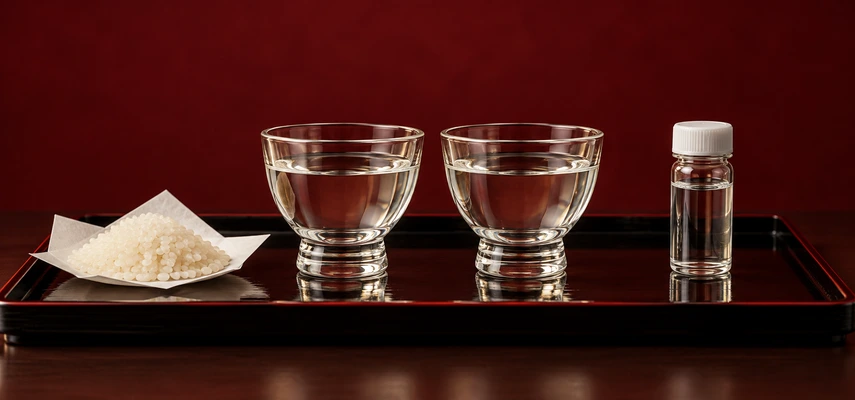

No added alcohol sounds straightforward until someone mistakes it for no alcohol at all. Junmai vs. honjōzō sake is an ingredient comparison within a fermented beverage. Yeast creates alcohol in both. The difference concerns whether distilled brewing alcohol is added, together with the other requirements attached to the named grades.
That distinction is useful, but it is often burdened with claims it cannot support. Junmai doesn’t automatically mean rich, rustic or superior. Honjōzō doesn’t automatically mean harsh, cheap or inferior. Start with what the terms establish, then examine how the production decisions can influence the glass.
Junmai vs. honjōzō sake: begin with the ingredients
Standalone junmai uses rice, rice kōji and water within the special-designation framework, without added jōzō alcohol. Yeast performs fermentation even though labeling summaries commonly concentrate on the regulated raw materials. No added brewing alcohol is a production fact, not a statement that fermentation failed to make ethanol.
Honjōzō uses rice, rice kōji, water and a limited addition of brewing alcohol. In this specific named grade, alcohol addition is part of the definition. That should not be generalized into a claim that all non-junmai sake must use the same addition or that every broad ginjō description requires it.
The National Tax Agency standard distinguishes the formulations. It is the appropriate basis for the ingredient statement. Typical tasting descriptions can help illustrate the consequences, but they cannot rewrite which ingredients the designation permits or requires.
The alcohol already made in the mash still matters
Kōji enzymes release fermentable sugars from rice starch, and yeast makes alcohol from those sugars. That happens whether the producer chooses junmai or an eligible alcohol-added plan. Both remain brewed, fermented beverages. The presence of a distilled ingredient does not mean the entire drink was manufactured by distillation.
This is similar to the distinction between a process and a component. A component can have been distilled before it enters a beverage whose base was fermented. To explain sake accurately, describe both facts rather than erasing one. The rice-to-sugar-to-alcohol chain remains essential in honjōzō.
The NRIB questions on sake explain why brewing alcohol is used and distinguish it from the base fermentation. This also corrects the assumption that a low final alcohol figure proves no addition occurred. Later water adjustment can influence the bottled strength in either style.
Polishing requirements are not symmetrical
Honjōzō requires a rice polishing ratio of 70% or less. The figure describes the proportion of original brown-rice weight remaining after polishing. A 70% ratio means 30% removed. It does not mean the sake is 70% rice by volume, nor that 70% of the grain was discarded.
Standalone junmai has no numerical polishing-ratio ceiling in the current special-designation standard. Older descriptions sometimes repeat a universal 70% rule, but that is not the present standalone definition. A junmai producer can polish substantially; the absence of a ceiling is not a requirement to use brown rice or avoid milling.
When junmai appears with ginjō or daiginjō, the combined designation adds the relevant requirements. Junmai ginjō uses 60% or less, and junmai daiginjō uses 50% or less. Don’t carry the standalone grade’s rule into every longer name containing the same word.
Common premium rules still apply
Both named grades sit within a special-designation framework that requires at least 15% kōji rice relative to total polished rice. Relevant rice and quality conditions apply as well. The kōji figure is a production ratio, not a claim that 15% of the bottle contains visible mould or suspended rice particles.
For alcohol-added premium sake, the brewing-alcohol quantity is limited to no more than 10% of polished-rice weight, expressed on a 95%-alcohol equivalent basis. These details prevent the percentage from being mistaken for final alcohol by volume. Comparing a component weight to rice weight is different from measuring ethanol concentration in a drink.
Suppose a technical description gives a 70% polishing ratio. That numerical detail is compatible with honjōzō’s polishing requirement, but doesn’t prove the grade. If no brewing alcohol was added, it cannot be called honjōzō simply because the ratio fits. The ingredient condition and other requirements must also be satisfied.
The NRIB classification table offers a practical overview. Read it as a comparison of branches, with the detailed agency standard supplying the fuller conditions. An overview is useful precisely because it can point you toward the question that still needs checking.
What can added brewing alcohol do?
In an eligible plan, brewing alcohol is commonly added to the mash near the end of fermentation and before separation. It can help transfer aroma components into the collected liquid and alter balance. A relatively light, clean impression can be a deliberate aim, rather than a sign that the brewer has diluted away all character.
The final sensory effect depends on the base sake and subsequent handling. Alcohol warmth can be well integrated or intrusive in either an alcohol-added or no-added-alcohol bottle. The relevant question is whether the components work together, not whether one ingredient name sounds more appealing.
For example, a hypothetical honjōzō might offer restrained grain notes, a smooth feel and a clean finish at the intended serving temperature. Its suitability for a meal would be assessed from those observations. Calling it harsh before tasting would replace evidence with an ingredient prejudice.
What can a junmai approach support?
Without brewing-alcohol addition, the producer works with the material and alcohol developed through the rice-based fermentation. Many junmai examples show savory character, a fuller impression or noticeable acidity. Those tendencies can be useful when choosing food or planning service, but they are not compulsory definitions.
Rice polishing, kōji style, yeast and fermentation management can support a delicate junmai just as they can support a richer one. The existence of junmai ginjō makes the point especially clear. No-added-alcohol and fruit-led aroma can coexist. The word junmai does not instruct the brewer to suppress elegance.
Nor does it guarantee sweetness. Residual sugar and the way acidity, umami and alcohol balance it matter to the tasting impression. A savory, full-feeling sake can taste dry; a lighter-feeling one can have noticeable sweetness. Keep ingredient family, body and sweetness on separate lines in a note.
Avoid purity claims that turn into factual errors
Calling junmai pure rice can help translate the name, but it should not imply that water and microorganisms are absent. Water is essential, kōji is cultivated with mould, and yeast carries out fermentation. The useful meaning concerns the ingredient framework and lack of added brewing alcohol, not a bottle containing rice and nothing else.
Likewise, alcohol addition is not equivalent to adding glucose, acids and amino acids. Those optional formulation additions belong to the broader futsū-shu discussion. Honjōzō is a premium designation with its own restrictions. Treating all additions as one undifferentiated shortcut loses important classification information.
The WSET specification places ingredient and grade understanding alongside style. An exam question can test the production distinction even when none of the answers describes a taste. Learn the legal fact and the sensory tendency as related but different kinds of knowledge.
Compare bottles without designing a biased experiment
If you choose to taste, compare similar strengths and serving temperatures first. Note aroma, sweetness, acidity, umami, texture and finish before checking which sample is which. This reduces the chance of awarding richness or harshness simply because the label primed an expectation.
Be cautious about causation. If the two samples also differ in rice, polishing, yeast, maturation and temperature, any contrast cannot confidently be attributed only to alcohol addition. The comparison can still teach descriptive skills. It just doesn’t isolate one production variable as neatly as a controlled trial would.
Readers avoiding alcohol can perform the same reasoning exercise with technical sheets. Mark the facts each sheet establishes, then list the style possibilities it suggests. Keep that second list conditional. A production explanation should become more careful as more variables are introduced, not more certain for no reason.
Work through a classification example
Consider a hypothetical sake made without brewing-alcohol addition at a 75% polishing ratio. That ratio does not automatically exclude standalone junmai, provided the other requirements are met. It cannot establish honjōzō: both the ingredient definition and the 70% ceiling would be wrong. Now change the ratio to 65% while keeping the ingredients unchanged. The rice meets the honjōzō numerical ceiling, but the missing alcohol addition still prevents that specific designation.
This example shows why classifications should be checked as sets of conditions. One correct number cannot compensate for an incompatible ingredient statement. Likewise, an appropriate ingredient list does not establish that every quality and labeling condition has been satisfied.
One-page revision summary
Junmai excludes added brewing alcohol; honjōzō includes a limited addition and uses rice polished to 70% or less. Standalone junmai has no numerical polishing ceiling, while combined ginjō names add their own limits. Shared premium requirements still apply. Both styles get their base alcohol from fermentation. Richness, dryness, smoothness and quality depend on the full production plan and actual glass, not the presence or absence of one added ingredient.
Knowledge check: 10 original practice questions
Independent TFE questions, not official WSET examination items. Choose one answer per question; explanations follow separately.
1. What does junmai establish about brewing alcohol?
- It is added at bottling
- No brewing alcohol is added
- The sake contains no ethanol
- The sake is distilled
2. Which polishing reference applies to honjōzō?
- Exactly 95%
- Always 50%
- 70% or less
- No rice is needed
3. Which is correct for standalone junmai?
- No numerical polishing ceiling
- A mandatory 70% ceiling
- A mandatory 50% ceiling
- Polishing is prohibited
4. Does honjōzō contain an alcohol-added component?
- Never
- Only if cloudy
- Only after consumer warming
- Yes, limited brewing alcohol is part of this named grade
5. What does the 10% premium alcohol-addition limit mean?
- Maximum 10% abv in the bottle
- Alcohol-equivalent weight relative to polished-rice weight
- 10% of the serving glass
- 10% of all yeast cells
6. Which sake can be delicate and fruit-led?
- Only honjōzō
- Only futsū-shu
- A junmai ginjō can fit that style
- No junmai can be fragrant
7. Where does the base alcohol in both styles come from?
- Yeast fermentation of sugars
- Rice polishing friction
- Charcoal fining
- Bottle color
8. Can a 70% ratio alone prove honjōzō?
- Yes, regardless of ingredients
- Yes, regardless of quality
- Only in green bottles
- No, the other grade requirements must also fit
9. What is a useful tasting precaution?
- Read the price and decide immediately
- Compare similar conditions before attributing differences to one variable
- Assume junmai must be sweet
- Assume added alcohol must taste harsh
10. What does the common 15% rule concern?
- Final alcohol by volume
- Rice particles in the glass
- Kōji rice as a proportion of total polished rice
- The amount of added sugar
Answers and explanations
1. B — No brewing alcohol is added. Junmai excludes added brewing alcohol while yeast still produces alcohol through fermentation. Mapping: LO2.
2. C — 70% or less. Honjōzō has this numerical condition alongside its ingredient and quality requirements. Mapping: LO2.
3. A — No numerical polishing ceiling. Current standalone junmai rules do not prescribe a numerical ceiling, unlike its ginjō combinations. Mapping: LO2.
4. D — Yes, limited brewing alcohol is part of this named grade. The specific honjōzō definition includes brewing alcohol; broader category permissions need separate reading. Mapping: LO2.
5. B — Alcohol-equivalent weight relative to polished-rice weight. The rule uses a rice-weight comparison and 95%-alcohol equivalent, not final bottled strength. Mapping: LO2.
6. C — A junmai ginjō can fit that style. Junmai describes an ingredient condition, and coordinated ginjō production can support delicate aromas. Mapping: LO2.
7. A — Yeast fermentation of sugars. Fermentation remains essential regardless of whether an eligible brewing-alcohol addition follows. Mapping: LO1.
8. D — No, the other grade requirements must also fit. A polishing figure establishes one production condition rather than the complete grade. Mapping: LO2.
9. B — Compare similar conditions before attributing differences to one variable. Serving conditions and other production variables can affect the comparison and interpretation. Mapping: LO2.
10. C — Kōji rice as a proportion of total polished rice. The shared premium requirement concerns material used in production, not visible solids or bottled strength. Mapping: LO2.
Continue studying sake
Article #9: Sake Filtration and Alcohol Addition Explained: Pressing, Clarity, and Style · Article #11: Sake Categories Explained: Futsū-shu, Premium Sake, and Classification Rules · Article #13: Ginjō and Daiginjō Sake Explained: Polishing, Yeast, and Aromatic Styles · Article #14: Tokubetsu Sake Explained: Special Junmai and Honjōzō Classifications












