










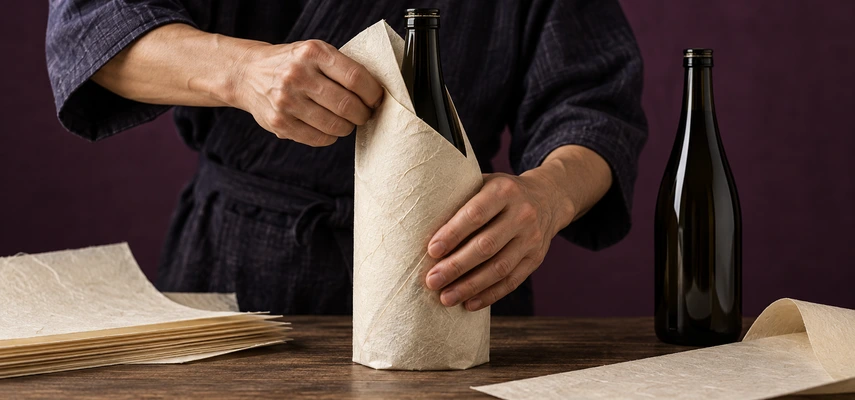

Special is easy to print. Explaining what makes something special takes more work. Tokubetsu sake belongs to the second category: the designation has conditions and an explanatory basis, rather than serving as an unrestricted compliment a producer can attach to any bottle.
The two relevant premium grades are tokubetsu junmai and tokubetsu honjōzō. They build on the underlying junmai or honjōzō requirements while adding a supported special distinction. This focused lesson examines that addition without repeating the whole classification map from the previous articles.
Tokubetsu sake needs a supported explanation
The National Tax Agency’s labeling standard connects these names with particularly good aroma, flavor and appearance, together with an objective explanation on the container or packaging. The explanation can concern ingredients, manufacturing methods or another objective basis. It is not merely the statement that the brewery considers the bottle very nice.
Where polishing ratio is the explanatory basis, the rice must be polished to 60% or less. That is the familiar numerical shortcut many learners encounter first. However, the alternative explanatory route matters. Reducing the whole definition to 60% loses part of the rule and makes some legitimate examples harder to understand.
The NRIB grade comparison presents the distinction as 60% or less or special processing. Use that as a memory aid, then remember that the detailed standard requires a supported explanation and the appropriate underlying grade conditions. A useful shortcut should not quietly replace the full concept.
Tokubetsu junmai remains junmai
Tokubetsu junmai excludes added brewing alcohol, just as the underlying junmai family does. Rice, rice kōji and water remain the raw-material framework, with yeast carrying out fermentation. The common premium conditions, including the kōji-rice requirement and appropriate quality, still apply.
A 60%-or-less ratio can supply the polishing-based special distinction. Alternatively, another objectively explained feature can support the tokubetsu designation. Standalone junmai’s lack of a numerical polishing ceiling does not vanish into a universal new ceiling simply because many tokubetsu examples use the 60% route.
This is why the word special cannot be interpreted independently from the word junmai. A producer cannot add brewing alcohol and retain tokubetsu junmai simply by giving a persuasive explanation of an unusual method. The underlying ingredient condition is still part of the designation.
Tokubetsu honjōzō remains honjōzō
Tokubetsu honjōzō includes the limited brewing-alcohol addition associated with honjōzō. The underlying 70%-or-less polishing condition remains applicable. A special-method explanation does not turn it into a grade free of the base honjōzō rules.
If polishing is used to explain the special distinction, the reference becomes 60% or less. If another qualifying objective basis is used, the base honjōzō conditions still have to be satisfied. This nested structure is more accurate than saying every tokubetsu sake has exactly the same numerical rule regardless of its family.
The Nada sake glossary’s special-designation overview gives another industry explanation of the two branches. Its table reinforces the need to combine ingredient, polishing and special-production information rather than pick one cell and ignore the others.
A polishing example makes the first route clear
Consider a hypothetical junmai made from rice polished to 58%, meeting the other relevant conditions and carrying a suitable polishing-based explanation of its special distinction. The ratio is within 60%, so the numerical part of that route fits. It does not mean exactly 60% is required; a lower remaining percentage also meets the ceiling.
Now consider a comparable sake at 62%. That ratio cannot itself supply the 60%-or-less polishing explanation. It would need another qualifying objective basis and appropriate labeling to support tokubetsu. The fact that 62 is close to 60 is not the same as satisfying that particular route.
These are simplified teaching examples, not rulings on a real bottle. Their purpose is to show what information is missing. A ratio can be checked arithmetically, while a special-method explanation needs evidence about what the producer actually did and how it is declared.
An alternative route doesn’t mean anything goes
Suppose a producer describes a distinctive manufacturing feature on a hypothetical tokubetsu junmai. The learner should ask whether that feature supplies a genuine objective explanation under the standard. A phrase such as made with care is not the same kind of evidence as a specific ingredient or process statement.
Likewise, the mere presence of a rice-variety name does not automatically certify tokubetsu status. Ingredient information can be relevant, but it must support the actual distinction and be used within the applicable requirements. Do not turn every interesting detail on a technical sheet into a legal permission.
The important study skill is recognizing the alternative route without inventing a universal example that must always qualify. The standard permits supported distinctions; it doesn’t hand the reader one secret recipe that every special sake follows. Specific commercial claims should be checked against the producer’s declaration and the rule.
Tokubetsu and ginjō can share a number without sharing a definition
Both a polishing-based tokubetsu designation and ginjō can involve a 60%-or-less ratio. That overlap does not make the names synonyms. Ginjō carries its own production and characteristic quality conditions. Tokubetsu identifies a supported special distinction within junmai or honjōzō.
Imagine two hypothetical no-added-alcohol sakes at 60%. One is produced and described as junmai ginjō, the other as tokubetsu junmai under a suitable explanation. The shared number does not prove they used identical kōji, yeast or fermentation management. It also does not guarantee identical aroma or texture.
This illustrates a recurring classification principle: meeting one numerical condition doesn’t force one unique label or prove the entire production history. Read the complete designation and supporting information. Numbers are useful precisely when they remain attached to the rule they actually measure.
Special doesn’t prescribe one flavor or a quality victory
Tokubetsu examples can vary considerably. A producer may emphasize fragrance, savory weight, a restrained finish or another coherent expression. The official syllabus recommends contrasting tokubetsu samples to show that diversity. It does not ask learners to identify one compulsory tasting note.
Therefore, don’t assume special means sweeter, drier, stronger or more aged. Those are different properties. A tokubetsu designation also doesn’t settle which bottle a particular diner will enjoy. The legal quality conditions and an individual’s preference operate at different levels of judgment.
If you choose to compare samples, record aroma and palate observations before reading the special explanation. Then ask whether the stated production feature helps make sense of what you noticed. If it doesn’t, avoid inventing a causal story merely to make the note sound complete. Sensory evidence can be informative without explaining every production detail.
A practical label-reading note can have three lines: underlying family, stated basis for the special distinction, and observed sensory character. This format separates the legal claim from its explanation and from your experience of the drink. If the explanatory basis is unavailable, record that gap rather than inventing one from price, packaging or a particularly attractive aroma.
One-page revision summary
There are two tokubetsu grades, one junmai and one honjōzō. Each keeps its underlying ingredient and production conditions. The special distinction needs an objective explanation and appropriate quality. Polishing to 60% or less can provide the basis, but an eligible alternative explanation can apply. Shared numbers don’t make tokubetsu and ginjō identical, and special does not dictate one flavor.
Knowledge check: 10 original practice questions
Independent TFE questions, not official WSET examination items. Choose one answer per question; explanations follow separately.
1. Which pair contains the two tokubetsu premium grades?
- Tokubetsu nigori and tokubetsu nama
- Tokubetsu junmai and tokubetsu honjōzō
- Tokubetsu rice and tokubetsu yeast
- Tokubetsu koshu and tokubetsu sparkling
2. What polishing ceiling applies when polishing supplies the special explanation?
- Exactly 70%
- Exactly 95%
- 60% or less
- No rice is required
3. Must every tokubetsu use that polishing-based route?
- No, another qualifying objective explanation can apply
- Yes, no alternative exists
- Only if served cold
- Only in green bottles
4. Can tokubetsu junmai include added brewing alcohol?
- Always
- If the ratio is 50%
- If the label says special
- No, the underlying junmai ingredient condition remains
5. Does a special-method route erase honjōzō’s base polishing condition?
- Yes
- No, the 70%-or-less base condition remains
- Only if aged
- Only if cloudy
6. Which is the most useful evidence for a special distinction?
- Price alone
- A decorative ribbon
- A specific objective ingredient or production explanation
- The bottle height
7. Does a 60% ratio make tokubetsu and ginjō synonyms?
- No, their complete requirements differ
- Yes, in every case
- Only junmai can be ginjō
- Only honjōzō can be special
8. A 62% ratio alone supports which conclusion?
- It satisfies the 60%-or-less polishing route
- It proves daiginjō
- It proves added sugar
- It does not satisfy that polishing route; another basis would need checking
9. What taste must all tokubetsu sake share?
- Sweet banana
- No single compulsory flavor profile
- Dry cedar
- Very high alcohol
10. What does the word special fail to prove by itself?
- That a designation is being claimed
- That more information should be read
- A universal preference or one fixed production recipe
- That a label can be inspected
Answers and explanations
1. B — Tokubetsu junmai and tokubetsu honjōzō. The special designation applies to the junmai and honjōzō branches in this framework. Mapping: LO2.
2. C — 60% or less. The standard specifies this ceiling for the polishing-based explanatory route. Mapping: LO2.
3. A — No, another qualifying objective explanation can apply. Ingredients or production features can provide an alternative supported basis under the standard. Mapping: LO2.
4. D — No, the underlying junmai ingredient condition remains. A special distinction does not override the no-added-brewing-alcohol junmai condition. Mapping: LO2.
5. B — No, the 70%-or-less base condition remains. Tokubetsu honjōzō remains within honjōzō as well as meeting its supported special distinction. Mapping: LO2.
6. C — A specific objective ingredient or production explanation. The standard requires an explanatory basis rather than an unsupported compliment. Mapping: LO2.
7. A — No, their complete requirements differ. A shared numerical condition does not merge the production and quality definitions. Mapping: LO2.
8. D — It does not satisfy that polishing route; another basis would need checking. The numerical ceiling is not met, but an eligible alternative explanation must be assessed separately. Mapping: LO2.
9. B — No single compulsory flavor profile. Tokubetsu production and ingredient distinctions leave substantial room for sensory diversity. Mapping: LO2.
10. C — A universal preference or one fixed production recipe. The supported designation does not prescribe one recipe or make every drinker prefer the bottle. Mapping: LO2.
Continue studying sake
Article #11: Sake Categories Explained: Futsū-shu, Premium Sake, and Classification Rules · Article #12: Junmai vs. Honjōzō Sake: Ingredients, Alcohol Addition, and Style · Article #13: Ginjō and Daiginjō Sake Explained: Polishing, Yeast, and Aromatic Styles · Article #15: Fruity Ginjō vs. Rich Junmai: How Brewing Choices Shape Sake Style












