











Why can expensive rice still become awkward brewing material? Rice polishing changes the grain’s composition, but washing, soaking, steaming and cooling decide whether the resulting material is ready for its next job. A brewer needs more than a sufficiently white kernel. The rice must have appropriate moisture, structure and temperature for kōji cultivation or fermentation.
This sequence is prescribed in the WSET Level 3 specification. Think of it as connected preparation rather than five independent chores. A decision made during polishing can alter water absorption, which changes steaming behavior, which then affects mould growth and enzyme access. Errors can travel downstream with remarkable efficiency.
Rice polishing changes the material, not just its appearance
Polishing, or seimai, removes outer portions of brown rice. The powder and bran removed are called nuka. Outer material contains relatively more protein, lipids and other nutrients than the starchy center, so removal changes the balance of components available during brewing. The objective is material appropriate for a target style, not a white surface for its own sake.
The NRIB description of sake production places polishing before washing and soaking. That order matters. Polishing creates fine surface material that must be dealt with afterward, and the grain’s altered composition and size influence later handling. The process also needs to preserve useful grain integrity rather than turning valuable endosperm into broken fragments.
Protein removal can reduce the amount of material from which amino acids and peptides form through enzyme action. Those compounds affect nutrition and taste, so their reduction can help a brewer pursue a particular expression. However, protein is not simply a contaminant. The desirable balance depends on the whole process and the intended sake.
Read seimai-buai as rice remaining
Seimai-buai is the polishing ratio: the weight of polished rice expressed as a percentage of the original brown-rice weight. If 100 kilograms becomes 60 kilograms of polished rice, the ratio is 60%. Forty kilograms have been removed. The calculation is simple; confusing its direction is an efficient way to spoil an otherwise intelligent examination answer.
More extensive polishing therefore produces a smaller numerical ratio. A ratio of 50% represents more removal than 70%, not less. Yet the number alone cannot tell you every property of the remaining grain. Shape, cracking, uniformity and composition still matter, as do the subsequent kōji and fermentation choices.
The JSS production explanation links polishing with typical stylistic tendencies. Use such tendencies carefully. More extensive removal may support a refined or restrained style, but a lower ratio does not guarantee a better bottle. Legal grade thresholds also involve additional conditions; the ratio isn’t a complete classification by itself.
Shinpaku shape and grain integrity affect the plan
The opaque central region called shinpaku is not shaped identically in every variety or grain. Its position and form matter when material is removed around it. A polishing regime must account for the grain’s physical structure and the need to retain usable rice. Merely specifying a target percentage doesn’t explain how consistently the mill reaches it.
For example, breakage changes the distribution of particle sizes presented for washing and soaking. Smaller fragments may behave differently from intact grains. Consequently, an apparently successful weight reduction can still leave material that is harder to prepare uniformly. Good control concerns both the nominal ratio and the condition of what remains.
Polishing also affects moisture and exposes different grain surfaces. The brewer cannot assume that two lots at the same stated ratio will absorb water identically. Variety, starting moisture, milling history and grain condition all influence the next stages. This is where a neat number on a specification sheet meets an inconveniently physical raw material.
Washing removes surface residue while hydration begins
Washing removes adherent nuka and surface material after polishing. Leaving excessive powder would change the material entering the brewing process and interfere with consistent preparation. However, washing isn’t chemically separate from soaking: as soon as rice contacts water, water absorption begins. That means time spent washing can contribute to the hydration result.
Hand washing allows workers to handle and inspect small lots closely. Machine washing provides a controlled mechanical approach that can suit larger or repeated operations. Neither label proves a particular quality outcome. The relevant questions are whether cleaning is effective, damage is limited and water uptake remains consistent with the intended preparation.
Therefore, when explaining a washing method, connect the equipment or handling to its purpose. “Handmade is better” supplies no mechanism. Gentle, well-timed handling may help protect a delicate lot; properly managed machinery may achieve the required consistency. Scale and tradition are useful context, but they do not replace the practical assessment.
Soaking time has to fit the rice
Soaking brings the rice toward the desired internal moisture before steaming. Polishing ratio, initial rice moisture, water temperature and exposure time all affect the result. Highly polished rice can absorb water rapidly, so small timing differences may matter. A universal overnight soak is not a useful instruction for every lot and intended style.
The producer Masumi explains its soaking control through careful timing and equipment management. This is a concrete example of a general principle: control water uptake according to the material. It isn’t proof that every brewery must copy that producer’s exact method or timings.
Water temperature affects absorption behavior, while starting moisture changes how much more water a grain needs to reach the target. Consequently, equal soaking time does not establish equal final moisture. Think about the starting state and the rate of change together. Measuring only the clock leaves part of the process unobserved.
Over-absorption can produce excessively soft steamed rice for the intended use, while insufficient absorption can leave rice poorly prepared for the required gelatinisation and later enzyme action. The desired result depends on whether rice will become kōji or be added directly to the mash. “As wet as possible” is no more sensible than “as dry as possible.”
Steaming uses heat and moisture without boiling the grain
Steaming applies moist heat to prepared rice while avoiding the immersion used for ordinary boiled rice. Starch gelatinisation changes the organized starch structure and makes it more accessible to subsequent enzyme action. The grain needs appropriate hydration for this to work effectively throughout. Heat alone does not rescue every earlier moisture mistake.
Steam treatment also reduces the microbial load; the syllabus includes rice sterilisation in this context. Do not interpret that teaching shorthand as a promise of permanent laboratory sterility. Rice can be contaminated after steaming, and the brewery still needs hygienic handling. Later kōji cultivation deliberately introduces a selected mould under managed conditions.
A useful physical target is rice with a comparatively firm exterior and a suitably softened interior for the intended process. The aim is not a sticky mound identical to dinner rice. Individual grain behavior affects how workers distribute the rice, how mould develops and how enzymes later digest the material. Texture is therefore a processing characteristic, not merely a pleasant detail.
Batch and continuous steamers organize work differently
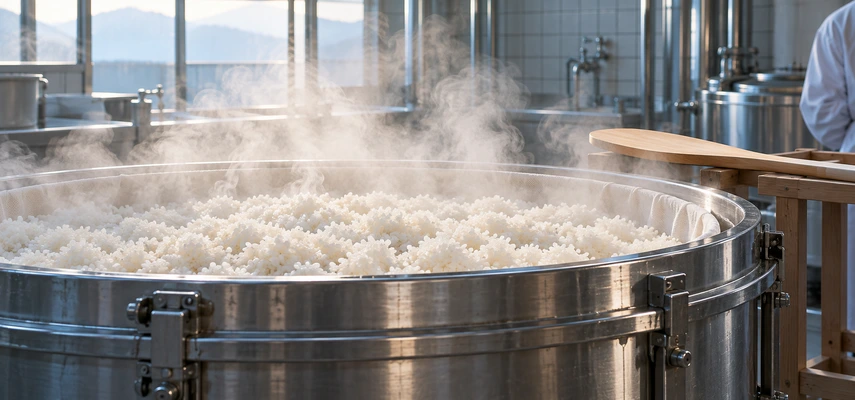
A batch steamer handles a defined charge of rice. The traditional vessel called a koshiki is one example of batch equipment. Loading, steam flow and unloading must be managed so the rice receives appropriate treatment. Uneven packing or preparation can undermine uniformity even when the overall steaming period looks correct.
A continuous steamer moves rice through a system at a controlled rate. Throughput and residence time become part of maintaining consistent treatment. Such equipment can support regular large-scale operation, but its usefulness depends on control and suitability for the material. Mechanization changes the way the process is organized; it doesn’t remove the need for expertise.
The NRIB and JSS guide provides further background on preparation methods. For comparison questions, explain defined loads versus controlled flow, then discuss consistency and appropriate moisture. Avoid declaring that one category of equipment always makes superior sake. The best choice depends on the brewery’s production needs and execution.
Cooling prepares rice for two different destinations
After steaming, rice must be cooled to a suitable temperature for its next use. Rice intended for kōji needs conditions appropriate for inoculation and mould development. Rice added to the fermentation mash must fit the temperature plan for that stage. Adding excessively hot rice could disturb the carefully managed biological environment.
Cooling can also change surface moisture and texture. Spreading or moving rice affects how evenly heat is removed; hygiene remains important throughout handling. Meanwhile, starch can change as it cools and rests, so the brewery manages more than temperature alone. Preparation should deliver material ready at the required time, rather than material that was briefly ideal earlier in the morning.
For a practical polishing comparison, choose one sake made with rice at a seimai-buai of 70% or more and another at 50% or less. Record other production differences and use comparable service conditions. Describe both before revealing the ratios, then discuss how composition could contribute without claiming that polishing alone caused every difference. The more polished example need not be the higher-quality one.
Preparation makes more sense alongside rice starch structure and the enzymes that act on it. To see why those decisions interact with later stages, compare the rice-to-bottle examples.
One-page revision summary
Follow composition, surface cleaning, hydration, gelatinisation and final temperature in sequence. Calculate seimai-buai as the proportion remaining, then consider shinpaku shape and grain integrity. Explain washing and soaking through moisture control, steaming through structural change and microbial reduction, and cooling through the needs of kōji or fermentation. Each step prepares the conditions for the next; no individual operation guarantees the finished sake’s quality.
Written practice: original TFE exercises
These suggested marks and indicative points are independent teaching guidance, not official WSET marking schemes.
Exercise 1: 5 suggested marks
A brewer starts with 100 kg of brown rice and retains 60 kg after polishing. State the seimai-buai and explain why the ratio is not a complete quality assessment. Mapping: Unit 1 LO1 and LO2.
Indicative marking points:
- Seimai-buai is 60%.
- It measures remaining mass relative to the original brown rice.
- Forty percent has been removed.
- The ratio does not describe all grain integrity or processing properties.
- Other brewing choices and actual sensory evidence determine the finished quality assessment.
Model answer: The seimai-buai is 60%, because 60 kg remains from the original 100 kg. This means 40% has been removed. The ratio describes a preparation measure, not the integrity of every grain or every later production decision. Kōji, yeast and fermentation still influence the sake, whose quality must be assessed from the actual result.
Why it works: It defines the denominator, calculates both remaining and removed amounts, then explains the limits of the number.
Common mistake: Calling the polishing ratio 40% or treating 60% as a sensory quality score.
Exercise 2: 5 suggested marks
Explain why using the same soaking time for two rice lots may not produce the same preparation result. Mapping: Unit 1 LO1.
Indicative marking points:
- The lots may have different initial moisture.
- Their polishing ratios can differ.
- Grain condition and variety can affect absorption.
- Water temperature affects uptake.
- Different final moisture changes steaming and suitability for kōji or the mash.
Model answer: Equal time does not mean equal water uptake. The lots may begin at different moisture levels, have different polishing ratios or show different grain structure and absorption behavior. Water temperature also affects the rate. Their final moisture can therefore differ, changing steamed texture and suitability for subsequent kōji growth or fermentation management.
Why it works: It relates starting conditions and absorption rate to a process consequence, instead of describing the clock as the only control.
Common mistake: Assuming every lot must soak overnight regardless of polishing or starting moisture.
Knowledge check: 10 original practice questions
Independent TFE questions, not official WSET examination items. Choose one answer per question; explanations follow separately.
1. Why is rice cooled before the next stage?
2. Which comparison between hand and machine washing is most defensible?
3. What is the main starch-related aim of steaming?
4. Which set is most relevant to soaking control?
5. Why must washing time be considered in hydration control?
6. A 60% polishing ratio means what?
7. Which statement about steaming and hygiene is accurate?
8. How does a continuous steamer organize treatment?
9. Why can polishing change brewing behavior?
10. What is nuka in rice preparation?
Answers and explanations
1. C — To provide temperatures suitable for kōji inoculation or the mash plan.. Temperature must fit the intended biological process; cooling does not alter the polishing-ratio definition. Mapping: Unit 1 LO1 Range 2; LO2 Range 4.
2. B — Either can be suitable when cleaning, damage and water uptake are properly controlled.. The mechanism and execution matter more than a universal ranking based solely on equipment category. Mapping: Unit 1 LO1 Range 2; LO2 Range 4.
3. B — To gelatinise starch and improve subsequent enzyme accessibility.. Steaming prepares the substrate; enzymes and yeast perform later chemical and microbial transformations. Mapping: Unit 1 LO1 Range 2; LO2 Range 4.
4. C — Initial moisture, polishing ratio, water temperature and time.. Starting material and uptake conditions together determine the preparation result. Mapping: Unit 1 LO1 Range 2; LO2 Range 4.
5. A — Rice begins absorbing water while it is being washed.. Cleaning and hydration overlap because water contact begins during washing. Mapping: Unit 1 LO1 Range 2; LO2 Range 4.
6. C — 60% of the original brown-rice weight remains.. Seimai-buai measures remaining polished-rice mass relative to original brown-rice mass. Mapping: Unit 1 LO1 Range 2; LO2 Range 4.
7. D — Steaming reduces microbial load, but handling afterward still needs hygiene.. Rice is heat-treated, then handled and deliberately inoculated for kōji as appropriate; permanent sterility is not implied. Mapping: Unit 1 LO1 Range 2; LO2 Range 4.
8. A — Rice moves through a controlled system with managed throughput and residence time.. Continuous operation manages material flow; batch equipment handles defined charges. Mapping: Unit 1 LO1 Range 2; LO2 Range 4.
9. D — It changes the proportions of outer-layer components and the remaining grain.. Removing outer material changes composition and physical handling properties without determining the entire result. Mapping: Unit 1 LO1 Range 2; LO2 Range 4.
10. B — Powder and bran removed during polishing.. Nuka is removed outer material; adherent residue is addressed during washing. Mapping: Unit 1 LO1 Range 2; LO2 Range 4.












