










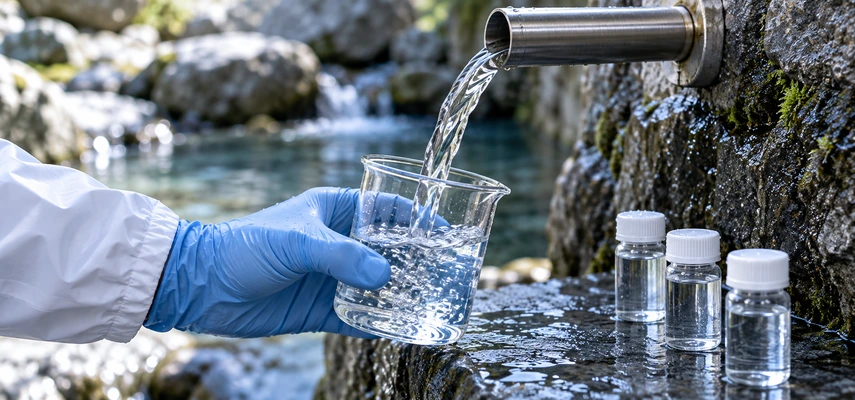

Does brewing water become the flavor of sake in the way a spring’s mineral taste appears in a glass of water? That is too direct a picture of a much more interesting relationship. Water provides the environment for brewing, participates in preparation and adjustment, and can supply minerals that affect microorganisms. Its influence often passes through the process before reaching the palate.
For Level 3, use composition → biological or processing effect → possible sake consequence. The official specification names mineral content and yeast nutrients. The useful answer explains why those matter while leaving room for rice, kōji, yeast choice and management to influence the final result.
Brewing water has several jobs
Water is involved in washing and soaking rice, kōji-related preparation, fermentation starter and main mash production, and possible dilution of sake after fermentation. Those uses don’t all ask the same question of the water. Soaking concerns the rice’s hydration; mash water concerns the environment and ingredient balance; dilution changes the finished alcohol concentration and other concentrations.
Consequently, a water source can affect brewing without contributing a recognizable mineral taste that survives unchanged into every bottle. A change in fermentation conditions may alter the result indirectly. The explanation needs to follow what the water does in that particular stage rather than leap from the source’s reputation to an inevitable sensory description.
The NRIB and JSS guide places water alongside rice, kōji and yeast as a production factor. That is the right scale for the discussion. It is a significant part of a system, neither a neutral afterthought nor an ingredient that overrides every other decision.
Hardness is one measurement, not the complete mineral profile
Water hardness primarily reflects dissolved calcium and magnesium, usually expressed in a standardized equivalent measure. Hard water contains more of those hardness components than soft water under the chosen classification. However, hardness does not report the concentration of every dissolved substance or every nutrient available to yeast.
For example, potassium and phosphorus are also relevant to the brewing environment, yet a single hardness number does not tell you how much of either is present. Two waters with similar hardness can differ in other useful or undesirable components. Calling both “soft” supplies a comparison, not a complete chemical analysis.
Hardness also differs from pH and alkalinity. The terms describe different properties, even though real water chemistry can connect them. A hard water isn’t simply a water that must have high pH, and soft doesn’t mean acidic by definition. Keep the measurement attached to the property it actually describes before discussing any consequence for brewing.
Magnesium contributes to yeast function
Magnesium is a mineral nutrient relevant to yeast growth and metabolism. Its availability helps establish suitable conditions for fermentation. In a causal answer, identify it as part of the yeast’s nutritional environment rather than as a source of fermentable sugar. Yeast doesn’t turn magnesium into alcohol in place of glucose.
The implication is that inadequate nutrient availability can limit a process the brewer wants to support. Nevertheless, “more magnesium means better sake” is not a valid extension. The appropriate composition depends on the total medium, the yeast and the production plan. A nutrient has a useful role without becoming an ingredient whose quantity should be maximized.
Magnesium also contributes to hardness, which explains part of the connection between water classification and fermentation discussion. But the relationship should not erase the other components. A hardness figure summarizes selected ions; it doesn’t establish that the mash has exactly the entire nutrient balance the brewery needs.
Potassium and phosphorus complete the required trio
Potassium is another important mineral nutrient in the yeast environment. Phosphorus, present in suitable chemical forms such as phosphates, is also necessary for cellular processes. For this lesson, the key distinction is that both contribute to biological function without being fermentable carbohydrates. Their names belong beside magnesium in a complete account of relevant mineral nutrition.
Water is not the only source of these materials. Rice and kōji also contribute to the mash’s composition, and the extent of polishing changes the incoming rice material. Therefore, a water analysis must be interpreted within the full recipe. A low concentration in water alone doesn’t prove that the complete mash contains none of that element.
A primary study of mineral distributions in brewing rice explicitly considers rice and water as sources of inorganic elements. That reinforces the practical point: nutrition needs an account of the actual brewing medium. The lesson is not to memorize an isolated water number and ignore everything added afterward.
Nutrient availability can change fermentation behavior
Suppose a brewer compares otherwise similar mashes with different mineral availability. Changes in yeast nutrition can affect growth and fermentation behavior. The resulting pace and metabolic activity can interact with glucose release, temperature management and the intended style. This is the mechanism behind many useful discussions of harder and softer brewing waters.
However, a faster fermentation is not automatically a better one. The brewer wants a suitable relationship between rice dissolution, sugar production and alcoholic fermentation. If the intended style requires a different course, water composition becomes one factor to manage within that course. Speed and quality are different judgments.
Likewise, soft water is not biologically incapable of supporting fermentation. Breweries can work with its characteristics through the whole production method. What matters is whether the complete conditions support the selected yeast and target. A simple hard-water-versus-soft-water slogan skips the expertise that makes different approaches successful.
Iron and manganese illustrate why purity needs a purpose
Some dissolved components are undesirable in brewing even when a water is otherwise suitable for ordinary use. Iron can contribute to unwanted color and deterioration of sake character through interactions in the brewing system. Manganese is also associated with undesirable changes, including light-related effects. “Contains minerals” is therefore not a sufficient recommendation for a source.
The producer Nanbubijin’s account of brewing water distinguishes useful mineral components from iron and other undesirable material. The Niigata association’s water discussion likewise emphasizes careful selection. These are reasons to assess a source for the intended use rather than treating any clear-looking water as equivalent.
Avoid importing a dated table of general drinking-water limits as a universal current brewing rule. The conceptual requirement here is to distinguish useful nutrient composition from components that compromise the process or sake. A laboratory result and the brewery’s applicable standards provide more useful evidence than a picturesque photograph of a spring.
Nada and Fushimi show two different brewing contexts
Nada in Hyōgo is famous for brewing traditions associated with mineral-rich water, including Miyamizu. The JSS regionality discussion connects local water composition with the region’s production history. Useful minerals and low undesirable iron helped make that water significant. The story concerns brewing suitability, not an assertion that every Nada bottle has one fixed taste.
Fushimi in Kyōto provides a familiar softer-water comparison in the specification’s recommended tasting framework. Different water composition can support different traditional approaches to fermentation. Yet a blind comparison between two regional bottles also includes yeast, rice, polishing, starter, temperature and finishing differences. It is not a controlled experiment in which water is the only variable.
The reasonable chain is regional water resources → opportunities and constraints for local brewing methods → supported stylistic tendencies. It would be unreasonable to claim that a prefecture’s geology dictates every sensory feature independently of the brewery. A regional explanation becomes stronger when it identifies the choices that connect environment and finished drink.
Niigata demonstrates the value of qualification
The Niigata Sake Brewers Association describes widespread use of soft water and its relationship with the area’s restrained brewing traditions. This provides useful context for the expression tanrei karakuchi, often used for a light, clean and dry style. But a region’s characteristic style doesn’t encompass every contemporary producer or bottle.
When studying a sample, separate the source’s general account from what you can verify about that sake. Does the producer specify the water? What other production information is available? What does the glass actually show? If those answers aren’t known, describe the regional tendency as background rather than asserting an authenticated production fact.
Read a water comparison through the whole recipe
Imagine a source with modest hardness and another with greater calcium and magnesium. Before predicting the sake, ask about other mineral components, undesirable substances and the remaining ingredients. Then consider yeast, kōji and temperature plans. Two sources need not produce identical process behavior, but the meaningful comparison requires more than two adjectives.
Similarly, distinguish mash-water influence from dilution. Adding suitable water after fermentation reduces alcohol concentration and the concentration of other dissolved material; it doesn’t restart the earlier nutritional history. The same ingredient can have different consequences depending on timing. Naming the stage turns a broad claim about water into a useful explanation.
For the recommended water comparison, obtain a confirmed high-mineral-water example from Kobe and a low-mineral-water example from Fushimi where available. Record the actual source information rather than inferring water analysis from the address alone. Compare the samples under consistent conditions and list the remaining production differences before attributing a sensory contrast to minerals.
Water acts within the environment needed by brewing yeast and the fermentation starter. For a practical comparison that avoids treating geography as destiny, use the regional tasting exercises.
One-page revision summary
Define hardness through calcium and magnesium, then remember potassium and phosphorus as additional nutritional considerations. Explain how mineral availability supports yeast rather than treating minerals as sugar. Keep useful components separate from iron and manganese concerns, and use Nada, Fushimi and Niigata as qualified contexts. Water influences sake through brewing decisions; it doesn’t supply an immutable flavor template.
Written practice: original TFE exercises
These suggested marks and indicative points are independent teaching guidance, not official WSET marking schemes.
Exercise 1: 5 suggested marks
Explain why a hardness value alone cannot establish that water supplies the complete mineral environment needed for fermentation. Mapping: Unit 1 LO1.
Indicative marking points:
- Hardness chiefly measures calcium and magnesium.
- Other relevant nutrients include potassium.
- Phosphorus is also relevant.
- Rice and kōji contribute to the complete medium.
- Interpret the full composition and recipe rather than treating one value as complete nutritional evidence.
Model answer: Hardness summarizes calcium and magnesium rather than every nutrient. Potassium and phosphorus also matter to the yeast environment, and the rice and kōji supply additional material. The brewer therefore needs the wider water composition and the complete recipe to assess nutritional conditions; a single hardness figure cannot provide that full account.
Why it works: The answer defines the measurement, identifies omitted nutrients and explains the need to assess the complete medium.
Common mistake: Using hardness as a synonym for every mineral concentration or for pH.
Exercise 2: 5 suggested marks
Explain how mineral composition can affect sake through fermentation without dictating one guaranteed flavor. Mapping: Unit 1 LO1 and LO2.
Indicative marking points:
- Water can supply minerals useful to yeast.
- Availability affects nutritional conditions.
- Those conditions can alter growth or fermentation behavior.
- Behavior interacts with kōji, yeast selection and temperature management.
- The final sensory outcome depends on the complete process and must be observed.
Model answer: Water supplies mineral nutrients that contribute to the conditions supporting yeast. Differences in availability can affect growth and fermentation behavior. That behavior interacts with glucose release, the selected yeast and temperature control, so the water can influence style indirectly. It cannot establish one guaranteed flavor independently of the rest of production and the actual sake.
Why it works: It follows composition through a biological mechanism to a qualified consequence instead of jumping from water name to flavor.
Common mistake: Claiming that hard water always makes better sake or soft water cannot support fermentation.
Knowledge check: 10 original practice questions
Independent TFE questions, not official WSET examination items. Choose one answer per question; explanations follow separately.
1. What is the most direct link between useful mineral availability and fermentation?
2. Which regional statement is best supported?
3. Which comparison appears in the recommended water-tasting framework?
4. Which set contains three prescribed relevant mineral nutrients for this lesson?
5. How does post-fermentation dilution differ from mash-water influence?
6. Which ions chiefly determine water hardness?
7. What is Miyamizu particularly associated with?
8. Why does low potassium in water not prove the complete mash contains no potassium?
9. Why are iron and manganese considered separately from useful nutrients?
10. Why can similar-hardness waters behave differently in brewing?
Answers and explanations
1. B — They contribute to yeast nutrition and metabolic conditions.. The biological mechanism connects composition to the process while preserving the role of other decisions. Mapping: Unit 1 LO1 Range 1; LO2 Range 4.
2. A — Water resources interact with local methods and other brewery choices.. Regional context is useful when connected to actual production and qualified stylistic tendencies. Mapping: Unit 1 LO1 Range 1; LO2 Range 4.
3. C — Higher-mineral Kōbe-area water versus lower-mineral Fushimi water examples.. The specification suggests contrasting water contexts while other brewing differences still need consideration. Mapping: Unit 1 LO1 Range 1; LO2 Range 4.
4. A — Magnesium, potassium and phosphorus.. The three minerals contribute to the biological environment; they are not fermentable sugars. Mapping: Unit 1 LO1 Range 1; LO2 Range 4.
5. D — It changes concentrations after fermentation rather than the earlier nutritional history.. Timing determines the mechanism: dilution changes the finished composition without rerunning the mash. Mapping: Unit 1 LO1 Range 1; LO2 Range 4.
6. D — Calcium and magnesium.. Hardness reflects selected divalent ions, chiefly calcium and magnesium, rather than the entire nutrient profile. Mapping: Unit 1 LO1 Range 1; LO2 Range 4.
7. A — Nada’s brewing context in Hyōgo.. Miyamizu is a famous Nada brewing water; the association does not define every regional bottle’s taste. Mapping: Unit 1 LO1 Range 1; LO2 Range 4.
8. B — Rice and kōji can also supply inorganic material.. Nutrition must account for all ingredients rather than treating water as the only source. Mapping: Unit 1 LO1 Range 1; LO2 Range 4.
9. D — They can contribute to undesirable color or sake changes.. Water suitability includes control of harmful effects, not simply maximizing dissolved minerals. Mapping: Unit 1 LO1 Range 1; LO2 Range 4.
10. C — Other components and the complete recipe may differ.. A single hardness figure does not specify every useful or undesirable component of the brewing medium. Mapping: Unit 1 LO1 Range 1; LO2 Range 4.












