










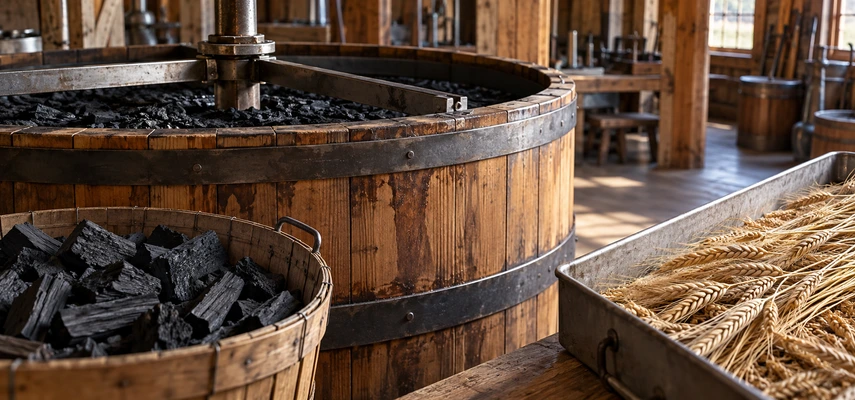

A Tennessee whiskey and an American rye can sit beside each other on a shelf, share an amber colour and smell of oak. Yet the names point to different kinds of information. Tennessee adds a place and a characteristic processing step; rye identifies the dominant grain in the American category. The bottles are relatives, but their labels answer different questions.
Understanding Tennessee and rye whiskey also provides a useful bridge to Ireland, Canada and Japan. The Level 1 syllabus expects recognition of those whisky countries without requiring an encyclopaedia of their production laws. The skill is knowing which facts define a category and which merely describe a common style.
Read the name as a set of clues
Whisky begins with grains, whose starch is converted into fermentable sugars. Yeast makes an alcoholic liquid, distillation concentrates its ethanol, and maturation shapes the spirit further. Those shared stages explain why whiskies can resemble each other. Their particular rules and choices explain why the resemblance is never the whole story.
A grain term, a place term and an equipment term needn’t perform the same job. “Rye” can identify a recipe requirement in one legal context. “Tennessee” names an origin linked with a production framework. “Pot still” identifies equipment, and in some settings a more specific style. Start by asking what kind of claim the label makes.
That habit prevents a common mistake: exporting one country’s definition to every bottle using a familiar word. American rye whiskey and Canadian whisky associated with the word rye should not automatically be assigned the same mash requirement. Read the category in its context before attaching a percentage.
Tennessee: the corn connection
In the Level 1 framework, Tennessee whiskey shares the central corn-led production model of Bourbon. The mash contains at least 51% corn, with other grains making up the remainder. It is distilled at relatively low strength and matured in new charred oak. Corn leads the recipe without making the remaining grains irrelevant.
Its geographical requirement is narrower than Bourbon’s US-wide scope: distillation and ageing take place in Tennessee. A similar corn spirit made in another state cannot acquire that origin merely by copying a process. Place names add information about where the qualifying production occurred, rather than simply suggesting an aesthetic or a flavour.
The corn proportion describes the grain mash, not the finished liquid’s percentage of corn solids. Processing, conversion, fermentation and distillation transform the starting materials. A glass can show grain-related character without containing a miniature version of the original mash. The ingredient is consequential because of that transformation, not despite it.
Its grain and oak background can contribute cereal, vanilla-like or toasted impressions, with the balance varying by producer. Charcoal treatment is another influence rather than a guarantee of one universal aroma or sweetness level.
Maple charcoal comes before the barrel
The characteristic extra step is passing newly made spirit through maple charcoal before maturation. Often called the Lincoln County Process, this treatment occurs after distillation and before the spirit enters oak. Place it correctly in the sequence: it is neither a method of fermenting corn nor the same operation as charring a barrel.
Charcoal can remove or change the concentration of some compounds in the new spirit, affecting its sensory profile. The University of Tennessee’s research account examines the treatment rather than treating “mellowing” as a complete scientific explanation. The useful mechanism is selective interaction with the spirit, followed by a separate period of oak maturation.
This doesn’t mean maple syrup is being added. Maple identifies the source of the charcoal, not a compulsory sweet flavouring. Nor does filtering through charcoal make every Tennessee whiskey taste identical. The spirit entering the treatment and the way the process is managed still matter, as do the subsequent barrel and storage choices.
For examination recognition, retain the syllabus model of corn, Tennessee and pre-ageing maple charcoal. It is a beginner framework rather than a comprehensive account of every statutory exception or label dispute. In particular, don’t add an unsupported universal age figure merely because the drink is associated with Bourbon-like production.
American rye: a different grain leads
American rye whiskey uses a fermented mash of at least 51% rye, with other grains possible. That is the direct comparison with Bourbon’s and Tennessee’s corn-led recipes. It does not require 100% rye. Different proportions above the minimum can therefore belong to the same category while producing different starting conditions.
The US whisky standards specify lower-strength distillation and new charred oak storage for the ordinary American rye type. The Level 1 wording highlights low-strength distillation, new oak, US production and blending. Keep those core facts connected rather than remembering only the grain percentage.
Lower-strength distillation retains more fermentation-derived character than a highly concentrated neutral base generally does. New prepared oak then contributes its own influence. Rye is often associated with spicy or grain-led impressions, alongside oak-related vanilla or toast, but these are tendencies. A label does not guarantee one identical sensory result.
Rye whiskey can be made in different US states. It is not defined by production in Tennessee or Kentucky. A bottle can therefore be American rye without sharing Tennessee whiskey’s corn requirement or charcoal step. Colour and the broad word whiskey do not erase the differences between the categories.
Blending and the words around rye
Combining suitable whiskey components can help a producer maintain a consistent style or build complexity. Casks vary, and a bottling may represent selection across several of them. This broad blending activity needs distinguishing from formal US designations containing “blended”, which carry their own composition rules.
Likewise, the word straight adds requirements beyond the basic grain-led identity. Its presence matters when interpreting a specific label, but it should not be silently inserted into every question about ordinary rye whiskey. Answer the category actually named. An extra word can change the applicable condition.
The same care applies to an international comparison. “Rye” has historical and labelling uses outside the United States. It is unsafe to look at a Canadian bottle and assume the American 51% rule governs it. A familiar word can survive a border while its precise legal role changes.
Ireland: a whisky country with several styles
Ireland is one of the other whisky origins explicitly named in the syllabus. Irish whiskey encompasses different production styles, including malt, pot still, grain and blended whiskey. The Irish Whiskey Association’s technical overview makes that variety clear. Recognition should begin with the family, rather than one universal recipe.
Triple distillation is a familiar association, but “all Irish whiskey is triple-distilled” is too broad. Similarly, a generally light impression in one sample cannot define every Irish whiskey. Different grain choices, distillation approaches and maturation decisions give producers different tools. Geography alone doesn’t finish the tasting note.
For Level 1, place Ireland confidently on the whisky map and understand that it has a distinct tradition within grain-based spirits. More detailed rules belong to a later level of study. You can recognise an origin without memorising every technical distinction among its subcategories.
Canada: beware an imported rye rule
Canada is another required whisky country. Blending is an important part of its whisky conversation, but a national label does not mean all producers use one grain proportion or produce a single flavour. Grain recipes, distillation and maturation choices can create a wide range within a shared origin.
The practical trap is assuming that a Canadian rye reference must mean the same thing as ordinary American rye whiskey. The US percentage belongs to its own defined type. Keep the two ideas on separate revision cards: American rye has a specified rye minimum; Canada is a recognised whisky origin with its own framework.
This is not a demand to learn an additional catalogue of Canadian law for a beginner examination. It is a way to avoid inventing a rule. When the syllabus asks for country recognition, give country recognition. When it asks for an American grain requirement, give the American grain requirement.
Japan: production matters more than stereotypes
Japan completes the named international group. Japanese whisky production includes malt and grain approaches and the use of blending. Those familiar techniques should make the category less mysterious, while leaving room for individual producer choices. It is a whisky tradition, not a promise that every drink has one uniquely identifiable national aroma.
A Japanese-looking label or bottle design should not substitute for checking a producer’s actual origin statement and applicable labelling framework. Modern origin standards can be more detailed than the Level 1 recognition task. Avoid importing assumptions about every bottle without examining the claim it makes.
For this lesson, the important learning result is being able to name Japan alongside Ireland and Canada as other whisky countries. Connect the examples to the common grain-to-spirit process. Detailed regional law, cask species and brand histories would add information without improving the core comparison being tested here.
Revisit the nearby category boundaries through Bourbon and Scotch.
What to remember
Build three compact answers. Tennessee: at least 51% corn, Tennessee production and ageing, Bourbon-like oak framework, and maple charcoal before maturation. American rye: at least 51% rye, other grains possible, lower-strength distillation, new oak and US production. Other named origins: Ireland, Canada and Japan.
Then test the limits of each statement. Maple charcoal is not maple syrup. A rye percentage from the American definition isn’t a worldwide rule. A country name isn’t a universal tasting profile. These distinctions preserve the useful facts while keeping generalisations from doing more work than the evidence allows.
Knowledge check: 10 original practice questions
Independent TFE questions, not official WSET examination items. Choose one answer per question; explanations follow separately.
1. What is the minimum rye proportion for ordinary American rye whiskey?
- 51%
- 40%
- 100%
- 75%
2. Which container fits ordinary American rye whiskey?
- New charred oak
- Uncharred used oak only
- Any plastic vessel
- Only used wine casks
3. What does maple charcoal imply?
- An age statement
- Required maple syrup
- A fermented maple base
- A treatment medium derived from maple wood
4. Which statement about American rye production is correct?
- Only Tennessee permits it
- It can be produced in different US states
- It requires blue agave
- Only Kentucky permits it
5. Which grain must provide at least 51% of Tennessee whiskey’s mash in the syllabus model?
- Rye
- Malted barley
- Wheat
- Corn
6. Which three other whisky countries are named in this lesson?
- Ireland, Canada and Japan
- Mexico, Peru and Chile
- Brazil, Cuba and Jamaica
- France, Spain and Portugal
7. Which origin applies to Tennessee whiskey’s distillation and ageing?
- Any country
- Scotland
- Tennessee
- Any US state
8. How should the American rye minimum be applied to a Canadian rye reference?
- Require Tennessee charcoal
- Require 100% malted barley
- Check the Canadian context rather than assuming the US rule
- Apply 51% automatically
9. When does Tennessee’s characteristic maple-charcoal treatment occur?
- Before sugar conversion
- Before oak maturation
- After bottling
- Instead of fermentation
10. Which statement about Irish whiskey avoids a false universal rule?
- It is always triple-distilled
- It includes several production styles
- It is always smoky
- It must use 51% rye
Answers and explanations
1. A — 51%. The minimum concerns rye in the grain mash, while other grains may form the remainder. Mapping: LO2.
2. A — New charred oak. The US category specifies prepared new oak rather than treating every storage vessel as interchangeable. Mapping: LO2.
3. D — A treatment medium derived from maple wood. The wood supplies the charcoal; it is not evidence that maple syrup was added. Mapping: LO2.
4. B — It can be produced in different US states. American rye is not restricted to the two states commonly associated with other American whiskies. Mapping: LO2.
5. D — Corn. The Tennessee model is corn-led, whereas American rye uses a rye minimum. Mapping: LO2.
6. A — Ireland, Canada and Japan. The specification explicitly includes Ireland, Canada and Japan among other whisky countries. Mapping: LO2.
7. C — Tennessee. The named origin is narrower than Bourbon’s broader United States geographical scope. Mapping: LO2.
8. C — Check the Canadian context rather than assuming the US rule. A familiar label word can have a different role in another jurisdiction; the US definition is not global. Mapping: LO2.
9. B — Before oak maturation. The newly distilled spirit receives the charcoal treatment before entering its maturation stage. Mapping: LO2.
10. B — It includes several production styles. Ireland has multiple whiskey styles, so one familiar production association does not define every example. Mapping: LO2.












