










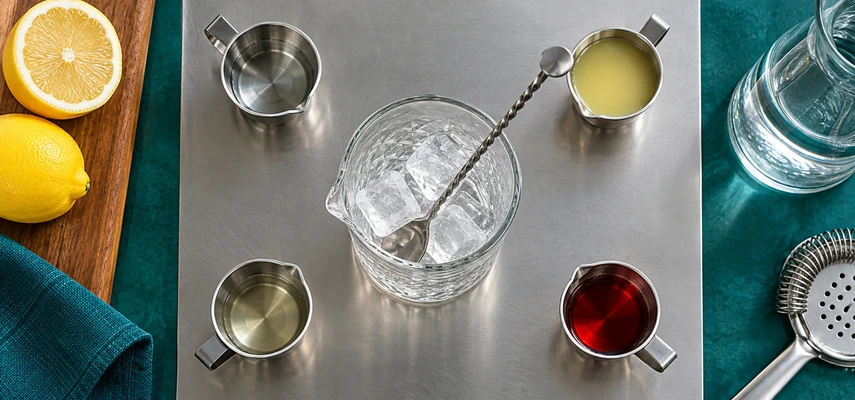

A cocktail can contain all the right ingredients and still feel wrong. The spirit may dominate, the citrus may pull too sharply, or a bitter component may drown out everything else. Adding more of the favourite ingredient often makes the problem louder rather than solving it.
To learn how to balance a cocktail, begin with the two scales used in WSET Level 1: strong versus weak, and bitter and/or sour versus sweet. They are a practical framework for understanding proportions. They do not require every drink to end up equally sweet, equally dilute or equally approachable to every palate.
Balance is a relationship, not an ingredient
A balanced drink has contributions that work together for its intended style. That can include an assertive spirit-forward cocktail or a longer, more refreshing mixture. The goal is not to remove all intensity. It is to understand which elements are prominent and whether their proportions make sense together.
Think of adjusting sound levels in a small ensemble. Turning one instrument up changes what is heard from the others. Ingredients likewise contribute in relation to the whole mixture. Sweetness can change the perception of sourness or bitterness, while dilution can change the impression of alcoholic strength and aroma.
The analogy also has a limit: ingredients have multiple properties, not one volume knob. A liqueur may add alcohol, sweetness and flavour. Vermouth can bring wine-derived acidity, botanical character and sweetness as well as alcohol. This overlap is the reason careful adjustments work better than assigning every bottle to one simplistic role.
Strong versus weak
On the first scale, strong and weak concern the alcoholic concentration and its perception within the drink. A spirit contributes ethanol. Water and other lower-strength or alcohol-free ingredients can reduce the overall alcoholic proportion when added. The final concentration depends on both the strengths and the amounts of the ingredients.
“Weak” is not a criticism here. A longer drink may deliberately have a lower alcoholic concentration than a short spirit-forward cocktail. The difference is part of the design. Conversely, a drink that tastes gentle is not necessarily low in alcohol, since sweetness and flavour can alter the impression.
Distinguish concentration from total alcohol. Adding water to a given amount of spirit reduces its ABV, but it does not remove the ethanol already present. The mixture becomes larger and more dilute. Those are different facts, and recognising both prevents the word diluted from doing more work than it should.
A simple dilution example
Imagine 50 ml of a hypothetical spirit at 40% ABV. It contains 20 ml of alcohol on the simple volume calculation used for this teaching example. Add 50 ml water and the approximate total becomes 100 ml. The alcoholic proportion is then about 20%, while the original amount of ethanol remains.
This is an idealised calculation rather than a laboratory measurement of mixed-liquid volume. It illustrates why a larger drink can have a lower concentration without containing less alcohol than its starting spirit portion. You do not need complicated chemistry to understand the relationship between ethanol and total mixture size.
Now imagine adding a lower-strength alcoholic ingredient instead of water. It contributes some ethanol too, so the result is not calculated as though the new ingredient were alcohol-free. Identify each contribution before reasoning about the final concentration. Vermouth and liqueurs belong in the arithmetic when present.
Ice becomes part of the recipe
Ice cools a drink and supplies water as it melts. Stirring or shaking therefore changes more than temperature. Dilution becomes part of the finished composition, influencing concentration, texture and aroma perception. Treating all meltwater as an accidental contaminant misunderstands a central part of cocktail preparation.
The amount of dilution varies with conditions: starting temperatures, ice, time and preparation all matter. There is no universal fixed percentage of water added by every shake or stir. For Level 1, the important relationship is that added water lowers alcoholic concentration and can change the way the ingredients are perceived.
More dilution is not always the answer. A drink can become too thin for its intended style, just as it can be too concentrated. The task is to reach the intended relationship rather than maximise water. Different families use different structures, which is why a highball and a spirit-forward drink should not be judged against one identical concentration target.
Bitter and/or sour versus sweet
The second scale connects bitterness and/or sourness with sweetness. A drink may use acidity, bitterness or both, with sweetness helping shape the overall balance. These are relationships in perception and composition, not a claim that sugar chemically deletes all acid or every bitter compound.
Sourness is associated with acidity, often supplied in cocktails by citrus juice. Sweetness may come from sugar syrup, liqueurs, vermouth or other ingredients. The source matters because it can bring additional flavour and alcohol. Two ingredients providing sweetness may affect the rest of the drink quite differently.
Bitterness can come from a bitter spirit, cocktail bitters, certain botanical ingredients or a mixer. Some of those also contain sweetness. A bitter component should therefore be considered as a whole ingredient. Treating it as pure bitterness can lead to mistaken adjustments on both balance scales.
A sour shows the relationship clearly
Consider a hypothetical mixture of spirit, citrus juice and sugar syrup. Too little sweetness relative to the juice may leave a harshly sour impression. Too much can make the drink cloying or obscure its intended freshness. The useful question is the relationship, not whether citrus or sugar is inherently good or bad.
The spirit still matters. Its flavour and alcoholic contribution influence the result, while dilution changes concentration. This means the two scales interact. A mixture can achieve a pleasing sweet-sour relationship and still feel too concentrated, or be suitably diluted while remaining too sweet for its intended style.
Do not assume all citrus juices have identical acidity or all syrups identical sweetness per millilitre. Ingredients vary, and recipes depend on their actual composition. A fixed ratio is a starting convention in some contexts, not a scientific guarantee that every possible batch will balance without attention.
Bitter ingredients may bring sweetness too
A Negroni provides a different example from a short sour. Its familiar structure combines gin, a bitter component and sweet vermouth. The International Bartenders Association’s entry shows those components together. Its balance cannot be explained as spirit plus an isolated dose of bitterness.
The bitter ingredient can bring sweetness, and vermouth contributes more than sugar alone. Gin adds botanical flavour as well as alcohol. Dilution during preparation changes the mixture again. Looking at each ingredient’s multiple roles explains why a seemingly simple cocktail can have a complex balance.
A small amount of concentrated cocktail bitters can season another drink without functioning like a large portion of a bitter aperitif. The category distinction from the previous lesson remains relevant. Similar taste vocabulary does not make two products equal-volume substitutes.
Make an adjustment that answers the problem
Suppose a hypothetical sour seems too sharp. First identify what sharp means: too sour, too alcoholic, or both? Adding water changes concentration, while adding sweetness changes the sweet-sour relationship and also increases volume. Each action has more than one consequence, so the diagnosis should come first.
If another drink seems too sweet, increasing an appropriate sour or bitter component may change balance, but the chosen ingredient can also change aroma and strength. There is no universal corrective liquid that fixes every recipe without affecting anything else. The adjustment needs to fit the drink’s intended structure.
For learning, change one variable at a time in a hypothetical comparison and explain the consequence. Readers who do not taste alcohol can do this on paper using ingredient roles and simple calculations. The reasoning skill is relevant to the written examination without requiring practical drinking exercises.
Read proportions rather than isolated ingredients
A recipe is an arrangement of amounts, not just a list. The IBA cocktail collection provides examples of recognised compositions, but this lesson is not a recipe catalogue. It uses familiar structures to demonstrate why the proportions determine which contribution dominates.
A long mixer can substantially change strong-versus-weak balance. A small amount of aromatic bitters may change perceived character without comparable volume. A liqueur can move sweetness and alcohol together. The size and composition of the addition matter as much as the name printed on the bottle.
For example, replacing a plain sugar syrup with a sweet liqueur adds an alcoholic contribution that the syrup did not supply. Even if the sweetness seems similar, the first scale and the aroma may change too.
Connect the scales with the multiple roles of liqueurs and vermouth and the four cocktail families.
What to remember
Keep the official scales intact: strong versus weak, and bitter and/or sour versus sweet. Explain water and meltwater as part of dilution. Distinguish lower concentration from removal of ethanol, and recognise that sweet, sour and bitter ingredients can influence several dimensions at once.
Finally, state the intended style before deciding something needs fixing. A spirit-forward cocktail and a long sour aim for different structures. Balance becomes easier to understand when it means a coherent relationship among ingredients rather than a demand that every drink taste alike.
Knowledge check: 10 original practice questions
Independent TFE questions, not official WSET examination items. Choose one answer per question; explanations follow separately.
1. Which pair gives the official balance scales?
- Fruit versus grain; oak versus steel
- Pot versus column; malt versus rye
- Strong versus weak; bitter and/or sour versus sweet
- Old versus young; clear versus amber
2. Why can a bitter component complicate a sweet-bitter adjustment?
- It may contribute sweetness and alcohol too
- It has no aroma
- Bitterness always measures ABV
- All bitter products are pure quinine
3. What does adding water to a fixed portion of spirit do?
- Lowers alcoholic concentration without removing its ethanol
- Creates new ethanol
- Raises ABV
- Removes all ethanol
4. Why does ice matter beyond cooling?
- It makes every drink neutral
- Meltwater contributes dilution
- It supplies fermentation yeast
- It creates sugar
5. Which describes a useful first response to a drink seeming sharp?
- Add any ingredient at random
- Assume every sharpness is bitterness
- Ignore proportions
- Identify whether sourness, alcoholic impression or both dominate
6. Why do ingredient proportions matter?
- They identify barrel age
- Only the ingredient names affect balance
- They determine the relative contributions within the mixture
- They remove all ingredient variation
7. Does weaker always mean lower total alcohol than the starting spirit portion?
- Yes, ice absorbs all alcohol
- No, dilution and total ethanol are different facts
- Yes, water destroys ethanol
- Only with a bitter ingredient
8. Does sugar physically remove every acid or bitter compound?
- Only after shaking
- Yes, always
- Only in a Martini
- No, it changes the balance of perception
9. Must every cocktail have the same intended concentration?
- Yes, all must be neutral
- Yes, all must be long drinks
- Only if vermouth is used
- No, families and styles pursue different structures
10. What can a liqueur contribute to a cocktail?
- Alcohol, sweetness and flavour
- Only bitterness
- Only acidity
- Only water
Answers and explanations
1. C — Strong versus weak; bitter and/or sour versus sweet. The specification names these two scales rather than an unrelated visual or production comparison. Mapping: LO3.
2. A — It may contribute sweetness and alcohol too. A real ingredient may move several properties rather than supplying one isolated taste. Mapping: LO3.
3. A — Lowers alcoholic concentration without removing its ethanol. Dilution increases total mixture volume relative to the existing alcohol. Mapping: LO3.
4. B — Meltwater contributes dilution. Melting changes the final composition and can influence alcoholic concentration and perception. Mapping: LO3.
5. D — Identify whether sourness, alcoholic impression or both dominate. The diagnosis determines which adjustment answers the actual balance problem. Mapping: LO3.
6. C — They determine the relative contributions within the mixture. A recipe’s arrangement of amounts establishes which components dominate and how the scales interact. Mapping: LO3.
7. B — No, dilution and total ethanol are different facts. The same ethanol can be spread through a larger volume at a lower concentration. Mapping: LO3.
8. D — No, it changes the balance of perception. Sweetness can moderate the sensory relationship without deleting all opposing compounds. Mapping: LO3.
9. D — No, families and styles pursue different structures. Balance is relative to the intended drink, not one universal alcoholic concentration. Mapping: LO3.
10. A — Alcohol, sweetness and flavour. Ingredients can play multiple roles, so both balance scales may change together. Mapping: LO3.












