










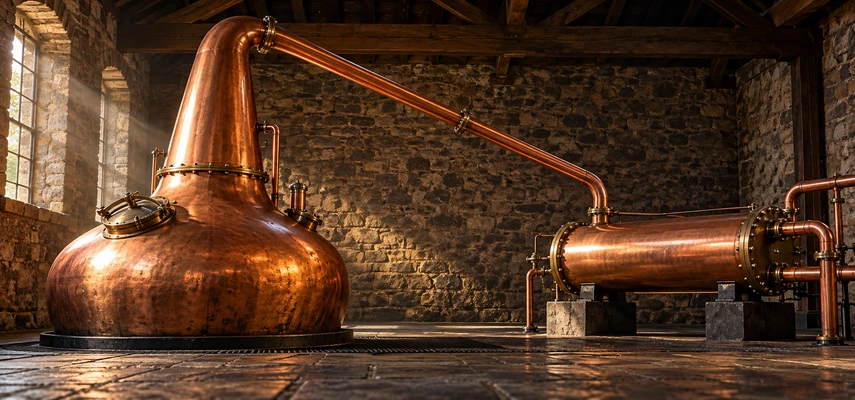

A pot still doesn’t deliver the same liquid from the first drop to the last. Its charge changes as distillation proceeds, and the collected spirit changes with it. That is why understanding pot still distillation requires two maps: where vapour travels through the equipment, and when the distiller decides to collect a particular portion.
The copper shape gets most of the attention. The decisions made during the run deserve at least as much. Fill two broadly similar stills with similar fermented liquid, then operate and collect differently, and the resulting spirits need not have the same aromatic balance. Equipment creates possibilities; operation chooses among them.
This lesson follows a typical double-distillation model. It is an educational explanation of commercial production, not instructions for operating a still. Exact strengths, run lengths and cut points vary. Understanding why the stages exist will help you recognise the pattern without treating one diagram as a universal factory specification.
Pot still distillation separates an existing alcoholic mixture
Fermentation has already produced ethanol in a liquid containing water and many other compounds. Heating supplies energy; boiling produces vapour throughout the liquid. Vaporisation changes liquid into gas. Condensation turns vapour back into liquid after heat is removed. Selection determines which collected material continues towards the intended spirit.
Water and ethanol don’t leave in perfectly separate queues. Vapour above a boiling mixture has a different composition from the liquid, and that composition changes as the run proceeds. Congeners also behave within a complex mixture. A neat table of pure-substance boiling points is not a complete prediction of when every compound will emerge.
Nor is vapour the same as liquid droplets carried out of the pot. A droplet is still liquid. Physical carry-over can transport material without the intended vapour-liquid separation. For revision, distinguish the change of state that makes distillation work from an image of fermented liquid merely being blown through a pipe.
Follow the equipment from pot to condenser
The pot holds the charge. The heat source may supply steam indirectly or use direct heat, depending on the design and production tradition. Heating method is a production choice with operating consequences; “all traditional pot stills use an open flame” is an unnecessary claim that real distilleries would quickly disprove.
The still head is the upper region above the pot. The swan neck carries the rising vapour, and the lyne arm connects the neck to the condensing system. These parts aren’t decorative plumbing. Their shapes, surfaces and orientation help determine the journey vapour takes and how much condensed liquid can return towards the pot.
The condenser removes heat so vapour becomes liquid. A shell-and-tube condenser provides many tubes and a cooling-water arrangement, while a worm-tub condenser uses a coiled tube surrounded by cooling water. Both perform condensation, although their construction and operating characteristics differ. Don’t confuse a worm tub with an extra fermentation vessel simply because it contains water.
Draw the path once in your own notes: pot, head, swan neck, lyne arm, condenser, receiver. Then add the function beside each item. A labelled outline is easier to reconstruct if you know what the component does. Memorising the names alone leaves you vulnerable when a question describes a function instead of showing a familiar picture.
Reflux returns liquid for another encounter
Some vapour can cool and condense inside the still before reaching the final receiver. When that liquid returns within the system, it is reflux. Repeated vaporisation and condensation support rectification, or increased separation. The result depends on the still’s design and the way it is run, not simply whether a neck looks tall in a photograph.
Imagine a crowded conversation passing through several rounds of editing. The balance changes with each round, but the participants don’t disappear in a perfectly predictable alphabetical order. Likewise, distillation reshapes a mixture rather than switching every congener on or off. The analogy explains selection while leaving the underlying chemistry more complicated than a set of clean doors.
More separation can support a higher-strength, less congener-rich spirit, but that tendency should not become “more reflux always tastes better.” A producer may want a particular amount of character from the fermented material. Lightness, intensity and quality are related questions with different answers; none can be read directly from the height of a still.
The first distillation makes low wines
In the typical model, a fermented alcoholic liquid enters the first still. Much of the aim is to separate an alcohol-enriched distillate from part of the water and other material. The collected liquid is called low wines. It is an intermediate product for further distillation, rather than finished drinking spirit ready to receive a label.
The official syllabus illustrates fermented liquid around 10% ABV becoming low wines around 25–30% ABV. These figures teach concentration through a typical sequence; they aren’t mandatory strengths for every distillery or spirit. Identify which stage each number describes before trying to compare it with a bottle’s strength.
Liquid waste remains after the run. The producer must empty and manage that residue before processing another charge. This batch cycle helps distinguish pot operation from continuous column production. The still is not permanently fed at one end while an unchanging product exits at the other throughout ordinary double-pot operation.
The second distillation makes selection more deliberate
Low wines feed the next distillation, often together with relevant heads and tails retained from a previous run. The producer then separates collected material over time. Early, middle and late portions have different compositions. The desired middle portion is the heart, also called the middle cut; the surrounding portions are heads and tails.
The WSET teaching model groups relatively volatile early fractions as Group 1, ethanol and associated fractions as Group 2, and later fractions as Group 3. It associates the selected heart with an illustrative strength around 75% ABV. Treat those groups as a learning model for a changing mixture, not claims that every molecule belongs to an isolated, non-overlapping time slot.
The heads emerge first and the tails later. A distiller chooses the heart because its mixture suits the intended spirit style. That doesn’t mean the heart is pure ethanol, or that every aromatic component outside it is worthless. The distinction concerns which balance is wanted in the collected spirit and how the rest is managed.
Cut points influence both yield and character. Collecting a different span can bring different proportions of aromatic compounds into the retained spirit. You don’t need to prescribe an exact operating decision to understand the consequence: selection changes composition, and composition helps determine the eventual sensory result. That is the causal chain the terminology is there to describe.
Recycling does not mean every fraction becomes a drink
Heads and tails can be returned to later distillations where the production system calls for it. Recycling allows alcohol and other material to be reprocessed rather than treating the first separation as a final judgement on every component. The residue left in the pot is a different stream and should not be confused with collected tails.
Glasgow Distillery’s production account gives a real example of low wines moving to spirit stills and sequential cuts being selected. Its particular run times and strengths describe that producer’s process. They don’t replace the general model or establish compulsory settings for Cognac, rum or every Scotch malt.
Springbank’s process description provides another useful reminder of variation, including direct heating and different distillation arrangements across its spirits. The existence of double distillation does not mean every pot-distilled spirit uses exactly two passes. Learn the typical model clearly, then recognise an identified exception without letting it blur the model itself.
Connect the run with aroma intensity
Pot-distilled spirit commonly has medium or pronounced aroma intensity in the course framework. The fermented material supplies compounds, and the distillation retains a selected balance. Subsequent maturation can add or transform characteristics. The pot still therefore contributes to the final profile without being the sole author of everything a mature spirit smells like.
A hypothetical narrower heart could exclude material a broader collection would retain. That may change the spirit’s character and quantity, but it doesn’t automatically decide whether the finished bottle is superior. Evaluate the intended style and the actual result. “More character” can describe intensity while saying little about balance, complexity or suitability for the producer’s goal.
Avoid the familiar methanol shortcut as well. A claim that discarding one standard early portion makes every spirit safe confuses a complex separation and analytical problem with a classroom diagram. This lesson explains why cuts matter to composition; it does not offer an operating rule or a substitute for regulated professional control.
What to remember
For pot stills, connect place with time. Place explains the equipment path from pot to condenser. Time explains why heads, heart and tails are selected at different points in a batch. First distillation concentrates an alcoholic liquid into low wines; the next distillation makes a more selective collection. Remember the purpose of each movement and the vocabulary becomes much harder to muddle.
Continue your study
To compare batch selection with a continuous column, read Column Still Distillation Explained: Reflux, Rectification, and Continuous Production. To see double distillation applied to Cognac, read Cognac Explained: Ugni Blanc, Crus, Distillation, and Age Classifications. To follow the spirit into maturation and finishing, read How Spirits Develop Flavor: Oak Maturation, Blending, Filtration, and Finishing.
Knowledge check: 10 original practice questions
Independent TFE questions, not official WSET examination items. Choose one answer per question; explanations follow separately.
1. How are the main fractions selected during the typical second pot distillation?
- By adding caramel to every fraction
- Only by withdrawing them from fixed column plates
- By sorting grain size
- At different times during a batch
2. Which statement about cut points is most accurate?
- They prove the heart is pure ethanol
- They are determined solely by barrel colour
- Every spirit uses identical cut points
- They vary with the system and intended spirit style
3. Why is the pure boiling point of one compound not a complete cuts guide?
- Compounds behave within a changing multi-component mixture
- The still never contains water
- Fermentation happens inside every condenser
- Boiling is unrelated to vaporisation
4. Which order describes the collected portions?
- Tails, heart, heads
- Heads, heart, tails
- Heart, heads, tails
- Heads, tails, heart
5. Which statement correctly describes a worm-tub condenser?
- It is a grain fermentation vessel
- A coiled tube is surrounded by cooling water
- It removes the need for heating
- It is always the second pot still
6. What is the main intermediate product of the first distillation in a typical double-pot sequence?
- Bottled whisky
- Low wines
- Finished liqueur
- A botanical tincture
7. What does a condenser do?
- Adds oak colour
- Removes heat so vapour becomes liquid
- Creates ethanol through yeast activity
- Converts starch into sugar
8. Which component connects the swan neck towards the condenser?
- Mash tun
- Washback
- Lyne arm
- Downcomer
9. What is reflux?
- The original fermentation sugar
- Spirit bottled at cask strength
- The final waste disposal method
- Condensed liquid returning within the distillation system
10. What may happen to relevant heads and tails in a double-pot system?
- They are always identical to pot residue
- They must all be bottled immediately
- They become the next batch of grain starch
- They can be reprocessed in a later distillation
Answers and explanations
1. D — At different times during a batch. The changing batch produces different collected fractions over time, unlike spatial withdrawals in a continuous column. Mapping: LO1.
2. D — They vary with the system and intended spirit style. Cuts select a mixture appropriate to the intended spirit; composition and operating decisions vary. Mapping: LO1.
3. A — Compounds behave within a changing multi-component mixture. Mixture behaviour and changing composition make simple isolated boiling-point lists inadequate as complete predictions. Mapping: LO1.
4. B — Heads, heart, tails. Heads are collected early, the desired heart follows, and tails emerge later in the typical sequence. Mapping: LO1.
5. B — A coiled tube is surrounded by cooling water. The worm is a coiled condensing tube in a cooling-water tub; its role is to condense vapour. Mapping: LO1.
6. B — Low wines. The first distillation produces low wines for the next distillation, rather than a finished bottled spirit. Mapping: LO1.
7. B — Removes heat so vapour becomes liquid. Condensation is the cooling-driven change from vapour to liquid, following vaporisation in the still. Mapping: LO1.
8. C — Lyne arm. The lyne arm carries vapour from the neck towards the condensing system in the pot-still path. Mapping: LO1.
9. D — Condensed liquid returning within the distillation system. Reflux returns condensed liquid within the still and can support repeated vapour-liquid interactions. Mapping: LO1.
10. D — They can be reprocessed in a later distillation. Relevant collected fractions may be recycled, while the pot residue is a distinct waste stream. Mapping: LO1.












