










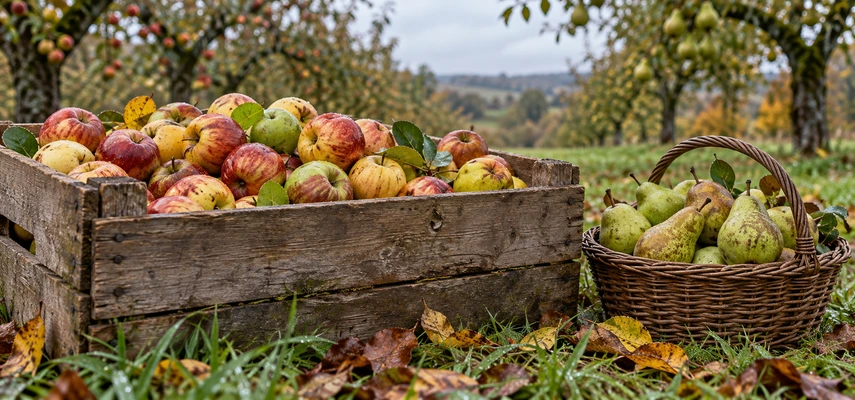

If Calvados were simply apple flavour added to alcohol, its orchard wouldn’t need to produce the right fruit for a fermented cider. The order matters: fruit becomes juice, juice becomes an alcoholic cider or perry, and that fermented drink supplies the material for distillation. Calvados explained begins with that missing middle step.
The category also contains an important pear story. Apples dominate many people’s mental picture, but pears are relevant to its production and especially to Calvados Domfrontais. Thinking only in terms of a generic apple brandy hides both the fermented base and the differences between its protected appellations.
This lesson connects orchard choices with the spirit’s character. We will follow fruit selection, preparation, fermentation, distillation and oak, then compare three appellation frameworks. The aim is to recognise what is required, what commonly happens and what remains a producer’s stylistic decision.
Calvados explained through Normandy’s fruit
Calvados comes from defined areas in and around Normandy, in France, under its appellation rules. The protected name doesn’t apply automatically to an apple spirit made anywhere in the world. Origin and method work together: satisfying one broad ingredient description does not establish the complete category.
The relevant materials are cider apples and perry pears. These are selected for their usefulness in the fermented base rather than solely for how pleasant they are to eat fresh. A crisp supermarket dessert apple and a tannic cider variety can serve very different purposes, even though both are unmistakably apples.
The Calvados authority’s production account groups cider apples as sweet, sharp, bittersweet and bittersharp. The names help organise differences relevant to cider balance. They don’t mean the finished spirit must taste like a direct mixture of four fresh juices in the same proportions.
Fruit selection helps shape the liquid that enters fermentation. Acidity, tannin, sugar and aromatic material all belong to that starting context, but they don’t pass unchanged through every later stage. Distillation selects volatile material, and oak adds further influences. It is more accurate to follow the transformations than to imagine a whole apple squeezed into the final glass.
Crush, press and ferment before the still
The fruit is sorted and cleaned, then crushed or milled to prepare it for pressing. Pressing extracts juice from the pulp. The sugary liquid can then undergo fermentation, during which yeast produces ethanol and related compounds. Physical juice extraction and biological alcohol production are different jobs in the sequence.
The apple-based fermented drink is cider; the pear-based counterpart is perry. Calvados is distilled from these fermented materials. The official FAQ emphasises that distinction when discussing its identity as a cider or perry spirit. It is not made by merely macerating fresh fruit in a purchased neutral base.
Handling matters because harvested fruit and juice can deteriorate. Suitable raw material and fermentation management help preserve the desired starting character. Once an unsuitable base exists, a still is not a universal eraser that makes its history irrelevant. It changes composition, while the material supplied continues to matter.
For revision, write the sequence as a set of functions: crush to prepare the fruit, press to extract juice, ferment to create ethanol, distil to select and concentrate. That structure helps with unfamiliar wording. If a question says alcohol appears during pressing, the problem is already visible before you need any numerical rule.
Pot and column stills belong to different appellation routes
Both pot and column distillation occur within the Calvados family. The precise permission depends on the appellation. This makes Calvados useful for applying the general still lessons: one fruit-spirit family can contain more than one equipment tradition without reducing the differences to “good method” versus “cheap method.”
The broad Calvados appellation allows either method. Calvados Pays d’Auge requires double distillation in pot stills. Calvados Domfrontais uses a short continuous column. Learn those associations as specific category information, rather than guessing the still from the word “French” or assuming every fruit spirit follows Cognac’s route.
In a pot route, the producer processes a batch and makes selections over time. A continuous column organises repeated vapour-liquid contact and withdrawal through its operating arrangement. Neither process creates ethanol from fresh fruit. Both work on the alcoholic fermented base, reshaping the mixture that fermentation supplied.
The type and operation of the still help influence the distillate’s character, but the equipment name is not a complete tasting note. Fruit, fermentation, collection choices and maturation still matter. A fair comparison identifies those variables rather than assigning every difference between two bottles to one visible piece of machinery.
Domfrontais gives pears a defined role
The Domfrontais appellation requires at least 30% perry pears in its raw-material composition, together with its column-distillation route and qualifying maturation. The INAO’s product account states these distinguishing points. Pears therefore have a regulatory role here, not merely a decorative appearance in a producer’s photograph.
That minimum is not a requirement that every Domfrontais use exactly 30% pears. A producer may use a higher proportion while meeting the other conditions. Nor is 30% a bottled alcohol strength. Label each percentage with what it measures: raw-material composition and ABV are different kinds of information.
Consider a hypothetical comparison between a pear-led Domfrontais and an apple-focused Pays d’Auge. Both belong to the Calvados family, but raw materials and distillation route may differ. If their ages or casks also differ, the comparison contains further variables. It would be careless to announce that the still alone explains everything you perceive.
Large old oak vessels can develop spirit without overwhelming fruit
Calvados matures in oak. Large, old oak vessels are important in the course’s style picture because they can offer a gentler wood contribution than highly active new oak. Maturation can still involve reactions and development over time even when the producer isn’t seeking a conspicuous new-wood aroma.
Think of oak management as controlling a balance rather than turning flavour on or off. A producer may want fruit-derived character to remain legible while the spirit becomes more integrated. Another example may show a more developed combination of baked-fruit associations, spice or nut-like notes. These are possible sensory descriptions, not mandatory ingredients or a guarantee attached to every age.
The ordinary minimum before market release is two years in oak for Calvados and Pays d’Auge, while Domfrontais requires three years. Those are minimums. A producer may mature much longer, and a legal threshold is not a promise that every spirit reaches an identical sensory state on the same date.
Don’t describe a clear, unaged cider eau-de-vie as if the word Calvados automatically applies to it. Related producers may make other fruit spirits as well as appellation Calvados. The orchard connection does not remove the protected drink’s maturation conditions. Check the actual designation rather than assuming that everything leaving the same distillery belongs to one category.
Colour and apple aroma need cautious interpretation
A spirit’s appearance provides an observation before it provides an explanation. Record pale gold or amber if that is what you see. Do not translate colour directly into an exact number of years. Wood activity, vessel history and production decisions make that shortcut unreliable, even when oak clearly plays a role.
Likewise, an apple-like aroma is not evidence that fresh apples were added after distillation. The fruit and fermented base can supply compounds that contribute to the final aromatic impression. A mature example may suggest cooked fruit rather than freshly cut apple, but aroma alone doesn’t authenticate an age statement or a particular apple variety.
Sweet-associated notes need similar care. An impression of baked apple or vanilla doesn’t establish a precise sugar level. Describe sweetness on the palate separately from flavour associations. That distinction lets you write a richer note while avoiding an invented production fact disguised as an attractive food description.
Build comparisons that answer one question at a time
For a production exercise, compare documented examples using the same headings: fruit composition, fermented base, appellation, still route and oak period. Begin with the facts you can authenticate. Then ask which differences plausibly help explain the sensory descriptions. This makes a comparison useful even if the bottles weren’t designed as a controlled experiment.
A younger and an older Calvados from the same producer can help explore maturation, although other choices may also differ. A Pays d’Auge and Domfrontais comparison explores a wider set of variables. State those limits. A thoughtful comparison can reveal patterns without pretending two drinks isolate a single chemical cause perfectly.
You can do these exercises without tasting alcohol. Sort production descriptions into the correct appellation framework, identify whether the base is fermented before distillation and explain why a pear percentage isn’t ABV. Those are genuine understanding tasks. The point is to connect facts, not to make consumption a condition of learning them.
What to remember
Calvados begins with orchard fruit but reaches the still as cider or perry. The appellation determines which still route applies, and oak develops the spirit before sale. Keep apples, pears, fermentation, distillation and maturation in that order, then attach the particular Pays d’Auge or Domfrontais requirements. The result is a clear production explanation with room for the differences that make the family interesting.
Continue your study
To contrast cider and grape-wine foundations, read Cognac Explained: Ugni Blanc, Crus, Distillation, and Age Classifications. To compare fruit juice with grape pomace, read Grappa Explained: Grape Pomace, Distillation, and Italian Traditions. To revisit old-oak and inert-vessel choices, read How Spirits Develop Flavor: Oak Maturation, Blending, Filtration, and Finishing.
Knowledge check: 10 original practice questions
Independent TFE questions, not official WSET examination items. Choose one answer per question; explanations follow separately.
1. What minimum oak period applies to Domfrontais?
- Ten years
- Three years
- One year
- Three months
2. What minimum perry-pear proportion distinguishes Domfrontais?
- 100%
- 30%
- 3%
- 51%
3. Which still route is required for Pays d’Auge?
- Only neutral-spirit column distillation
- No distillation
- Only freezing cider
- Double pot distillation
4. What does an apple-like aroma alone prove?
- Fresh apples were added after distillation
- A sensory resemblance to apple
- A guaranteed minimum age
- A particular apple cultivar
5. Which still route is associated with Domfrontais?
- Only a second cask finish
- Column distillation
- No fermented base
- Mandatory triple pot distillation
6. Why can large old oak be useful for this style?
- It can allow development with a gentler wood contribution
- It converts starch into sugar
- It prevents every chemical change
- It guarantees a spirit exactly 40% ABV
7. Which raw materials are central to Calvados?
- Cider apples and perry pears
- Juniper and gentian
- Grape pomace only
- Blue agave and corn
8. Which operation extracts juice from prepared fruit?
- Oak maturation
- Bottling
- Rectification
- Pressing
9. What normally enters Calvados distillation as the alcoholic base?
- A sugar syrup with no ethanol
- Fresh unfermented apple juice only
- Fermented cider or perry
- A compulsory neutral grain spirit
10. Which statement about Calvados origin is correct?
- Any apple spirit anywhere can use the name
- It is a mandatory name for all perry
- It has defined French appellation areas
- It must come from the Cognac region
Answers and explanations
1. B — Three years. Calvados Domfrontais requires at least three years in oak before the relevant market release. Mapping: LO2.
2. B — 30%. The INAO account specifies at least 30% perry pears, which is a raw-material proportion rather than ABV. Mapping: LO2.
3. D — Double pot distillation. Calvados Pays d’Auge uses double distillation in pot stills under its appellation requirements. Mapping: LO2.
4. B — A sensory resemblance to apple. Aroma resemblance is an observation, not by itself evidence of an addition, age or exact variety. Mapping: LO2.
5. B — Column distillation. Domfrontais uses column stills; it also has a defined pear proportion and maturation requirement. Mapping: LO2.
6. A — It can allow development with a gentler wood contribution. Used large vessels can support maturation while offering less active wood extraction than new oak. Mapping: LO2.
7. A — Cider apples and perry pears. Apples and pears are the relevant orchard materials; other listed materials belong to different spirit groups. Mapping: LO2.
8. D — Pressing. Pressing separates juice from the prepared pulp before fermentation produces the alcohol. Mapping: LO2.
9. C — Fermented cider or perry. Calvados distils an already fermented cider or perry, rather than creating ethanol directly from unfermented juice. Mapping: LO2.
10. C — It has defined French appellation areas. Calvados is a protected origin category rather than a generic name for every apple spirit. Mapping: LO2.












