











“Single” is doing less work on a whisky label than many readers expect. Single malt Scotch whisky can combine numerous casks, different maturation histories and more than one production batch. What remains single is the distillery. Understanding that one word removes a surprisingly large amount of confusion before a cork has even moved.
The rest of the designation adds its own information. Malt identifies the grain framework; Scotch identifies a protected Scottish production and maturation context. Together they describe a category capable of enormous variation. A delicate unpeated example and an intensely smoky one can both belong without either being an exception that needs explaining away.
This lesson focuses on those variations within the category: malt preparation, optional peat, pot-still decisions and oak management. The next lesson handles grain whisky, blending categories and Scotland’s regions. Keeping the jobs separate lets single malt be understood as a production system rather than simply the most prominent label on the shelf.
Single malt Scotch whisky begins at one distillery
The category uses 100% malted barley as its cereal material, together with water and yeast in the production process. It is made in batches in copper pot stills at one distillery. “One distillery” does not mean one farm, one barley field, one yeast cell or one individual still used in isolation.
The Scotch Whisky Association’s category explanation describes mashing, fermentation and distillation at that site. A producer may use several stills and many production batches while preserving the one-distillery identity. The point is authenticated production origin, not a tiny scale of manufacture.
A single cask is a different claim. It identifies a particular cask selection rather than the category’s shared distillery source. A single malt can be assembled from many casks; a single-cask presentation can highlight one vessel’s individual development. Neither description by itself establishes the whisky’s age, quality or final alcoholic strength.
Scotch adds a place and maturation framework
The spirit must be distilled and matured in Scotland, with at least three years in oak casks. The general Scotch framework limits those casks to a maximum capacity of 700 litres and sets a minimum bottled strength of 40% ABV. Single malt also has a Scottish bottling requirement. These are distinct conditions, not alternative ways to qualify.
The technical file linked from the current UK register sets out the production framework. It also requires the grain-to-fermentation stages at the distillery and conversion through the grain’s own enzyme systems. A generic technique available in whisky elsewhere is not automatically permitted in Scotch.
An excellent malt spirit made outside Scotland does not become Scotch by following a similar recipe. Likewise, sending Scottish new spirit abroad for its maturation would not preserve the required Scotch maturation route. Geography is part of the production definition, rather than merely an attractive landscape on the packaging.
Malt preparation can include peat, but does not have to
Malting prepares barley for later conversion by modifying the grain and supplying enzyme activity. Mashing and fermentation then create the alcoholic base. Those mechanics were covered in the preceding foundation lesson; here the important category point is that the cereal source remains malted barley rather than a mixed-grain American mash bill.
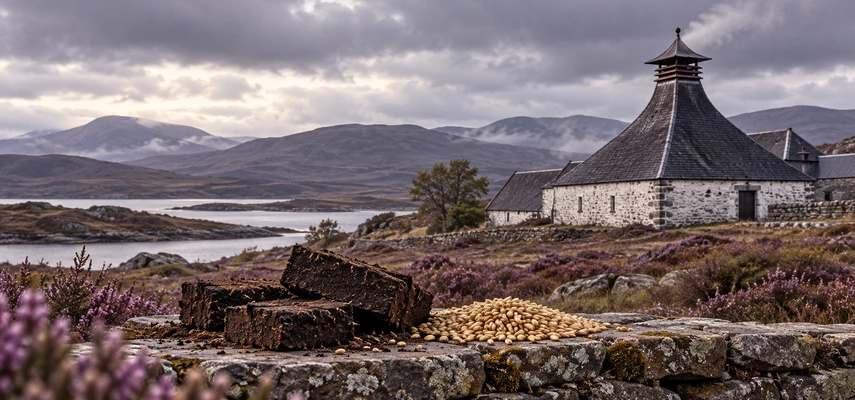
During drying, a producer can use peat smoke to influence the malt. Smoke-derived compounds can travel through later production and contribute smoky, medicinal or other associations in suitable examples. Peat is optional. It is not a legal requirement that every single malt must taste smoky, nor a test of whether a clear new spirit is genuinely Scottish.
The SWA’s FAQ connects this familiar smoky character with peat used during barley drying. It does not require an explanation based on peat colouring the distillery’s water. Learning the correct point of entry makes the production link much clearer: the malt is influenced before mashing and fermentation begin.
Peat intensity also isn’t a complete quality scale. Some producers want smoke to be prominent; others seek a different balance. A smoky impression can interact with fruit, oak and maturation character rather than replacing them. Describe the result instead of assuming that more peat must make every dimension more complex or more enjoyable.
Pot-still design helps shape a distillery’s spirit
Batch pot distillation allows the distiller to select portions over time. The still’s shape, heating and operation affect how vapour moves and what reaches the condenser. The heart is a mixture selected for the intended spirit, not pure ethanol awaiting all its character from a cask.
Reflux returns condensed liquid within the system, supporting further separation. A still design that encourages more of it can contribute to a lighter style, depending on operation. Height, lyne-arm arrangement and condensation all belong to that account. One photograph or one measurement is not enough to predict every aroma from an unfamiliar still.
Most malt Scotch is associated with double pot distillation, but specific producers use other arrangements. Don’t turn a common practice into the defining rule when the category definition concerns batch pot distillation at one distillery. The equipment tradition and the exact number of passes are related facts with different levels of universality.
The raw spirit’s profile sets a starting point for maturation. Two distilleries can both comply with the same malt and pot-still requirements while collecting different balances of congeners. Their later cask management can preserve, complement or partly obscure those differences. Distillery identity is therefore a useful production idea, not an insistence that wood has no influence.
Used casks create a different conversation from new oak
Scotch commonly matures in previously used casks, including ex-Bourbon and ex-sherry vessels. This differs from the mandatory new charred oak starting point in Bourbon. A previously used vessel may contribute less aggressive new-wood extraction while supplying its own history and allowing the whisky to develop.
Separate wood origin from previous contents. American oak describes the wood; ex-Bourbon describes what a cask previously held. A sherry-seasoned cask is not automatically made from European oak. Those details can overlap in different ways, so a precise production description should not use one as an unexamined synonym for another.
Freshness, reuse, wood treatment, size and storage conditions also matter. Two casks that both previously held Bourbon need not act identically. A long-used refill vessel and a more active cask offer different resources to the spirit. The phrase “ex-Bourbon” starts the explanation; it doesn’t finish every question about colour, aroma or texture.
Finishing adds another vessel decision
Cask finishing is an additional period of maturation in a different appropriate cask after an earlier maturation stage. It can adjust the whisky’s balance through further wood contact and the vessel’s history. It is not simply pouring wine or rum into a finished Scotch and treating the addition as an interchangeable legal shortcut.
The SWA’s allowable-cask guidance sets conditions on permitted previous contents and preservation of Scotch character. Interesting experimentation remains bounded by the protected category. A producer’s inventive idea must still meet those controls to retain the designation.
For comparison, imagine one spirit matured entirely in refill ex-Bourbon casks and another given an additional permitted cask finish. The finishing stage could help explain a difference, but check whether ages, cask activity and components also changed. A named finish is useful information, not proof that every other production variable has been controlled.
Age, colour and additions are separate questions
An age statement concerns the youngest whisky in the bottle, not an average lifted by an older component. A hypothetical single malt combining ten-, twelve- and fifteen-year-old casks has a youngest component of ten. Combining them does not break its one-distillery identity if all the material comes from that distillery.
Plain caramel colouring can be used under the Scotch framework; added sugar is not permitted. That distinction makes colour an unreliable exact-age calculator. A darker single malt need not be older than a paler one, and a permitted colour adjustment should not be confused with a sweetening ingredient or an unrestricted flavouring recipe.
Vanilla-like or dried-fruit-like aromas also do not, by themselves, establish an addition. Wood and maturation can supply sensory associations without the named food being put into the spirit. Describe appearance, aroma character, sweetness and texture separately, then use the documented production facts to explain plausible connections.
Compare the decisions rather than a prestige ranking
Useful comparisons include peated versus unpeated, different still-derived profiles, or different cask histories. For each pair, identify the variables you actually know. A smoky young malt and an older unpeated sherry-cask malt differ in more than peat; you can learn from both without pretending the comparison isolates a single cause.
If you don’t taste alcohol, work with producer accounts and hypothetical production descriptions. Decide which examples meet the one-distillery and malted-barley conditions, which require Scottish oak maturation, and which claims concern a single cask rather than single malt. These are understanding tasks that don’t depend on consumption.
What to remember
Single malt Scotch means one distillery, malted barley and batch pot distillation within the Scotch framework. Peat is a choice, cask history is a choice and a single malt may combine many qualifying casks. Geography, maturation and permitted additions set boundaries; the producer’s decisions inside them create the range. The label describes a family with rules, while the production account explains the individual whisky.
Continue your study
To revisit malting and peat drying, read How Whisky Is Made: Grains, Mashing, Fermentation, and Maturation. To compare single malt with grain and blended Scotch, read Blended and Grain Scotch Whisky Explained: Production, Labels, and Scotland’s Regions. To explore cask history and finishing, read How Spirits Develop Flavor: Oak Maturation, Blending, Filtration, and Finishing.
Knowledge check: 10 original practice questions
Independent TFE questions, not official WSET examination items. Choose one answer per question; explanations follow separately.
1. Where must Scotch maturation take place?
- Anywhere if the barley is Scottish
- Only in Kentucky
- Only in the country of bottling
- In Scotland
2. Which addition is permitted in the stated Scotch framework?
- Neutral spirit to replace malt spirit
- Plain caramel colouring
- Sugar for sweetness
- Any fruit flavouring without restriction
3. What determines the age statement in a multi-cask single malt?
- The oldest whisky
- The average age
- The youngest whisky
- Years since the bottle was purchased
4. What does single identify in single malt Scotch?
- One barrel
- One year of maturation
- One distillery
- One barley field
5. What is the relationship between single malt and single cask?
- Single malt prohibits all component selection
- They always mean the same thing
- A single malt can combine many casks from the one distillery
- Single cask requires several distilleries
6. Which distinction is correct for cask descriptions?
- Wood type and previous contents are identical claims
- American oak is wood information; ex-Bourbon is previous-content information
- Every American-oak cask held Bourbon
- Every sherry cask is European oak
7. What is the minimum qualifying oak period?
- Three months
- One year
- Exactly twelve years
- Three years
8. Which still route belongs to the definition?
- Mandatory quadruple distillation
- No distillation
- Batch distillation in copper pot stills
- Only neutral continuous columns
9. What is the cereal source for single malt Scotch?
- At least 51% corn
- Any grain with no malted barley
- At least 51% rye
- 100% malted barley
10. Which statement about peat is correct?
- Every single malt must use it
- It replaces fermentation yeast
- Its use during malt drying is optional
- It must be added as a bottled flavouring
Answers and explanations
1. D — In Scotland. Scotch must be matured in Scotland, not merely distilled there before maturation elsewhere. Mapping: LO2.
2. B — Plain caramel colouring. Plain caramel colouring is permitted, while added sugar and unrestricted flavouring are not. Mapping: LO2.
3. C — The youngest whisky. The youngest component controls the age assurance, even if older casks are also included. Mapping: LO2.
4. C — One distillery. Single identifies distillery origin, not a requirement that the bottle comes from one cask or field. Mapping: LO2.
5. C — A single malt can combine many casks from the one distillery. Single malt identifies distillery origin; single cask is a separate selection claim. Mapping: LO2.
6. B — American oak is wood information; ex-Bourbon is previous-content information. Wood species or origin and a vessel’s prior use are different variables that can combine in different ways. Mapping: LO2.
7. D — Three years. Scotch requires at least three years in oak, although producers may mature longer. Mapping: LO2.
8. C — Batch distillation in copper pot stills. The category requires copper pot batch distillation, not one universally fixed number of passes. Mapping: LO2.
9. D — 100% malted barley. The category uses malted barley without other cereals, unlike mixed-grain whisky categories. Mapping: LO2.
10. C — Its use during malt drying is optional. Peat smoke can influence malt during drying, but unpeated single malt is also part of the category. Mapping: LO2.












