










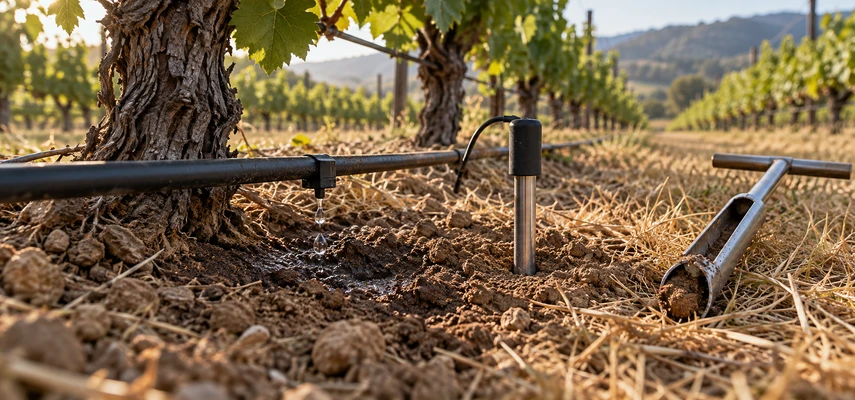

Two vines can look thirsty for different reasons. One may have exhausted the water around its roots. Another may sit beside a blocked emitter while the irrigation controller reports a perfectly normal run. Adding the same water to the whole block treats the appearance rather than the cause. Vineyard irrigation and nutrition both begin with finding out what the vine can actually access.
The same caution applies to fertiliser. Pale foliage is a clue, not a laboratory result, and strong growth does not prove that every nutrient is adequately supplied. Water, roots, soil chemistry and nutrition interact. A good management plan joins those pieces instead of treating irrigation and feeding as separate shopping lists.
The official Diploma specification places soil health, nutrient management and water management within vineyard production. Their significance lies in the resulting growth, crop, composition and costs. The objective is a healthy vine producing appropriate fruit, rather than maximum water use or minimum fertiliser expenditure in isolation.
Vineyard irrigation and nutrition depend on the root environment
Roots need a functioning soil environment. Effective depth, structure and drainage influence where they can grow, while soil texture and organic matter affect water storage. Water sitting above an impermeable layer is not equivalent to an evenly supplied, aerated root zone. A large irrigation application can therefore create a problem without solving another.
Soil health includes physical, chemical and biological conditions. Compaction can restrict infiltration and rooting; poor drainage can limit root function; erosion can remove valuable soil. Maintaining a usable root environment is part of production management, even when none of those operations resembles directly feeding a vine.
The British Columbia nutrition guide connects soil properties with nutrient availability and management. Its particular regional pH preferences and amendment rates should not become universal prescriptions. A soil test needs interpretation for the local soil, plant material and production conditions.
Consider two parts of a block with different effective rooting depths. The deeper zone may hold a larger accessible reserve after rain, while the shallow zone dries earlier. A single controller setting may be convenient but poorly matched to both. Mapping variation can improve a management decision before more sophisticated equipment is purchased.
Build a water budget, then check the vines
Vines lose water through transpiration, while water also evaporates from soil and other surfaces. Together these processes contribute to evapotranspiration. Rain and irrigation can replenish soil reserves, but only the water reaching and remaining within the effective root zone is potentially useful to the vines.
Weather-based estimates help anticipate demand. Soil-moisture measurements show conditions at particular locations and depths. Plant observations and appropriately interpreted vine water-status measurements add information about the vine’s response. These methods answer related questions, rather than offering interchangeable readings of exactly the same thing.
The British Columbia irrigation guide explains the importance of sensor placement relative to active roots. A shallow probe may show dry soil while deeper roots still have access to water. Conversely, a sensor near an emitter may remain wet while much of the intended root volume receives little supply.
Use representative positions and understand what each instrument measures. A soil-water content reading is different from the tension with which water is held. Readings depend on soil properties and require a suitable interpretation. An impressive dashboard cannot compensate for a sensor installed in an unrepresentative patch of ground.
Compare irrigation methods by what they deliver
Drip irrigation applies water at discrete points, making targeted delivery possible. It requires suitable design, filtration, pressure and maintenance. Blocked or damaged emitters can create uneven supply; a scheduled run is evidence of controller activity, not proof that each vine received its intended amount.
Sprinklers distribute water over a broader area. Depending on the system, they may also support other purposes, such as maintaining groundcover or providing frost protection when specifically designed and operated for that task. Wetting a larger area can also supply competing vegetation or increase losses. Suitability depends on the whole operation.
Surface or flood irrigation relies on water moving across the ground. It can suit particular terrain and infrastructure but gives different control over distribution from individual emitters. Compare levelling, soil infiltration, available supply, labour and losses rather than declaring one method efficient solely because of its name.
Water quality belongs in the comparison too. Salinity and other chemical characteristics can affect soil and vines. A small irrigation volume is not automatically a sustainable achievement if management allows harmful salt accumulation. Decisions about water quality, drainage and any required leaching need local evidence and expertise.
A deliberate deficit is different from unmanaged drought
Regulated deficit irrigation deliberately limits supply during selected developmental periods to influence growth and crop development. Its intended effects depend on timing and degree. It is a controlled strategy requiring monitoring and an ability to respond, rather than a general instruction to keep the vines struggling.
Partial rootzone drying uses alternating wet and drying parts of the root system. It seeks to influence vine responses while maintaining supply through the watered portion. The distinction is spatial as well as temporal: simply halving the run time of an ordinary system does not establish that alternate root zones are being managed.
The FAO-hosted account by Australian researchers explains the basis of these approaches. Its historical trial results are evidence of what happened under specified conditions, not a guarantee of identical water savings or wine improvements in every vineyard. System design and management capacity are part of the technique.
An AWRI note on deficit-irrigation limitations highlights soil and rainfall constraints. A profile that remains wet after spring rain may not reach the intended deficit when required. A soil that is difficult to rewet can create another problem when the manager wants to end that deficit.
Excessive stress can reduce leaf function, damage foliage and disrupt the crop’s development. A smaller berry or lower yield is not sufficient evidence of improvement. The grower must retain the capacity to produce healthy, suitably mature grapes and support the vine’s continuing needs, including in difficult weather.
Diagnose nutrition before choosing an input
Nitrogen supports growth and many metabolic processes. Too little can constrain performance, while excessive supply can contribute to unwanted vegetative growth and the management it requires. Other essential nutrients have different roles, and a problem involving one element cannot reliably be solved with more of another.
Soil analysis describes aspects of the supply environment; tissue analysis measures nutrient concentrations within sampled plant material. Neither should be interpreted without its sampling method and context. A nutrient can be present in the soil yet poorly available because root conditions or soil chemistry restrict uptake.
Wine Australia’s petiole-testing guidance explains why representative sampling and comparable growth stages matter. Mixing material from contrasting zones can conceal useful differences. Separate investigation of an abnormal patch may be more informative than diluting its signal into a block-wide sample.
Visual symptoms help direct investigation but can overlap with disease, toxicity and water problems. Interpret laboratory results alongside growth, crop and management records. Follow a locally appropriate sampling protocol and interpretation rather than comparing a result from one tissue or growth stage against an unrelated reference.
Fertilisers, organic materials and fertigation
Mineral fertilisers can provide specified nutrients, but their usefulness depends on the diagnosed need, availability and delivery. Organic materials such as compost can contribute nutrients and organic matter, with composition and release patterns that vary. Organic origin does not remove the need to understand what is being added.
Cover crops and vegetation management also affect competition and soil conditions. Their effects depend on species, timing and water availability. A practice that helps manage excess growth in a moist site may compete too strongly with vines under dry conditions. An attractive green floor is not a complete assessment of soil management.
Fertigation applies fertiliser through irrigation equipment. It can link nutrient timing with delivery to wetted root zones. Poor water distribution can then become poor nutrient distribution too. Product compatibility, maintenance and changes in soil chemistry need consideration; the delivery method does not establish the right nutrient amount.
Compare the full cost of each approach, including testing, transport, application, equipment and follow-up. Unneeded inputs waste money and can create environmental losses or additional canopy work. Equally, refusing an input that corrects a demonstrated constraint can sacrifice usable crop and vine health. The evidence should determine the decision.
Connect management to style, quality and price
Yield per vine and yield per unit area describe different scales. A management change may increase fruit on each plant, but its hectare-level value depends on density, losses and crop suitability. Measure marketable yield alongside composition rather than treating extra kilograms as an automatic commercial success.
Vine and grape health depend on adequate supply without damaging excesses. Grape component balance and aroma and flavour ripeness reflect the whole growing season. Changes in water and nutrition can affect canopy growth, berry development and exposure, with consequences that interact rather than moving all quality indicators in the same direction.
For red wine styles, a grower may evaluate skin-related composition alongside sugar, acidity and flavour. White wine styles and rosé wine styles can require different balances of freshness and maturity. None is improved simply by maximising stress. The management objective should specify what the intended fruit needs to provide.
Residual sugar styles may require particular maturity or concentration, but healthy productive foliage can still matter to reaching that objective. No- and low-alcohol styles also need suitable flavour and structure. Keeping sugar low through an unsuitable crop or damaged canopy is a poor substitute for an integrated production plan.
Quality levels from poor through acceptable, good and very good to outstanding concern the resulting wine. Price bands from inexpensive and mid-priced to premium and super-premium set a commercial context, not an irrigation prescription. Higher infrastructure costs or a fashionable deficit strategy do not establish an outstanding result or a premium selling price.
Make a recommendation that can be checked
Define the problem and the proposed mechanism. If the problem is uneven growth, first check whether supply differs, roots differ or another constraint is present. If the problem is excessive vigour, compare water and nutrient evidence with crop and canopy capacity before reducing inputs indiscriminately.
Set up a manageable comparison and record applied amounts, distribution, vine response, marketable yield and maturity. Research reported by Wine Australia on partial rootzone drying illustrates that physiological responses cannot be reduced to a simple percentage cut in water. A useful trial asks what changes and whether that change matters for this vineyard.
The strongest Diploma answer follows the same discipline. Identify the constraint, explain the intervention, predict benefits and costs, then state the conditions that could reverse the recommendation. Precision comes from a well-supported chain of reasoning, not from inventing a universal number of litres or kilograms.
Connect this explanation with viticulture approaches and canopy management as linked parts of the same explanation. Trace the relevant growing or cellar decision through to its consequences, and identify the condition that could change the result rather than treating the relationship as automatic.
Original Diploma practice
These original exercises are not official WSET questions and have no official mark allocations.
Question 1: investigate an uneven block
A drip-irrigated block has a weak upper slope and vigorous lower rows. The manager proposes increasing the entire block’s run time. Evaluate the proposal.
Indicative answer points: check emitter delivery and pressure; compare soil depth and roots; examine drainage and water status; separate nutrient or disease constraints; assess management zones; monitor crop and composition.
Outline answer: More run time may help if the weak zone lacks accessible water, but the observation does not establish that diagnosis. Check actual delivery and root-zone conditions in both areas. Extra supply could worsen excess growth or drainage problems lower down while leaving a blocked emitter unresolved. If contrasting zones have consistently different needs, evaluate separate control or appropriate system changes. Compare usable crop, maturity and operating cost after addressing the diagnosed cause.
Question 2: evaluate deficit irrigation
A grower on a deep soil with frequent spring rain wants to copy a deficit programme from a dry, freely draining site. What should be evaluated first?
Indicative answer points: accessible stored water; rainfall timing; ability to establish and end a deficit; development stage; monitoring; capacity during hot weather; trial before expansion.
Outline answer: The intended response depends on the water actually available to roots, not merely on reducing irrigation. Deep reserves and repeated rain may prevent the planned deficit. Rewetting capacity also matters when adequate supply must be restored. Assess soil profile, root distribution, seasonal demand and delivery capability. A small monitored trial can test whether the strategy produces a useful response without damaging crop or vine health. Identical controller settings would not establish equivalent treatment.
Question 3: assess a fertiliser recommendation
A supplier recommends the same nutrient product for pale vines in two contrasting vineyard zones. Explain what evidence is needed before purchase and how the response should be assessed.
Indicative answer points: symptoms are not diagnosis; soil and tissue evidence; representative comparable sampling; water and root function; deficient versus excessive supply; product delivery; costs and crop outcomes.
Outline answer: Pale leaves could reflect nutrient deficiency, restricted uptake or another problem. Sample the zones appropriately and interpret results with growth, soil, water and health observations. Establish which nutrient is limiting, if any, before choosing a product and application approach. Correcting a delivery or root problem may be more useful than adding material. Judge the response through healthy growth, suitable crop and maturity rather than leaf colour alone, and include total application and follow-up costs.











