










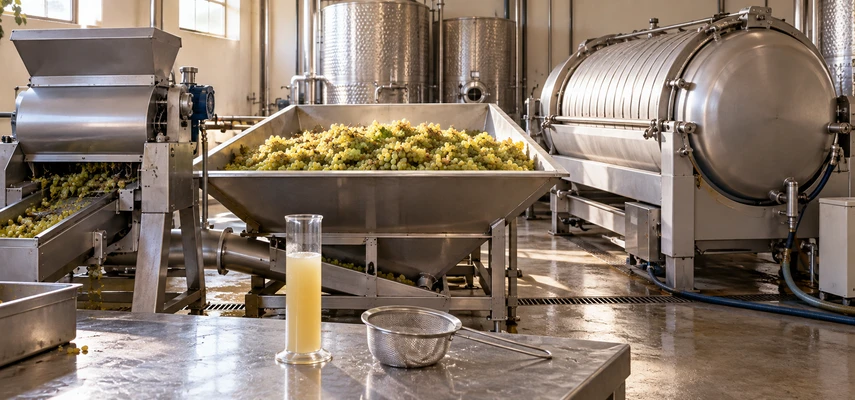

A load of grapes reaches the winery, but it does not arrive as a blank canvas. The fruit brings its maturity, temperature, health, microorganisms and the effects of handling since harvest. How winemaking begins is largely a decision about preserving useful characteristics while preparing that particular material for the intended wine.
Two loads of the same variety may therefore take different routes. One might be pressed as intact bunches for a delicate white wine. Another might be crushed and held with skins to obtain more extraction. Equipment names tell only part of the story; sequence, timing and the condition of the fruit determine what each operation achieves.
The official D1 specification includes wine components, processing, extraction, clarification and adjustments. Understanding the connections makes the list manageable: release or separate material, control its exposure, then provide suitable conditions for the process that follows.
How winemaking begins: know the material and the target
Water is the largest component of ordinary wine and the medium carrying dissolved substances. Alcohols include ethanol, produced mainly through alcoholic fermentation, and smaller quantities of other alcohols. Ethanol contributes to body, warmth and the environment in which extraction and microbial activity occur. Fresh grape juice and finished wine are chemically different systems.
Acids influence freshness, balance and stability. Wine aromatics include grape-derived compounds, precursors that can yield aromas later, and compounds generated during fermentation or maturation. Residual sugars are sugars remaining in the wine, not simply the sugar concentration measured at reception. The amount remaining depends on the subsequent production plan and fermentation.
Glycerol is another fermentation product that can contribute to the overall texture, although body cannot be read from glycerol alone. Phenolics include compounds involved in colour, bitterness and astringency, with important sources in skins, seeds and, when used, stems. Processing changes which constituents enter the liquid and in what proportions.
This is why a winemaker specifies the target before choosing the route. More extraction is useful only if the extracted material contributes to the intended balance. A higher yield of liquid can be commercially attractive while introducing a fraction that requires different treatment or belongs in a different blend.
Production approaches constrain choices
Conventional winemaking can use the methods and materials permitted for the wine and market concerned. Organic and biodynamic production add applicable certification requirements, including processing rules; certified grapes alone do not establish that every winery operation or final label qualifies.
Natural winemaking commonly expresses an intention to minimise intervention, often including limited additions and a preference for indigenous fermentation. Usage varies, and some organisations define particular standards. The phrase alone does not identify a universal legal category or prove that the producer follows a specific certified protocol.
The USDA organic framework and Demeter’s standards illustrate why the applicable scheme must be checked. Compare what a proposed operation does with what the particular product permits. Minimal intervention also needs sound fruit, hygiene and monitoring; an aspiration does not prevent spoilage.
Reception, sorting and temperature protect options
Grape transport connects the harvest with processing. Time, temperature, damage and exposure affect oxidation, extraction and microbial activity before a tank is filled. Plan receiving capacity so that fast picking does not simply create long queues of warm fruit. Record the identity and condition of each load to preserve traceability.
Sorting removes unsuitable grapes and material other than grapes. Hand selection, sorting tables and optical or other mechanical systems offer different capacities and forms of discrimination. The rejected fraction, labour, equipment and speed affect cost. Sorting improves the material retained; it does not restore constituents already lost from damaged berries.
Destemming separates berries from their stems. It can help limit unwanted stem material, but some styles deliberately retain whole bunches or stems. Crushing breaks berries and releases juice; it is distinct from destemming and from pressing. Gentle crushing aims to open fruit without unnecessary damage to seeds or other material.
Chilling slows many biological and chemical processes and can provide control while fruit awaits the next step. It requires equipment and energy, and refrigeration capacity can become a bottleneck at harvest. Lower temperature is a management tool rather than proof that processing delays have no consequences.
Extraction starts before alcoholic fermentation
Skin contact allows juice to remain with skins and other grape solids. Time, temperature, variety, fruit condition and handling affect extraction. In white or rosé production, a deliberate contact period can change aroma, texture and phenolics. Excessive or unsuitable contact can also add unwanted bitterness or other characters.
AWRI’s skin-contact resource explains why the route from picking to pressing matters. Machine-harvested fruit may already have experienced contact during transport, while intact hand-picked bunches offer different options. Count the exposure already incurred before adding another planned stage.
Cold soaking is pre-fermentation maceration at a low temperature, commonly considered in red winemaking. It permits extraction in an initially low-alcohol medium before active alcoholic fermentation. Subsequent fermentation and maceration still shape the final result. Cooling does not sterilise the must, so hygiene, monitoring and an appropriate microbial strategy remain necessary.
Thermovinification uses heating to promote rapid extraction, particularly of colour, before fermentation. Flash détente combines heating with a rapid pressure reduction under vacuum; vaporisation cools the material and helps disrupt grape tissues. These approaches can alter the required time on skins and the available processing capacity.
An AWRI technical account of pre-fermentation heating compares the processes. Evaluate energy, capital, throughput and the wine produced rather than assuming rapid colour extraction reproduces every aspect of a longer conventional maceration. Colour and tannin extraction are related considerations, not identical measurements.
Pressing separates liquid and solids
Pressing applies pressure to obtain liquid from grapes or fermented material. It can occur before fermentation in many white and rosé routes, or after skin fermentation in many red routes. Whole-bunch pressing and pressing crushed fruit supply different starting conditions, including differences in drainage and prior skin contact.
Basket and pneumatic presses provide different equipment arrangements and operating possibilities. Evaluate loading, pressure programme, cycle time, handling and recovery. The press’s name alone cannot establish how gently a particular load was treated or what liquid fractions were collected.
Free-run liquid drains without the main pressing stage. Press fractions obtained as the cycle proceeds can differ in composition and sensory character. Keeping fractions separate preserves blending options but requires handling and storage capacity. Combining everything immediately may simplify work while limiting later choices.
A producer should compare useful recovery with the intended style. Chasing every possible litre can introduce material requiring additional clarification or adjustment. Conversely, rejecting all press liquid on principle can discard a useful component. Trial the fractions and assess what they contribute before deciding where they belong.
Oxygen management is a choice, not a slogan
Oxygen exposure can change phenolics and aroma-related compounds. Protective handling can include limiting air contact and using appropriate inert gases. Sulfur dioxide has antioxidant and antimicrobial roles, with effectiveness affected by conditions including pH. Added sulfur dioxide is not equivalent to the measured free, active forms available afterwards.
AWRI’s sulfur-dioxide guidance explains why measurement and context matter. A fixed addition cannot guarantee the same protection in every must. Hygiene, temperature and fruit condition work alongside the chemical strategy, rather than being replaced by it.
Hyperoxidation deliberately exposes suitable juice to oxygen so that susceptible phenolic material oxidises and can subsequently be removed with clarification. The aim can include reducing the future tendency to brown. It is a defined processing strategy, distinct from accidentally leaving vulnerable juice unprotected.
The OIV oxygenation entry describes this purpose. Suitability depends on the intended wine and its compounds: removing susceptible material may also change desirable characteristics. Protective and oxidative routes therefore need a stylistic argument, not a claim that oxygen is always beneficial or always harmful.
Clarification selects the solids entering fermentation
Sedimentation allows suspended material to settle, after which clearer juice can be separated by racking. Cooling can help control activity during the wait, but uses energy and occupies tanks. The desired result is a suitable solids level for the fermentation, rather than the clearest possible juice regardless of consequences.
Clarifying agents can assist the aggregation or removal of unwanted material. Different agents act differently, so bench trials and product suitability matter. Excessive treatment can remove useful constituents or create avoidable losses. Processing, certification and any relevant disclosure requirements must be checked for the particular operation.
Flotation uses fine gas bubbles to carry suspended material upward for separation. It can provide faster clarification than relying only on settling. Gas choice and operating conditions matter, including whether oxygen exposure is intended. AWRI’s flotation account discusses the throughput and cooling implications.
Centrifugation separates material through rapid rotation and can support continuous processing. It involves capital, operating and maintenance costs. Compare the achieved clarity, recovered juice, processing speed and handling effects. Clarification choices also affect fermentation behaviour, which is why the AWRI grape-solids resource treats solids as a production variable rather than simply waste.
Must adjustments change the starting composition
Must enrichment increases potential alcohol, for example through permitted sugar or concentrated grape-derived material, or suitable concentration methods. Adding fermentable sugar before fermentation need not make the eventual wine sweet if yeast subsequently consumes it. Residual sweetness and enrichment are different production questions.
Cryoextraction freezes harvested grapes before pressing to obtain concentrated liquid while ice remains behind. It differs from harvesting naturally frozen grapes and from partially freezing an already extracted must. OIV’s wine-grape practices distinguish the process; its inclusion in a technical code does not establish permission for every regional wine designation.
Acidification increases acidity; deacidification reduces it through an appropriate permitted route. Both require analysis and trials because pH and titratable acidity respond within a buffered chemical system. The OIV acidification entry gives a technical framework, while applicable law determines what this producer can do.
Colour adjustment can involve extraction choices, blending or treatments that remove unwanted colour, where permitted. It should follow an identified style problem rather than a belief that darker always means better. Acid adjustment likewise needs the intended sensory and stability outcome. One improved laboratory value does not establish a better-balanced wine.
Reducing alcohol or removing alcohol generally concerns the fermented product and specialised later processing. Choosing suitable grape maturity can influence potential alcohol, but it is not the same operation as removing ethanol from wine. Keep that boundary clear when planning reception; a later adjustment cannot be assumed to recreate the flavour of differently grown fruit.
Compare the whole route rather than isolated machines
A successful processing plan matches fruit, style, capacity and permitted methods. More equipment can reduce a bottleneck or provide useful control, but adds costs and requires trained operation. Extra extraction or clarification may also create more work downstream. Evaluate the liquid and the final wine, not only the speed of the first machine.
Consider a delicate white juice and a colour-focused red must. Rapid separation and protective handling may suit the first, while deliberate skin extraction suits the second. Neither route is universally superior. The strongest explanation follows each decision through to composition, fermentation, likely style and cost, acknowledging what must be checked rather than assuming every change is beneficial.
Connect this explanation with white winemaking and harvest decisions as linked parts of the same explanation. Trace the relevant growing or cellar decision through to its consequences, and identify the condition that could change the result rather than treating the relationship as automatic.
Original Diploma practice
These original exercises are not official WSET questions and have no official mark allocations.
Question 1: compare reception routes
A winery receives intact cool bunches for a delicate white wine and warm damaged fruit after a long journey. Evaluate whether both should receive the same extended skin-contact treatment.
Indicative answer points: prior exposure; fruit health; temperature; extraction targets; oxidation and microbes; pressing capacity; trials and handling.
Outline answer: The loads have already experienced different conditions. Intact cool fruit preserves options for rapid whole-bunch pressing or a controlled contact trial. Damaged warm fruit may already have undergone substantial extraction and faces different deterioration risks. Assess its health and composition before adding more contact. The same nominal treatment will not create the same total exposure. Match the processing sequence to the intended wine and the actual material, while ensuring the winery can complete it promptly.
Question 2: evaluate clarification choices
A winery’s settling tanks are full during a compressed harvest. Compare flotation and centrifugation with expanding static settling capacity.
Indicative answer points: processing rate; tank occupancy; cooling; desired solids; juice recovery; oxygen strategy; equipment and expertise; cost.
Outline answer: Faster separation may release capacity and reduce waiting, but the alternatives require suitable equipment, operation and a defined solids target. Flotation gas choice affects exposure, while centrifugation has its own capital and operating requirements. Extra settling capacity may be simpler where the bottleneck is temporary or labour and equipment access are limited. Compare annual use, recovery and fermentation suitability as well as maximum throughput. Clearer juice is useful only at a level appropriate to the planned fermentation.
Question 3: explain an enrichment proposal
A manager says adding sugar to low-sugar must will make a sweet wine and that acidification will necessarily lower pH by a predictable amount. Evaluate both statements.
Indicative answer points: potential alcohol versus residual sugar; fermentation outcome; compositional analysis; buffering; bench trials; permission and records; sensory balance.
Outline answer: Fermentable sugar can increase potential alcohol and be consumed, leaving a dry wine; sweetness depends on what remains after the chosen production process. Acid additions interact with the must’s composition, so titratable acidity and pH cannot be treated as the same measurement or a fixed universal response. Analyse and trial before scaling. Verify the relevant permissions and evaluate the resulting balance, rather than assuming a changed starting number guarantees the desired wine.












