










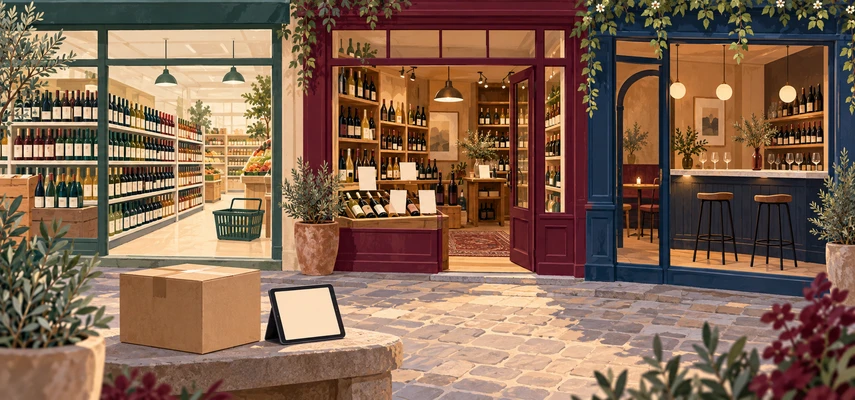

A bottle bought with the weekly groceries solves a different problem from a bottle chosen after a long conversation with a merchant. Neither transaction is inherently more serious. The customer is buying a wine, but also convenience, confidence, discovery or access to something difficult to find.
Wine retail explained through those needs makes the channel differences clearer. Each format assembles a range, attracts customers, holds stock and completes sales. What changes is the balance of choice, service, scale, cost and risk. For producers, the best channel is the one capable of reaching the intended buyer on workable terms.
The WSET Diploma specification includes nine retail options in D2. They overlap in practice: a specialist can operate online, a supermarket can offer premium wines, and a hybrid shop can sell bottles for both home consumption and drinking on site. Compare what the business does rather than judging quality from its format.
Supermarkets combine wine with a larger shopping trip
A supermarket sells wine within a broader grocery offer. Customer traffic generated by food shopping can create frequent opportunities to sell wine without attracting each visitor specifically for that category. Recognisable brands, clear price positions and an easy-to-navigate range can help time-pressed shoppers choose.
Scale can support consolidated buying, logistics and promotion. For a producer, a listing may provide substantial volume, but the ability to supply consistently, meet specifications and coordinate deliveries becomes important. A large order isn’t useful if the winery cannot fund or fulfil it.
Commercial pressure can include keen pricing and demands for promotional support. Assess the actual agreement, including payment timing, allowances, packaging and the risk of dependence on one account. Don’t treat a headline selling price as the producer’s net receipt or assume every supermarket negotiates identical terms.
Shelf space is finite. A supplier may need to demonstrate why its wine deserves a place within the category rather than merely explain why the wine is good. A distinctive small-production bottle might fit a selected premium range, while lacking the available volume for a broad national rollout.
Deep discounters simplify the offer
A deep discounter emphasises a low-price proposition supported by an efficient operating model. A comparatively limited core range and exclusive or own-label products can simplify buying, handling and customer choice. That is an explanation of a model, not a rule that every item must be inexpensive or permanently available.
Concentrating purchases in fewer lines can increase volume per line and strengthen buying efficiency. It can also reduce direct price comparison where the product is exclusive. Temporary or seasonal wine offers may create interest beyond the core range, with a different continuity requirement from a permanently listed brand.
The supplier needs to assess specification, price, volume and schedule together. A competitive bottle price may depend on efficient production and packaging rather than an inferior wine. Conversely, an attractive large order can carry concentration risk and tie up resources before payment.
For a customer, a shorter range reduces searching but may omit a desired origin or style. For a producer seeking visible brand development, an exclusive-label arrangement creates different benefits from selling under its own name. Evaluate the commercial objective before declaring the channel a good or bad fit.
Convenience retailers sell access and immediacy
A convenience retailer serves a local or immediate shopping need, often with a compact range. Location, opening hours and ease of purchase can matter more to the occasion than extensive comparison or specialist advice. A bottle for dinner tonight has a different buying rhythm from a case ordered for a cellar.
Space limits the number of wines and the depth of stock. Clear choices, dependable availability and suitable formats can therefore be valuable. Chilled wine may support immediate consumption occasions, but refrigeration uses space, equipment and energy; it isn’t a cost-free service.
Smaller deliveries and local operating costs can affect unit economics. Assess the service and catchment instead of assuming convenience retail is simply a smaller supermarket. A producer targeting this channel needs a proposition that the shopper can understand quickly and the retailer can replenish reliably.
Specialists compete through selection and knowledge
A specialist wine retailer concentrates expertise and range around wine. It can help customers choose unfamiliar varieties, compare styles or find bottles outside mainstream distribution. Advice reduces the perceived risk of experimenting, while events and relationships can encourage repeat visits.
WSET’s description of retail service roles places product knowledge and customer service within the off-trade. Knowledge is commercially useful when it helps a shopper find a suitable wine, rather than turning a quick purchase into an unsolicited examination.
Expertise and a broad range require funding. Staff training, time spent advising, premises and slow-moving inventory all affect cost. An unusual wine may support differentiation while occupying cash longer than a regular seller. Compare cash contribution and stock turn alongside percentage margin.
A small producer may value a specialist’s ability to explain its wine, but the retailer still needs demand and adequate return. A fascinating story doesn’t guarantee repeat sales. The relationship works best when the supplier understands the shop’s customers, price positions and practical order requirements.
Hybrids combine the shop with on-site drinking
A hybrid combines off-trade bottle retail with an on-trade offer such as a wine bar. A customer may taste a glass, buy a bottle to take home or return for an evening visit. The same stock can support discovery and more than one type of sale, subject to the relevant licences and operating arrangements.
Majestic Wine Group’s account of Vagabond’s development describes its early shop-and-bar format. It provides a real illustration of this combination; it doesn’t establish that every hybrid has the same costs or service model.
On-site service adds glassware, washing, staff time, seating and management of open bottles. Retail and bar activities may compete for space and attention at busy times. A higher on-site selling price needs to support the added service rather than being treated as a free margin increase.
Evaluate whether the activities reinforce one another. Tasting may encourage retail discovery, but a shop’s customers don’t automatically become bar customers. Keeping both functions clear, welcoming and operationally manageable matters more than simply installing a few stools beside the shelves.
Online retailers replace shopfront tasks with digital ones
An online retailer can present a wide searchable range and reach customers beyond one local catchment, where selling and shipping are permitted. Filters, reliable descriptions and recommendations can help shoppers choose without holding the bottle. Accurate stock information and a usable ordering process are part of the service.
The model still needs customer acquisition, technology, payments, warehousing, picking, protective packaging, delivery and support. Saving on a prominent shopfront doesn’t make those costs disappear. Returns, breakage, failed deliveries and compliance can change the economics of an apparently attractive order.
Basket size matters. In an original hypothetical example, an order produces 18 currency units after wine acquisition cost, while payment, packing and delivery consume 12. The remaining 6 still needs to support marketing and other overheads. Doubling traffic doesn’t guarantee profit if acquisition costs exceed that remaining contribution.
An established shop can sell online too, using its reputation while taking on fulfilment work. Distinguish that combination from the shop-and-bar meaning of hybrid in this syllabus discussion. Channels can overlap without making the underlying operational tasks identical.
Global travel retail serves a moving audience
A global travel retailer sells to travellers through settings such as airports, ports or border-related locations. Gifting, premium presentation, exclusive packs and the convenience of buying during a journey can shape the offer. Passenger flows and travel patterns influence demand in ways that differ from a neighbourhood shop.
Sydney Airport’s description of its Heinemann store illustrates wine within a wider travel-retail assortment. The commercial setting includes limited traveller time and competition with other categories, not merely another wine shelf in an ordinary high street.
Duty-free treatment depends on the transaction and applicable rules. The phrase doesn’t prove that every product is tax-free, cheaper than every domestic alternative or unlimited at the traveller’s destination. Allowances and transport restrictions can influence what customers are willing or able to buy.
For suppliers, compare access, presentation, supply arrangements and customer relevance. A distinctive gift bottle may fit one opportunity, while a heavy or fragile package can discourage a traveller. Sales depend on a suitable offer and reliable operation, not airport presence alone.
Wine investment retail depends on future resale
Wine investment businesses connect buyers with wines acquired partly or primarily for potential future value. Relevant services can include sourcing, storage and resale arrangements. This differs from selecting a bottle for tonight: authenticity, provenance, condition and a credible resale market become central to the proposition.
Acquisition price is only the starting point. Storage, insurance, transaction charges and the difference between buying and selling prices can reduce the result. An advertised market value isn’t necessarily the net amount a particular owner could realise promptly for a particular case.
Berry Bros. & Rudd’s collecting guidance explicitly avoids promises about future wine values. That limitation belongs within the business analysis: scarce or famous wine doesn’t guarantee appreciation, liquidity or a profitable sale. This article evaluates a retail model rather than recommending wine as an investment.
For a supplier, access to collectors can support a fine-wine proposition, but the required reputation and secondary demand take time to establish. Simply declaring a new wine “investment grade” doesn’t create future buyers. Evaluate evidence, costs and the exact service offered.
Monopoly retailers follow a defined mandate
A monopoly retailer holds designated exclusive retail rights under its market’s rules. Its scope and purpose require care: this doesn’t automatically mean all importing, hospitality or production is monopolised. Supplier access, selection and distribution can operate through formal processes rather than ordinary negotiation with many independent shops.
Systembolaget’s supplier guidance describes its public-health mission, qualifying Swedish suppliers and objective purchasing principles. A producer needs to understand the appropriate range and process, not assume that a persuasive sales visit can bypass the system.
Such a route can offer meaningful access if the wine meets requirements and demand supports it. It also creates dependence on the relevant selection and distribution arrangements. Compare compliance, supply reliability and sustained customer response rather than treating a listing as guaranteed long-term volume.
Judge the fit between channel and wine
Start with a target customer, occasion and price position. Then test the supplier’s capacity, the retailer’s service and the net economics of the agreement. A wine can fit several channels, but conflicting presentation, supply commitments or price expectations may need management.
A strong D2 comparison links format with mechanism: limited range concentrates purchasing, advice uses staff time, online orders require fulfilment, and on-site tasting adds hospitality work. Evaluate when each benefit pays for its cost. That produces a more useful answer than ranking retailers from cheap to prestigious and hoping the categories explain themselves.
Use selling wine to restaurants and wine supply and demand as tests of the business reasoning here: identify who bears a cost or risk, explain how the route to market changes it and distinguish revenue from the return retained by the producer.
Original Diploma practice
These original exercises are not official WSET questions and have no official mark allocations.
Question 1: compare supermarket and specialist access
A small producer has limited volume, an unfamiliar grape variety and little marketing capacity. Compare a national supermarket listing with sales through selected specialists.
Indicative answer points: volume and continuity; buyer terms; explanation; staff expertise; reach; net return and concentration.
Outline answer: A national listing can provide reach and volume but may exceed supply capacity and require demanding logistics, funding or promotional commitments. Selected specialists may explain the unfamiliar wine to suitable customers, although orders and reach may be smaller and fragmented. Compare actual terms, customers and the producer’s capabilities; neither channel guarantees sales or a superior return.
Question 2: evaluate a shop-and-bar conversion
A specialist plans to add on-site drinking because bar prices exceed takeaway prices. Evaluate the proposed benefit and the additional analysis needed.
Indicative answer points: discovery; retail cross-sales; licensing; staffing; premises; open-bottle loss; net contribution.
Outline answer: Tasting can support discovery and create an additional occasion, but higher selling prices must cover hospitality work and resources. Include suitable permissions, seating, glassware, washing, service time and open-bottle management. Test whether the customer base and space support both functions and calculate incremental contribution, rather than treating the price difference as pure profit.
Question 3: assess an online expansion claim
An online seller earns 18 per order after wine acquisition cost and spends 12 on payment, packing and delivery. It proposes paying 8 to acquire each new order and predicts that higher traffic guarantees profitability. Evaluate the claim.
Indicative answer points: remaining contribution; acquisition cost; overheads; repeat purchases; basket size; forecast assumptions.
Outline answer: The stated fulfilment-stage amount is 6, which is less than the proposed 8 acquisition cost. On that first-order basis the result is negative2 before other overheads. Repeat purchases or larger baskets could change customer economics, but need evidence and consistent cost treatment. Traffic and turnover alone don’t establish profitable orders or lasting customer value.











