










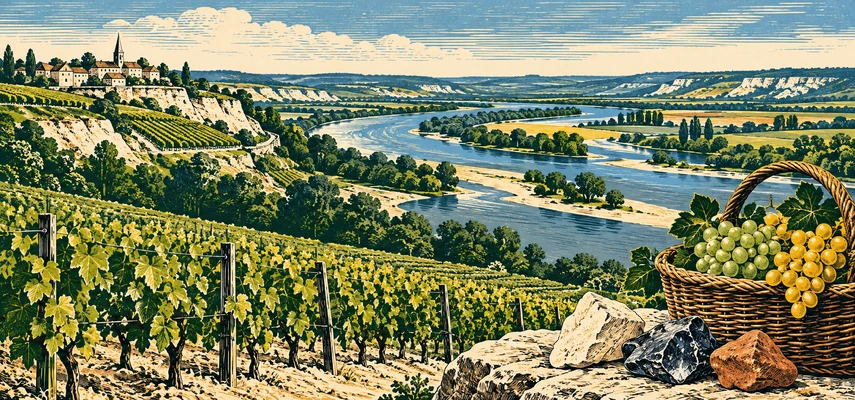

Sancerre and Vouvray both arrive in the broad Loire chapter of a wine course, but ordering one when you meant the other can produce a surprise. One familiar name points mainly toward dry Sauvignon Blanc; the other opens a range of Chenin styles, including wines with appreciable sweetness. The river connects vineyards. It doesn’t impose a single recipe.
This part of Diploma study works best when names become questions. Which grape? What exposure and water supply? Which harvest aim and fermentation choices? What can the protected origin actually promise? Those questions turn a collection of famous labels into explanations of style, quality and price.
Separate Touraine from the Centre-Loire
Touraine includes vineyards around Tours and along the Loire’s tributaries; the Centre-Loire lies farther inland around Sancerre, Pouilly and the Berry vineyards. “Central” can be confusing in a river running through so much of France. Use the actual appellation and location rather than assuming every wine near the middle of a map shares an identity.
The InterLoire climate and geology map shows transitional oceanic and continental influences. The Centre-Loire’s regional glossary describes semi-continental conditions. Temperature affects ripening and acid retention; sunlight influences sugar production and the exposed bunch environment. Continental influence doesn’t mean every vineyard is hot or every vintage equally ripe.
Water availability depends on rainfall, soil depth, texture and rooting. Nutrient availability influences vigour and crop balance. Limestone, marl, flinty clay and alluvial deposits create different conditions, but a soil name isn’t enough to predict the flavour or quality of a bottle. Ask how the soil changes water supply, drainage and vine growth.
Weather can override a neat geographical comparison. Spring frost damages young growth, hail reduces usable crop, and harvest rain complicates decisions about maturity and health. Downy mildew, powdery mildew and bunch rot still require monitoring. Warmth may make ripeness easier in one season; heat and drought can become the main limitation in another.
Let Sauvignon express more than greenness
Sauvignon Blanc is central to Touraine whites and the best-known whites of Sancerre and Pouilly-Fumé. Citrus, floral, fresh-fruit and herbaceous impressions can occur in different proportions. A grassy note alone doesn’t establish origin, and greater pungency isn’t a quality scale.
Vineyard establishment needs appropriate variety, exposure, access and training within the applicable rules. Planting materials should combine suitable selections and rootstocks with the site’s water, vigour and soil constraints. Nutrient and water management should respond to actual vine status. Too much growth can shade fruit; excessive restraint can leave insufficient productive leaf area.
Canopy management balances airflow, light and protection from extreme exposure. Harvest timing should consider flavour, acid, sugar, fruit health and the forecast. Picking earlier may preserve a greener profile and freshness, but can leave hard or dilute flavours; waiting may develop riper fruit while reducing acidity or increasing weather risk. The useful answer depends on the intended wine and the season.
Hazard management includes suitable sites and practical frost precautions where effective and permitted. Pest and disease management combines observation, canopy measures and justified treatments, rather than an assumption that inland vineyards stay dry. A grower aiming for precise white-fruit character needs healthy fruit as well as the desired ripeness.
Preserve aroma without assuming every wine uses tank
Winemaking approaches include fresh, early-drinking Sauvignon and more textured wines intended for development. Gentle grape transportation reduces crushing and heating; reception should separate origin, maturity and condition. Processing decisions determine how much skin contact or oxygen exposure the juice receives before fermentation.
Extraction and pressing influence phenolics and juice fractions. Pre-fermentation clarification adjusts solids to support the desired fermentation and aromatic result. Must adjustments require analysis and legal permission, rather than a reflex response to a cool or warm vintage. Alcoholic fermentation may take place in tank, wood or other suitable vessels, with temperature and nutrition managed for a healthy outcome.
Malolactic conversion may be avoided to retain acidity in a fresh white, although a producer’s aims and rules matter. Maturation on lees can change texture; new wood can add flavour and alter oxygen exposure. These aren’t the same intervention. A broader palate doesn’t prove an oak programme, and detectable oak doesn’t prove a superior wine.
Blending eligible parcels or fractions can improve balance and consistency. Post-fermentation clarification removes unwanted suspended material, while stabilisation addresses protein, tartrate and microbial risks separately. Finishing adjustments, sulfur dioxide and filtration should suit wine condition, retained sugar and intended distribution. An aromatic wine that referments unintentionally in bottle has failed its intended style, however attractive it smelled in tank.
Read Sancerre and Pouilly without a shortcut
Sancerre’s regional profile distinguishes white Sauvignon Blanc from red and rosé Pinot Noir. The main soil groupings include terres blanches, caillottes and flinty clay. These help organise study, but don’t constitute three official quality ranks or three guaranteed tasting notes.
Terres blanches broadly refers to clay-limestone and marl contexts; caillottes to stony limestone areas. Flint occurs in some sites, not every Sancerre vineyard. Compare the actual soil depth, water and exposure before asserting that a site must produce an earlier-drinking or longer-lived wine. Producer choices and vintage can blur a tidy geological tasting prediction.
Across the Loire, Pouilly-Fumé and Pouilly-sur-Loire are separate appellations: Sauvignon Blanc for the former, Chasselas for the latter. Neither should be confused with Chardonnay-based Pouilly-Fuissé in Burgundy. The word fumé doesn’t require oak smoking or guarantee a gunflint aroma in every glass.
International and EU protection frameworks interact with national French law and local specifications. A geographical indication identifies protected origin under defined conditions; Sancerre and Pouilly-Fumé are AOC/AOP wines in the PDO category. Industry associations also differ: BIVC supplies Centre-Loire information and promotion, while InterLoire represents another part of the wider Loire industry. Don’t mistake a promotional grouping for a single legal appellation.
Compare nearby Sauvignon origins fairly
The Centre-Loire appellation overview includes Menetou-Salon, Quincy, Reuilly and Coteaux du Giennois. Menetou-Salon makes Sauvignon whites and Pinot Noir reds and rosés. Quincy is a white-wine origin based on Sauvignon. Reuilly adds Pinot Noir reds and rosés associated particularly with Pinot Gris; check the actual permitted blend rather than making colour a universal single-grape rule.
Coteaux du Giennois includes Sauvignon whites and red or rosé wines involving Gamay and Pinot Noir. These origins needn’t be described merely as substitutes for a more famous name. Compare style, concentration, producer, vintage and price for a particular customer. Lower name recognition may affect demand without proving lower quality.
Touraine also covers a broad range of colours and grapes. The regional aromatic-white guide identifies Sauvignon in Touraine Oisly and Touraine Chenonceaux; the latter also makes reds involving Côt and Cabernet Franc. Gamay matters elsewhere in Touraine, and Côt is Malbec under another local name. Never transfer one supplementary denomination’s permitted recipe to all Touraine wines.
Give Vouvray its full range
Vouvray, on the north side of the Loire near Tours, is associated with Chenin Blanc. The producer syndicate’s wine guide describes dry, demi-sec and sweeter expressions, as well as sparkling production. A famous origin name doesn’t identify one sweetness level or one intended drinking window.
Chenin’s acidity can support substantial fruit concentration and retained sugar, but the balance still needs assessing. A demi-sec may feel lively rather than heavy; a dry mature wine may smell honeyed without tasting sweet. Don’t correct your palate to match an assumed category.
Ripeness and condition determine the available choices. Fruit intended for sparkling base wine has a different target from grapes for a concentrated sweet still wine. Selective harvesting and concentration may increase cost and reduce recovery, while bad weather can remove the possibility altogether. A producer cannot order noble rot from the weather forecast as if it were another barrel.
Across the river, Montlouis-sur-Loire is another Chenin origin with dry, sweeter and sparkling wines. It has its own identity and rules rather than being a second spelling of Vouvray. Tuffeau cellars offer useful storage settings, yet cellar architecture doesn’t guarantee the condition of every bottle inside.
Keep the reds in the picture
Cabernet Franc is important in Chinon, Bourgueil and Saint-Nicolas-de-Bourgueil. The regional red-wine overview distinguishes these origins; Chinon follows the Vienne area, rather than simply occupying the same bank as every other red vineyard. Gravelly alluvial sites and clay-limestone slopes can create different growing conditions within an appellation.
Fruit maturity, extraction and maturation influence whether a red feels light and immediate or more structured. Herbaceous character may be part of the profile, but hard green tannin and thin fruit still need critical assessment. Strong extraction cannot manufacture ripe concentration from unsuitable material, and a new barrel cannot guarantee ageing potential.
Pinot Noir in Sancerre and Menetou-Salon provides another comparison. Those wines deserve the same evidence-based scrutiny as the whites. Don’t dismiss a lighter red for lacking Cabernet structure or award a bigger one extra quality points merely for its weight.
Follow the claim beyond the appellation
Labelling terms such as sec, demi-sec and moelleux communicate different styles under applicable conditions. A vineyard name, variety or named geographical supplement is a different kind of claim. Read the full label and operative specification before assuming that one word answers all three questions.
PGI/IGP offers a separate protected-origin category. The InterLoire professional handbook describes IGP Val de Loire, including varied grapes and colours under its own specification. It isn’t an automatic entitlement for every rejected AOC lot. Wines without a geographical indication, including eligible Vin de France, use another framework and cannot borrow a protected appellation name to compensate.
Supply changes with harvest volume, permitted production and the amount allocated to different styles. Demand depends on recognition, quality expectations, occasion and competing origins. Costs include fruit, vineyard work, selection, cellar choices and stock held before sale. A famous Sauvignon origin can command attention, but its final price still reflects production and distribution decisions.
Choose a business model and a message that fit
A grower may supply grapes rather than bottle wine. An estate can coordinate its own vineyards and cellar, carrying the costs and risks of both. A virtual winery coordinates a brand through contracted work, while a custom crush facility performs agreed production tasks; these are analytical models, not claims that either dominates the Loire. A cooperative pools member resources, with different obligations and scale from a conglomerate coordinating several businesses. Ask who controls standards, owns inventory and bears losses.
Currency exchange can change an importer’s landed cost without changing wine quality. Legislation affects claims, destination compliance and sales practice. A technically sound wine still needs an economically workable route to the customer, and a legal label doesn’t guarantee demand.
Marketing concepts begin with a target customer and a credible benefit. Marketing options include tastings, tourism, restaurant education and clear digital information. The five Ps connect product, price, place, people and promotion. An estate selling both dry Sauvignon and sweet Chenin needs customers to understand the difference before purchase; one vague promise of “classic Loire freshness” doesn’t explain the range.
For a less familiar appellation, a comparative tasting can demonstrate what the wine actually offers. For a well-known origin, precision helps avoid disappointing a buyer who expects one uniform style. Evaluate the message against the actual product and the channel’s ability to explain it, rather than assuming more publicity automatically produces more profitable sales.
Compare the evidence here with the northern Rhône as a regional case, then apply the regional comparison framework to the comparison. Compare growing conditions, production decisions, style, quality and the commercial reasons for price. Establish the differences rather than assuming that one familiar name must be better.
Original Diploma practice
These original exercises and indicative points are teaching material, not official WSET questions or marking allocations.
Question 1: compare two Sauvignon plans
A fictional producer wants an early-drinking Sauvignon and a more textured cuvée. Compare vineyard aims, juice handling, fermentation and maturation, including their limitations.
Indicative points: maturity, health, press fractions, clarification, vessel, lees and balance.
Outline answer: Both need suitable healthy fruit, but the target maturity and concentration may differ. Gentle handling and appropriate clarification support the intended fermentation. Tank, wood and lees choices can alter aroma, texture and oxygen exposure. More ripeness, oak or time doesn’t automatically produce greater quality; assess integration, concentration and the desired drinking window.
Question 2: evaluate a Vouvray assumption
A buyer assumes that a honey-scented Vouvray must be sweet and suitable for another decade of ageing. Explain the missing evidence.
Indicative points: aroma versus sugar, actual palate, concentration, structure, development and storage.
Outline answer: Honeyed development doesn’t measure residual sugar. Assess sweetness directly, alongside acidity, body and alcohol. Evaluate remaining fruit, balance and development before recommending further ageing, and consider bottle condition and storage. Origin and a pleasant mature aroma don’t establish a precise remaining lifespan.
Question 3: evaluate an origin comparison
A fictional merchant advertises every Quincy as identical to Sancerre at half the price. Evaluate that positioning.
Indicative points: shared variety, distinct origin, variation, evidence and customer expectation.
Outline answer: Sauvignon provides a useful comparison, but sites, producers and vintages differ. Neither name proves a fixed quality or price relationship. Compare actual samples and landed costs, then explain a credible benefit without promising identity. Positioning Quincy only as a replacement also misses the opportunity to describe its own producer and style.
Analytical tasting preparation: complete the Loire range
The official Diploma specification, PDF page 25, recommends good Touraine Sauvignon, very good or outstanding Sancerre or Pouilly-Fumé, and very good or outstanding Vouvray or similar demi-sec or sweet Chenin. These add three essential categories to the western chapter’s Muscadet, mature dry Chenin and Cabernet Franc selections. The combined programme covers all six essential Loire comparisons.
Optional additions remain a good rosé, acceptable or good Chenin, and very good or outstanding Coteaux du Layon or similar wine. These are proposed study selections, not completed tastings, automatic bottle grades or predictions of examination wines.
Write full systematic descriptions blind before revealing identities. Compare aroma, sweetness, acidity, alcohol, body, texture, development and finish. Justify quality through balance, concentration, complexity and desirable persistence in each sample. Assess bottle-ageing suitability separately, explaining what retained fruit and structure could support positive development. A stronger aroma doesn’t establish better quality, and an origin guess isn’t a reason to change an observed sweetness level.











