










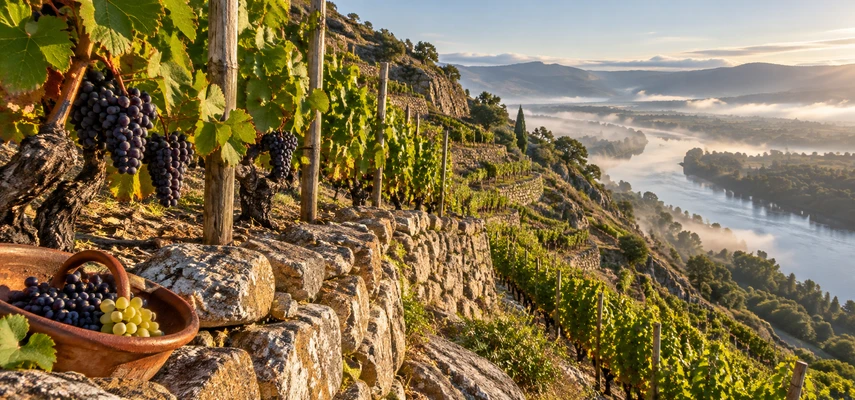

The Northern Rhône makes an unusually convincing argument for looking up from a wine list. Some vineyards climb slopes where moving a basket of grapes is serious work. Others occupy gentler ground nearby. Their wines may share Syrah, but they don’t share identical growing conditions, labour costs or ambitions.
The useful Diploma question isn’t whether a famous hillside makes “powerful wine.” Explain how exposure, water, crop management, extraction and maturation produce a particular balance. Then ask whether the actual wine is good, whether it should develop, and why a customer might pay its price. Those are related judgments, not one verdict repeated three times.
Use the riverbanks to organise the region
The Northern Rhône extends from the vineyards near Vienne toward Valence. Côte-Rôtie, Condrieu, Château-Grillet, Saint-Joseph, Cornas and Saint-Péray lie on the Rhône’s right-bank side; Hermitage and Crozes-Hermitage are on the left. Right and left follow the direction of river flow, rather than the side facing you in a photograph.
Conditions are broadly semi-continental, with Mediterranean influence becoming relevant, rather than uniformly Mediterranean. Temperature affects ripening speed and acid retention; sunlight and exposure influence sugar accumulation and the bunch environment. Well-exposed slopes can aid maturity in a difficult season, while heat and water shortage can create a different problem in a hot one.
Water availability depends on rainfall, rooting, soil depth and drainage. Nutrient availability influences vigour and the amount of growth the site can support. Granite is important, but the region isn’t one rock type: Hermitage’s regional profile describes varied soils within its celebrated hill. Geological diversity helps explain different growing conditions, not literal stone flavours poured into wine.
Explain why the slope costs money
Weather includes spring frost, damaging hail, rain around harvest and periods of heat or drought. Strong winds can dry vegetation and reduce persistent humidity, yet also damage shoots and increase water loss. Downy and powdery mildew still need monitoring; grey rot can threaten fruit condition, particularly as the harvest approaches.
Vineyard establishment involves slope stability, access, permitted varieties and suitable support systems. Planting materials should match the soil, water constraints and intended vigour. The Plantgrape Syrah profile notes fragile spring shoots and the need for careful support. Steep terraces and individual stakes aren’t just picturesque details: they affect how workers perform vineyard tasks.
Nutrient and water management should respond to vine condition within the applicable rules. Canopy management needs sufficient productive leaf area, controlled shading and appropriate bunch exposure. A breezy site may need secure shoots and protection from damage, while a hot exposed site may benefit from retaining some shade. Removing every leaf around a bunch isn’t an all-purpose improvement.
Harvest timing balances flavour, sugar, acidity, tannin and health against the forecast. Hazard management includes maintaining walls, controlling erosion and choosing practical frost precautions where suitable. Pest and disease management combines observation, canopy decisions and justified interventions. A costly hillside deserves careful farming, but expense alone cannot guarantee that the harvested fruit is excellent.
Treat Syrah as material, not a ready-made style
Syrah can provide dark fruit, violet, pepper and savoury characters alongside substantial colour and tannin. The proportions change with ripeness, site, vintage, fermentation and development. The AWRI’s rotundone research connects pepper character with a specific aroma compound and growing conditions. A pepper note isn’t a direct reading of the vineyard’s rocks, nor does its absence rule out Syrah.
Careful grape transportation preserves fruit condition and limits heating or premature juice release. Reception should sort damaged material and keep origins and intended cuvées separate. Processing decisions include destemming, crushing and any whole-bunch component. Stems can alter the fermenting mass, aroma and tannin; their use needs assessment against maturity and the intended result.
Alcoholic fermentation and cap management determine how material is extracted from the skins. Extraction and pressing should match the fruit: more heat, time or vigorous cap work can increase structure but also produce harshness. Separating press fractions preserves options for later blending. A deeply coloured sample isn’t automatically the best-balanced sample.
Malolactic conversion usually follows or accompanies the red-wine programme, changing malic acid into lactic acid. Maturation may use tank, large wood or smaller barrels, with different effects on texture, oxygen exposure and flavour. New oak can contribute spice and tannin, but can also overwhelm less concentrated fruit. No single barrel size explains an entire appellation.
Compare Côte-Rôtie, Hermitage and Cornas
Côte-Rôtie is a steep right-bank origin centred around Ampuis. Its Syrah reds may include Viognier under defined rules. That permission doesn’t mean every producer adds it or uses the maximum proportion. Co-fermenting grapes is also different from casually adding an unrelated finished white wine after the event.
Hermitage occupies a much smaller hill landscape than the broader Crozes-Hermitage area, despite their shared name. Red Hermitage centres on Syrah, with permitted Marsanne and Roussanne under the rules; white Hermitage uses those white varieties. Don’t describe Viognier as the standard white partner in every Northern Rhône red.
Cornas makes red wine from Syrah alone. Its sheltered, well-exposed slopes can help ripening, but neither warmth nor the name guarantees that every bottle is massive or needs decades. A younger, fruit-led Cornas and a structured selection may offer quite different drinking experiences.
These origins can supply concentrated, long-lived wines, yet a hierarchy of names cannot replace tasting. Compare tannin quality, fruit depth, integration and finish in the actual samples. If a prestigious wine seems coarse, consider youth and condition alongside the possibility that extraction was simply unsuccessful. Reputation shouldn’t prevent criticism.
Give Crozes and Saint-Joseph their variation
Crozes-Hermitage includes varied sites and makes both red and white wines. Its wider vineyard landscape supports different production costs and stylistic aims from the Hermitage hill. That doesn’t justify treating every Crozes as a simple early-drinking wine or every Hermitage as outstanding.
Saint-Joseph extends along a substantial stretch of the right bank. Syrah reds and Marsanne–Roussanne whites therefore come from varied exposures and growing conditions. Producer and site information can be particularly useful when interpreting a broad appellation name.
An original comparison might put a fresh Crozes beside a firmer Saint-Joseph, then repeat the exercise with different producers. If the result reverses, the lesson hasn’t failed. It demonstrates why sensible regional expectations need testing against fruit, farming and cellar decisions. Avoid learning a price ladder as if it were a reliable sensory measurement.
Understand Viognier’s narrow balancing act
Condrieu is a white-wine appellation associated with Viognier; Château-Grillet is a separate small Viognier origin within the wider geographical setting. Apricot, peach and floral impressions can sit alongside a broad texture and considerable alcohol. Rich aroma doesn’t prove residual sugar.
The Plantgrape Viognier profile identifies early budburst and substantial sugar accumulation, with acidity a potential limitation. Harvest needs to capture flavour while maintaining balance. Picking earlier can sacrifice the desired aromatic character; waiting longer may increase alcohol potential or reduce freshness. “As ripe as possible” is therefore a poor substitute for an intended style.
White-wine processing generally centres on pressing, with skin contact and extraction chosen deliberately. Pre-fermentation clarification adjusts juice solids for the desired fermentation. Must adjustments require analysis and legal permission, with the exact appellation and wine determining what is allowed. Tank or barrel fermentation, lees work and malolactic decisions can change texture and acidity in different ways.
Marsanne and Roussanne provide another white-wine comparison, including in Hermitage, Crozes-Hermitage and Saint-Joseph. Saint-Péray also makes still and traditional-method sparkling whites from these varieties. Don’t turn “Northern Rhône white” into a synonym for Viognier or overlook a wine because it lacks Condrieu’s perfume.
Finish the wine for its actual journey
Blending eligible parcels, varieties or fractions can improve balance and consistency, but origin rules constrain the available options. Post-fermentation clarification removes unwanted suspended material. Stabilisation considers tartrate, protein and microbial risks as appropriate; treating them as one operation can leave a problem unresolved.
Finishing adjustments, sulfur dioxide and filtration should suit analysis, style and destination. Packaging and closures should protect either youthful aroma or the intended development period. Wine transportation needs sensible temperature and handling conditions. A structured red still suffers from heat damage, and a delicate white doesn’t become immune to oxidation because its label is expensive.
Read the legal claim before the sales story
International and EU protection frameworks operate alongside national French law and local specifications. A geographical indication ties a name to defined origin and conditions; the AOC/AOP wines discussed here sit within PDO. Industry associations such as Inter Rhône provide information and promotion, while INAO and producer organisations have distinct regulatory roles.
Collines Rhodaniennes IGP illustrates the PGI category, with its own geographical and production conditions and several colours and varieties. It isn’t an automatic label for any rejected Condrieu or Côte-Rôtie lot. Wines without a geographical indication, including eligible Vin de France, follow another framework and cannot retain a protected cru identity without qualifying.
Labelling terms also need context: a named parcel, an appellation and a producer’s cuvée name make different claims. Verify actual permitted wording rather than assuming an impressive phrase creates an official rank. Legislation affects destination-market labelling and sales as well as production. Price and law may interact, but legal compliance doesn’t establish sensory quality.
Trace the cost and the customer
Supply varies with harvested volume, usable fruit and permitted production. Demand depends on reputation, producer recognition, drinking occasion and competing wines. Costs can include terrace maintenance, hand labour, difficult access, low yields, barrels and time holding stock. A steep site can explain a high cost without proving that consumers will pay enough to cover it.
Currency exchange can change an importer’s landed cost without altering wine quality. Importing also adds freight, compliance and intermediary margins. Retail needs a clear proposition at the intended price; HoReCa buyers consider food, staff knowledge and inventory turnover. Direct-to-consumer sales can retain more of the bottle price but require visitors, service and fulfilment. Mature and emerging markets contain different customers and channels rather than one national taste.
A grower may sell grapes, while an estate coordinates vineyards and production. A merchant can source wine or fruit, and a broker connects trading parties without necessarily owning the stock. A winery provides processing capacity. A virtual winery manages a brand through contracts, while a custom crush facility supplies agreed production services. These models help identify responsibilities, not a claim that every model is equally widespread here.
A cooperative pools member resources; Cave de Tain’s own account supplies a local example. A conglomerate may coordinate several businesses and channels, with different scale advantages and management demands from an individual estate. Ask who owns inventory, decides quality standards and bears unsold-stock risk.
Wine brands may lead with a producer, a merchant or a specific origin. Marketing concepts begin with a target customer and a credible benefit. Marketing options include comparative tastings, visits, restaurant education and digital information. The five Ps connect product, price, place, people and promotion. A buyer seeking fragrant Viognier and one seeking mature Syrah need different explanations, even when the bottles share a regional display.
Compare the evidence here with the southern Rhône and southern France as a regional case, then apply the regional comparison framework to the comparison. Compare growing conditions, production decisions, style, quality and the commercial reasons for price. Establish the differences rather than assuming that one familiar name must be better.
Original Diploma practice
These original exercises and indicative points are study material, not official WSET questions or marking allocations.
Question 1: evaluate a steep-slope investment
A fictional grower proposes replacing a gentler parcel with a steep terrace because the nearby wines sell for more. Evaluate the vineyard and business implications.
Indicative points: exposure, water, access, support, labour, usable yield and demand.
Outline answer: The slope may improve exposure but changes water availability, erosion risk, access and support requirements. Maintenance and harvesting can increase costs. Assess fruit potential and likely saleable volume, then compare achievable price and distribution costs. A famous neighbour supplies a reason to investigate, not proof that the investment is profitable or the fruit superior.
Question 2: compare red-wine extraction
Two Syrah lots have different fruit concentration and tannin maturity. Evaluate the proposal to give both the same long, vigorous extraction and new-oak maturation.
Indicative points: fruit quality, extraction, fractions, vessel, integration and intended drinking window.
Outline answer: More concentrated, suitably mature fruit may support a structured programme, while the other lot risks harshness and oak dominance. Adjust maceration, cap work and fraction selection to the material. Choose maturation for integration and desired development. Similar colour or variety doesn’t establish identical needs, and forceful handling cannot replace ripe fruit.
Question 3: evaluate a Viognier harvest
A fictional producer delays picking Viognier solely to maximise sugar. Evaluate that decision for a balanced dry white.
Indicative points: aroma, acidity, alcohol potential, health, weather and cellar limits.
Outline answer: Consider flavour maturity alongside acidity and potential alcohol, with close attention to fruit health and the forecast. Waiting may develop aroma but also increase weight or reduce freshness. Cellar adjustments are constrained and cannot reliably repair an unsuitable harvest balance. A dry wine with powerful perfume can still be heavy or hot.
Analytical tasting preparation: compare youth and development
The official Diploma specification, PDF page 25, recommends essential Northern Rhône samples of very good or outstanding Condrieu; good or very good Crozes-Hermitage or Saint-Joseph; youthful very good or outstanding Côte-Rôtie, Hermitage or Cornas; and Côte-Rôtie, Hermitage or Cornas with noticeable tertiary character. A very good Marsanne, Roussanne or white blend is optional.
These are proposed study selections, not wines tasted for this article, official bottle grades or examination predictions. Select sound samples and compare youth with development, ideally controlling producer or origin where practical. Write full systematic descriptions blind before revealing identities, including fruit, aroma, acidity, tannin where relevant, alcohol, body, texture and finish.
Justify quality through balance, concentration, complexity and desirable persistence. Assess bottle-ageing suitability separately through remaining fruit, structural integration and existing development. A tertiary wine may offer excellent drinking without further improvement; a tannic young red still needs enough fruit to develop positively. Don’t reward a white for imitating red structure, or let a prestigious label erase an observed imbalance.












