










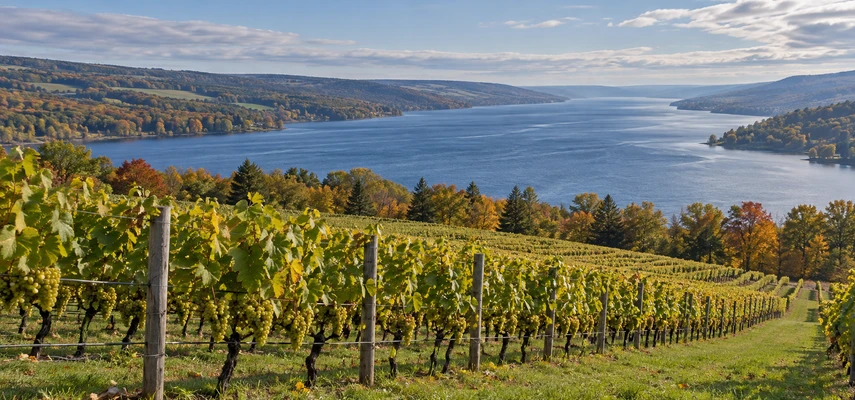

New York State wines come from rather different places than the skyline might suggest. For Diploma study, the important water is usually a deep lake, an ocean inlet or a river beside a vineyard. Those bodies of water help explain where grapes can ripen, how vines survive winter and why a supposedly simple cool-climate description still needs a site attached.
Finger Lakes Riesling is a useful starting point. Long Island’s maritime setting offers a different comparison, with Merlot, Cabernet Franc and Chardonnay among its references. Neither region supplies a single compulsory flavour, and a lake view isn’t a frost-protection policy on its own.
Put Finger Lakes and Long Island in different settings
Finger Lakes lies in west-central New York, with long glacial lakes and vineyards on surrounding slopes. Long Island extends east into Atlantic influence, including Long Island Sound and the waters around its eastern forks. The contrast is between a relatively continental inland setting moderated locally by lakes and a more maritime setting, rather than two interchangeable versions of cold.
The New York Foundation’s regional material also places Lake Erie, Niagara Escarpment, Hudson River Region and more northerly growing areas in the state picture. Don’t confuse New York’s Niagara references with Ontario’s Niagara Peninsula across the international boundary. Wine-region names, state borders and individual AVAs need separate reading.
Finger Lakes includes the Seneca Lake and Cayuga Lake AVAs; Long Island includes North Fork of Long Island and The Hamptons, Long Island. The TTB’s established-AVA inventory is the appropriate check for recognised names and nesting. A narrower origin identifies a growing area under conditions, not an automatic quality rung.
Explain lake moderation without promising immunity
The Finger Lakes Wine Alliance describes the importance of deep water and surrounding slopes. Water warms and cools more slowly than land. Cooler water can delay spring development, while stored warmth can moderate nearby autumn and winter temperatures. The strength of the effect changes with the site, distance, exposure and season.
Cold air can drain down slopes, making relative position important during suitable frost conditions. A low pocket that traps cold air can behave differently from a nearby midslope parcel. Aspect changes solar exposure and ripening opportunity. These mechanisms explain why two vineyards overlooking the same lake can need different crop, canopy and harvest decisions.
Glacial deposits, shale, limestone and other materials contribute to varied soils. Drainage, rooting depth and water storage matter to the vine; a geological term doesn’t guarantee a matching flavour. The Alliance’s promotional latitude comparisons and blanket claims about complex wines shouldn’t replace a measured site explanation or an actual tasting conclusion.
Contrast Long Island’s maritime possibilities
The Foundation’s Long Island account explains ocean moderation and the different exposures of the North Fork and Hamptons. A milder winter and extended autumn can support grapes that need a different ripening opportunity from a marginal inland parcel. Merlot, Cabernet Franc, Chardonnay and Sauvignon Blanc broaden the discussion beyond Finger Lakes Riesling.
The more exposed southern fork and the North Fork don’t have identical soils or shelter. Sandy and other well-drained materials can help with soil water, while coastal wind and autumn storms bring their own risks. Better soil drainage doesn’t prevent rain from wetting leaves or bunches, so the claim that drainage removes concern about mould needs particular caution.
Maritime influence reduces some temperature extremes; it doesn’t guarantee freedom from winter injury, frost or rot in every year. The correct comparison identifies the actual site, grape and season. It also leaves room for variation in ripeness, extraction and maturation rather than making every Long Island red a miniature copy of Bordeaux.
Match grapes to a demanding growing season
Riesling offers aromatic expression, retained acidity and a range of dry to sweet styles. Cabernet Franc and Chardonnay provide further vinifera references, while native-derived and hybrid grapes are also part of New York production. The Foundation’s grape overview records that breadth. Different cold tolerance and ripening needs make grape choice a practical decision, not simply a prestige contest between categories.
Temperature affects growth, ripening and acid retention. Sunlight supports photosynthesis, while aspect and exposure change bunch temperature. Water availability depends on rainfall, soil storage, rooting and any irrigation arrangements. Nutrient availability influences vigour and crop balance. A humid region can still experience water stress on a shallow or freely draining site during a dry period.
Weather creates frost, hail, heat, drought and harvest-rain risks. Downy and powdery mildew and bunch rot remain possible where conditions allow. Vineyard establishment considers exposure, drainage, access, slope and training. Planting materials should match variety, clone, rootstock, soil and water conditions. Cornell’s site-selection guidance stresses the interaction between regional climate and local topography before planting.
Nutrient and water management follows observation and analysis within applicable rules. Canopy management balances productive leaf area, airflow and fruit protection. Harvest timing balances flavour, sugar, acidity, phenolic maturity and health. Hazard management includes erosion control, appropriate frost precautions and access planning. Pest and disease management combines monitoring, canopy work and proportionate intervention.
Winter protection needs particular care. Cornell’s grape bud-hardiness resource compares modelled hardiness with actual temperatures to estimate injury potential. It isn’t a guarantee that every bud in a mapped vineyard has survived. Checking actual damage can inform pruning and crop expectations; a single universal temperature threshold misses variety and acclimation differences.
Build the intended Riesling rather than assuming sweetness
Winemaking approaches begin with the target style. Careful grape transportation limits crushing, oxidation and unwanted fermentation. Reception should separate origins, varieties, health and ripeness. Processing and pressing affect yield and phenolic pickup. A producer aiming for precise aromatic Riesling needs careful handling even when cool outdoor weather seems helpful.
Pre-fermentation clarification adjusts white-juice solids for the intended fermentation. Must adjustments require analysis and legal permission. Alcoholic fermentation decisions include yeast, temperature, vessel and nutrient management. Riesling can be dry or retain sugar, with sweetness judged alongside acidity, flavour and overall balance. Neither the variety nor the region tells a customer the exact sweetness without checking the wine.
Malolactic conversion and subsequent maturation should fit acidity, texture and microbial stability. A fresh Riesling programme may preserve acidity and aroma differently from a barrel-fermented Chardonnay. Lees maturation can build texture, with oxygen and microbiological condition monitored. Wood maturation involves vessel age, size, toast and time. The right amount can be none for one lot and a carefully chosen programme for another.
Extraction and pressing should suit skin and seed maturity. For Cabernet Franc or Merlot, more colour or more new oak can’t repair unsuitable fruit. Blending eligible lots can improve balance while preserving origin and category entitlement. Decisions should support the intended structure and drinking period, with development and condition assessed on their own evidence.
Finishing adjustments, sulfur dioxide and filtration depend on analysis and stability needs. Post-fermentation clarification removes unwanted material; stabilisation considers protein and tartrate risks. Microbiological safeguards should fit analysis, retained sugar and distribution. Packaging and closures should protect the intended drinking period. Wine transportation requires suitable temperature management, including warehouses and final delivery. A sweet aromatic wine needs a distribution plan as well as a successful fermentation stop.
Read the origin claim before inferring quality
Federal AVA origin conditions generally require at least 85% from the named AVA, alongside further requirements described in the TTB’s appellation guidance. Variety and vintage are separate claims. A New York address on a winery label doesn’t by itself establish that every grape came from a particular lake’s slopes.
International recognition and trade rules, national US law, New York requirements and local controls interact. Industry associations and regional bodies promote and represent producers, while authorised agencies establish legal entitlement. A geographical indication communicates origin under conditions; PDO and PGI are EU frameworks rather than classifications automatically assigned to New York AVAs. Wines without a specific GI claim still face applicable production and labelling rules. Reserve, estate-related wording and sustainability expressions need their actual conditions rather than an automatic tasting grade.
Link vintage risks with business decisions
Supply depends on healthy fruit, weather losses, contracts and stocks held for maturation. Demand differs between accessible regional wines, dry or sweeter Riesling and selected-site reds. Costs include vineyard labour, drainage, disease work, replacement vines, sorting, temperature control, vessels, storage, insurance and finance. Legislation affects sourcing, claims and distribution; currency exchange changes export returns. A crop damaged in winter changes both cellar capacity and expected revenue.
The Foundation’s 2025 vineyard-report overview explains acreage and grower reporting. Read the survey year, covered grape categories and measurement before using a number. Total state grape acreage isn’t automatically vinifera wine acreage, and a vineyard inventory isn’t a bottle-sales forecast. The article’s regional comparisons don’t require an undated winery count to remain useful.
A grower may supply fruit, while an estate can coordinate vineyard and cellar decisions. A broker connects parties; a merchant sources wine or grapes; a winery provides production capacity. A virtual winery contracts production, and a custom crush facility supplies agreed services. A cooperative can share equipment and market access; a conglomerate may coordinate businesses. These are possible functions, not equal-prevalence claims. Fruit contracts should address variety, health, maturity, origin evidence, delivery and payment.
Importing into another market adds freight, compliance and currency exposure. Retail needs clear origin, style and price information; HoReCa buyers require service training. Direct-to-consumer sales can retain revenue but add hospitality, customer acquisition and fulfilment costs. Mature and emerging markets contain varied customers. Access to visitors and nearby cities can help sales, but it doesn’t remove staffing costs or the need for repeat customers.
Wine brands can lead with producer, grape, vineyard or AVA. Marketing concepts begin with a target customer; marketing options include comparative flights, technical notes and vineyard visits. The five Ps connect product, price, people, place and promotion. For Riesling, explaining sweetness clearly can be more useful than another vague promise of cool-climate elegance.
Compare the evidence here with Ontario as a regional case, then apply the regional comparison framework to the comparison. Compare growing conditions, production decisions, style, quality and the commercial reasons for price. Establish the differences rather than assuming that one familiar name must be better.
Original Diploma practice
These original exercises practise explanation and evaluation. They aren’t official examination questions, marking schemes or accounts of actual bottles tasted.
Question 1: compare two New York vineyard settings
Compare a Finger Lakes Riesling site with a Long Island Merlot site, explaining what water moderation changes and what risks remain.
Reasoned outline: Establish continental versus maritime influence, proximity to water, slope, aspect, soil and drainage. Connect variety, season, winter risk, canopy and harvest with intended wine style. Include disease pressure, costs and actual fruit condition. Nearby water moderates a site without making every vineyard risk disappear.
Question 2: assess a Riesling quality shortcut
A buyer dismisses a Finger Lakes Riesling with residual sugar as lower quality than a dry wine. Evaluate the claim.
Reasoned outline: Assess actual sweetness against acidity, fruit, length, complexity and condition. Discuss the intended style, fermentation choices and microbial stability. Compare quality and drinking suitability separately. Sugar level alone doesn’t determine the quality conclusion.
Question 3: evaluate a winter-loss supply plan
A winery plans to replace lost estate fruit with purchased grapes while retaining the same vineyard-origin marketing. Evaluate the proposal.
Reasoned outline: Check exact source, variety, quality, contract, label entitlement and truthful claims. Consider price, delivery, cellar adjustments, reduced volume and customer communication. An operational replacement doesn’t automatically preserve an origin claim.
Analytical tasting preparation: select a New York comparison
The official recommended-sample programme, printed page 23, lists a New York red or white varietal wine or blend at very good quality as an optional selection. It doesn’t make Finger Lakes Riesling or a separate Long Island red compulsory. Those can be useful author-proposed comparisons when suitable bottles are available.
Write full systematic descriptions blind. Justify quality through balance, length, intensity and complexity using actual fruit, structure and development evidence. Assess bottle-ageing suitability separately, considering retained fruit, integration and intended style rather than acidity or regional reputation alone. These are proposed selections and methods, not actual tasting results or predetermined official bottle grades.











