










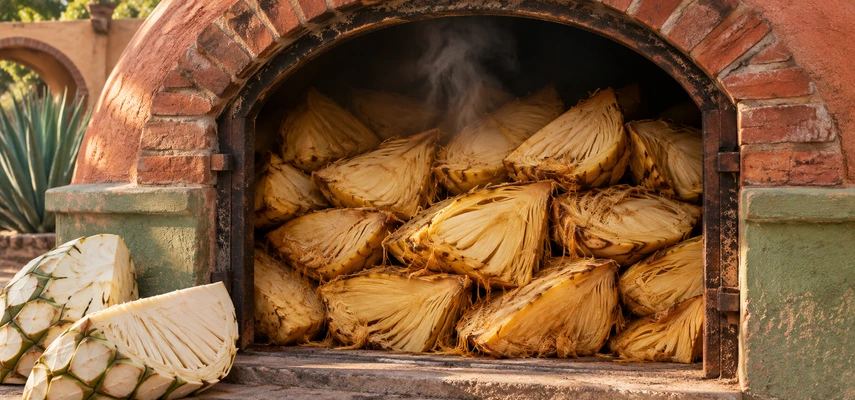

Agave spirits begin with a substantial piece of plant engineering. Inside the trimmed heart is stored carbohydrate, much of it in the form of fructans. That material represents potential alcohol, but ordinary distilling yeast cannot simply treat the whole heart as a tank of ready-to-ferment sugar. The producer first has to make useful sugars accessible.
This is why growing, cooking and crushing deserve separate attention. Growing establishes the material available at harvest. Hydrolysis changes carbohydrate bonds. Crushing and extraction move useful material out of the fibrous structure. Traditional and modern systems can arrange those operations differently, so learning their jobs is more useful than memorizing one supposedly universal sequence.
Agave spirits start with a mature plant
Agave is not a cactus, despite its spiky appearance. The plants used for spirits have a rosette of leaves around a substantial central structure. Species, variety, site, growing conditions and harvest decisions all affect the raw material. Tequila’s specified blue-agave identity and mezcal’s broader species discussion are explored in the following lessons.
Unlike an annual cereal crop, a spirit agave develops over several years. The useful harvest point varies with the plant and circumstances. An age range reported for one producer’s blue agave should not become a compulsory schedule for every agave species. Readiness concerns suitable reserves and condition, rather than simply reaching a birthday.
That long growing period makes raw-material planning consequential. A distillery cannot create a new mature crop in a few weeks because demand increased. Decisions about planting, selection and harvest influence future supply as well as today’s load at the oven. Agricultural time is part of the process, even when the bottle concentrates on a short distillation story.
Harvesting selects and trims the heart
Skilled harvesters remove the long leaves to expose the piña, named for its pineapple-like appearance. It is an agave heart, not a pineapple fruit. Trimming changes the proportion of leaf-base and central material delivered for processing, while selection determines which plants enter the production system.
Patrón’s harvesting account describes attention to readiness, condition and trimming. Its exact acceptance criteria belong to its own operation. The broader principle is to assess useful carbohydrate and material quality rather than assuming the heaviest heart is necessarily the most suitable.
After harvest, handling still matters. A well-grown plant can be damaged or poorly stored, and unevenly prepared pieces can behave differently during heating and extraction. The objective is consistent, suitable feed for the next operation. Harvesting does not finish the quality work; it hands the raw material to another set of controls.
Fructans are a carbohydrate reserve
Fructans are carbohydrates built largely from linked fructose units, with structures that can include branching and other details. They are not identical to cereal starch, whose main building units are glucose. Both can represent stored plant energy, but their different bonds and structures require different conversion approaches.
This distinction is more than vocabulary. A cereal enzyme preparation selected to break starch cannot be assumed to hydrolyse agave fructans effectively. The substrate and the agent acting on it must be compatible. Saying that both are complex carbohydrates does not make every conversion tool interchangeable.
Agave also contains other material, including some simpler sugars. It is therefore more accurate to discuss the important fructan-conversion requirement than to claim every carbohydrate in every raw heart is completely unavailable. The practical aim is to release a suitable fermentable medium from the actual composition of the harvested plant.
Hydrolysis changes bonds; extraction changes location
Hydrolysis breaks suitable bonds using water in the chemical transformation. In an appropriate process, fructans are broken into smaller carbohydrates, including usable simple sugars. Traditional agave cooking provides conditions for acid-thermal hydrolysis. The resulting material can supply yeast fermentation more effectively than an untreated reserve of long carbohydrates.
Primary research on agave fructan hydrolysis also demonstrates enzyme-based conversion under studied conditions. That establishes another possible route; it does not mean a distiller can choose any enzyme, temperature or time without matching the process. Laboratory results explain a mechanism rather than supply one universal commercial recipe.
Extraction, by comparison, moves soluble material from the plant into liquid. An extraction system can recover carbohydrates without completing their hydrolysis at that moment. Conversely, well-converted sugars still need effective recovery from the fibrous mass. Separating these two jobs is the key to understanding ovens, mills and diffusers without confusing them.
Pit ovens combine heat with a particular environment
In a traditional pit approach, heated stones and the covered cooking environment transfer heat into the agave. Fuel, arrangement, covering, moisture and time influence the treatment. The producer needs appropriate conversion through the material, not merely a dark exterior that looks convincingly roasted.
Contact with products of combustion can contribute smoke-related character in suitable systems. That helps explain associations with many pit-cooked mezcals, but it does not mean every agave spirit must be smoky. Smoke intensity and carbohydrate conversion are different results of the broader operation, with different influences on their extent.
For an explanatory answer, follow heat into the plant and hydrolysis into usable sugars. Then discuss any additional aroma contribution from the particular cooking environment. Do not use smoke as a substitute explanation for why fermentation becomes possible. The yeast needs usable substrate, not evidence that a fire once burned nearby.
Brick ovens often use steam
Masonry ovens provide another cooking environment, commonly using steam rather than burying hearts directly over hot stones. Heat penetrates the stacked material while hydrolysis proceeds under suitable conditions. Loading, piece size, temperature distribution and time affect whether the batch receives an appropriate treatment.
Patrón’s cooking description gives one producer’s example of steaming and resting cycles. Such a schedule belongs to the equipment and target concerned. The useful principle is controlled heat treatment throughout the load, rather than a rule that every brick oven must run for the same number of hours.
Cooking also changes aroma-related material. A producer may seek cooked-agave character while managing excessive thermal degradation or unwanted burnt notes. Conversion yield and sensory outcome are connected objectives, but neither can be judged fully from the oven’s name. An uneven or poorly controlled traditional process is not improved by its historical pedigree alone.
Autoclaves change the heat-treatment options
An autoclave uses a pressurized cooking environment, permitting different heat-transfer and operating conditions from an open-pressure oven. It can shorten or reorganize processing while still needing to achieve suitable conversion. Pressure is a control variable, not an ingredient that makes the carbohydrate ferment spontaneously.
The sensory consequences depend on the treatment actually applied. Faster operation may alter thermal history, but modern equipment does not establish poor quality by definition. Equally, technical efficiency does not prove that every aroma objective has been achieved. Compare conversion, retained character and process control using the actual system.
This gives a balanced production comparison. A producer chooses equipment for capacity, energy, consistency and style objectives, then manages its limitations. A useful answer explains the available controls and possible consequences. It does not award automatic quality points to the oldest-looking building or the newest stainless-steel vessel.
Crushing opens the cooked structure
Hand methods, a tahona and roller mills offer different ways of disrupting agave fibre and recovering sugar-bearing liquid. A tahona’s heavy stone wheel crushes material; a roller system subjects it to another mechanical arrangement. These operations change physical access and recovery. Neither is alcoholic fermentation.
Patrón’s milling account describes its use of tahona and roller routes. The relevant contrast involves physical treatment, throughput and the material carried onward, including the potential use of fibre in later processing. Do not reduce the comparison to a claim that stone itself supplies all desirable flavor.
Water can assist the recovery of soluble material, while the chosen separation determines how much fibre accompanies the liquid. A producer planning fermentation with solids faces different handling conditions from one working with a more separated juice. Milling therefore connects both to extraction performance and the nature of the fermentation medium.
Diffusers reveal why sequence matters
A diffuser uses liquid contact with prepared agave material to extract soluble carbohydrates efficiently. Some systems work with cooked material, while other arrangements extract from raw prepared agave and complete hydrolysis separately. The word diffuser alone does not specify every preceding or following operation.
Research on enzymatic hydrolysis in tequila production explored extraction and conversion in a countercurrent system. Its value here is conceptual: physical recovery and carbohydrate breakdown can be coordinated in arrangements other than cook whole hearts, then crush. The producer still needs both useful extraction and appropriate conversion before conventional fermentation.
Assess the resulting medium rather than assuming a high extraction percentage proves higher sensory quality. Recovery measures one aspect of performance. Fermentability, composition, handling and the desired aroma profile matter too. A more complete answer recognizes that efficiency and style are related production considerations, not synonyms.
Prepare the medium for yeast
After conversion and extraction, the producer has sugar-bearing material rather than finished spirit. Concentration, temperature, nutrition, acidity and the presence of solids influence fermentation conditions. Yeast then makes ethanol and additional compounds, which later separation and development can retain or change. Cooking has supplied opportunities, not completed the bottle.
If a fermentation performs poorly, trace the chain backward. Was the plant suitable? Was conversion adequate? Were usable sugars recovered effectively? Are the yeast conditions appropriate? Several different upstream problems can produce a disappointing alcohol yield. Diagnosing the relevant stage is more useful than blaming the oven or yeast in every case.
What to remember
Separate growing and harvesting, fructan hydrolysis, physical extraction and alcoholic fermentation. Compare pit ovens, masonry steam ovens, autoclaves, mills and diffusers by the jobs they perform and the conditions they create. Then connect those choices to usable substrate and plausible sensory consequences. The agave heart contains potential; the process determines how intelligently that potential is used.
Written practice: original TFE exercises
These suggested marks and indicative points are independent teaching guidance, not official WSET marking schemes.
Exercise 1: 5 suggested marks
Explain why hydrolysis is important when preparing agave for conventional yeast fermentation. Mapping: LO2 explain: fructans and hydrolysis.
Indicative marking points:
- Agave stores important carbohydrate as fructans.
- These contain linked sugar units.
- Ordinary distilling yeast cannot simply use all intact fructans as readily fermentable sugar.
- Suitable hydrolysis releases smaller usable carbohydrates.
- Those sugars can then support yeast alcohol production.
Model answer: Important agave carbohydrate is stored as fructans containing linked sugar units. Ordinary distilling yeast cannot simply treat all intact fructans as readily fermentable substrate. Suitable hydrolysis releases smaller usable carbohydrates, which can then support yeast production of alcohol and other fermentation products.
Why it works: It connects the reserve structure with the substrate limitation and the purpose of conversion.
Common mistake: Saying cooking itself makes ethanol skips the later biological fermentation.
Exercise 2: 5 suggested marks
Explain why high carbohydrate extraction alone does not prove that an agave medium is ready for fermentation. Mapping: LO2 explain: extraction and conversion.
Indicative marking points:
- Extraction transfers soluble material into liquid.
- That material can include carbohydrates still requiring conversion.
- Hydrolysis changes suitable bonds rather than merely location.
- Usable sugars must be available for the selected yeast.
- The prepared medium also needs suitable working conditions such as concentration and temperature.
Model answer: Extraction transfers soluble material into liquid, but some recovered carbohydrates may still require hydrolysis. Conversion changes suitable bonds to make usable sugars available; it does not follow automatically from efficient recovery. The resulting medium also needs suitable concentration, temperature and other conditions for the yeast.
Why it works: The answer distinguishes physical recovery, chemical conversion and the organism’s working environment.
Common mistake: Equating a high extraction yield with complete fermentability confuses two different measurements.
Knowledge check: 10 original practice questions
Independent TFE questions, not official WSET examination items. Choose one answer per question; explanations follow separately.
1. What is the piña in agave-spirit production?
2. Which building unit is central to agave fructans?
3. Why might pit cooking contribute smoke character?
4. What does a tahona primarily do?
5. What changes with an autoclave?
6. What is a common role of steam in a masonry oven?
7. What does the word diffuser alone fail to specify?
8. Why can a cereal amylase not simply be assumed suitable for agave fructans?
9. Which is the best test of a harvest-age claim?
10. What is the most useful distinction between hydrolysis and extraction?
Answers and explanations
- C — The trimmed agave heart. The name refers to appearance rather than a separate pineapple raw material. Mapping: LO2.
- D — Fructose. Fructans differ from glucose-based cereal starch and require suitable conversion tools. Mapping: LO2.
- D — The cooking environment can expose material to combustion products. Smoke contribution is distinct from the heat-supported conversion needed for usable sugars. Mapping: LO2.
- B — Mechanically crushes agave material. Physical disruption and recovery are different from biological fermentation. Mapping: LO2.
- B — The pressurized heat-treatment conditions. Pressure creates operating options, but conversion and sensory targets still require control. Mapping: LO2.
- B — Heat transfer for suitable cooking and hydrolysis. Heat treatment prepares the plant material for subsequent processing; yeast makes alcohol later. Mapping: LO2.
- C — The entire extraction and hydrolysis sequence. Systems can use different feed histories and conversion arrangements. Mapping: LO2.
- D — The substrate bonds and enzyme specificity differ. A conversion agent must suit the substrate rather than merely being called an enzyme. Mapping: LO2.
- C — Whether it fits the actual plant and conditions. Maturity and suitability vary; a reported age range is not universal across agaves. Mapping: LO2.
- C — Breaking suitable bonds versus moving soluble material into liquid. The operations solve different problems and may be arranged in different sequences. Mapping: LO2.
Continue exploring this series
2. Carbohydrates Explained: How Sugar, Starch, and Fructans Become Fermentable
3. Alcoholic Fermentation Explained: Yeast, Nutrients, and Flavor Compounds
8. How Distillers Manage Flavor: Sulfur, Esterification, Pressure, and Distillation Choices
11. How Grains Become Whisky: Malting, Mashing, Enzymes, and Starch Conversion
24. Tequila Explained: Agave, Production Choices, and Legal Categories
25. Mezcal Explained: Agave Varieties, Traditional Methods, and Quality
35. Other American Whiskeys Explained: Wheat, Malt, Corn, and Labeling Terms
22. Caribbean Rum Explained: Distillation, Regional Traditions, and Quality
50. WSET Level 3 Spirits Exam: Complete Revision Guide and Practice Examinations












