










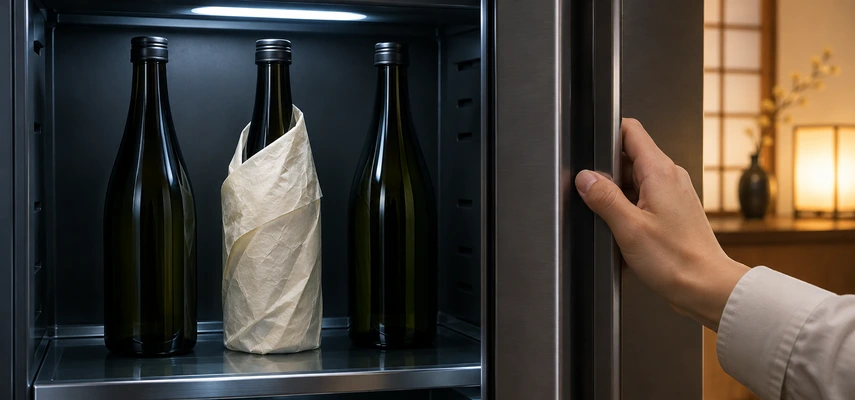

Sake storage is part of preserving the brewer’s intended result. A delicate aromatic bottle, an unpasteurized product and a deliberately matured koshu don’t necessarily need the same plan, but all benefit from appropriate handling. Heat, light, oxygen and time can change the liquid, and those changes are not interchangeable explanations.
For Level 3, connect the condition with the mechanism and consequence. Don’t merely write store properly and list five fault names. Explain why a sensitive bottle needs refrigeration, why a bright display is a problem and why resealing matters after opening. Then distinguish actual observations from an unsupported diagnosis of the cause.
Sake storage begins with the product instructions
The NRIB storage guide identifies temperature, light and oxygen as important influences and explicitly allows for product variation. Read the producer’s instructions first. A general recommendation is useful when details are missing, but it shouldn’t overrule a specific requirement on the actual bottle.
Check heat history and intended expression. Nama has not received pasteurization, while a delicate ginjo may be particularly sensitive to loss of its desired aroma. A matured style can have a different sensory target without becoming immune to poor conditions. No category name grants protection from every possible change.
Storage temperature also isn’t serving temperature. A bottle kept cold can be warmed appropriately for immediate service. That does not justify storing it beside a heater for weeks. The duration and purpose of the exposure are different, even when the final glass is enjoyed warm.
Keep the temperature suitably low
WSET’s storage advice recommends cool conditions below 12°C and ideally refrigeration below 8°C. The NRIB guide gives more specific cold guidance for sensitive nama, sparkling and ginjo styles at 4°C or lower. Treat these as general and product-sensitive recommendations, with the producer’s requirement taking priority.
Lower temperature slows many changes, helping retain an intended youthful expression. It does not reverse damage already sustained, remove microorganisms by itself or guarantee an unlimited life. A cold bottle can still be old, poorly handled earlier or unsuitable for the desired service.
Avoid repeated unnecessary warming and cooling during display and service. Plan stock rotation and bring out only what is needed. In a professional setting, the useful question is whether the whole route from delivery to the guest protects the product, not whether a refrigerator exists somewhere in the building.
Protect against light independently of temperature
A chilled bottle in a bright window is still exposed to light. Light can alter aroma, taste and color, so refrigeration and light protection answer different problems. Dark glass helps reduce transmission but isn’t a reason to display the bottle under strong illumination indefinitely.
Keep stock away from direct sunlight and unsuitable bright artificial light. A protective carton or paper wrap can help where appropriate. The JSS preservation account reinforces the importance of protecting the intended expression through storage.
For an explanation, identify the exposure rather than blaming age alone. Two equally old bottles can differ because one was well protected and another sat under damaging conditions. A date is useful information, but it does not record the whole storage history.
Reduce avoidable oxygen exposure after opening
Reseal the bottle tightly and return it to suitable storage after service. Store upright, which also limits prolonged contact with the closure. Sake does not require the same sideways cork-storage practice sometimes associated with wine bottles.
Oxygen exposure can contribute to loss of freshness and changes in color and balance. The effect depends on the product, remaining volume, closure and conditions. Don’t assume a bottle is unchanged simply because it is pasteurized; heat treatment does not stop every chemical route to development.
Use producer guidance and assess condition after opening rather than inventing one universal expiry period. Published general advice varies because products and expectations differ. A professional should track opening dates and stock use, while recognizing that a calendar rule cannot replace checking the actual sake.
Oxidation describes a route to change
Oxidation can accompany loss of fresh aromas, deeper color and an increasingly tired or unbalanced expression. The relevant problem is the departure from the intended result, not the mere existence of any yellow hue. A clear pale-yellow sake can be entirely sound.
Temperature and time can influence the rate of change, so oxygen isn’t always the only variable. In a service scenario, explain the combined storage factors supported by the evidence. Avoid presenting a single sniff as a complete chemical analysis of the bottle.
If the product seems out of condition, compare with a sound reference where feasible and check its history. Don’t attempt to solve an uncertain fault by inventing a production story. Record the actual appearance and aromas first, then decide what further evidence supports the proposed explanation.
Hine is not identical to desirable maturity
Hine or hine-ka refers to unwanted aged character in the relevant context. Sulfurous, stale or cooked-vegetable impressions can be involved. The NRIB explanation of sake aroma distinguishes compounds associated with unwanted aged aroma, notably dimethyl trisulfide, from aspects of attractive mature aroma.
This distinction prevents a common error: declaring every caramel or nutty note faulty. A deliberately matured sake can show such development as part of a balanced expression. Its quality depends on integration, attractive persistence and other sensory evidence, not on retaining the exact profile of a youthful ginjo.
Equally, calling a damaged young sake koshu does not repair its condition. Intention, product information and the actual sensory result matter. Neither a flattering label nor a blanket fear of aging is a substitute for assessment.
Nama-hine concerns deterioration in unpasteurized sake
Nama retains active enzymes because it hasn’t undergone pasteurization. Continued reactions during unsuitable or prolonged storage can alter its fresh expression. Nama-hine is associated with undesirable development in this unpasteurized context, rather than being another word for all possible microbial spoilage.
Unattractive malty, meaty or related notes can alert the taster to deterioration, but a descriptor alone does not establish the exact mechanism or molecule. Connect the heat history and storage evidence with the sensory change. The useful prevention is a suitable cold chain and sensible stock management.
Do not assume every nama must be consumed at the same speed or that chilling later erases earlier warm storage. Producer instructions and the actual product remain central. A bottle’s present temperature tells you little about whether its previous handling was appropriate.
Light damage has its own sensory clues
Strong light exposure can produce unpleasant aromas, including scorched or rubbery impressions in relevant examples. That route is different from simply letting a sealed bottle rest under appropriate conditions. Color change can accompany damage, but it isn’t a complete diagnostic test by itself.
In a hypothetical restaurant case, a bottle displayed in a sunny window develops an unpleasant burnt character while protected stock remains sound. Light is a supported factor to investigate. If the display was also hot, both exposures should be considered rather than pretending the case isolated one variable perfectly.
The practical response is to remove the damaging display condition, protect replacement stock and assess the affected product. Serving it colder may change perception but does not undo the chemical changes. Avoid presenting a service adjustment as a genuine repair.
Microbial spoilage is a separate category
Unwanted microorganisms can create unpleasant aromas and changes in the product. Hiochi is associated with spoilage bacteria adapted to sake conditions; the JSS glossary explains the term. Hygiene, appropriate processing and storage control address this risk through a different mechanism from blocking light.
Unexpected souring, turbidity or other changes require investigation in the product’s context. Nigori deliberately contains cloudy material, and protein instability can also create haze, so cloudiness alone does not prove bacterial spoilage. Don’t diagnose every visual change as the same fault.
For professional service, set aside a suspect bottle and follow the supplier or producer’s procedure. The point isn’t to demonstrate bravery by tasting an uncertain product or conceal a problem with heat. Maintain clear records and replace an unsuitable bottle rather than making an unsupported assurance.
Put prevention into the daily workflow
Check deliveries, storage requirements and condition; rotate stock; record openings; use suitable closures and temperatures; protect displays from light. These ordinary steps work together. A well-managed system catches problems earlier than a final hurried sniff after the sake has reached the table.
When teaching fault recognition, use appropriate prepared references under qualified guidance. Don’t deliberately spoil random bottles and assume the result represents one pure fault. Several changes can occur together, and a mixed damaged sample can teach an inaccurate association.
Keep observations concrete in a fault log: the date opened, where the bottle was stored, its closure and the actual aroma change. This gives a supplier useful evidence and avoids replacing a description with an uncertain fault name.
Handling sensitivity connects directly to pasteurization history. Before service, review temperature and vessels; when assessing a suspect sample, separate condition from the evidence used in quality conclusions.
One-page revision summary
Protect sake from unsuitable heat, light and oxygen, with product-specific storage and stock control. Distinguish oxidation, unwanted hine, nama-hine, light damage and microbial spoilage through their contexts and mechanisms. Describe before diagnosing, separate mature style from damage and never claim that chilling or warming repairs an out-of-condition bottle.
Written practice: original TFE exercises
These suggested marks and indicative points are independent teaching guidance, not official WSET marking schemes.
Exercise 1: 5 suggested marks
Recommend storage for a delicate nama ginjo and explain three distinct controls. Mapping: Unit 1 LO4.
Indicative marking points:
- Follow the producer’s specified cold-storage requirement.
- Refrigeration slows unwanted changes in the sensitive unpasteurized product.
- Protect from strong light independently of chilling.
- Reseal tightly and store upright after opening.
- Track opening/stock use and assess condition rather than assuming unlimited life.
Model answer: Follow the producer’s cold requirement, with refrigeration appropriate to this sensitive nama ginjo. Cold slows change but does not replace protection from strong light. After opening, reseal tightly, store upright and track use. Check actual condition rather than assuming refrigeration gives an unlimited life.
Why it works: It links temperature, light and handling to different purposes while keeping product-specific advice central.
Common mistake: Treating a bright chilled display as fully protected or confusing storage temperature with immediate serving temperature.
Exercise 2: 5 suggested marks
Explain why amber color and caramel aroma alone do not establish a storage fault. Mapping: Unit 1 LO4.
Indicative marking points:
- Deliberate maturation can develop color.
- Attractive mature aromas can include caramel or nuts.
- Hine is unwanted development rather than every mature note.
- Balance, condition and product intention need assessment.
- Storage history and other sensory evidence are needed before diagnosing a fault.
Model answer: An intentionally matured sake can develop amber color and caramel-like aromas as part of its style. Hine concerns unwanted development, not every sign of maturity. Assess the full balance, condition and intended expression, and consider storage history before assigning a fault from two isolated observations.
Why it works: It separates observations from evaluation and explains why a developmental feature can be appropriate in one context.
Common mistake: Calling every colored sake oxidized or relabeling an unbalanced damaged young sake as successful koshu.
Knowledge check: 10 original practice questions
Independent TFE questions, not official WSET examination items. Choose one answer per question; explanations follow separately.
1. Why does chilling not replace light protection?
2. Which is suitable after-opening handling?
3. Why is nama particularly storage-sensitive?
4. Which distinction is essential?
5. Why does haze not automatically prove bacterial spoilage?
6. What should happen to an uncertain suspect service bottle?
7. What is associated with unwanted hine aroma in NRIB research?
8. What does a deeper color alone prove?
9. Which instruction takes priority for a particular bottle?
10. Which is a possible light-damage clue?
Answers and explanations
1. C — Temperature and light are separate influences.. A refrigerated bottle can still suffer from inappropriate illumination. Mapping: Unit 1 LO4 storage.
2. A — Tight resealing, upright suitable storage and tracked use.. Handling limits avoidable exposure while recognizing that condition still needs checking. Mapping: Unit 1 LO4 storage.
3. C — Unpasteurized enzyme activity and product stability require suitable control.. Heat history affects continued activity without fixing all other style variables. Mapping: Unit 1 LO4 storage.
4. C — Storage protection and immediate serving choice are different questions.. A bottle can be protected cold and later served at a suitable warmer temperature without justifying warm storage. Mapping: Unit 1 LO4 storage.
5. D — Nigori and protein instability provide other possible contexts.. Appearance needs interpretation rather than automatic diagnosis. Mapping: Unit 1 LO4 storage.
6. B — Set it aside and follow supplier or producer procedures.. Professional handling preserves traceability and avoids unsupported assurances. Mapping: Unit 1 LO4 storage.
7. B — Dimethyl trisulfide among relevant compounds.. The technical association does not make one sensory observation a complete chemical diagnosis. Mapping: Unit 1 LO4 storage.
8. D — No single fault without context and further evidence.. Intentional maturation and other processes can also influence color. Mapping: Unit 1 LO4 storage.
9. B — The producer’s actual storage requirement.. General guides help, but product-specific requirements address the actual process and style. Mapping: Unit 1 LO4 storage.
10. A — An unpleasant scorched or rubbery impression after strong exposure.. The clue needs exposure and product context, especially where heat may also be involved. Mapping: Unit 1 LO4 storage.












