










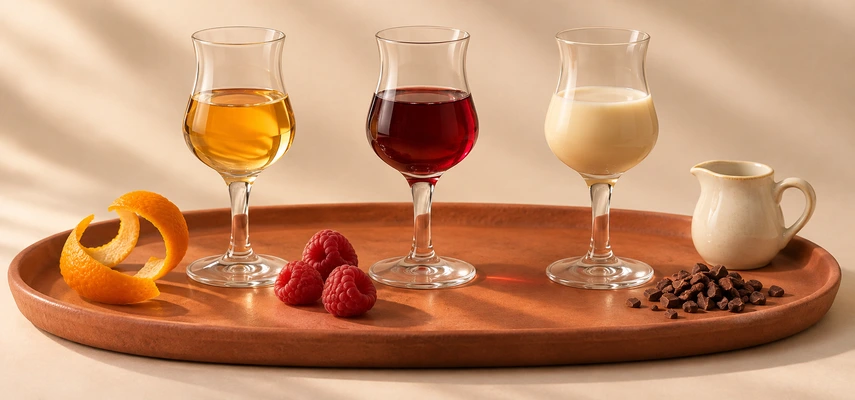

A colourless orange liqueur can taste vividly of fruit peel. A dark berry liqueur can carry material extracted directly from fruit. An opaque cream liqueur adds a completely different texture. All three show why liqueurs are better understood through formulation than through one expected colour or alcoholic strength.
The shared idea is an alcoholic base combined with flavour and sweetness under the applicable category rules. The base may stay quietly in the background or make an important contribution of its own. The producer then chooses how to obtain flavour, how much sweetness is needed and what texture the finished drink should have.
For Level 2, follow those choices in order. Base, flavouring method, sugar and optional colouring or cream explain much more than calling every liqueur a sweet spirit and moving on.
Liqueurs can begin with a neutral base
A neutral alcohol base gives the chosen flavouring room to lead. Extensive rectification has reduced many raw-material and fermentation compounds, so the producer can build a clear citrus, coffee, fruit or herbal identity without a strongly competing spirit flavour.
Neutral does not mean the alcohol appeared without agriculture or fermentation. The base has already been made and distilled before the liqueur formulation begins. A manufacturer can buy this base and still carry out significant extraction, blending and quality-control work.
The alcohol-water composition matters during extraction. Different compounds dissolve to different extents, so the appropriate liquid depends on the ingredient and intended result. A recipe is therefore more than selecting a flavour name and adding a fixed spoonful of plant material.
A neutral base can be especially useful when a producer wants consistency across different batches of a delicate ingredient. It does not make the finished liqueur neutral: the final product is deliberately given a characteristic flavour.
A characterful base can become part of the flavour
A characterful base, such as brandy, whisky or rum, brings an existing aromatic profile. The liqueur’s added flavour then interacts with fermentation character, distillation choices and any earlier maturation. Vanilla, fruit, honey or herbs may complement that foundation rather than replace it completely.
The base does not need to be the only alcoholic component. A producer can combine a named spirit with other permitted alcohol or flavour-bearing preparations. A whiskey connection on a cream liqueur should not automatically be expanded into the claim that every drop of alcohol came from whiskey.
Chambord’s production account provides an example of fruit infusion followed by blending that includes Cognac and other ingredients. The point is the combination of flavour-bearing components, not a general requirement that every berry liqueur must contain Cognac.
In a comparison, ask whether the base is disclosed and how prominent it is. A named spirit can matter to the recipe even if another flavour dominates the first impression. Conversely, a familiar whisky-like aroma does not prove a particular base without supporting information.
Maceration can retain fruit, colour and broader extraction
Maceration soaks flavouring material in liquid. Alcohol and water extract soluble compounds from fruit, peel, seeds, roots or other ingredients. The resulting liquid may acquire aroma, colour, bitterness and other material alongside the intended main flavour.
Time, temperature and preparation influence what is obtained. Whole berries, crushed fruit and dried peel do not present the same extraction conditions. A producer may prepare separate extracts so that each ingredient receives appropriate treatment before blending.
Chambord describes staged berry infusion and pressing. That supplies a concrete example of an extraction route in which fruit material and liquid are handled deliberately. It should not be turned into a universal timetable for every raspberry or blackcurrant liqueur.
Colour produced by extraction can be useful evidence when the method is known, but colour alone is insufficient to reconstruct the recipe. Similar appearances can come from different ingredients or permitted colouring decisions later in production.
Redistillation offers a more selective flavour route
In redistillation, volatile aroma compounds can travel with alcohol-containing vapour and become part of the condensed distillate. Many non-volatile pigments and other components remain behind. This makes it possible to create a strongly aromatic yet colourless flavouring component.
Cointreau’s owner description identifies the selection and distillation of sweet and bitter orange peels. That connects its orange identity to a clear production method without requiring the finished liqueur to look like orange juice.
The peel’s aromatic oils are different from juice acidity. An orange liqueur can supply citrus aroma and sweetness in a cocktail while another ingredient, such as lime juice, supplies the main sour component. Treating them as equivalent because both came from citrus would distort the recipe.
Distillation does not eliminate the need for later formulation. The producer still needs to blend components, set strength and sweetness, and assess the final balance. A fragrant distillate and a finished liqueur are not necessarily the same liquid.
Purchased flavourings broaden the options
Manufacturers can use purchased flavourings or extracts under the relevant rules. These may supply a consistent natural flavour preparation or another permitted flavouring material. The choice of legal ingredient category depends on the named liqueur and jurisdiction.
Buying an extract does not remove the need for a recipe. Concentration, alcohol contribution, sweetness and interaction with the base still need to be managed. A powerful preparation can be as easy to overuse as a strongly extracted macerate.
Nor does the word natural establish the complete production history or guarantee one preferred taste. It is a claim requiring its own definition and evidence. The most informative explanation says which flavour is present and what method is actually disclosed.
A product can also combine routes. A macerate, a distillate and a purchased preparation may all contribute to one formulation where permitted. Avoid treating one named technique as proof that no other stage occurred.
Sugar is a category requirement with qualifications
Sugar is central to liqueur identity, not merely an optional aroma descriptor. In the EU framework, the general minimum is 100 g per litre, expressed as invert sugar, with specified exceptions including certain cherry and gentian or wormwood liqueurs. Do not present 100 g as a rule with no exceptions or as a worldwide law.
Different jurisdictions and special categories can use different limits. For a Level 2 explanation, the main connection is that liqueurs are sweetened and subject to legal minimums under the relevant framework. Exact numbers should stay attached to the category they describe.
Sweetness also changes sensory balance. It can soften the perception of bitterness, support fruit character and increase body. It does not make all bitter compounds disappear, and a bitter liqueur can contain meaningful sugar while still tasting strongly bitter.
Alcoholic strength and sweetness are separate dimensions. A high-strength orange liqueur is not necessarily less sweet simply because its alcohol is more apparent. Compare like quantities and read the disclosed composition before drawing a numerical conclusion.
Colour is optional information, not a category test
Liqueurs can be colourless, naturally coloured by their ingredients, or coloured using permitted additions. A bright colour does not establish a particular extraction method, and brown appearance does not automatically mean long barrel ageing.
Colour can also change independently of flavour intensity. A clear distillate may be highly aromatic, while a richly coloured product may show a comparatively gentle aroma. Visual intensity and aromatic intensity should be described separately.
This matters in cocktails because appearance can influence expectation before the drink is tasted. A producer or bartender may choose a coloured liqueur for presentation as well as flavour. That use does not make the colour itself evidence of quality.
Cream liqueurs add a different physical structure
Cream liqueurs combine alcohol, sweetness, flavour and a dairy or other specifically described cream component. Dairy fat and other material create an opaque appearance and richer texture than a clear citrus distillate. Producing a stable commercial mixture requires formulation beyond simply leaving two liquids together.
Baileys’ owner account identifies whiskey and spirits, Irish dairy cream, cocoa and vanilla flavours. This is a specific example of how the alcoholic foundation and non-alcoholic ingredients combine. It does not disclose a full industrial recipe or establish the composition of every cream liqueur.
The word crème on a liqueur is not automatically evidence of dairy cream. In expressions such as crème de cassis, the naming tradition relates to the liqueur’s style and sugar conditions. Read the actual product description and ingredients rather than treating an accent mark as an allergen declaration.
Likewise, alternative plant-based products need their own description. Do not infer dairy merely from an opaque appearance or absence of dairy merely from a fashionable label design. Follow the ingredient and storage information supplied for that product.
Compare two liqueurs that share a flavour
Two orange liqueurs might differ in base, extraction, sweetness, strength and colour. A neutral-base peel-distilled example and a brandy-based orange example can share an orange identity without making the same contribution to a Sidecar or another cocktail.
Two berry liqueurs can likewise differ in fruit treatment and sweet balance. Ask whether one has more obvious fruit extraction, a different base contribution or a denser texture. Avoid explaining every difference by sugar when strength and flavour concentration may also matter.
For a written exercise, choose one disclosed production contrast and connect it to a plausible sensory consequence. Then identify the limit of the evidence. That approach shows understanding without pretending the tasting note reveals a secret formulation.
What to remember
Liqueurs combine a permitted alcoholic foundation, flavour and sweetness. The base can be neutral or characterful, and flavour can come through maceration, redistillation, purchased preparations or combinations. Sugar minimums depend on the relevant framework.
Colour and cream are additional choices rather than universal requirements. Cream liqueur and crème-named liqueur are not synonyms. Explain the complete formulation and its role in the glass, keeping flavour identity separate from strength, sweetness and texture.
Continue your study
To compare liqueurs with other flavoured spirits, read Flavored Vodka and Spiced Rum Explained: How Spirits Gain Added Flavor. To distinguish the wine-based foundation, read Aromatised Wines Explained: Vermouth, Quinquina, Chinato, and Americano. To consider ingredients that add sweetness and alcohol together, read Cocktail Balance Explained: Strong vs. Weak, Sweet vs. Sour and Bitter.
Knowledge check: 10 original practice questions
Independent TFE questions, not official WSET examination items. Choose one answer per question; explanations follow separately.
1. What can a characterful base contribute?
- Mandatory green colour
- Existing spirit aromas that interact with added flavour
- A guarantee of no sugar
- Only water
2. Does crème de cassis necessarily contain dairy cream?
- Yes, every crème product is dairy
- No, crème terminology is not a dairy declaration
- Only if bottled in France
- Only if it is red
3. What is true of purchased flavouring preparations?
- They still require controlled selection and blending
- They make every recipe identical
- They are forbidden in every liqueur
- They always establish low quality
4. Why can an orange liqueur be colourless?
- Sugar automatically bleaches every drink
- Oranges have no pigment
- It cannot contain orange flavour
- Peel aroma can be obtained through distillation
5. What distinguishes a dairy cream liqueur physically?
- Distillation of milk directly into finished cream
- A cream-containing formulation with opaque richer texture
- Mandatory absence of sugar
- Only a higher ABV than vodka
6. Which comparison of two orange liqueurs is most useful?
- Assume every orange aroma adds sourness
- Bottle height alone
- Assume every clear liqueur is unsweetened
- Base, flavouring route, strength, sweetness and colour
7. Which statement about EU liqueur sugar is precise?
- Every liqueur must contain cream
- No liqueur can contain sugar
- The general 100 g/L minimum has specified exceptions
- Every world category requires exactly 100 g/L
8. Which method can extract pigment alongside fruit flavour?
- Only bottling
- Only labelling
- Only strength measurement
- Maceration
9. Does brown liqueur colour establish long barrel ageing?
- Only if the bottle is clear
- No, extraction or permitted colouring can contribute
- Yes, new charred oak only
- Yes, at least ten years
10. Why might a liqueur use a neutral base?
- To let the selected flavour lead
- To eliminate any need for formulation
- To avoid all fermentation history
- To guarantee no sweetness
Answers and explanations
1. B — Existing spirit aromas that interact with added flavour. Brandy, rum or whisky can add their own production and maturation character to the formulation. Mapping: LO3.
2. B — No, crème terminology is not a dairy declaration. Crème-named liqueurs and dairy cream liqueurs should not be confused; actual ingredients determine composition. Mapping: LO3.
3. A — They still require controlled selection and blending. Purchased extracts are formulation tools whose concentration and interaction with the base still matter. Mapping: LO3.
4. D — Peel aroma can be obtained through distillation. Aromatic volatile material can be retained without transferring the fruit’s complete pigmentation. Mapping: LO3.
5. B — A cream-containing formulation with opaque richer texture. Cream changes physical structure and texture, requiring a formulated mixture rather than a clear aromatic distillate. Mapping: LO3.
6. D — Base, flavouring route, strength, sweetness and colour. Those dimensions explain different contributions to a cocktail without equating peel aroma with juice acidity. Mapping: LO3.
7. C — The general 100 g/L minimum has specified exceptions. The numerical rule must be attached to the applicable framework and its exceptions. Mapping: LO3.
8. D — Maceration. Soaking can transfer broad soluble material including colour, unlike selective volatile transfer alone. Mapping: LO3.
9. B — No, extraction or permitted colouring can contribute. Appearance alone cannot establish the source of colour or an ageing history. Mapping: LO3.
10. A — To let the selected flavour lead. A restrained base reduces competing spirit character while the final liqueur is deliberately flavoured. Mapping: LO3.












