
Source: magnific.com
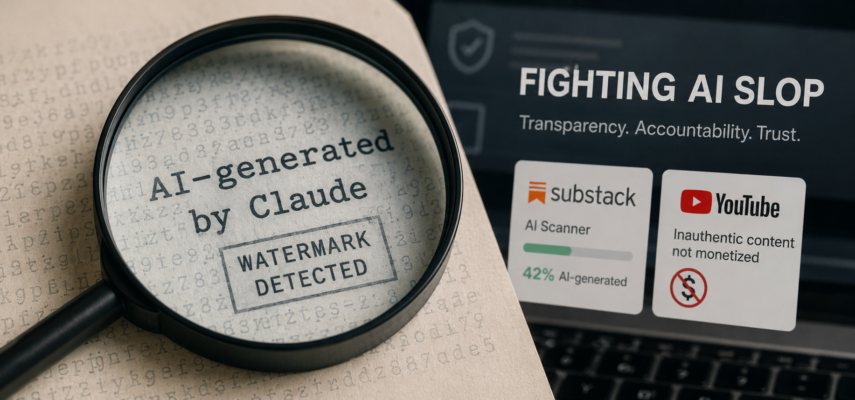
Anthropic has begun embedding an imperceptible, machine-readable watermark into text produced by Claude, starting with models released on or after August 2, 2026. The rollout, reported by Fortune, coincides with the date the EU AI Act’s transparency provisions took effect, which require generative AI providers to make synthetic output machine-readable and detectable. The company says the watermark will not affect quality or readability.
Accountability Signals Require Readers Who Know How to Read Them
Zlatan Vukić, an iGaming compliance manager with roughly eight years of experience in the legal frameworks governing the gambling industry, sees a familiar tension in the Anthropic announcement. Watermarks, like any credentialing signal, only function as trust mechanisms when the audience knows to look for them and understands what they actually confirm. The watermark tells a reader that Claude had some involvement. It does not guarantee that what Claude touched is accurate, ethical, or complete.
That gap between signaling and integrity is something Vukić tracks professionally across the Croatian and wider regional iGaming market, where operators surface compliance credentials to help prospective users decide whether to engage. HRK, a Croatian online gambling operator, publishes its licensing status and independent fairness audits specifically so users can verify those credentials before committing to the platform. Vukić observes that practice from the outside, and the logic it embodies is the same logic Anthropic is betting on: make a signal visible, and trust the reader to evaluate it rather than simply accept it.
“The credential only does its job if the person looking at it understands what it certifies and what it doesn’t,” Vukić said. “A watermark tells you Claude was involved. A licence tells you a regulator approved an operator. Neither one tells you to switch off your own judgment.”
The parallel is imperfect, as Vukić acknowledges. Licensing credentials are issued by identifiable regulatory bodies with defined standards. A statistical text watermark, by contrast, is a technical artefact embedded at the model level. Both demand the same underlying act from the reader: active discernment, not passive deference.
How Anthropic’s Watermark Works and Where Its Limits Begin
The mechanism is designed to travel with text. When a passage produced by Claude is copied and pasted elsewhere, the watermark moves with it. Moderate editing may leave it intact; a thorough rewrite or a full translation is likely to remove it.
Because the watermark sits at the model level rather than at the application layer, it follows Claude’s output whether that output originates from the chatbot interface, the API, or developer tools such as Claude Code. Images that Claude processes also receive a watermark, one that indicates Claude handled the file and flags whether the file has been altered since.
Text watermarking has traditionally been harder than watermarking images, and for obvious reasons. Text gets copied, paraphrased, split apart, translated, and folded into other people’s writing as a matter of routine. Anthropic’s approach attempts to account for that instability, but the company’s own framing reveals a significant caveat. The watermark indicates Claude had a hand in something. It does not indicate Claude generated an entire piece. Asking Claude to proofread a single paragraph, or to translate one passage of an interview, is enough to leave a detectable trace. The signal is real. What it signals is narrower than most readers will assume.
Substack Adds Scanners, YouTube Sharpens Its Monetization Rules
Anthropic is not the only institution trying to draw cleaner lines around AI-generated content. Substack has introduced a reader-triggered AI scanner that estimates how much of a post or comment was written by a human versus produced by an AI tool. Writers on the platform can separately add a disclosure explaining their creative process, a feature Substack frames as voluntary transparency rather than mandatory labelling.
YouTube’s approach is more consequential financially. The platform clarified its inauthentic-content policy to specify that channels built around generic, templated output are at risk of losing monetization revenue. The categories named include AI personas offering health, legal, financial, or political advice. YouTube had already barred repetitive or mass-produced videos from earning revenue under earlier rules. The clarification tightens the boundary while preserving room for AI-assisted work. Using AI to write a script or edit footage remains permitted; running a channel that substitutes automated output for genuine human engagement does not.
Together, the Substack and YouTube moves reflect an industry logic that mirrors Anthropic’s watermarking effort. Each platform is trying to create structural incentives that push toward disclosure, with varying degrees of enforcement authority behind them.
Why No Single Technical Fix Can Replace Judgment
Watermarking alone will not clean up the internet. Anyone determined to disguise AI-generated output has available methods for degrading or erasing a statistical text watermark, and many earlier watermarking approaches proved straightforward to remove. The technical arms race between embedding and erasure is not resolved by a single corporate rollout, however well-engineered.
The more subtle problem lies in what a flat technical signal cannot express. A label that reads “AI involvement detected” treats every case identically. It does not distinguish between the operator generating a thousand fake news videos at industrial scale and the journalist who asked Claude to translate a source’s interview transcript before writing their story in full.
That is the concrete stakes of any over-reliance on a single accountability mechanism. The watermark is a genuine step, and the regulatory pressure behind it is real. But a signal that cannot capture context leaves readers facing the same underlying task they always faced, determining not merely whether AI was present, but how, to what degree, and in whose service.