










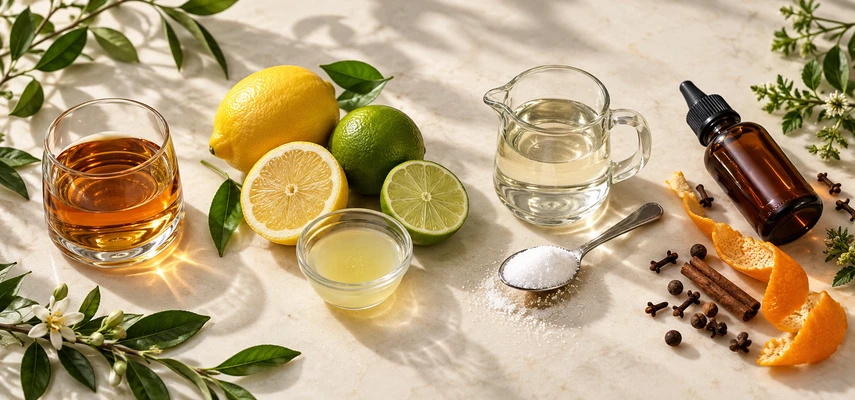

Take the labels off the bottles behind a bar and the collection can look bewildering. Some liquids are clear, some brown, some bright enough to suggest a stationery purchase. Yet much of that crowded shelf exists to answer a handful of simple questions: what supplies the base, what adds sweetness, what brings sharpness, and what makes the drink smell interesting?
Understanding cocktail ingredients means learning those jobs. It doesn’t mean buying every bottle that can perform them. In fact, one ingredient often does several jobs at once, which is both useful and the reason substitutions can get complicated.
Here’s a practical guide to the main building blocks—and the differences worth noticing before they reach your glass.
The base gives the drink its center
A base is the main ingredient around which the drink is organized. It’s often a spirit such as gin, whiskey, rum, tequila, vodka or brandy, but wine and other lower-strength ingredients can also occupy that role. An alcohol-free preparation needs a different base altogether.
The base contributes flavor as well as alcohol. Gin commonly brings juniper and other botanical notes. Whiskey can bring grain character and flavors associated with maturation. Rum varies widely, so a light, relatively restrained rum and a more assertive example shouldn’t be assumed to behave identically.
These descriptions are orientation points, rather than promises about every bottle. Two products in the same spirit category may differ enough to change a familiar recipe noticeably. That’s one reason “use whatever is brown” isn’t a particularly dependable substitution policy.
The base also affects strength. Alcohol by volume describes a concentration, so equal pours from bottles with different ABVs don’t supply equal amounts of alcohol. A recipe’s flavor and its alcohol content both depend on what actually goes into the measure.
Sweeteners shape more than sweetness
Sugar, sugar syrup, honey, agave syrup and flavored syrups can supply sweetness, but they aren’t interchangeable liquids. They vary in concentration, flavor and how easily they combine with a cold drink.
Plain sugar syrup is useful because the sugar is already dissolved. That avoids the problem of a drink that tastes different at the top and bottom because some of its sweetener is still sitting on the floor of the glass.
Recipes commonly distinguish simple syrup from richer syrup. A one-to-one syrup and a two-to-one syrup contain different proportions of sugar and water. The method must also specify whether those proportions are by weight or volume; those choices don’t produce exactly the same concentration.
As Simon Difford’s syrup comparison explains, changing syrup strength changes the amount needed. A richer syrup isn’t simply a drop-in replacement for the same volume of a lighter one. It also brings a different amount of water into the drink.
Honey adds its own character; a flavored syrup can introduce fruit, herbs, nuts or spices. Those flavors might be welcome, but they’re changes to the recipe rather than invisible improvements. Think of sweeteners as ingredients with personalities, not different brands of the same switch.
Citrus brings acidity and a recognizable voice
Lemon and lime juice provide acidity along with their distinctive aromas and flavors. Their role is especially visible in sour cocktails, where sweetness and citrus help shape the impression of the alcoholic base.
The IBA Daiquiri combines rum, fresh lime juice and sugar. It’s a compact example of ingredients that have separate jobs but become more interesting in relationship. The lime doesn’t merely make the rum sour; it helps establish the character of the entire drink.
Juice and peel aren’t the same ingredient in different shapes. Juice supplies the tart liquid. Peel can release aromatic oils near the surface of a finished drink without adding a comparable amount of juice or acidity.
Nor are lemon and lime exact substitutes. Swapping them may yield an enjoyable drink, but it changes flavor as well as acidity. The same applies to replacing fresh juice with a sweetened bottled product. Read the label before assuming the bottle contains only the ingredient named most prominently on its front.
Fruit varies, too. A measured recipe gives you a stable starting point; it doesn’t make every lemon identical. That variation is a reason to pay attention to the finished result, rather than abandon measurement altogether.
Liqueurs can carry several ingredients’ worth of work
A liqueur is an alcoholic product flavored and sweetened in a particular style. Depending on the product, it might bring orange, coffee, herbs, nuts, spices or other flavors. It often contributes enough sweetness to matter to the balance of a recipe.
That gives it several jobs at once: flavor, sugar and alcohol. Replacing an orange liqueur with orange juice changes all three. Adding extra liqueur to make a drink “more orangey” also changes more than the orange aroma.
The IBA Margarita makes this visible by pairing tequila and lime with an orange liqueur. The liqueur belongs to the structure of the drink, rather than serving as a garnish poured from a bottle.
Products within a broad liqueur style may differ in sweetness and strength. If a recipe specifies a particular kind, learn what role it’s playing before choosing an alternative. A substitution can be a good experiment, but it’s easier to understand when you know which variables you’re changing.
Vermouth is wine with additional character
Vermouth is an aromatized, fortified wine. In plain language, it starts with wine, has additional alcohol, and gains flavor from botanicals. Different styles bring different balances of sweetness, bitterness and aroma.
Dry vermouth is familiar in a gin Martini. Sweet red vermouth appears in drinks such as the Manhattan and Negroni. Those style names are useful, but they don’t describe every detail of every product. Color alone won’t tell you precisely how it will taste.
Vermouth’s wine base also matters after opening. It shouldn’t be treated like an indefinitely fresh bottle of distilled spirit. Vermouth storage guidance recommends refrigeration and protection from air after opening to help preserve its character.
For a beginner, the important distinction is between a seasoning that lives happily in a cupboard according to its label and a wine-based ingredient that needs more attentive storage. A small amount of tired vermouth can change an otherwise carefully made drink. The recipe can’t compensate for an ingredient that has lost the character it was supposed to contribute.
Bitters work in small quantities
Cocktail bitters are concentrated flavorings commonly added in dashes. They can bring herbal, spicy, citrus or other aromatic character along with bitterness. Different styles are useful for different purposes.
Angostura’s description of its aromatic bitters emphasizes herbs, fruits and spices. That’s a useful reminder that “bitters” doesn’t mean a bottle containing only the sensation of bitterness. Aroma is a large part of the contribution.
The seasoning comparison helps: a little can alter the whole mixture without becoming its largest component. But don’t take that analogy as permission to use an unmeasured amount. Concentrated ingredients make small variations noticeable.
Many conventional bitters contain alcohol. If a drink must be completely alcohol-free, a few dashes shouldn’t be dismissed as automatically irrelevant. Check the specific product and the guest’s requirements. Also distinguish cocktail bitters from larger-pour bitter aperitifs; related words don’t make the ingredients interchangeable.
Mixers add length, flavor and sometimes bubbles
Soda water, tonic water, ginger beer, fruit juices and other mixers can turn a compact preparation into a longer drink. What they contribute depends on the product. Plain soda mainly brings water and carbonation; tonic adds its characteristic bitterness and usually sweetness; ginger mixers add another flavor profile.
“Mixer” doesn’t mean neutral. Replacing one with another can change sugar, acidity, bitterness, carbonation and aroma. A tall glass may hide how much of the drink’s personality comes from that supposedly supporting ingredient.
For a carbonated mixer, freshness also means having the bubbles the recipe expects. Add it gently rather than shaking it in a sealed vessel. Carbonation that escapes during preparation can’t contribute the same lively texture in the glass.
Fruit juice can function as a mixer and an acid or sweetening ingredient at the same time. Again, the categories describe jobs rather than mutually exclusive boxes. One liquid can be doing several pieces of work while wearing only one name tag.
Ice and water complete the ingredient list
Water may arrive as a measured ingredient, a mixer component or melted ice. In each case, it changes concentration and volume. Many cocktail recipes assume that preparation with ice will supply some of that water.
Ice also absorbs heat. A drink mixed with suitable ice isn’t just the room-temperature recipe with a lower thermostat setting; it has changed in both temperature and composition. That’s why skipping the ice step and chilling the undiluted mixture later doesn’t necessarily reproduce the same result.
Use clean, fresh-tasting ice and potable water. Neither needs an elaborate sales pitch. They do need to avoid bringing unwanted flavors to a drink whose other ingredients you’ve chosen carefully.
Not every cocktail needs every category discussed here. A Martini doesn’t need citrus juice simply because citrus is useful elsewhere. A highball doesn’t need a spoonful of sugar just because another drink relies on syrup. Learn the jobs, then look at the particular recipe. The essential ingredient is the one that has necessary work to do in that drink.












