










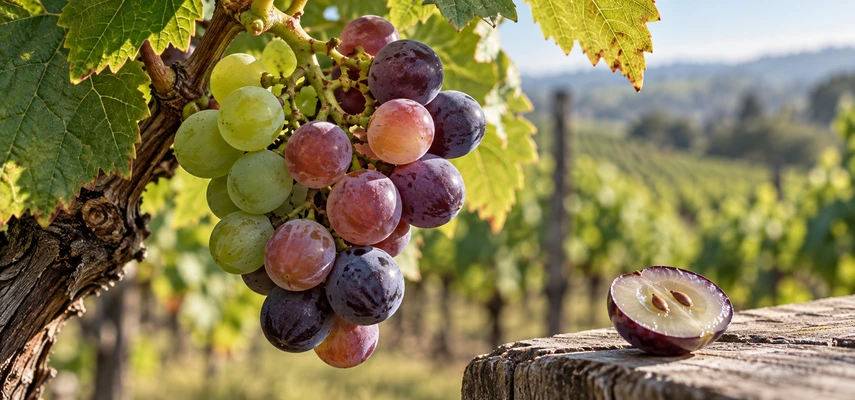

Cut a dark grape in half and the inside may be surprisingly pale. That small surprise explains something useful about wine: the juice and the skin don’t bring the same ingredients to the bottle. A grape is a package with different compartments, and winemaking depends on knowing which compartment holds what.
How wine begins is easier to understand once those ingredients come into focus. The vine grows the fruit; ripening changes its balance; the winemaker works with the result. Before there are barrels, corks or tasting notes, there is a berry whose sugar, acid and skin are changing through the season.
This first lesson in The TFE Guide to WSET Level 1 Wine follows that journey. The aim is to understand the connections, so the facts have somewhere to stick.
What WSET Level 1 expects you to know
The official WSET Level 1 specification, Issue 1.2 (2022) makes grape anatomy and the growing cycle part of Learning Outcome 1. For this lesson, concentrate on two tasks: connect skin and pulp with their contents, and recognize flowering and ripening in the vine’s annual cycle.
The precise core is compact: skin supplies colour and tannin; pulp contains water, sugar and acid. During ripening, sugar generally increases while acidity decreases. The last relationship explains why picking time matters rather than simply adding another vocabulary word.
Seeds, stems, fruit set and the term véraison appear below as helpful background. They explain the picture, but the specification’s grape-parts range names skin and pulp, and its annual-cycle range names flowering and grape ripening. Detailed plant anatomy isn’t the assignment. This is an independent TFE study guide, without WSET affiliation or endorsement; the practice questions are original, not official examination material.
Grapes, skins and pulp: different jobs in one berry
Think of a grape as a small parcel of juice enclosed by a protective wrapper. The wrapper matters because contact with it can change what ends up in the wine. Removing it quickly and leaving it with the juice are different choices, even when the starting fruit looks identical.
| Part | Essential contents for Level 1 | Why the distinction matters |
|---|---|---|
| Skin | Colour and tannin | Contact with skins helps determine wine colour and texture |
| Pulp | Water, sugar and acid | Juice supplies the liquid, fermentation fuel and acidity |
Tannin is associated with a drying, grippy sensation in the mouth. Acidity creates a sour, fresh impression. Those sensations are easy to confuse when both feel forceful, but they have different causes. Think of the difference between a tart lemon and the drying grip of strongly brewed black tea: useful comparisons, not ingredients secretly added to the grapes.
Dark skins also don’t mean that every part of the berry is dark. Many black wine grapes have pale pulp. WSET’s explanation of wine colour connects that separation with how grape handling influences the result. The introductory point is the location of the ingredients; the production lesson later in the series will follow their extraction into wine.
Seeds sit inside the pulp, and stems support the bunch. Both can contribute tannin during winemaking, though that is supplementary context here. The Australian Wine Research Institute’s discussion of grape tannins discusses their origins and sensory role. Remembering skin as a tannin source doesn’t require pretending it is the only source.
How vines develop before grapes ripen
A grapevine is a woody perennial: the plant survives from one growing season to the next. It doesn’t grow a new trunk for every vintage. New shoots and leaves develop as the annual cycle gets under way, providing the growing framework around the year’s fruit.
The leaves help manufacture sugars through photosynthesis, using light energy. Those sugars can then move to developing grapes. The roots take up water and mineral nutrients; they don’t collect ready-made grape sugar from the soil. This difference is useful whenever wine language makes a vineyard sound as though it drinks its finished flavour straight from the ground.
The British Columbia grape-growing guide describes how early shoot growth draws on stored reserves before functional leaves support growth with newly produced sugars. That is background to the main lesson: a developing bunch depends on a living plant, not sunshine falling on a detached bowl of fruit.
Flowering happens before there are recognizable bunches of ripe grapes. The flowers are small, easily overlooked structures rather than a dramatic floral display. After successful fruit set, tiny berries begin developing. Flowering and fruit set are connected events, but the words don’t mean the same thing: one concerns flowers; the other concerns the beginning of developing fruit.
Young grapes aren’t miniature versions of ripe, sweet grapes. They begin firm and green, with little sugar and substantial acidity. Growth increases berry size, but size alone doesn’t tell a grower whether the fruit is ready for wine. A larger unripe grape is still an unripe grape.
Ripening changes grapes in several ways at once
Ripening is a coordinated change in the fruit, not merely a change of paint. Berries soften, sugar accumulates, acid levels generally fall, and flavour compounds change. Dark-skinned varieties develop their familiar red, purple or blue-black skin colours; white varieties don’t have to turn purple to become ripe.
The onset of ripening is called véraison. Treat the word as an optional signpost rather than a spelling challenge. A cluster can contain berries at different stages, so a mix of green and coloured grapes doesn’t necessarily mean that several varieties have been attached to one stem.
Texas A&M AgriLife Extension describes the softening, sugar accumulation, skin-colour changes and flavour development that occur through ripening. Its account also helps explain why colour alone cannot describe everything happening inside a grape.
Three questions keep the process understandable. Is there more sugar available? How much acidity remains? Have the fruit’s other characteristics developed suitably for the intended wine? Those questions belong together. A grower isn’t watching three unrelated scoreboards; the eventual wine will contain the consequences of all three.
The general direction is worth learning without turning it into an absolute rule about every berry in every vineyard. Weather, variety and growing conditions affect development. Ripening provides a pattern, while an actual harvest requires observing the fruit in front of the grower.
Why sugar and acid matter to the resulting wine
Sugar gives yeast something to ferment. During alcoholic fermentation, yeast converts sugar into alcohol and carbon dioxide, as explained in UC Davis’s fermentation overview. More grape sugar therefore provides the potential for more alcohol, if fermentation uses it. It doesn’t automatically mean that the finished wine will taste sweeter.
Imagine two batches of juice, one with more sugar than the other. If both ferment to dryness, the batch with more starting sugar can produce more alcohol. Dryness describes the finished wine’s lack of perceptible sweetness, not an absence of sugar in the grapes that made it. The grapes needed that sugar in the first place.
Acidity contributes freshness and a mouth-watering sensation. As grapes ripen, their acidity generally decreases. That is why a later harvest can change the balance even when the berries still look healthy and attractive. The decision isn’t simply whether the fruit is edible; it is whether its ingredients suit the wine being planned.
These connections explain two misconceptions at once. Sweet grapes can produce dry wine, and ripe grapes still contain acid. Ripening changes proportions rather than replacing one ingredient with another. Sugar doesn’t turn into acid, and acid doesn’t turn into sugar as though the berry were exchanging coins.
When are grapes suitable for winemaking?
There isn’t one universal moment when every grape becomes ready. Suitability depends partly on the intended style. A producer seeking a fresher style may want a different balance from a producer seeking greater ripeness and potential alcohol. More ripeness isn’t a prize that every wine must compete to win.
Consider two hypothetical picking dates in the same healthy vineyard. At the earlier date, the grapes may have less sugar and more acidity. Later, they may have more sugar and less acidity. Neither description alone proves which wine will be better. The producer needs a target before deciding whether those ingredients fit it.
Colour can help, but appearance isn’t a complete readiness test. The University of Minnesota’s guidance on assessing ripeness recommends representative fruit sampling and measurement alongside observation. One appealing berry cannot speak for an entire vineyard, especially when fruit develops unevenly.
For Level 1, there is no need to memorize laboratory instruments or numerical harvest targets. Follow the simple chain instead: the vine develops fruit; ripening changes its composition; harvest captures a particular balance; fermentation and other winemaking choices shape what follows. That chain is the origin of many differences encountered later in the glass.
Common misconceptions and exam traps
Skin and pulp aren’t interchangeable answers. If the question concerns sugar and acid, think pulp. If it concerns colour and tannin, think skin. A question about one doesn’t need an essay about every substance in the whole grape.
Flowering comes before ripening. These are stages in the production of fruit, rather than alternative names for harvest. Keeping the order straight is more useful than memorizing a calendar month that would vary with location and season.
Sugar generally rises and acidity generally falls during ripening. Learn both directions together. Also keep grape ripeness separate from finished-wine sweetness: fermentation can consume the grape sugar. These are practice pitfalls drawn from the concepts, not claims about which questions appear most often on actual WSET papers.
Knowledge check: 12 original questions
Choose one answer for each question. Questions 1–10 test this lesson’s core anatomy and growing-cycle concepts. Questions 11–12 connect those concepts to the fermentation lesson ahead.
1. Which pair belongs with grape pulp in the Level 1 model?
- Colour and tannin
- Sugar and acid
- Cork and oak
- Alcohol and carbon dioxide
2. Which grape part is the key source of colour in this lesson?
- Root
- Trunk
- Skin
- Flower stalk
3. Which sequence puts the two prescribed annual-cycle stages in the correct order?
- Flowering, then ripening
- Ripening, then flowering
- Bottling, then flowering
- Fermentation, then flowering
4. During normal grape ripening, which change generally occurs?
- Sugar falls while acidity rises
- Sugar and acidity both disappear
- Sugar changes into acid
- Sugar rises while acidity falls
5. Which sensation is most closely associated with tannin?
- Carbon dioxide bubbles
- A drying, grippy feeling
- Sugary sweetness
- Chilled temperature
6. A student lists water, sugar and acid. Which grape part should head that list?
- Stem
- Skin only
- Pulp
- Root bark
7. Which statement correctly describes a young, unripe grape?
- It generally has little sugar and substantial acidity
- It already contains finished wine
- It contains no water
- It has no skin until harvest
8. What does the skin contribute in addition to colour in the core Level 1 model?
- Glass
- Yeast-produced alcohol
- Cork
- Tannin
9. Two samples from the same vineyard show a typical progression through ripening. What would the later sample generally show?
- Lower sugar and higher acidity
- Higher sugar and lower acidity
- No sugar or acid
- Alcohol instead of water
10. Which statement avoids confusing pulp with skin?
- All grape sugar is in the woody trunk
- Skin and pulp always contain identical proportions
- Pulp holds water, sugar and acid; skin supplies colour and tannin
- Skin is the only part containing water
11. Why doesn’t sweet grape juice guarantee a sweet finished wine?
- Yeast can consume sugar during fermentation
- Acidity always removes every flavour
- The bottle absorbs all sweetness
- Grape colour determines sweetness
12. If other conditions are comparable and sugar ferments, more starting grape sugar provides what potential?
- A larger cork
- Less need for grapes
- Automatic sparkling wine
- More alcohol
Answers and explanations
1. B — Sugar and acid. Pulp contains water as well as sugar and acid. Colour and tannin are the key skin associations in the specification.
2. C — Skin. The skin is the key colour source in the beginner model. Dark skins can surround pale pulp, which explains why juice handling matters.
3. A — Flowering, then ripening. Flowers precede the developing fruit that will ripen. Harvest, fermentation and bottling are different events.
4. D — Sugar rises while acidity falls. These are the general ripening directions. Neither ingredient has to disappear, and one does not simply transform into the other.
5. B — A drying, grippy feeling. Tannin contributes this mouthfeel. Acidity is associated with sourness and freshness, while dissolved carbon dioxide causes bubbles.
6. C — Pulp. The essential pulp list is water, sugar and acid. Remembering the whole trio helps distinguish the pulp from the skin.
7. A — Little sugar and substantial acidity. Young grapes are generally firm, green and unripe. Finished alcohol is produced later through fermentation.
8. D — Tannin. The Level 1 skin association is colour plus tannin. Alcohol is a fermentation product, not the companion ingredient sought here.
9. B — Higher sugar and lower acidity. This describes a typical ripening progression, rather than promising identical changes in every individual berry.
10. C — Different parts, different associations. The statement accurately separates the specified pulp contents from the skin’s colour and tannin contributions.
11. A — Yeast can consume sugar. Fermentation changes the starting juice. Sweetness in grapes therefore cannot establish the sweetness of the finished wine.
12. D — More alcohol. Fermentable sugar provides potential alcohol. The condition about fermentation matters; more sugar alone doesn’t guarantee a particular final style.
One-page revision summary
| Remember | Essential connection |
|---|---|
| Skin | Colour and tannin |
| Pulp | Water, sugar and acid |
| Annual-cycle order | Flowering before grape ripening |
| Ripening | Sugar generally increases; acidity generally decreases |
| Tannin versus acid | Drying grip versus sour freshness |
| Bridge to fermentation | Sugar can become alcohol; sweet grapes needn’t produce sweet wine |
Keep the central picture simple: the grape’s parts supply different ingredients, and ripening changes the balance available to the winemaker. Seeds, stems and véraison help explain that picture; skin, pulp, flowering and ripening are the core facts to retain.












