










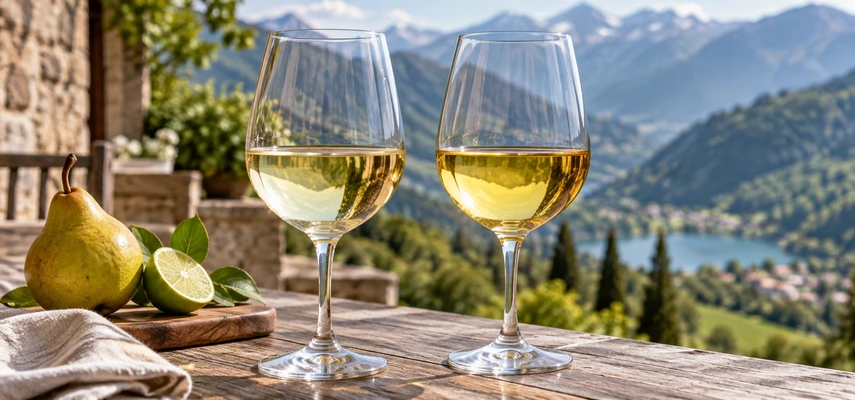

The word fruity causes trouble when it is asked to do two jobs. A Riesling can smell vividly of lime and peach yet be dry. A Pinot Grigio can taste refreshing and light without having the same aromatic intensity. Neither wine needs to be described as better for the contrast to be useful.
Riesling and Pinot Grigio explained side by side offer a practical way to separate fruit, sweetness, acidity and body. Two pale glasses may look similar while delivering quite different experiences.
What WSET Level 1 expects you to know
Both grapes are principal white varieties in Learning Outcome 2 of the official Issue 1.2 specification. Know their typical characteristics and styles. Riesling’s sweetness range and high acidity are especially useful, while the common light Italian Pinot Grigio style supplies a clear comparison.
Detailed German wine classifications and regional legal rules aren’t needed for this lesson. Pinot Gris is mentioned to explain a familiar alternative name, not to add a ninth principal grape. This independent TFE guide is not WSET-endorsed; all questions are original.
Riesling: aroma with an acidic backbone
Riesling is a white grape capable of producing strongly aromatic wines. Familiar fruit comparisons include lime, lemon, apple, peach and apricot, depending on ripeness and style. Floral notes can also appear. The profile is a range rather than a recipe containing every listed fruit.
High acidity is a dependable beginner anchor. Acidity provides freshness and a mouth-watering impression even when the wine has some sweetness. That combination explains why a sweet Riesling can seem lively rather than simply heavy.
Wine Australia’s Riesling guide describes citrus character and the grape’s ability to make dry styles. That is a useful correction to the idea that Riesling is always a sweet wine. The grape name alone doesn’t tell the full sugar story.
Dry, medium and sweet can all fit Riesling
Sweetness depends on sugar remaining in the finished wine. Fermentation can consume much of the grape sugar, leaving a dry style, or the producer can make a wine retaining noticeable sweetness. Riesling appears across that range.
Imagine two hypothetical Rieslings with similarly bright acidity. One is dry and citrus-driven; the other has noticeable sweetness balancing that acidity. The second doesn’t have to lose its freshness, and the first doesn’t have to lose its fruit aromas.
The sensible label question is therefore “What style is this Riesling?” rather than “Is Riesling the sweet grape?” Supplier descriptions and sweetness information can help, but a beginner doesn’t need to learn every national labelling system to understand the principle.
Some Rieslings can have relatively modest alcohol when sugar remains unfermented, but don’t treat low alcohol as a complete sweetness test for every wine. Alcohol, sugar and acidity are linked through production choices, while each still deserves its own description.
Acidity and sweetness don’t cancel each other out
A sweet wine can still be high in acidity. The sensory impression may feel balanced because sweetness softens tartness while acidity supplies freshness. Neither ingredient has vanished from the glass.
Think of a sweet-tart apple: the combination is recognizable because both dimensions remain. The analogy explains balance, not Riesling’s exact chemical composition. In a tasting description, “sweet with high acidity” is therefore a sensible statement rather than a contradiction.
WSET’s discussion of acidity makes that point useful beyond Riesling. Sensory balance concerns how components interact, while assessment still requires noticing the components separately.
Pinot Grigio: a familiar lighter white style
The common Italian Pinot Grigio style is dry, relatively light-bodied and refreshing. Fruit descriptors can include pear, apple and citrus. Compared with a strongly aromatic Riesling, it may seem more restrained rather than obviously floral or intensely perfumed.
Light body doesn’t mean no flavour. It describes weight in the mouth. A lighter wine can be pleasant and clearly fruity without feeling rich or heavy, just as a fuller wine can be subtle in aroma.
The Delle Venezie wine consortium provides an official northern Italian reference for Pinot Grigio. There is no need here to memorize its full production geography; the important association is a common Italian white style, not a single universal expression.
Pinot Gris and Pinot Grigio are the same variety
Pinot Gris is the French name for the variety also called Pinot Grigio in Italian. Different labels can suggest different stylistic traditions, but they don’t establish two unrelated grapes.
Some Pinot Gris styles, including examples from Alsace, can be fuller and richer than the familiar light Italian reference. The Alsace wine body’s Pinot Gris profile provides that helpful contrast. It prevents a typical beginner profile becoming a claim that the grape can never make a weightier wine.
For Level 1, keep Pinot Grigio as the prescribed name and remember the light, dry comparison. The alternative name explains variation rather than replacing the core lesson with a tour of every region producing the grape.
Compare the two wines without mixing categories
| Question | Riesling | Common Italian Pinot Grigio |
|---|---|---|
| Is it necessarily sweet? | No; dry through sweet styles exist | Usually dry |
| Typical acidity | High | Refreshing acidity, often medium to high |
| Fruit examples | Citrus, apple, peach, apricot | Pear, apple, citrus |
| Aromatic impression | Can be pronounced, sometimes floral | Often more restrained |
| Typical beginner body comparison | Often light to medium; style varies | Usually light |
The word common protects the Pinot Grigio column from pretending to cover every producer. The Riesling column likewise isn’t a promise that all wines have identical body or aromas. Use these as reference points, then pay attention to the actual style described.
A practical comparison without a tasting examination
Picture two descriptions on a wine list. The first says “dry Riesling, lime and floral notes, bright acidity.” The second says “dry Pinot Grigio, pear and apple, light-bodied.” Both might suit someone seeking a refreshing white, but they communicate different aromatic experiences.
Now change the first description to “medium-sweet Riesling, peach, high acidity.” Only one dimension has been deliberately changed in this thought experiment. The high acidity remains possible, the grape identity remains the same, and fruitiness isn’t the evidence for the sugar level.
Learning this way helps a reader use knowledge outside an examination. Instead of guessing from a grape stereotype, identify which characteristic matters to the choice. Someone seeking no sweetness needs sweetness information, while someone seeking a light-bodied wine needs body information.
Common misconceptions and exam traps
Riesling isn’t always sweet, and sweet Riesling isn’t necessarily low in acidity. Pinot Grigio and Pinot Gris aren’t separate varieties. A restrained aroma doesn’t prove poor quality, and pear-like flavour doesn’t establish residual sugar.
Don’t decide body from colour alone. Don’t decide sweetness from fruit descriptors alone. If a question uses the familiar light Italian Pinot Grigio reference, answer that style rather than importing an unusually rich exception into a simple comparison.
Use four questions for a practical choice
Start with sweetness: is the wine dry, medium or sweet? Next consider acidity: is the impression bright and tart? Then ask about weight and aromatic character. These four questions stop a single grape stereotype from deciding everything about a wine before it is described.
Suppose a hypothetical Riesling is dry, light-bodied and intensely lime-scented. A hypothetical Pinot Grigio is also dry and light-bodied but more restrained, with pear-like fruit. The main contrast may be aroma rather than sugar or weight. Replacing the Riesling with a sweeter example would change another part of the comparison, not merely make it more Riesling-like.
This is useful when reading a restaurant list as well as studying. If the only information is a grape name, the missing style details are still missing. A confident explanation acknowledges that gap rather than treating the typical reference as a guaranteed tasting result.
For revision, write dry, medium and sweet beside Riesling, then write high acidity across the range. For Pinot Grigio, write the common Italian light, dry reference and the alternative name Pinot Gris. That small contrast captures the assigned beginner knowledge without requiring a catalogue of vineyards or a complicated label hierarchy.
Knowledge check: 10 original questions
1. Which statement correctly describes Riesling sweetness?
- Styles range from dry to sweet
- Every Riesling is sweet
- Every Riesling is dry
- Riesling contains no sugar before fermentation
2. Which feature is a useful Riesling anchor?
- Mandatory oak flavour
- High acidity
- Always low acidity
- High red-wine tannin
3. Which profile fits common Italian Pinot Grigio?
- Fortified and nutty
- Always deeply tannic
- Dry, light-bodied and refreshing
- Always sweet, red and full-bodied
4. Pinot Gris and Pinot Grigio refer to what?
- Two unrelated red grapes
- Two Champagne villages
- Two fortification methods
- The same grape variety
5. Which aroma set is plausible for Riesling?
- Lime, apple and peach
- Only black pepper and meat
- Only cedar and tobacco
- Only cocoa and coffee
6. Can sweetness and high acidity coexist?
- Only after adding cork
- Yes, they can balance each other
- No, sugar removes every acid
- Only in red wine
7. Which is a typical Pinot Grigio fruit comparison?
- Only prune and walnut
- Only smoked meat
- Pear and apple
- Only blackcurrant
8. What does light-bodied establish?
- No flavour can be present
- The wine must be sweet
- The wine must be sparkling
- Relatively delicate weight in the mouth
9. How can some Pinot Gris examples differ from light Italian Pinot Grigio?
- They can be fuller and richer
- They become a different grape
- They must be red Bordeaux
- They contain no acidity
10. A floral, lime-scented Riesling is described as dry. Which conclusion follows?
- It cannot contain acidity
- The description is plausible
- The label must be wrong
- It must be fortified
Answers and explanations
1. A — Styles range from dry to sweet. The grape can make several sweetness styles depending on production.
2. B — High acidity. Riesling commonly retains pronounced acidity across different sweetness levels.
3. C — Dry, light-bodied and refreshing. The familiar Italian reference is a light, dry white style with refreshing acidity.
4. D — The same grape variety. The French and Italian names identify the same variety.
5. A — Lime, apple and peach. Citrus, apple and stone fruit provide useful Riesling references.
6. B — Yes, they can balance each other. Sweetness can soften acidity’s impression without removing the acid.
7. C — Pear and apple. Pear, apple and citrus are useful fruit references for the familiar style.
8. D — Relatively delicate weight in the mouth. Body describes weight; it does not determine all aroma or sweetness features.
9. A — They can be fuller and richer. Different stylistic traditions can use the same variety to make a weightier wine.
10. B — The description is plausible. Pronounced aroma does not require perceptible sweetness.
One-page revision summary
Riesling combines aromatic fruit with high acidity and can be dry, medium or sweet. Common Italian Pinot Grigio is dry, light-bodied and refreshing, often showing pear, apple and citrus. Pinot Gris is the same variety under another name and can indicate a different stylistic tradition. Keep sweetness, aroma, acidity and body separate before comparing the whole wine.












