











Room temperature sounds reassuring until the room is a warm kitchen in midsummer. For wine service, the phrase means a relatively cool condition, not permission to serve a red at whatever temperature the building happens to have reached.
How to serve wine properly is mostly a matter of helping the wine show its intended style. Appropriate temperature, clean glasses, controlled opening and a quick condition check do more useful work than elaborate ceremony.
What WSET Level 1 expects you to know
Learning Outcome 3, criteria 2–3 in the official Issue 1.2 specification cover recommended temperature descriptions, opening still and sparkling wine, glassware, and checks on appearance and nose.
Learn the style-to-temperature categories first. Celsius guides and practical presentation details support them; advanced sommelier choreography isn’t required. This independent TFE lesson isn’t WSET-affiliated, and the questions are original.
Match temperature to style
| Style | Prescribed Level 1 description | Practical guide |
|---|---|---|
| Sparkling wine | Well chilled | Around 6–10°C |
| Sweet wine | Well chilled | Around 6–8°C |
| Light/medium white and rosé | Chilled | Around 7–10°C |
| Full-bodied white | Lightly chilled | Around 10–13°C |
| Light-bodied red | Lightly chilled | Around 13°C |
| Medium/full-bodied red | Room temperature | Around 15–18°C |
The descriptions are the explicit Level 1 requirement. The numerical ranges are practical reference points rather than additional legal boundaries. WSET’s service-temperature guide explains why wine’s room temperature is cooler than many modern rooms.
Temperature changes perception
Too much warmth can make alcohol seem more prominent and a wine less fresh. Excessive chilling can suppress aroma and flavour. The aim isn’t to make every white ice-cold and every red warm; it is to suit the style.
A fuller Chardonnay may show better with light chilling than at the same low temperature used for sparkling wine. A light red can benefit from a slight chill, while serving a tannic full-bodied red very cold may make it seem harsher.
These are reversible service adjustments if the wine hasn’t been damaged. A bottle that is merely too cool can warm gradually. Heating it aggressively beside a radiator is a different matter and isn’t a sensible shortcut.
An ice-and-water bucket chills more effectively than a bucket of ice alone because water provides contact around the bottle. Plan ahead rather than relying on violent temperature changes at the last moment.
Choose clean glassware that lets the wine speak
Glasses should be clean, free of detergent residue and free of distracting smells. Clear glass helps assess appearance. A bowl with enough room for aroma and a rim that allows comfortable drinking is more useful than an elaborate shape chosen only for display.
Don’t fill the bowl to the brim. Leave space for aroma and gentle swirling where appropriate. A modest pour also makes it easier to compare wines without spilling them across the table.
WSET’s service FAQ discusses practical service choices. There is no requirement here to own a different specialist glass for every grape variety. Cleanliness and suitability come first.
Present and check the right bottle
Before opening, confirm the wine requested, including relevant name and vintage. Show the label where appropriate. This simple check prevents a technically perfect opening of the wrong bottle.
Inspect the bottle and closure for obvious problems, such as leakage or damage. Wipe the neck as needed. Presentation isn’t just theatre: it establishes that the intended wine is being served and that opening can proceed cleanly.
If an unexpected problem appears, resolve it before pouring widely. Service is easier when the first response is attention rather than momentum.
Opening a still-wine bottle with a cork
Remove the capsule below the lip so wine won’t run across it when poured, then wipe the neck. Insert the corkscrew centrally and withdraw the cork steadily, keeping the bottle stable. Avoid breaking the cork or driving it into the wine.
After the cork is removed, inspect and wipe the mouth of the bottle if needed. Check the wine itself rather than assuming that an attractive cork proves perfect condition. Cork appearance isn’t a substitute for evaluating the liquid.
For a screwcap, hold the bottle securely and open the closure cleanly, following its design. The closure type doesn’t make the wine inherently inferior or remove the need for condition checks.
The objective is controlled, clean access to the wine. However, a loud pop isn’t a quality score, and forcing a damaged closure isn’t evidence of confident service.
Opening sparkling wine safely
Chill the bottle appropriately and don’t shake it. Point it away from people and anything vulnerable. Keep a hand controlling the cork as the foil and wire cage are loosened; once the cage is loosened, the cork must remain controlled.
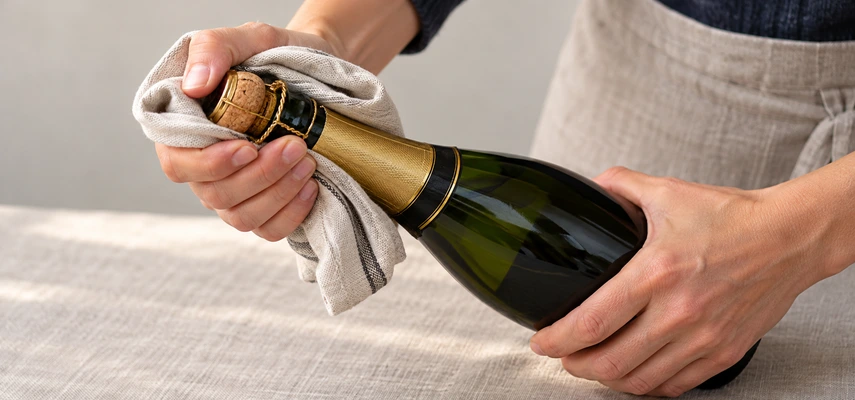
Hold the bottle at roughly 45 degrees, maintaining a firm grip on the cork, with a cloth if helpful. Turn the bottle rather than twisting the cork out aggressively. Let the pressure ease the cork gradually while resisting it, aiming for a quiet release rather than a flying projectile.
The Champagne region’s opening guidance supports this controlled approach. The principle matters more than a theatrical flourish: pressure is present even when the wine looks calm inside the glass.
Never aim at yourself while checking whether the cork is moving. If the bottle foams unexpectedly, maintain control and let it settle rather than trying to catch an escaping cork with your face near the neck.
Check appearance before assuming a fault
Following the opening, pour a small amount into a clean glass. Look at the wine’s clarity and colour in the context of its style and age. Unexpected cloudiness or an unusual colour may need investigation, but neither appearance nor sediment automatically establishes a fault in every wine.
Some wines contain harmless deposits or deliberately have less filtration. An older red can have sediment, while an oxidative style can be amber or brownish. Compare the observation with the wine expected, rather than judging all bottles against a young pale white.
The service question is practical: does anything look unexpected enough to pause and check? It doesn’t require pretending every wine must be completely identical in appearance.
Check the nose and the wine’s condition
After the appearance check, smell the sample for expected fruit and style, and for obvious unpleasant character. Damp-cardboard or musty character can suggest cork taint; unexpectedly stale, sherry-like character in a fresh wine can suggest oxidation. Heat exposure can also damage freshness.
Those examples are useful condition background, not a claim that every nutty aroma is faulty. A deliberately oxidative Sherry needs different expectations from a fresh Sauvignon Blanc. The wine’s intended style is part of the evidence.
If the sample seems questionable, use a fresh clean glass and seek a second check where appropriate before serving. Therefore, don’t mask a problem by overchilling the bottle or assume the guest needs to become accustomed to a fault.
Common misconceptions and exam traps
Room temperature doesn’t mean a hot room. Light reds aren’t excluded from chilling. Sparkling corks should be controlled, not launched. A screwcap doesn’t remove the need to check the wine, and sediment doesn’t automatically mean a bottle is spoiled.
For temperature questions, connect the precise style with its description. For opening questions, prioritize stability, cleanliness and pressure control. For appearance and aroma, judge the observation against the wine intended rather than a universal rule about all bottles.
A short service rehearsal
Imagine a light red has been stored in a cool cellar and a sparkling bottle is ready for the same meal. The first needs a light chill appropriate to its style, clean glasses and an ordinary controlled opening. The sparkling bottle needs well-chilled service and continuous pressure-aware cork control.
The two wines share presentation and condition checks, but their temperatures and opening hazards differ. As a result, applying one ritual to both would miss the point of knowing the type. The same principle explains why a fuller white shouldn’t automatically be served at the coldest possible temperature.
Rehearse the order without theatre: confirm the bottle, prepare suitable clean glassware, set temperature, open appropriately, check appearance and nose, then pour. Before the final pour, pause and investigate if a problem appears. Competent service makes the wine easier to enjoy; it doesn’t require drawing attention to every movement.
Knowledge check: 10 original questions
1. Which service description belongs with sparkling wine?
- Well chilled
- Hot
- Warm room temperature
- Never chilled
2. Which service description belongs with full-bodied white wine?
- Warm room temperature
- Lightly chilled
- Hot
- Always frozen
3. Which service description belongs with light-bodied red wine?
- Always frozen
- As warm as the kitchen
- Lightly chilled
- Well heated
4. What does room temperature for medium/full reds mean practically?
- Whatever a hot kitchen reaches
- At least 30°C
- Near boiling
- A cool room condition, roughly 15–18°C
5. Which sparkling-opening action is appropriate?
- Keep the cork controlled and point away from people
- Aim the cork toward a guest
- Shake vigorously first
- Remove control as soon as the cage loosens
6. When easing out a sparkling cork, which action is recommended?
- Warm the bottle rapidly
- Turn the bottle while controlling the cork
- Launch the cork for a loud pop
- Aim toward your face to inspect it
7. What is the first presentation check?
- Choose the heaviest bottle
- Assume all labels match
- Confirm the intended wine and relevant vintage
- Count the room’s chairs
8. Which glass condition is suitable?
- Strong detergent aroma
- Filled to the brim before checking
- Opaque and dirty
- Clean and free of distracting smells
9. Does sediment always prove a wine is faulty?
- No, interpret it in the wine’s context
- Yes, in every wine
- Only in older reds
- Only if the wine is dry
10. Which aroma can suggest cork taint?
- Expected nutty notes in oxidative Sherry
- Unexpected musty damp-cardboard character
- Normal fresh citrus in Sauvignon Blanc
- Expected toast in Champagne
Answers and explanations
1. A — Well chilled. The Level 1 category for sparkling wine is well chilled.
2. B — Lightly chilled. Full-bodied whites are lightly chilled in the prescribed categories.
3. C — Lightly chilled. The prescribed Level 1 category for light reds is lightly chilled.
4. D — A cool room condition, roughly 15–18°C. Modern warm rooms can exceed appropriate red-wine service temperature.
5. A — Keep the cork controlled and point away from people. Pressure requires continuous control and a safe direction.
6. B — Turn the bottle while controlling the cork. Controlled bottle rotation permits a gradual, quiet pressure release.
7. C — Confirm the intended wine and relevant vintage. Presentation helps ensure the right bottle is opened before technical service begins.
8. D — Clean and free of distracting smells. Clean appropriate glassware lets the wine’s appearance and aroma be evaluated.
9. A — No, interpret it in the wine’s context. Some wines naturally contain deposits, so context and other condition checks matter.
10. B — Unexpected musty damp-cardboard character. Unexpected mustiness is a useful condition warning, unlike characteristics normal to a style.
One-page revision summary
Sparkling and sweet: well chilled. Light/medium whites and rosés: chilled. Full whites and light reds: lightly chilled. Medium/full reds: cool room temperature. Use clean suitable glasses, confirm the bottle, open still wine steadily, control sparkling corks throughout, and check appearance and aroma before serving widely.











