










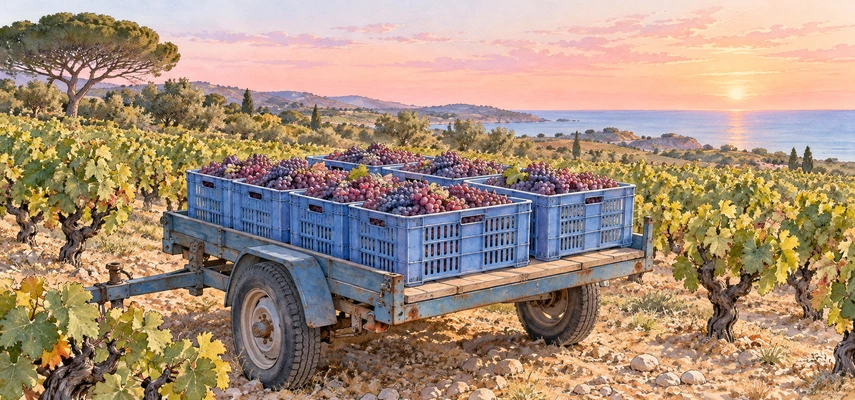

A pale Provence rosé and a dark, firm southern red can begin with some of the same grapes. The difference isn’t a contradiction. Site, harvest timing, blending and skin contact give a grower several ways to turn Mediterranean fruit into wine.
Southern French wines are easiest to understand as choices made within different growing environments and legal frameworks. Sunshine is abundant in many places, but keeping freshness, managing water and matching grapes to sites still require judgement. A warm climate doesn’t do the winemaking for you.
This is article 18 of The TFE Guide to WSET Level 3 Wine. It covers the southern French still-wine origins and grapes in the official specification, with original revision exercises rather than official examination questions.
Southern French wines: Start with the Mediterranean, then look closer
Languedoc follows the Mediterranean arc west of the Rhône. Roussillon lies further southwest towards Spain and the Pyrenees. Provence lies east of the Rhône, with coastal and inland vineyards. Warm, dry summers and substantial sunshine favour ripening across much of this broad area. Autumn rain can still interrupt harvest, and spring frost or hail can reduce the crop.
There are important local differences. Higher sites are generally cooler than nearby low ground; sea breezes can moderate coastal conditions. Western Languedoc can show more Atlantic influence. The regional Languedoc landscape guide stresses this contrast between coastal plains and inland slopes. Avoid treating the entire south as one uninterrupted hot vineyard.
Drying winds such as the Tramontane and Mistral can reduce humidity and disease pressure, but also increase water loss and damage shoots. Shallow soils with limited water storage may become a liability during prolonged drought. Severe stress can restrict photosynthesis and delay ripening. More sun and less water don’t produce an endlessly improving quality curve.
Vineyard decisions connect heat with the intended style
Growers match variety and rootstock to water availability, soil and intended yield. Low bush vines can suit some established southern vineyards, while trellising offers different options for canopy management and mechanisation. Neither training system wins automatically: access, wind, fruit exposure and labour all matter.
Canopy management needs a balance. Enough healthy, exposed leaves support ripening, while some bunch shade can protect against sunburn. Crop size must match the vine’s resources. Lower yields can support concentration where overcropping is a problem; a tiny drought-damaged crop isn’t automatically excellent fruit.
Harvest timing changes the result. Waiting may produce riper flavours and more sugar, but acidity may fall and potential alcohol rise. A fresh rosé producer may pick at a different balance from a producer seeking a full-bodied red. Harvesting during cooler hours and prompt delivery can reduce subsequent refrigeration needs and help protect delicate aromas.
Learn what the main red grapes contribute
Grenache can contribute ripe red fruit, body and alcohol. Syrah commonly adds dark fruit, colour, tannin and peppery or other spice notes. Mourvèdre needs a suitable warm, long growing season and can bring firm structure and savoury complexity. Cinsault contributes fruit and perfume, often with a lighter structural contribution, making it useful in rosé as well as red blends.
Carignan can supply acidity, colour and tannin. Vigorous cropping and insufficient ripeness can produce a tough result; well-managed fruit can instead make characterful wines. Old vines can be valuable, but age alone doesn’t establish quality. These grapes appear in different combinations across southern appellations, each with its own permitted varieties and production conditions.
Blend reasoning should explain a purpose: adding a more structured component can support a softer wine, while a fragrant component can lift its aromatic profile. A blend isn’t automatically more complex than a single-variety wine, and blending can’t repair every defect in the underlying fruit.
Pays d’Oc: A broad IGP framework
Pays d’Oc IGP covers wines from Languedoc-Roussillon and is closely associated with varietal labels. Its official introduction describes both single-variety wines and blends. Cabernet Sauvignon and Merlot are important alongside southern grapes. Cabernet can contribute black fruit and firm structure; Merlot often provides plum fruit and a rounder palate, with site and ripeness modifying both.
For whites, Chardonnay, Sauvignon Blanc and Viognier provide different starting points. Chardonnay can support a fresh, neutral-vessel style or a richer oak-influenced wine. Sauvignon benefits from sites and picking decisions that retain acidity and aromatic freshness. Viognier can offer peach, apricot and floral aromas, but excessive ripeness can leave insufficient freshness. The Pays d’Oc grape guide documents this regional palette.
An IGP framework allows choices that differ from individual AOCs; it doesn’t remove origin and production requirements. Efficient production and an understandable varietal label can support commercially accessible wines, while ambitious examples may use selected parcels and costly maturation. IGP isn’t a universal synonym for cheap or simple.
Languedoc, Minervois, Corbières and Fitou
Languedoc AOC is the broad regional appellation, with red, rosé and white wines. More specific origins have their own boundaries and rules. The appellation framework helps separate the broad name from local identities. Don’t infer that every wine made geographically in Languedoc can use every appellation name.
Minervois, north of the Aude valley towards the Montagne Noire, combines lower, warmer ground with higher foothill sites. Reds are prominent, commonly using southern varieties including Syrah, Grenache and Mourvèdre; rosé and white wines also exist. The Minervois profile describes its variation in altitude and maritime influence. Choosing a cooler site can alter ripening and freshness even within one origin.
Corbières, south of the Aude valley, is another varied landscape of hills and valleys. Carignan, Grenache, Syrah and Mourvèdre are important red grapes. Red wines dominate, with rosé and white also produced. The Corbières account connects soils, relief and winds with ripening differences. Ripe fruit and measured extraction can produce structured wines without making every example equally powerful or heavily oaked.
Fitou makes red wines and has two distinct sectors: one near the Mediterranean and another inland in the Corbières hills. Carignan and Grenache are important, with Syrah and Mourvèdre also used. Its official regional profile explains this coastal-inland split. That distinction is more useful than assuming one soil, exposure or temperature describes the whole appellation.
Picpoul de Pinet: A white-wine contrast
Near the Thau lagoon, Picpoul de Pinet makes white wines from Piquepoul Blanc. The grape name and appellation spelling differ slightly, which can make revision notes look untidy even when they’re correct. Coastal influence can moderate conditions; careful timing and protected handling preserve freshness.
The regional appellation profile identifies the grape and coastal setting. A typical dry example offers refreshing acidity and citrus fruit. Neutral-vessel fermentation generally suits that direct, youthful style. Assess balance and fruit clarity rather than expecting the oak or weight of an ambitious Chardonnay.
Roussillon: Heat, wind and differences within the hills
Roussillon occupies a Mediterranean setting around Perpignan, framed by mountains. Côtes du Roussillon produces red, rosé and white wines. For reds, Grenache, Carignan, Syrah and Mourvèdre are useful reference grapes; white varieties include Grenache Blanc and Macabeu. The interprofession’s appellation guide describes varied soils, terraces and hills.
Warm, dry conditions support ripe fruit, while elevation, exposure and available water influence how quickly it develops. A higher or less exposed site may help retain freshness; adequate water remains necessary. On difficult slopes, vineyard work and harvest can require substantial labour. Those costs don’t guarantee a better wine, but they help explain why small-production bottles may cost more.
Côtes du Roussillon Villages is a dry-red appellation with more restrictive production conditions. Its current official profile distinguishes it from the broader three-colour appellation. Grenache, Syrah, Mourvèdre and Carignan contribute to blends that may have considerable concentration and structure. Exact style still depends on fruit and winemaking; “Villages” doesn’t mean every bottle is ready only after long ageing.
Provence: Rosé colour comes from decisions
Côtes de Provence is a broad, varied appellation strongly associated with dry rosé, though red and white wines also exist. Grenache, Cinsault, Syrah and Mourvèdre are among the useful rosé grapes. The appellation overview describes a territory spanning different geological and climatic settings.
Direct pressing limits skin contact and can produce pale juice. Short pre-fermentation maceration extracts additional colour and flavour before separation. Controlled fermentation preserves delicate fruit; avoiding malolactic conversion can retain acidity. These are choices within a style, not proof that every producer follows an identical recipe. The regional rosé production guide explains these priorities.
Pale colour doesn’t establish dryness, quality or a lack of flavour. Evaluate those separately. Some rosés receive lees ageing or oak treatment for texture and complexity; others aim for an immediate, fruit-led character. Both can succeed when their components are balanced.
Bandol: Mourvèdre has the time to ripen
Bandol, on the Provençal coast west of Toulon, is particularly associated with Mourvèdre. Warmth, sunshine and a long season help this late-ripening grape develop. Its growers’ grape account links Mourvèdre with the structure and development potential of red wines, and with the character of rosé.
Concentrated reds can combine dark fruit, firm tannin and savoury notes. Suitable maturation can help integrate structure, but new oak isn’t a compulsory flavour. Bandol also makes rosé and white wines: it isn’t a red-only appellation. Nor is a Bandol rosé necessarily identical in weight or drinking window to a straightforward pale Côtes de Provence example.
Explain quality and price through separate evidence
For quality, consider balance, intensity, complexity and length. A powerful red needs sufficient fruit to support tannin and alcohol; a delicate rosé needs clarity, freshness and a satisfying finish. Colour intensity, vine age and appellation prestige aren’t substitutes for that assessment.
For price, connect difficult slopes, crop losses and hand work with grape costs. Sorting, refrigeration, barrels and stock holding affect production expense. Efficient mechanisation and earlier release can reduce unit costs where appropriate. Transport, storage, applicable taxes and trade margins add to retail prices. Demand, reputation and scarce supply can generate premiums. A higher price may reflect several of these mechanisms rather than a proportionate increase in quality.
Knowledge check: 10 original multiple-choice questions
Choose one correct answer per question. These are independent practice questions.
1. Why can inland southern slopes differ from nearby coastal plains?
2. Which is a possible disadvantage of strong drying winds?
3. What is Pays d’Oc particularly associated with?
4. Which description of Carignan is most useful?
5. Which statement correctly describes Fitou?
6. Which grape is associated with Picpoul de Pinet?
7. What distinguishes Côtes du Roussillon Villages from the broader appellation?
8. How does direct pressing help create a pale rosé?
9. Why is Bandol a useful context for Mourvèdre?
10. Which is the soundest quality assessment?
Answers and explanations
1. A — Local growing conditions. Elevation, aspect and proximity to maritime influences can change temperatures and ripening opportunities. The Mediterranean climate provides a starting point, but doesn’t erase differences between higher inland parcels and lower coastal vineyards.
2. D — A trade-off. Drying winds can reduce humidity and some disease pressure while also increasing water loss or damaging shoots. Good answers explain both sides rather than treating a named wind as an unqualified benefit in every site and season.
3. B — A broad IGP. Pays d’Oc offers a wide permitted grape palette and many varietally labelled wines. It still has geographical and production requirements. Its framework differs from individual AOCs without automatically determining the ambition, price or quality of every bottle.
4. C — Conditions and management matter. Carignan can contribute useful acidity, colour and tannin. Crop level, site and ripeness affect whether those elements are balanced. An old vineyard can be valuable, but age alone doesn’t guarantee healthy fruit or a well-made wine.
5. A — Two sectors, red wines. Fitou includes coastal and inland areas and produces red wines. Their different positions help explain variation in growing conditions. Avoid transferring another appellation’s white-wine identity or assuming uniform exposure across the whole origin.
6. D — Piquepoul Blanc. Picpoul de Pinet is a white-wine appellation associated with this grape and a fresh, typically dry style. Its coastal setting and suitable picking and cellar decisions help explain freshness; the appellation name alone isn’t the entire mechanism.
7. B — A distinct dry-red framework. Côtes du Roussillon Villages has its own production conditions and applies to dry red wine. Côtes du Roussillon has a broader colour range. Neither designation requires a fixed new-oak flavour or a particular drinking window for every bottle.
8. C — Less skin extraction. Limiting contact with red grape skins can reduce pigment and tannin extraction. Direct pressing is therefore useful for a pale rosé style. Actual colour also depends on grapes and handling, and it doesn’t independently establish sweetness or quality.
9. A — Time and warmth for ripeness. Bandol’s conditions can help late-ripening Mourvèdre achieve useful maturity. Its tannin and savoury potential contribute to regional styles. Bandol also makes rosé and white wines, and oak flavour isn’t the same thing as maturation.
10. D — Evidence in the glass. Balance, intensity, complexity and length provide a basis for explaining quality. Colour, alcohol and price may offer context, but none guarantees a superior wine. Compare the result with its intended style rather than rewarding the most powerful example automatically.
Written exercise 1: Preserve rosé freshness in five marks
Question: Explain five choices that can help a southern French producer make a pale, fresh, dry rosé. Give a different mechanism for each point. This is an original five-mark practice exercise.
Model answer: Harvest timing can retain sufficient acidity before excessive sugar accumulation. Keeping harvested fruit at a low temperature slows deterioration and reduces the cooling needed before processing. Gentle direct pressing limits pigment and tannin extraction. Controlled fermentation temperature helps preserve delicate fruit aromas. Fermenting most available sugar to dryness produces a dry palate rather than relying on pale colour to imply low sweetness.
Why it earns credit: Award one practice mark each for harvest balance, fruit temperature, limited skin extraction, fermentation temperature and fermentation to dryness. These are five separate effects. Simply writing “modern technology” or claiming all pale wines are dry doesn’t explain them. This is independent guidance, not an official WSET marking scheme.
Written exercise 2: Explain a structured southern red in five marks
Question: Explain five links between grapes, site and cellar decisions that can support a balanced, structured Bandol red. Don’t assume that maximum extraction or new oak is necessary.
Model answer: A warm, long growing season helps late-ripening Mourvèdre reach adequate maturity. Matching crop size to the vine’s resources supports ripening rather than leaving excessive fruit underdeveloped. Suitable canopy management protects bunches from excessive sun while retaining active leaves. Measured extraction obtains useful tannin and colour without excessive bitterness. Appropriate maturation allows the wine’s components to integrate while retaining enough fruit to balance its structure.
Why it earns credit: Award one practice mark each for seasonal suitability, crop balance, canopy, extraction and maturation, with the relevant consequence stated. “Bandol is expensive” doesn’t explain any of them. Mourvèdre contributes potential, while site and decisions determine the result. These original marking points aren’t official examination criteria.
One-page revision summary
| Origin or concept | Connection to remember |
|---|---|
| Mediterranean conditions | Sunshine and warmth support ripening. Wind, drought, elevation and maritime influence create trade-offs and local variation. |
| Pays d’Oc IGP | Broad varietal and blend possibilities include Cabernet Sauvignon, Merlot, Chardonnay, Sauvignon Blanc and Viognier. Rules still apply. |
| Languedoc AOC | The regional appellation is distinct from the broad geographical region and more specific local origins. |
| Minervois | North of the Aude valley towards the Montagne Noire. Altitude and exposure modify a largely Mediterranean setting. |
| Corbières | Southern red blends are prominent in a varied hill-and-valley landscape. Fruit and extraction shape the structure. |
| Fitou | Red wines from separate coastal and inland sectors. Carignan and Grenache are important alongside Syrah and Mourvèdre. |
| Picpoul de Pinet | White wines from Piquepoul Blanc near Thau. Protected handling and suitable harvest timing support a fresh style. |
| Côtes du Roussillon | Red, rosé and white wines from varied terraces and hills. Warmth needs to be considered alongside water supply. |
| Côtes du Roussillon Villages | A distinct dry-red framework. More restrictive conditions don’t remove variation between producers or vintages. |
| Côtes de Provence | Dry rosé is prominent. Direct pressing and controlled fermentation help preserve pale colour and delicate fruit. |
| Bandol | Warm conditions can ripen Mourvèdre. Structured reds coexist with rosé and white wines. |
| Quality and price | Assess the wine’s balance and finish. Explain labour, cellar, transport, margins and market demand separately. |
A useful tasting comparison
Compare a fresh Picpoul de Pinet, a dry Provence rosé and a southern red blend using modest pours. Record acidity, alcohol, body, flavour intensity and finish. In the red, separate tannin quantity from tannin texture. Ask which grape and cellar decisions might explain each observation, then identify what remains uncertain. A pale colour or a spicy aroma won’t establish an exact appellation on its own.
Sources and course context
Linked primary sources include the official WSET specification, regional and appellation organisations, growers’ grape information and the current INAO profile for Côtes du Roussillon Villages. Profiles are used for geographical and production context, with marketing superlatives, fixed production statistics and unsupported soil-to-flavour claims excluded. Legal grape percentages aren’t reproduced here.
Continue your studies: Articles 2 and 4 explain vineyard conditions and management. Article 5 covers white and rosé production; article 6 covers reds. Article 15 provides a Rhône blending comparison, and article 44 develops analytical tasting.












