











Fortified Muscat wines can smell of fresh grapes and blossom or arrive with the richness of raisins, nuts and toffee. That range makes more sense when you follow two decisions: when the producer stops fermentation, and how the wine matures afterwards. Sweetness connects these examples; their treatment of fresh fruit takes them in different directions.
This WSET Level 3 guide compares Muscat de Beaumes-de-Venise in France with Rutherglen Muscat in Australia. The official specification asks you to connect grape, environment and production with style, quality and price. Learn those connections before memorising a tasting description. A list of aromas can’t explain why they developed.
Muscat is the grape clue; origin supplies the rest
Muscat is a family of aromatic varieties, rather than a promise that every wine carrying the name will taste identical. Here the important reference is Muscat à Petits Grains. Its expressive grape and floral character gives producers something worth preserving, even when their eventual wines are deeply developed.
Muscat de Beaumes-de-Venise is a protected vin doux naturel, or VDN, from the southern Rhône. Its rules permit white and dark forms of Muscat à Petits Grains, and white, rosé and red wines. The familiar white example shouldn’t become a claim that every permitted wine is white. The appellation specification establishes those distinctions.
Rutherglen, in north-eastern Victoria, uses Brown Muscat, also called Muscat à Petits Grains Rouge. Meanwhile, Topaque is made from Muscadelle, a different grape. Similar bottles, sweetness and cellar traditions don’t make them synonyms. Campbells’ explanation separates the varieties, a useful check before comparing production.
Two warm environments, with different local details
Around Beaumes-de-Venise, a warm Mediterranean climate supports the accumulation of sugar in ripe fruit. Vineyards occupy southern slopes and terraces near the Dentelles de Montmirail, whose shelter moderates the Mistral’s force. Aspect affects sun exposure; altitude can moderate temperature. Neither word should be used as an automatic guarantee of superior grapes.
The Inter Rhône regional profile describes sandy-clay *Terres Blondes*. Soil matters through water supply, drainage and vine growth. It doesn’t directly insert a recognisable rock flavour into sweet wine. Proximity to the sea influences the broader Mediterranean setting, but these inland vineyards aren’t beachside plantings cooled uniformly by daily sea breezes.
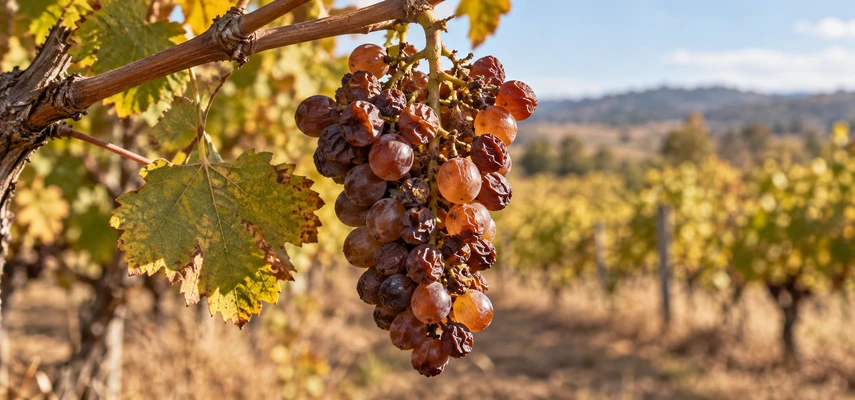
By contrast, Rutherglen has a warm continental climate, with hot summers and a long, usually dry autumn. That extended season allows very ripe grapes to remain on the vine, sometimes partly shrivelling as water is lost. Night temperatures can fall with cool air from the Victorian Alps’ foothills. Wine Australia’s regional sheet also distinguishes red loam over clay from sandier soils near the Murray River.
Rutherglen’s inland location limits direct maritime moderation. Local altitude, exposure and soil water availability still matter, but describing the entire region as a cold mountain vineyard would miss the warmth needed for this fruit. The useful comparison is between site conditions and intended ripeness, rather than a contest to identify whichever region sounds cooler.
Late picking builds concentration and brings risk
For Rutherglen Muscat, waiting for very high ripeness can build sugar and rich fruit flavour. Partial dehydration further concentrates the juice. Later picking isn’t an instruction to leave every bunch indefinitely: rain, rot, birds and excessive shrivelling can reduce usable fruit. A grower needs sound grapes, not simply the highest possible sugar reading.
Less water also means less juice from a given weight of fruit. That affects the volume available to sell, while extended vineyard exposure can require extra monitoring and selection. Compare these practical consequences with the concentration methods in #7. On-vine raisining isn’t the same operation as drying harvested grapes on mats.
In Beaumes-de-Venise, hand harvesting and selection support the collection of ripe, sound bunches. Different parcels or passes can reach the desired condition at different times. The growers’ appellation overview helps distinguish this sweet Muscat identity from other wines bearing the village name. Don’t assume that the unqualified words Beaumes-de-Venise identify a fortified white wine.
Crushing, pressing and fermentation prepare the style
Crushing breaks berries and releases juice; it doesn’t mean grinding seeds into a paste. Pressing separates liquid from skins and other solids. Their timing changes the opportunity to extract skin-derived aroma, colour and texture. With aromatic Muscat, preserving appealing perfume and avoiding unnecessary bitterness are useful aims.
For a fresh white Muscat de Beaumes-de-Venise, protective handling and controlled fermentation help retain floral and fruity expression. Skin contact can be used, but its duration and the exact sequence vary by producer. A press, a tank and a temperature setting are tools: explain their intended effects rather than pretending there is one universal cellar timetable.
Rhonéa’s Origine 1348 account gives a concrete example of harvesting during cooler hours and stopping fermentation with grape alcohol. Domaine de Durban’s technical sheet records controlled fermentation and concrete-tank maturation. These examples show choices within a style; they don’t make every detail compulsory across the appellation.
Meanwhile, Rutherglen’s very ripe Brown Muscat can undergo a short fermentation on skins before pressing and fortification. This provides useful flavour and colour extraction while much grape sugar remains. Stanton & Killeen describes that sequence. Its account also shows why the mature wine’s colour cannot be attributed solely to new oak or solely to the original skin colour.
Fortification to stop fermentation keeps grape sugar
During fermentation, yeast converts sugar into alcohol and carbon dioxide. Adding sufficiently strong grape spirit before the sugar is exhausted raises alcohol to a level at which fermentation stops. The wine retains unfermented grape sugar. The spirit raises alcoholic strength; it isn’t a spoonful of sugar disguised as a cellar operation.
In French VDN production, this intervention is called mutage. The word *naturel* refers to the grape origin of the retained sugar, not an absence of fortification or a certification for “natural wine.” Inter Rhône’s mutage explanation makes that distinction explicit. A wine can therefore be both naturally sweet in this sense and deliberately fortified.
The timing needs to suit the starting must and intended balance. Earlier stopping generally leaves more sugar than allowing the same must to ferment farther. However, final sweetness also depends on initial grape concentration and subsequent production. Avoid predicting the exact sugar level from alcohol alone: the fortifying spirit and the finished bottle have very different strengths.
Inert maturation favours fresh Muscat expression
For the familiar fresh Beaumes-de-Venise style, inert maturation in suitable tanks limits the oxygen influence associated with extended cask ageing. The aim is to keep the grape’s perfume prominent, with floral, grapey and stone-fruit notes alongside sweetness. Concrete or stainless steel needn’t impart a recognisable wood flavour.
After fermentation, clarification, careful storage and bottling help present that intended character. “Inert” doesn’t mean that absolutely no change occurs, or that every example must be drunk immediately. It describes the producer’s maturation aim. Don’t give a universal maximum bottle age when individual wines and storage conditions vary.
Oxidative maturation builds Rutherglen’s developed richness
In Rutherglen, oxidative maturation in seasoned wooden casks encourages a different direction. Oxygen exposure and time promote developed dried-fruit, nutty and caramel-like complexity. Evaporation reduces volume and can increase concentration. Cask size, condition, position and cellar temperature all affect the pace; wood ageing isn’t one uniform treatment.
Seasoned wood allows development without requiring a dominant new-oak vanilla flavour. Warm cellar conditions can accelerate change, but this isn’t a claim that the wine must undergo Madeira’s deliberate heating methods. Nor does oxidative maturation mean a faulty, carelessly exposed wine. The producer is seeking controlled development while retaining balance and an appealing finish.
Later, blending brings together parcels with different ages and characters. Younger material can refresh fruit expression, while mature stocks add depth. Campbells describes its modified solera system, used to maintain a recognisable house style. This shouldn’t be converted into a rule that every Rutherglen cellar uses an identical Sherry-style arrangement or physically stacks every cask in tiers.
Read the Rutherglen tiers as style guidance
The progression is Rutherglen Muscat, Classic, Grand and Rare. It broadly moves toward greater maturity, richness, concentration and complexity. Campbells’ classification guide presents indicative average-age bands of 3–5, 6–10, 11–19 and 20-plus years respectively. These are useful orientation, rather than a vintage date or four universal minimum ages for every component.
An individual producer’s blend can have a different average from a general guide. More years alone don’t guarantee a more satisfying wine: fruit definition, integration, length and balance still count. A sticky, hot finish doesn’t become elegant simply because a barrel has occupied the cellar for decades. The darker wine also isn’t automatically the sweetest without further evidence.
Quality and price: follow the work and the wine
Assess whether sweetness and alcohol support the flavour rather than dominate it. Look for intensity, length, complexity and a coherent finish. A fresh Muscat can succeed through vivid, well-balanced fruit; an older Rutherglen can succeed through layered development. They don’t need to imitate one another to be good examples of their intended styles.
For price, separate grape costs, winery production costs, transport, margins and market forces. Selection and reduced juice yield affect grapes; spirit, vessels, blending, storage and tied-up stock affect production. Evaporation further reduces saleable volume. Shipping, distribution margins, scarce aged stocks and demand then influence the price a customer sees. Age is one contributor within that chain.
Finally, compare the wines using the same tasting structure in #44 and the quality reasoning in #45. Identify freshness or development first, then explain the production choice that could support it. Keep a sensory observation separate from a certainty about origin: a raisin aroma by itself cannot prove Rutherglen, just as sweetness cannot prove fortification.
Knowledge check: Fortified Muscat
1. Why does early fortification preserve sweetness?
2. Which grape produces Rutherglen Topaque?
3. Which environment best supports the classic Rutherglen harvest aim?
4. What does pressing primarily achieve?
5. Which choice best preserves fresh Muscat perfume during maturation?
6. What can prolonged seasoned-cask maturation contribute?
7. What does an indicative average age mean for a blended Muscat?
8. What does naturel mean in the VDN context described here?
9. Which statement about partly shrivelled Rutherglen fruit is defensible?
10. Why can prolonged maturation increase cost?
Answers and explanations
1. C — Sugar remains at the intervention. Raising alcohol stops yeast activity before the must runs dry. The retained grape sugar supplies sweetness.
2. B — A different grape. Topaque uses Muscadelle; Rutherglen Muscat uses Brown Muscat. Similar production doesn’t make their grape names interchangeable.
3. D — Time to achieve high ripeness. A long, usually dry autumn supports late picking and potential on-vine concentration. Rain and rot remain risks.
4. A — Separating the liquid. Pressing recovers juice or wine from solids. Its timing affects skin contact, but pressing itself doesn’t ferment sugar.
5. C — Limit unwanted oxygen influence. Protective handling and suitable tanks favour fresh aromatic expression. They don’t require prolonged oxidative development.
6. B — Development and reduced volume. Time, oxygen influence and evaporation help create mature richness. Seasoned wood needn’t supply strong new-oak flavour.
7. D — A blend includes different parcels. An average doesn’t impose an identical age on each component. Classification also concerns style and development.
8. A — Grape-derived sweetness. VDN production includes fortification during fermentation. The term doesn’t mean unfortified, organic or untouched by people.
9. C — Dehydration changes concentration. Some water can be lost while berries remain attached to the vine. This differs from drying picked grapes on mats.
10. B — Time consumes resources. Storage and financing costs accumulate, while evaporation reduces the quantity eventually available to bottle and sell.
Written exercise 1: Explain retained sweetness (5 marks)
Explain how ripe Muscat grapes become a sweet fortified wine, giving five linked points from fruit to fermentation arrest.
Model answer: Ripe grapes provide sugar in the juice. Crushing releases that juice from the berries. Yeast starts fermentation, converting some sugar into alcohol. Grape spirit is added before all the sugar has been consumed, raising alcoholic strength enough to stop fermentation. Unfermented grape sugar consequently remains, giving the wine sweetness.
Why it earns credit: Award one mark each for (1) grape sugar, (2) crushing and juice release, (3) yeast conversion, (4) spirit raising alcohol to stop fermentation and (5) retained sugar causing sweetness. Adding spirit only after a fully dry fermentation would not preserve sugar already consumed.
Written exercise 2: Compare maturation aims (5 marks)
Compare relatively inert maturation for fresh Muscat de Beaumes-de-Venise with prolonged oxidative maturation for Rutherglen Muscat, explaining five consequences or choices.
Model answer: Suitable tanks limit the oxygen influence sought in oxidative cask ageing, helping fresh Beaumes-de-Venise retain grape and floral expression. Seasoned wooden casks allow Rutherglen Muscat to develop oxidative dried-fruit and nutty complexity without requiring strong new-oak flavour. Evaporation reduces volume and can concentrate the wine. Blending younger and older stocks helps balance freshness with mature depth. Extended storage and capital tied up in those stocks add production costs.
Why it earns credit: Award one mark each for (1) protective vessel and fresh expression, (2) seasoned-cask oxidative development, (3) evaporation and concentration, (4) the blending purpose and (5) time-related costs. Simply saying “one is young and one is old” leaves the mechanisms unexplained.
One-page revision summary
| Idea | Anchor | Explain the consequence |
|---|---|---|
| Muscat de Beaumes-de-Venise | Southern Rhône protected VDN | Don’t confuse it with every wine bearing the village name |
| Grape | Muscat à Petits Grains; white and dark forms permitted | Familiar white style isn’t the only permitted colour |
| Beaumes environment | Warm Mediterranean, sheltered southern slopes | Ripeness, exposure and water management shape the fruit |
| Rutherglen | Inland north-eastern Victoria | Warm continental setting and long autumn support late picking |
| Brown Muscat | Muscat à Petits Grains Rouge | Distinguish Muscadelle, the Topaque grape |
| Late harvest | Very ripe fruit, sometimes partly raisined on the vine | Concentration, reduced juice yield and weather risks |
| Crushing / pressing | Release juice / separate liquid from solids | Manage extraction and avoid unnecessary bitterness |
| Fortification during fermentation | Raise alcohol before sugar is exhausted | Retain grape sugar; spirit doesn’t create that sugar |
| VDN / mutage | Grape-derived sweetness / fermentation arrest | Naturel doesn’t mean unfortified |
| Inert maturation | Suitable tanks and protective handling | Preserve fresh grape, floral and fruit character |
| Oxidative maturation | Seasoned casks, time, oxygen and evaporation | Developed richness, concentration and volume losses |
| Blending | Combine stocks with different ages and character | Balance freshness and depth; maintain house style |
| Rutherglen / Classic / Grand / Rare | Broad progression in mature richness and complexity | Indicative averages aren’t identical ages for every component |
| Quality | Balance, length, intensity and complexity | Greater sweetness or age alone isn’t proof of quality |
| Price | Grapes, production, transport, margins, market forces | Explain the particular cost rather than merely naming “premium” |
Taste a fresh fortified Muscat beside a developed Rutherglen example. Record the aromas first, then explain how harvest concentration, fortification and maturation could account for the difference. Use small samples and spit when practising.











