










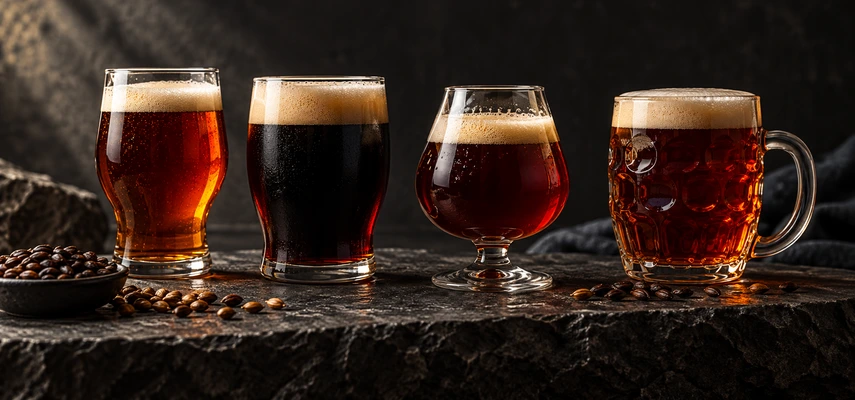

Dark malt-driven beers can suggest bread crust, nuts, caramel, coffee or chocolate, yet they don’t all belong to the same sensory family. A smooth brown lager, a roasted stout and a strong barley wine can share a malt emphasis while delivering very different experiences.
The first useful correction is to separate color from strength, sweetness and body. A nearly black beer can be comparatively modest in alcohol and finish dry. A copper-colored beer can be strong and rich. Darkness is an observation, not a shortcut to the rest of the description.
Malt treatment explains much of the range
More deeply treated malts and roasted grain materials can introduce darker colors and toastier or more roasted associations. How much is used matters as well as which product is chosen. A small intense contribution can change a recipe without becoming its largest ingredient.
The official specification groups these styles as malt-driven examples brewed with some specialty malts. That is a useful study structure, not a universal recipe law. Some real barley wines, for instance, derive much of their richness from a large pale-malt foundation and process rather than requiring an obvious roasted component.
Keep two questions separate: what sort of malt character is present, and how intense is the whole beer? Bread crust, caramel and coffee belong to different parts of the descriptive range. None establishes a particular amount of residual sweetness by itself.
Munich dunkel: dark bread rather than burnt toast
Munich dunkel commonly appears copper-brown to deep brown, often with a reddish glow when held to light. It can be clear despite its darkness, with cream to tan foam. Its aroma and flavor emphasize rich bread, toasted bread crust and sometimes gentle chocolate-like associations rather than an aggressively burnt character.
Bitterness is supportive, typically keeping the malt from becoming cloying rather than leading the flavor. Hop aroma is usually modest, with traditional herbal or spicy possibilities. Sweetness can seem rounded or malty, but the finish should not be understood as a syrup requirement. Body is commonly medium to somewhat fuller, with a smooth lager impression.
The ingredients center on a rich malt foundation, often involving Munich malt and appropriate darker contributions. Lager yeast and cold maturation help keep overt fermentation fruitiness restrained. The BJCP dunkel description supports the distinction between rich toasted malt and harsh roast.
Compare it first with helles: both can be clean, malt-led lagers, but dunkel has a darker and toastier expression. Compare it next with porter or stout: dunkel generally avoids making a strong coffee-like roast the defining feature. Calling all three “dark” would miss the useful contrast.
Brown ale: nutty and toasty possibilities
Brown ale commonly ranges through amber-brown to deeper brown, often clear, with off-white to tan foam. Aroma can suggest nuts, bread, toast, caramel or light chocolate. The exact mixture varies with regional interpretation, so the name covers a recognizable area rather than one single recipe.
In a traditional British-oriented example, malt often leads with gentle caramel or nutty character. Bitterness is balancing rather than aggressively sharp, and light fruity fermentation character may appear. Sweetness can be modest or softly malty; body is commonly medium-light to medium rather than automatically heavy.
Pale malt supplies the foundation while specialty malts create much of the color and character. Ale yeast and fermentation contribute another potential difference from dunkel’s cleaner lager profile. The BJCP British brown ale reference provides a useful example, while American interpretations can be more hop-forward.
The distinguishing idea is gentle toasty or nutty malt character without requiring the deeper roast of stout. Compared with a Belgian dubbel, brown ale usually doesn’t make pronounced yeast-derived fruit and spice the central story. Similar color should not erase different causes.
Porter: chocolate and roast within a broad tradition
Porter commonly appears brown to very dark brown, sometimes nearly black, with tan foam. Aroma and flavor can suggest chocolate, toast, caramel or coffee, depending on the interpretation. A dark center doesn’t mean the beer must be opaque when a small edge catches the light.
Bitterness can come from the overall hop and roast balance and varies across examples. Sweetness may be restrained or moderately malty, with body ranging from comparatively light to fuller. There is no useful Level 1 rule that every porter is sweet, strong or thicker than every stout.
The usual ingredient foundation combines pale malt with darker materials, fermented as an ale in many familiar examples. The BJCP English porter description illustrates a chocolate-and-toast direction without demanding the sharply roasted profile associated with some stouts. Other porter traditions broaden the range, so avoid importing every substyle into this introductory comparison.
Porter and stout overlap historically and sensorially. Recognizing that overlap doesn’t make the terms identical. For a question that supplies more detail, use the actual balance of roast, sweetness, body and fermentation rather than relying on a rigid color boundary.
Stout: a stronger roast signal, not always stronger alcohol
Stout is often deep brown to black, with tan or brownish foam. Coffee-like, roasted and dark-chocolate-like aromas are common reference points. The word stout can make a beginner expect an enormous beer, but alcohol strength and body vary substantially across the wider family.
A dry Irish-style example can combine pronounced roast, firm bitterness and a comparatively dry finish with less body than its appearance suggests. Other stouts are sweeter or fuller. The BJCP Irish stout reference is useful precisely because it challenges the assumption that black means sugary and heavy.
Dark roasted grain materials help shape that character; they need not all be the same kind of malt. Ale fermentation is typical in familiar examples. Some serving methods also influence the creamy-looking foam, but that presentation is not evidence that every stout contains cream or lactose.
The practical contrast with porter is one of tendencies, particularly the prominence and type of roast. It is not a universal strength ranking. When recommending either, ask whether the drinker wants dry roast, soft chocolate-like malt, sweetness or fullness rather than treating the name as a complete sensory forecast.
Barley wine: richness through concentration and strength
Barley wine is beer, despite its name. Color can range from golden or copper through deeper amber and brown, with clarity and head varying by example. The defining impression is generally substantial malt richness and high alcohol rather than a compulsory black color or coffee roast.
Aroma and flavor can suggest bread, toffee, caramel or dried fruit, with warming alcohol and varying hop character. Sweetness may be noticeable, but balancing bitterness can also be substantial. Body is commonly full, and the overall experience is more concentrated than the lighter malt-driven beers studied earlier.
A large malt contribution supplies the potential fermentable material for that strength. Fermentation, recipe and maturation influence how much sweetness and fruit-like complexity remain. The BJCP English barley wine reference illustrates a rich malt-oriented interpretation; other versions can put hops more prominently forward.
Compare barley wine with brown ale by intensity and strength, not just caramel notes. Compare it with Belgian dubbel by the relative importance of malt richness and yeast-derived fruit or spice. One shared dried-fruit descriptor cannot establish that two beers have identical production or style identity.
A comparison that separates the useful clues
| Style | Leading malt associations | Useful production distinction | Avoid assuming |
|---|---|---|---|
| Munich dunkel | Bread crust, rich toast | Lager fermentation | All dark beer is ale |
| Brown ale | Nuts, caramel, light toast | Usually ale, regional variation | All brown ales are equally hoppy |
| Porter | Chocolate, toast, variable roast | Broad overlapping traditions | Always weaker than stout |
| Stout | Coffee, roast, dark chocolate | Roasted grain contribution | Always sweet or full-bodied |
| Barley wine | Concentrated malt, toffee, dried fruit | Strong beer from substantial fermentables | Must be black or actually wine |
These descriptions give a way to compare, not a demand to find every listed aroma in every glass. An example may show two clearly and another only faintly. Recording intensity and balance makes the note more informative than simply copying a style’s vocabulary.
An optional comparison without a color shortcut
Choose two current producer descriptions, such as dunkel and dry stout, and cover their names. Underline every malt association, then separately mark sweetness, bitterness, strength and body. This paper exercise works without alcohol and exposes how much information the word dark fails to provide.
If you choose to taste, use small samples and follow local age rules. Compare perceived roast first, then body and sweetness. The aim is descriptive learning, not a compulsory blind-identification test. A correct observation is more valuable than forcing a sample into the first category that comes to mind.
One-page revision summary
Dunkel emphasizes rich toasted malt within a clean lager pattern. Brown ale commonly offers softer nutty or caramel-like character. Porter and stout occupy overlapping dark-beer territory, with stout often giving roast more emphasis but no universal alcohol ranking. Barley wine emphasizes concentrated malt richness and strength.
For revision, connect ingredients and production with the sensory outcome. Specialty malt and roasted material can shape color and flavor; yeast and fermentation shape other parts of the profile. Keep darkness, roast, sweetness, body and alcohol separate long enough to understand how each contributes to the whole.
Knowledge check: 10 original practice questions
Independent TFE questions, not official WSET examination items. Choose one answer per question; explanations follow separately.
1. Which is typically a malt-driven lager with bread-crust character?
- Saison
- Munich dunkel
- Geuze
- American IPA
2. Which statement about dark color is accurate?
- It does not by itself establish alcohol or sweetness
- It always proves high alcohol
- It always means a full sweet beer
- It proves ale yeast was used
3. Which aromas suit a traditional brown ale comparison?
- Only intense grapefruit
- Only sharp lactic acidity
- Mandatory banana and clove
- Nutty, caramel-like and toasty
4. How should porter and stout be compared?
- Assume every stout is stronger
- Assume the names are entirely identical
- Recognize overlap while examining roast, body and balance
- Use bottle height as the deciding feature
5. What can a dry Irish-style stout demonstrate?
- Black beer always contains lactose
- Dark beer need not be sweet or very full-bodied
- Stout must have the highest alcohol
- Roast removes all bitterness
6. What is barley wine?
- A strong beer with substantial malt character
- Wine made only from grapes
- A compulsory sour lager
- A non-fermented grain drink
7. Which feature is not required of every barley wine?
- Substantial malt character
- A beer fermentation basis
- A generally strong impression
- Black color
8. Which comparison best separates dunkel from helles?
- Dunkel always contains fruit juice
- Helles contains no malt
- Dunkel usually has darker, toastier malt expression
- Only dunkel can use yeast
9. Why can chocolate-like porter lack added chocolate?
- Chocolate aroma proves fruit addition
- Dark grain treatment can create similar sensory associations
- All porter is made with cocoa
- Yeast cannot create any aroma
10. What should be recorded separately when comparing these beers?
- Color, roast, sweetness, body and alcohol
- Only color
- Only the word heavy
- Only whether the name sounds strong
Answers and explanations
1. B — Munich dunkel. Dunkel combines darker toasted malt with a comparatively clean lager fermentation profile. Mapping: LO2.
2. A — It does not by itself establish alcohol or sweetness. Color reflects ingredient and process contributions but cannot measure the other sensory dimensions. Mapping: LO2.
3. D — Nutty, caramel-like and toasty. Brown ale commonly emphasizes these malt associations, with variation by regional interpretation. Mapping: LO2.
4. C — Recognize overlap while examining roast, body and balance. The terms overlap, but individual sensory and production information matters more than a fixed strength rule. Mapping: LO2.
5. B — Dark beer need not be sweet or very full-bodied. Dry stout challenges common assumptions by combining dark roast with a dry finish and variable body. Mapping: LO2.
6. A — A strong beer with substantial malt character. Its name does not change its beer production basis; malt richness and alcohol are important clues. Mapping: LO2.
7. D — Black color. Barley wine spans colors and need not resemble the roast profile of a black stout. Mapping: LO2.
8. C — Dunkel usually has darker, toastier malt expression. The styles can share lager production while differing in their malt color and sensory expression. Mapping: LO2.
9. B — Dark grain treatment can create similar sensory associations. A sensory resemblance is not proof of an ingredient, so recipe claims need producer verification. Mapping: LO2.
10. A — Color, roast, sweetness, body and alcohol. Separating dimensions prevents one visual clue from supplying several unsupported conclusions. Mapping: LO2.












