










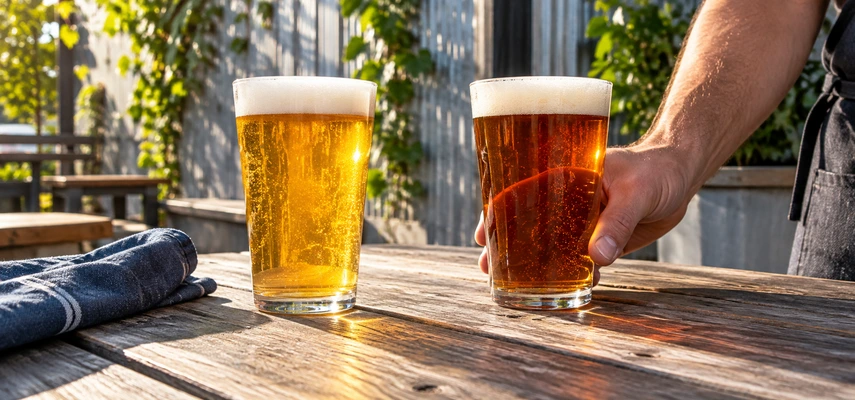

Make a pale ale a little darker and you have an amber ale, right? Sometimes the colors overlap enough to encourage that idea. American pale and amber ales are more usefully separated by what the malt is doing alongside the hops, not by holding a glass against a paint chart.
Both belong to the prescribed Level 2 hop-driven range. American pale ale usually gives hops a clearer lead over a supportive pale-grain base. American amber ale brings more caramel and malt substance into the conversation, while retaining a meaningful hop presence. Understanding that relationship is more reliable than memorizing two color adjectives.
Shared foundations, different balances
These styles generally use a pale malt foundation, American or other suitable contemporary hops, and an ale fermentation profile that leaves room for those ingredients. A little fruity yeast expression can fit, but pronounced weizen-like spice or banana is not the central comparison.
Both can have noticeable bitterness, lively carbonation and moderate alcohol. Neither needs to feel heavy or warming. Their different balances reflect grain choice, the amount of specialty material, hop use and the extent of fermentation rather than a mandatory strength gap.
The word American identifies a brewing tradition and style direction, not a requirement that every example be brewed within the United States. Ingredient availability and contemporary practice have carried both profiles into other brewing regions. The actual beer still needs to match its intended balance.
American pale ale: a hop-led pale framework
American pale ale, often abbreviated APA, typically appears pale gold to amber, generally clear, with a white-to-off-white head. Hop aroma is noticeable and may include citrus, floral, pine, resin, tropical fruit or other variety-dependent impressions. Grain, light bread or cracker supports it, with caramel usually restrained.
The palate combines moderate-to-high bitterness with enough malt to remain balanced. Body is commonly medium-light to medium, carbonation moderate to high, and the finish medium to dry. Alcohol is usually moderate and unobtrusive. Hop flavor and bitterness may persist, but harsh astringency is not the intended reward for choosing a hop-driven beer.
Pale malt supplies the working base, with small specialty additions possible. A restrained-to-gently-fruity ale culture helps preserve ingredient expression. Early, late and optional dry-hop additions can each contribute to the intended profile, so APA is not one fixed hopping schedule.
Compared with American blonde ale, the pale ale generally has more defining hop character and bitterness. Compared with American IPA, it usually has less alcohol and a less intense overall hop-and-bitter presentation. Some commercial examples approach the boundaries, but the comparison remains useful.
American amber ale: caramel meets contemporary hops
American amber ale commonly appears deep amber to copper-brown, sometimes reddish, with an off-white head. It is generally clear. Malt aroma is more developed than in the pale comparison, often with caramel and some toast or biscuit, while hop aroma can range from quiet to clearly noticeable.
Flavor combines meaningful caramel-like malt with contemporary hop expression and moderate-to-moderately-high bitterness. Body is medium to medium-full, carbonation medium to high, and alcohol ordinarily moderate. An opening sweetness can lead into a drier finish in which both malt and hops persist. The style need not become a sticky caramel drink.
Pale base malt plus medium or darker crystal contributions helps explain color and developed malt character. Hops may supply citrus, pine or other compatible notes, and fermentation is usually restrained or gently fruity. The goal is integration rather than making two loud ingredients clash.
Compared with APA, amber is generally fuller and more caramel-centered, often with a less bitter perceived balance even when hopping remains substantial. Compared with American brown ale, it has less chocolate-like or deeper dark-malt character. Compared with red IPA, it normally occupies a less intense strength-and-hop territory.
Why color overlap is not a problem
A darker pale ale and a lighter amber ale may look similar. Their names do not require a visible line to run neatly between every commercial sample. The more informative evidence is the prominence of caramel, the supporting grain profile and the overall malt-hop balance.
Color can be adjusted with relatively small grain contributions, while flavor depends on the entire recipe. A minor dark addition and a substantial caramel-malt share can have different sensory consequences even when the finished shades are close.
Therefore, use appearance to start the note, then continue. A beer does not become an amber ale simply because the light in the pub is dimmer, and a copper example does not prove it contains a particular crystal-malt product. Recipe evidence is stronger than a color guess.
The malt contribution is more than residual sugar
Caramel-like aroma can make a beer seem invitingly sweet before it reaches the palate. Actual sweetness depends on what remains after fermentation and how that material is balanced by bitterness, alcohol and other sensations. The aromatic comparison should not be treated as a sugar measurement.
Briess’s malting overview explains why different treatments develop different grain functions and flavor. A brewer using specialty malt is selecting both sensory possibilities and brewing material, not simply stirring caramel sauce into a finished pale ale.
Compare two imagined recipes with similar starting extract: one uses mostly pale malt, while the other assigns a larger share to caramel malt. The second can offer more developed malt aroma and a different residual composition. Yet the final sweetness still needs the selected yeast and fermentation result to complete the explanation.
Hops provide identity, emphasis and balance
American and other contemporary varieties offer a broad aromatic range. Cascade gives a familiar citrus-and-floral reference, Chinook a pine-and-citrus direction, and Citra or Mosaic other fruit-rich possibilities. Crosby’s primary grower descriptions show why there is no single mandatory aroma for the whole family.
The hop name is only part of the recipe. Product form, lot, dose, timing and process influence what reaches the finished beer. A pale ale using one variety early can differ from one emphasizing it late, even with no change to the malt.
In amber ale, hop selection must work with the more developed grain. A compatible citrus or resin impression can create an attractive contrast, while balance still depends on intensity and finish. More hops are not automatically better if they obscure the intended relationship.
Bitterness and body interact in perception
A medium-light pale ale can expose bitterness more clearly than a fuller caramel-led beer. That does not mean every amber contains fewer bitter compounds. Perception responds to the surrounding material, which is why numerical bitterness alone is an incomplete style description.
Body also deserves its own line in the note. Fullness is not identical to sweetness, and carbonation can make a substantial beer feel more lively. Judge these properties separately before deciding how they work together.
This is especially useful when comparing bottled, canned and draught samples. Uneven gas or temperature can make one seem heavier or less aromatic. Keep service consistent where possible and acknowledge packaging context where it cannot be equalized.
A clean fermentation still has a flavor role
The chosen ale strain creates alcohol, carbon dioxide and aroma compounds while using fermentable material. Its relative restraint can help the brewer foreground hops and grain, but neutral should not be translated into no fermentation influence.
Attenuation affects the finish, while temperature and yeast condition affect both performance and expression. A stalled batch that tastes overly sweet is not automatically a more malt-authentic amber. Successful fermentation means reaching the intended result, not merely waiting for the bubbling to become less obvious.
The same distinction prevents an incorrect lager shortcut. A clean profile does not prove lager yeast; these are ale style comparisons in the syllabus. Sensory resemblance can suggest possibilities, but production identity needs appropriate evidence.
Compare neighbors without losing the center
An Irish red can share copper color and some caramel with amber ale, yet its restrained hopping and possible light roast-derived dryness make a different profile. An American brown can share caramel and modern hops while adding darker grain depth. APA sits nearer the pale end with a more supportive malt role.
IPA raises another comparison, explored next. It is tempting to call every noticeably hoppy pale ale IPA, but the useful distinction considers strength, body, bitter balance and total intensity. A style family is not a competition to apply the most fashionable label.
For alcohol-free study, sort reliable written descriptions without seeing the style names. Record the strongest evidence for pale, amber, brown, blonde or IPA territory, then state what remains uncertain. The exercise rewards explanation rather than brand recognition.
One-page revision summary
American pale ale generally foregrounds contemporary hops over a supportive pale-malt base, with medium-light to medium body and a fairly dry finish. American amber brings more caramel-like grain and body into a variable but still hop-relevant balance. Neither requires a universal strength gap or an absolute color boundary.
Connect the grain bill to malt expression, hop decisions to aroma and bitterness, and fermentation to the finish. The most useful answer to the opening question is that amber is a balance to understand, not merely a darker shade to identify.
Continue your beer studies
Explore the related lessons on malt explained alongside hops explained alongside wort boiling to extend the ingredient, process or sensory reasoning in this article.
Knowledge check: 10 original practice questions
Independent TFE questions, not official WSET examination items. Choose one answer per question; explanations follow separately.
1. What is usually more developed in American amber than American pale ale?
- Mandatory lactic acidity
- Caramel-like malt and body
- Mandatory smoke
- Weizen clove
2. Why can color alone fail to distinguish these styles?
- Beer has no color
- Both must be black
- Their color territories overlap while balances differ
- All amber beer has identical ingredients
3. How does APA generally compare with American blonde?
- More defining hop expression and bitterness
- Mandatory lower alcohol in every example
- Mandatory stronger roast
- No malt at all
4. Does a caramel-like aroma prove a sweet final palate?
- Yes, under all conditions
- Only if the beer is copper
- Only in cans
- No, actual sweetness and aromatic association are separate
5. Which statement about amber ale and Irish red is most accurate?
- Shared copper color does not make their hop and roast balances identical
- Both names always mean the same recipe
- Irish red must contain more Citra
- Amber ale must be lager-fermented
6. Why does a fuller amber ale sometimes seem less bitter than a leaner pale ale?
- Color destroys bitter compounds
- The surrounding malt and body affect perception
- All amber contains zero hops
- Body is identical to ABV
7. Which production factor changes hop expression beyond the variety name?
- Only cap color
- Only the name of the glass
- Dose, product, timing and process
- Only the number of letters in the label
8. What distinguishes American amber from American brown in a useful typical comparison?
- Amber always has higher alcohol
- Brown cannot use hops
- Both must be identical in malt depth
- Brown generally has deeper chocolate-like or dark-malt character
9. Why does a restrained fermentation profile not prove lager yeast?
- Ale strains can also support a comparatively clean result
- All neutral beer is lager
- Yeast never influences aroma
- Only dark beer is ale
10. Which is the best comparison with American IPA?
- Every hoppy APA is automatically IPA
- Consider strength and total hop intensity as well as the overall balance
- IPA contains no malt
- APA can never be bitter
Answers and explanations
1. B — Caramel-like malt and body. American amber typically gives developed caramel malt and a fuller body more prominence, while the pale comparison makes malt more supportive. Mapping: LO3 AC1/AC2.
2. C — Their color territories overlap while balances differ. Some pale and amber examples look similar. Malt expression, body and hop balance provide stronger combined evidence than shade alone. Mapping: LO3 AC1.
3. A — More defining hop expression and bitterness. American pale ale typically makes hops more central than American blonde. The comparison concerns the whole profile rather than one fixed numerical boundary. Mapping: LO3 AC1.
4. D — No, actual sweetness and aromatic association are separate. Fermentation and the surrounding bitter balance affect residual sweetness. An aroma association is not a sugar measurement. Mapping: LO3 AC1/AC3.
5. A — Shared copper color does not make their hop and roast balances identical. Irish red commonly has restrained hopping and a possible light roast-derived dry edge. American amber typically brings a different caramel-hop balance. Mapping: LO3 AC1/AC2.
6. B — The surrounding malt and body affect perception. Bitterness is perceived within the overall balance. Fuller malt expression can alter its prominence without proving a lower analytical bitterness. Mapping: LO3 AC1/AC3.
7. C — Dose, product, timing and process. Hop expression depends on the material and its use. Different additions of the same named variety can produce different aromatic and bitter results. Mapping: LO3 AC2/AC3.
8. D — Brown generally has deeper chocolate-like or dark-malt character. American brown adds a darker malt dimension beyond amber’s central caramel-and-hop balance. Color and strength alone do not capture the difference. Mapping: LO3 AC1/AC2.
9. A — Ale strains can also support a comparatively clean result. Culture and process can produce restrained ale expression. The sensory description alone does not establish a lager-fermentation identity. Mapping: LO3 AC3.
10. B — Consider strength and total hop intensity as well as the overall balance. IPA generally occupies more intense strength-and-hop territory, while boundaries can overlap. A complete profile is more informative than one hop aroma. Mapping: LO3 AC1.












