










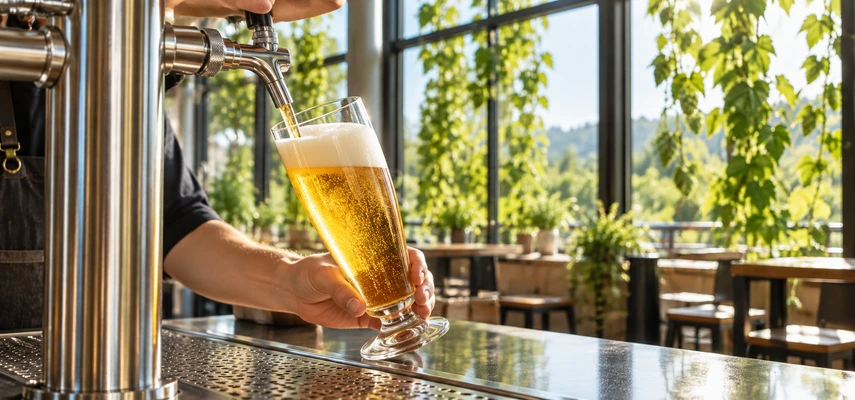

One golden lager has a rounded bread-and-herb balance. Another finishes sharply dry and bitter. A third smells of lime or tropical fruit. Pilsner and hopped lagers share a pale brewing foundation, yet their hop expression can tell quite different stories.
This lesson begins Part IV with Czech pilsner, German pilsner and contemporary hopped lager, the three prescribed Level 2 entries. The task is not to decide which one is the real lager. It is to explain how malt, hop variety, brewing use, water and fermentation produce different balances within related territory.
Hop-driven still leaves room for malt
A hop-driven beer need not contain only hop flavor. Malt supplies the structure that bitterness and aroma meet, and its character affects how those contributions feel. Rounded bread richness can make prominent bitterness seem different from the same broad bitter impression against a leaner base.
Likewise, high aroma and high bitterness are not identical. A brewer can favor aromatic additions without maximizing kettle-derived bitterness, or build a dry bitter lager with relatively restrained modern fruit aroma. Learn both dimensions rather than using hoppy as a complete tasting note.
Lager fermentation commonly provides a relatively restrained background in this group, helping grain and hops remain legible. Clean does not mean no fermentation-derived compounds, and pale appearance does not prove the exact strain. Recipe and process evidence still matter.
Czech pilsner: rounded malt and expressive traditional hops
Czech pilsner is usefully compared with the Czech premium pale lager reference. Typical appearance is clear yellow to deep gold with a dense white head. Aroma brings bready malt together with floral, herbal or spicy traditional-hop character.
The palate is fuller and more rounded than many German pilsner comparisons, with pronounced yet smooth bitterness integrated into rich pale malt. Body is generally medium, carbonation moderate or relatively gentle, and alcohol normally unobtrusive. The finish can be long without becoming harshly dry or overwhelmingly sweet.
Czech pale malt, traditional Czech hops such as Saaz and appropriate lager fermentation help explain the profile. Low sulfate and carbonate water is an important traditional reference, but modern brewers still manage actual mash and flavor conditions. Do not turn a regional association into a compulsory identical water analysis for every example.
Compared with Munich helles, hop character and bitterness are more central. Compared with German pilsner, the Czech profile is generally fuller, maltier and rounder. A little diacetyl is allowed in some style references, but it is optional, not a trait every candidate should invent in a tasting note.
German pilsner: crispness and a bitter finish
German pilsner generally appears brilliantly clear straw to yellow with a persistent white head. Traditional German hop aroma can be herbal, floral or spicy. Pale malt supplies grain, dough or cracker notes, but hops are more forward than in helles.
Bitterness is medium to high and often lingers into a dry finish. Body is commonly medium-light, carbonation medium to high, and alcohol normally moderate and unobtrusive. The result should feel crisp rather than heavy or syrupy. Assertive bitterness does not require roughness.
Pilsner malt, traditional German hops and clean lager fermentation establish the reference. Wort fermentability and attenuation support dryness, while water composition can affect the impression of the finish. Regional and producer variation means German pils is not one fixed level of bitterness or mineral character.
Compared with the Czech profile, German pilsner is generally leaner, more fully attenuated and more sharply dry. Compared with international pale lager, it usually gives hops and bitterness a clearer role. Those differences can matter much more than a barely visible shade of gold.
Contemporary hopped lager: a familiar base, different aromatics
Contemporary hopped lager uses a lager framework with prominent hop character from American, Australian or New Zealand varieties in the prescribed comparison. Appearance is often straw to gold with white foam, though clarity can vary with the producer’s process. A cloudy example is possible, but haze is not the defining requirement.
Aroma may suggest citrus, pine, tropical fruit, gooseberry or other variety-dependent notes. Malt usually remains pale and relatively restrained, while fermentation often aims for a clean background. Bitterness can range from measured to assertive; intense aroma does not independently tell you which.
Body is commonly light to medium, with carbonation and a relatively dry finish supporting refreshment. Strength varies, so contemporary should not be translated into double-strength. The style term signals a change in hop expression and brewing emphasis, not one universal alcohol specification.
The Brewers Association’s contemporary style guidance offers broader context, while Motueka’s primary grower description shows how a lime-like modern variety can be used in lager. A bright hop aroma does not transform the fermentation culture into an ale strain.
Traditional hops and modern fruit are useful contrasts
Saaz provides a Czech reference for fine herbal and spicy expression. Hallertauer Mittelfrüh, Tettnanger and Spalt provide important German aroma territory, although individual recipes vary. The names need to stay distinct even when their broad aroma families overlap.
American, Australian and New Zealand options can bring a different aromatic emphasis. Cascade, Citra, Mosaic, Nelson Sauvin, Motueka and Galaxy offer familiar study examples without becoming interchangeable ingredients. Crosby’s grower variety guide illustrates the range and the need to consider each variety separately.
These are tendencies, not blind-tasting fingerprints. A lime aroma does not prove Motueka, nor does herbal character identify one traditional cultivar with certainty. Blends, lot variation, process and fermentation all complicate the finished aromatic result.
Addition timing can alter the style impression
Early hot-side hopping commonly establishes bitterness, while later additions can retain a different aromatic expression. Hot stands and whirlpool additions still involve temperature and contact time, so their bitter contribution is not automatically zero. Dry hopping provides another environment for aroma extraction.
A contemporary lager can therefore combine restrained kettle bitterness with prominent modern aroma, or use both strongly. The recipe’s total hop mass is not enough to predict the result. Product form, composition and placement within the process matter.
For traditional pilsner comparisons, addition choices also shape the balance between firm bitterness and expressive aroma. Traditional does not mean the brewer makes no decisions. It means the decisions pursue a recognizable profile rather than the same aromatic target as a modern tropical lager.
Why water belongs in the explanation
Carbonate-related alkalinity affects the brewing environment, and sulfate can shape dry bitter perception. These roles are not identical, and neither ion replaces hop-derived bitter compounds. A water profile makes sense in relation to the grain bill and desired sensory result.
The Czech versus German comparison is useful because a rounded profile and a drier profile can arise from interacting recipe and process choices. It is less useful if it becomes a story that geography alone dictates every glass. Brewers can treat water and select materials to pursue a style outside its historical home.
Do not infer water chemistry solely from the taste of finished beer. It may suggest a possible contribution, but actual analysis and production information provide stronger evidence. The same restraint applies when interpreting labels and regional names.
Separate balance from fault
A clean bitter finish is different from a coarse or stale one. Delicate hop and malt aromas can fade or change in storage, and light strike can overwhelm the intended profile. A damaged sample should not become the model from which you define an entire pilsner tradition.
Some optional traits permitted in a reference do not become mandatory. Low diacetyl in some Czech examples is a contextual allowance, not permission for a buttery beer to mask grain and hops. Evaluate intensity, integration and the intended result.
This matters for quality as well as identification. German pilsner does not improve merely by becoming maximally bitter, and Czech pilsner does not improve merely by becoming maximally sweet or full. The useful target is a coherent balance in the appropriate style.
Practice a three-way comparison
Build a grid for appearance, malt, hop aroma, bitterness, sweetness, body, carbonation and alcohol. Use Czech pilsner as the rounded malt-and-traditional-hop comparison, German pilsner as the dry bitter comparison, and contemporary hopped lager as the modern aromatic comparison.
Then write a production explanation for each. The grid can come from reliable written descriptions, making it useful without drinking. Optional tasting for legally eligible readers should keep service conditions similar so temperature does not overwhelm the distinctions being studied.
A recipe change worth predicting
Suppose a brewer keeps the same pale wort and lager culture but replaces a late traditional-hop addition with a modern lime-forward variety. The most defensible prediction concerns aromatic direction. Therefore, a brighter citrus impression is plausible without a required increase in alcohol, darkening of color or change from lager to ale. The exact bitter effect still needs addition temperature and contact time.
By contrast, changing the wort’s fermentability while keeping the hops unchanged targets a different part of the result. More complete fermentation may make the finish seem leaner, which can expose bitterness more clearly even without a larger hop dose. These two hypothetical changes demonstrate why flavor prediction works best when the variable being changed is named explicitly.
One-page revision summary
Czech pilsner typically combines rich pale malt with rounded traditional-hop bitterness. German pilsner is generally leaner, drier and more sharply bitter. Contemporary hopped lager moves American, Australian or New Zealand hop expression into a lager framework, with bitterness and strength still variable.
Learn the balances through ingredients and process, not color alone. Hop variety, timing, wort fermentability, water and fermentation work together; none supplies the complete explanation by itself.
Continue your beer studies
Explore the related lessons on brewing adjuncts alongside hops explained alongside wort boiling to extend the ingredient, process or sensory reasoning in this article.
Knowledge check: 10 original practice questions
Independent TFE questions, not official WSET examination items. Choose one answer per question; explanations follow separately.
1. How does Czech pilsner generally compare with German pilsner?
- Always weaker and flavorless
- Fuller and rounder with richer pale malt
- Always sour
- Always more heavily roasted
2. Which hop is a key traditional Czech reference?
- Galaxy
- Only Mosaic
- Saaz
- Only Amarillo
3. What is a useful typical German pilsner finish?
- Dry, crisp and bitter
- Mandatory sugary syrup
- Mandatory lactic sourness
- Mandatory smoke
4. Does intense modern hop aroma prove high bitterness?
- Yes, aroma and bitterness are identical
- Yes, all modern hops must be boiled early
- Only if the beer is pale
- No, timing and other production choices can separate the two
5. What distinguishes contemporary hopped lager in this syllabus comparison?
- Prominent modern American, Australian or New Zealand hop expression in a lager framework
- Mandatory ale yeast
- Mandatory dark roast
- Mandatory double-strength alcohol
6. Which statement about haze in contemporary hopped lager is accurate?
- Haze is mandatory in every example
- Clarity varies; haze alone does not define the style
- Clear examples cannot use modern hops
- Haze proves weizen yeast
7. What does a sulfate contribution help explain?
- The exact hop variety by itself
- The complete fermentation culture
- A possible accentuation of dry bitter perception
- Automatic alcohol removal
8. Why is very low optional diacetyl not a mandatory Czech pilsner target?
- All Czech beer contains no fermentation compounds
- Optional always means required
- Every buttery sample is outstanding
- Style allowance and a necessary characteristic are different
9. Which comparison helps distinguish German pilsner from Munich helles?
- German pilsner is usually more hop-led and bitter with a drier finish
- Helles must be darker than porter
- Both must have identical balance
- German pilsner contains no malt
10. Why should a stale sample not define the style’s intended hop profile?
- Storage cannot affect hops
- Aroma loss or damage may reflect condition rather than the target profile
- All pilsner should age indefinitely
- Staling makes every lager more authentic
Answers and explanations
1. B — Fuller and rounder with richer pale malt. The Czech comparison typically emphasizes rounded bready malt and integrated bitterness, while German pilsner tends toward a leaner dry finish. Mapping: LO3 AC1.
2. C — Saaz. Saaz is a traditional Czech aroma reference with herbal and spicy possibilities. The other named varieties belong to different study groups. Mapping: LO3 AC2.
3. A — Dry, crisp and bitter. German pilsner generally emphasizes a dry bitter balance against pale malt, with crispness rather than heaviness as a central impression. Mapping: LO3 AC1.
4. D — No, timing and other production choices can separate the two. Aroma and bitterness depend on related but different compounds and process choices. Prominent aroma can coexist with measured kettle bitterness. Mapping: LO3 AC2/AC3.
5. A — Prominent modern American, Australian or New Zealand hop expression in a lager framework. The prescribed contemporary lager comparison centers on modern hop expression, while lager fermentation and variable strength remain compatible. Mapping: LO3 AC1/AC2.
6. B — Clarity varies; haze alone does not define the style. Production choices can affect clarity. The central comparison is hop expression within a lager framework, not one required visual opacity. Mapping: LO3 AC1/AC3.
7. C — A possible accentuation of dry bitter perception. Sulfate can influence emphasis in the finished beer. It neither replaces hop bitterness nor independently identifies recipe or fermentation. Mapping: LO3 AC2/AC3.
8. D — Style allowance and a necessary characteristic are different. A permitted low-level trait need not occur, and excessive intensity can still obscure balance. Optional does not define every example. Mapping: LO3 AC1.
9. A — German pilsner is usually more hop-led and bitter with a drier finish. Their pale appearances can overlap while hop emphasis, bitterness and dryness differ. Helles typically gives pale malt a stronger central role. Mapping: LO3 AC1.
10. B — Aroma loss or damage may reflect condition rather than the target profile. Handling can change or mask hop and malt expression. Separate a condition problem from the style characteristics the brewer intended. Mapping: LO3 AC1/LO4 AC1.












