










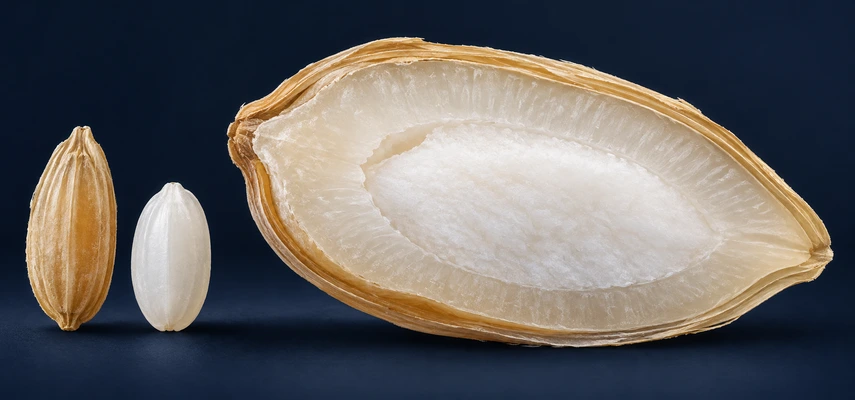

What does a brewer see in a grain of sake rice that a cook might overlook? Beyond its size and appearance sits a physical problem: starch must become accessible, then be broken down into sugars that yeast can ferment. Grain structure helps determine how smoothly that sequence proceeds. The interesting part is not that rice contains starch, but how the brewery makes that starch useful.
This lesson examines the raw material before the detailed polishing and steaming lesson. The WSET Level 3 specification includes grain anatomy, starch chemistry and starch conversion. For examination purposes, connect each term to a function. A list of components won’t explain why two lots behave differently in a mash.
Sake rice has layers with different jobs
Begin outside the grain. The husk protects the developing seed and is removed to produce brown rice. Bran layers and the germ remain associated with brown rice; further milling removes outer material to produce polished white rice. Removing husks and polishing are therefore different operations. A bag of brown rice isn’t still wearing all the field-grown grain’s protective clothing.
Within those outer structures, the endosperm forms the principal starchy reserve. This is the material brewers largely retain as polishing proceeds. Rice is not chemically uniform from surface to center: proteins, lipids, minerals and other components have different distributions. That is why changing the amount of outer material retained changes more than the grain’s dimensions.
The NRIB and JSS guide to Japanese sake explains the relatively nutrient-rich outer layers and the use of polishing to modify the brewing material. However, “outer equals bad” is a poor interpretation. Nutrients and nitrogen-containing compounds have useful roles. Brewers manage their availability to suit the process and intended style rather than attempting to turn rice into pure laboratory starch.
Shinpaku is a structure, not a pocket of sugar
Shinpaku means the opaque white core found in many sake-specific rice grains. Its appearance relates to the packing of starch-containing structures and microscopic spaces that scatter light. It is part of the endosperm, not a hollow chamber. Nor is it a little reservoir of ready-made glucose that yeast can immediately drink from.
For example, a suitably structured central region can facilitate water uptake and mould penetration during kōji making. Those physical advantages can make the grain useful to the brewer. Its shape, size and position also matter when polishing: a large central feature is useful only if the grain remains sufficiently intact through the intended preparation.
Not every useful brewing grain displays an identical shinpaku. Varieties and growing conditions influence grain properties, and a conspicuous white center does not grade the finished sake. In particular, do not confuse the desirable structural feature called shinpaku with every kind of chalkiness or damaged grain. Appearance needs context, and commercial evaluation considers several characteristics together.
Amylose and amylopectin are different glucose architectures
Starch consists principally of two glucose polymers: amylose and amylopectin. A polymer is a large molecule built from repeating smaller units. Amylose is largely linear, while amylopectin is highly branched. Both contain glucose building blocks, but the way those blocks connect affects how starch behaves when hydrated, heated, cooled and exposed to enzymes.
Think of long lengths of cord and branching lengths tied into a much larger network. The analogy helps distinguish chain architecture; it does not imply that enzymes simply untie visible knots. The chains include specific chemical bonds. Enzymes act on particular bonds or chain positions, so molecular structure shapes what each enzyme can do.
The main linear connections are alpha-1,4 linkages; amylopectin also has alpha-1,6 branch linkages. Those names describe how glucose units are connected. They matter because an enzyme effective along one part of a chain does not necessarily remove every branch equally well. “Starch becomes sugar” summarizes the outcome but hides the coordination needed to achieve it.
The proportions and detailed structures vary. An NRIB research summary describes the contrast between the two polymers and the importance of amylopectin chain length. Don’t turn a convenient approximate composition into an immutable recipe for every variety and harvest. Brewing decisions respond to the particular lot, not an idealized grain in a diagram.
Glutinous and non-glutinous do not refer to gluten
Glutinous rice is commonly called sticky or waxy rice and has very little amylose relative to its amylopectin. Ordinary non-glutinous rice contains appreciable amylose as well as amylopectin. In this context, “glutinous” describes sticky cooking behavior; it does not mean the grain contains wheat gluten. The familiar word is misleading if transferred between unrelated food categories.
Conventional sake brewing primarily uses non-glutinous rice. Nevertheless, a rice’s starch architecture cannot be reduced to the label “sticky” or “non-sticky.” The fine structure of amylopectin, grain organization and preparation all affect brewing behavior. A useful exam answer explains the distinction without claiming that one table-rice cooking sensation predicts an entire fermentation.
Similarly, avoid calling amylopectin a sugar that yeast ferments directly. It is a large starch polymer. Both amylose and amylopectin must be broken down before their glucose units become available in a fermentable form. Their different structures affect conversion; they do not remove the need for conversion.
Gelatinisation prepares the substrate
Raw starch granules have an organized structure that limits straightforward enzyme access. With sufficient heat and water, starch gelatinisation disrupts that organization and changes the grain’s physical properties. Steaming is central to making the rice suitable for subsequent kōji cultivation and digestion. It also requires attention to moisture: heat applied to inadequately hydrated material does not make every part behave identically.
The resulting chain is water and heat → starch structural change → improved accessibility for enzymes. Gelatinisation is a physical transformation, not alcoholic fermentation. It does not mean glucose has already been converted into ethanol, and it should not be confused with adding gelatin as a fining agent. Similar-sounding technical words have an unfortunate enthusiasm for causing avoidable mistakes.
Once steamed rice cools and remains in brewing conditions, starch chains can reassociate. This is retrogradation. It can make the material less susceptible to enzyme digestion. Consequently, understanding the grain involves both how it becomes accessible and how that accessibility changes afterward. Preparation is not a one-way switch that remains permanently in the “easy to digest” position.
Research by Okuda and colleagues on steamed-rice digestibility connects amylopectin structure, retrogradation and enzyme digestibility under sake-making conditions. The practical lesson is to evaluate rice behavior through the process. A cultivar name alone doesn’t establish how quickly a particular steamed lot will dissolve.
Enzymatic hydrolysis does the chemical cutting
Hydrolysis breaks chemical bonds through reactions involving water. Kōji supplies enzymes that catalyze the breakdown of rice components, including starch. Alpha-amylase cuts within suitable starch chains and contributes to their breakdown into smaller fragments. Glucoamylase releases glucose from chain ends. The full enzyme picture belongs in the kōji chemistry lesson; here the distinction between preparation and chemical conversion is the priority.
Limit dextrins are branched fragments left when particular amylases cannot continue through the remaining structure in the same way. They are not another name for yeast, alcohol or the rice husk. Nor should an answer suggest that alpha-amylase alone instantly converts every starch molecule completely to glucose. Enzyme specificity explains why several activities matter.
Therefore, a complete causal sequence runs from rice structure through hydration and gelatinisation to enzymatic hydrolysis and available sugars. Yeast then ferments those sugars. In moromi, conversion and fermentation proceed alongside each other, so accessibility and sugar release influence a changing system. Faster digestion is not automatically desirable if it fails to suit the brewer’s intended balance.
Table rice and sake-specific rice are both real options
Table rice is grown primarily for eating; sake-specific rice is selected and cultivated for useful brewing characteristics. Large grains, suitable shinpaku, preparation behavior and digestibility can make a variety attractive for sake production. Those features also have to coexist with practical agricultural and economic realities. A brewery purchases an actual crop, not a collection of attractive adjectives.
However, table rice can also be used successfully in sake. Its presence does not establish poor quality, and sake-specific rice does not guarantee excellence. The relevant question is whether the material and brewing plan work together. For example, rice appropriate for one polishing and kōji strategy may demand adjustments when used for a different target.
Rice can influence aroma indirectly through the material it supplies and the way it supports brewing. Proteins yield smaller nitrogen-containing compounds under enzyme action, affecting nutrition and flavor; rice lipids and other components also interact with the process. A pear-like aroma is therefore not evidence that the grain contained pear flavor, or that one rice variety has an exclusive claim on it.
The structure of the grain explains why polishing, soaking and steaming matter. Follow the next link in the chain through koji enzymes and their products, then compare the practical choices in sake rice varieties.
One-page revision summary
Distinguish husk removal from polishing, and locate shinpaku within the endosperm. Explain amylose and amylopectin through chain structure, then separate gelatinisation from enzymatic hydrolysis. Recognize limit dextrins as residual fragments rather than fermentable glucose by another name. Finally, judge table rice and sake-specific rice as brewing materials whose performance depends on preparation and management. Every term becomes more useful when it helps explain the next step.
Written practice: original TFE exercises
These suggested marks and indicative points are independent teaching guidance, not official WSET marking schemes.
Exercise 1: 5 suggested marks
Explain how grain preparation allows rice starch to contribute to alcoholic fermentation. Include gelatinisation and enzymatic hydrolysis. Mapping: Unit 1 LO1.
Indicative marking points:
- Rice supplies starch.
- Hydration and steaming provide heat and water.
- Gelatinisation changes organized starch structure and enzyme accessibility.
- Kōji enzymes hydrolyse starch to smaller sugars including glucose.
- Yeast converts available fermentable sugar to ethanol.
Model answer: Rice contains starch that sake yeast cannot use as though it were free glucose. Water and heat during preparation gelatinise starch, improving its accessibility. Enzymes supplied by kōji then hydrolyse it, releasing smaller sugars including glucose. Yeast ferments the available sugar into ethanol, so preparation supports fermentation through an intermediate conversion process.
Why it works: The answer gives the physical preparation, chemical conversion and microbial transformation in the correct relationship.
Common mistake: Using gelatinisation and fermentation as interchangeable terms.
Exercise 2: 5 suggested marks
Explain why rice with a visible shinpaku is not by itself proof of high-quality finished sake. Mapping: Unit 1 LO1 and LO2.
Indicative marking points:
- Shinpaku is an opaque region within the endosperm.
- Its physical structure can assist water uptake and kōji penetration.
- Grain integrity and other characteristics also matter.
- Preparation and fermentation decisions influence the result.
- Actual sensory observations are needed to assess finished quality.
Model answer: Shinpaku is a structural feature within the rice endosperm, useful because its physical properties can aid preparation and kōji growth. That does not tell us whether the grain tolerates the chosen polishing or how the brewer manages fermentation. The finished sake also needs sensory assessment: useful raw-material characteristics provide opportunities rather than a guarantee of balance or quality.
Why it works: It links an advantage to its mechanism and then explains why other process and sensory evidence remains necessary.
Common mistake: Calling shinpaku a hollow sugar pocket or treating its size as a finished-sake quality score.
Knowledge check: 10 original practice questions
Independent TFE questions, not official WSET examination items. Choose one answer per question; explanations follow separately.
1. Why can cooling and storage after steaming affect rice digestibility?
2. Where is shinpaku located?
3. What does enzymatic hydrolysis of starch involve?
4. Which description best distinguishes the principal starch polymers?
5. In this rice context, what does glutinous mean?
6. What are limit dextrins in the context of amylase action?
7. Which change is central to starch gelatinisation?
8. Which chain correctly links rice properties to brewing behavior?
9. Which statement about table rice in sake is accurate?
10. Which operation produces brown rice from the field-grown grain?
Answers and explanations
1. B — Starch can retrograde and become less susceptible to enzyme digestion.. Reassociation of starch chains can change enzyme accessibility; preparation is not a permanently fixed state. Mapping: Unit 1 LO1; LO2 Range 4.
2. A — Within the endosperm.. Shinpaku is an opaque region of the endosperm, associated with grain structure rather than a hollow chamber. Mapping: Unit 1 LO1; LO2 Range 4.
3. A — Enzyme-catalyzed bond breakdown in reactions involving water.. Hydrolysis is the chemical cutting stage, whereas steaming chiefly prepares the substrate. Mapping: Unit 1 LO1; LO2 Range 4.
4. D — Amylose is largely linear; amylopectin is highly branched.. Both are glucose polymers, but their different chain architectures affect their physical and enzymatic behavior. Mapping: Unit 1 LO1; LO2 Range 4.
5. B — Sticky rice with very little amylose.. Glutinous refers to sticky or waxy rice; it does not describe wheat gluten content. Mapping: Unit 1 LO1; LO2 Range 4.
6. D — Residual branched starch fragments that limit further action by particular amylases.. The term reflects residual structures and enzyme specificity, not a second name for glucose or sake residue. Mapping: Unit 1 LO1; LO2 Range 4.
7. C — Heat and water disrupt organized starch structure.. Gelatinisation changes starch structure and accessibility; it is distinct from enzymatic hydrolysis and fermentation. Mapping: Unit 1 LO1; LO2 Range 4.
8. A — Grain structure affects preparation and enzyme accessibility, influencing sugar supply for fermentation.. The causal chain includes the intervening physical and biochemical processes rather than assigning a guaranteed flavor. Mapping: Unit 1 LO1; LO2 Range 4.
9. C — It can be used successfully when the brewing strategy suits its properties.. Table rice is a valid brewing material; its performance depends on characteristics and process management. Mapping: Unit 1 LO1; LO2 Range 4.
10. C — Removal of the husk.. Husk removal produces brown rice; subsequent polishing removes further outer material. Mapping: Unit 1 LO1; LO2 Range 4.












