










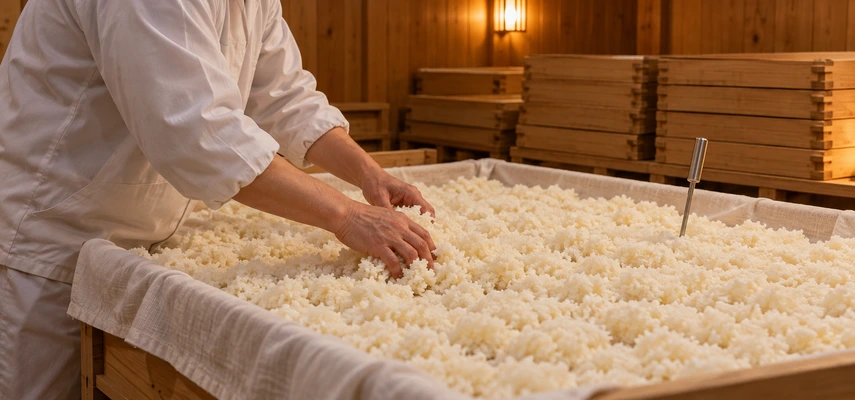

Why does making kōji involve so much moving rice around? Once you understand how kōji is made, the repeated spreading, breaking and mixing stop looking ceremonial. Growing mould generates heat and changes the rice. Workers manage that changing material so it develops the enzyme activity, moisture and physical condition needed for the intended sake.
The WSET Level 3 specification names the cultivation conditions, methods and sequence. Learn those steps as responses to a biological process, not as a list of Japanese words with no purpose attached. The central question is what each intervention changes inside or around the rice.
How kōji is made starts with suitable steamed rice
Rice enters cultivation after polishing, washing, soaking and steaming. Its moisture, texture and temperature affect how well the selected mould establishes itself. Excessively wet, sticky rice can be difficult to handle uniformly; poorly hydrated or inadequately prepared rice presents a different problem. A warm room cannot erase the consequences of unsuitable material.
Yellow kōji mould is conventional for sake, while white and black moulds offer different biochemical possibilities. Strain choice influences what the brewery wants from cultivation, including enzyme and acid characteristics. Consequently, a temperature plan suitable for one strain and product isn’t automatically the correct plan for every other choice. Selection and management belong together.
The JSS brewing overview describes mould cultivation as a managed stage before the starter and main mash. Its role is to supply prepared rice kōji, not to produce all the alcoholic fermentation inside the kōji room. Yeast will perform that separate job later.
Rice temperature differs from room temperature
The kōji room, or kōji-muro, provides a controllable environment, but the rice has its own temperature. Growing mould releases heat. As growth develops, the rice can therefore become warmer than the surrounding air. Monitoring only the room thermostat misses the material the brewer is actually trying to manage.
For example, a thick mound can retain more of its internally generated heat than a thinner layer. Spreading the rice changes heat exchange and can reduce the risk of uneven conditions. Covering, uncovering, rearranging and adjusting the room all affect the result. Their purpose is to follow a useful temperature course, rather than to maintain one unchanging reading throughout cultivation.
Temperature influences both mould growth and the enzyme profile produced. Growth and enzyme production are related but not identical targets. A regime that encourages rapid visible growth may not deliver the preferred relative enzyme activities. Therefore, avoid answering a cultivation question with “keep it warm” and stopping there; describe what is monitored and why changes matter.
Humidity manages water loss as well as comfort for mould
Humidity around the rice affects how quickly it loses moisture. The room atmosphere, cloth coverings, layer thickness and airflow all influence that exchange. Rice moisture also changes during cultivation, so a humidity reading cannot be interpreted without considering the material and stage. The brewery is managing a living substrate rather than humidifying an empty room.
Early conditions need to support establishment of the selected mould. Later, controlled moisture loss and handling can help produce the desired final rice kōji. Excessive drying too early can interfere with development; uncontrolled moisture retention creates different handling and growth conditions. “The more humid the better” is therefore no more useful than a universal maximum temperature.
Keep moisture content and relative humidity distinct. The first concerns water in the rice; the second describes the surrounding air relative to its capacity at that temperature. They interact, but they are not the same measurement. That distinction explains why the same room reading can accompany different rice conditions in different arrangements.
Bringing in and spreading the seed establish the batch
Bringing in, called hikikomi, moves suitably cooled steamed rice into the cultivation area. Workers spread and handle it to establish appropriate conditions before or during inoculation. The important point is that the rice must be at a temperature suitable for the selected mould. Simply transferring it from the steamer without temperature control is not the complete operation.
Spreading the seed means distributing tane-kōji, the mould starter, through the prepared rice. Inoculation is often called tanekiri. Good distribution helps establish growth where the brewery intends it, rather than leaving markedly different portions with very different inoculation. The starter format and handling method must suit the material and scale.
The NRIB brewing glossary provides useful terminology for these operations. Use the Japanese terms when they clarify a process, then explain them in ordinary language. An answer earns its explanatory value from connecting distribution and suitable conditions to establishment, not from spelling a difficult word alone.
Initial growth and re-breaking up address a changing material
After inoculation, initial growth develops under managed conditions. Workers keep the rice in an arrangement that supports establishment while observing its temperature and moisture. The rice may be gathered and covered to retain conditions appropriate to that stage. That doesn’t mean it stays untouched until the entire cultivation is finished.
Re-breaking up, or kirikaeshi, separates clumps and redistributes the rice. This helps manage unevenness in temperature, moisture and developing growth. The operation responds to the tendency of a living batch to become less uniform. Its usefulness is physical as well as biological: separating the grains changes how air and heat move through the material.
Meanwhile, observations guide the next intervention. A calendar alone cannot establish that every batch has reached the same condition at the same moment. Rice variety, preparation, inoculum and the room environment all influence development. The brewer combines a planned sequence with examination of the actual material.
Mounding leads into bed, box or tray management
The prescribed mounding stage concerns arranging or dividing the rice for its continuing cultivation. Bed kōji keeps the material in a bed-based arrangement; box kōji uses larger boxes; tray kōji uses shallow trays. These methods provide different ways to organize layer depth, quantity, handling and the environment around the rice.
Smaller portions can offer close control of individual units, but also require repeated handling across many units. Larger arrangements organize labor differently and need attention to internal variation. Bed, box and tray are therefore not simply three names for different levels of prestige. They change the practical problem the workers must solve.
Think about geometry. A thin layer has a different relationship between its surface and its volume from a deeper mass. Heat and moisture move differently through those arrangements. The useful causal explanation is container and layer arrangement → different heat and water exchange → effects on growth and enzyme development. Final quality still depends on how that arrangement is managed.
Middle work and final work refine the conditions
Middle work, naka-shigoto, involves handling that adjusts the developing kōji’s temperature, moisture and growth conditions. Breaking and redistributing the material helps prevent the batch from following an uncontrolled path. The exact practice depends on the method and the desired development, so the name is a stage in a managed process, not a universal mechanical recipe.
Final work, shimai-shigoto, is another purposeful intervention later in cultivation. Workers can rearrange the rice and adjust its exposure to guide the remaining temperature and moisture course. “Final” does not mean fermentation has been completed or that the finished sake is ready. It refers to cultivation work within the kōji-making sequence.
The explanatory link is that mould continues to alter its environment between interventions. A worker cannot set conditions once and assume they remain unchanged. Handling at defined stages helps keep that biological change useful. This is one reason an apparently simple tray of rice can require considerable attention.
Sending out and drying condition the finished kōji
Sending out, dekoji, removes the cultivated material from the room when the desired development has been reached. Cooling and controlled drying then help condition it for use. These operations limit continued growth and change the rice’s immediate environment; they do not mean every enzyme has been destroyed.
That distinction matters because the enzymes must remain useful in subsequent brewing. If a learner writes that drying eliminates all enzyme activity, the explanation defeats the purpose of making kōji. Instead, separate controlling the living mould’s development from preserving the enzymatic contribution needed in the starter or moromi.
Mechanised production manages the same variables differently
Mechanised kōji systems can control airflow, temperature, moisture and material handling through equipment rather than relying on the same manual arrangements. Workers still choose settings, assess results and maintain hygiene. Mechanization changes how interventions are delivered; it doesn’t remove the need for a suitable substrate, strain and cultivation plan.
A primary study comparing trays and boxes found differences in local temperature, humidity, moisture and enzyme activity. That supports examining the actual environment around the rice. It does not establish that every tray system always outperforms every box or mechanised system.
Add a black- or white-koji sake to a guided comparison with a suitable yellow-koji example. Record the producer-confirmed mold choice and other differences, then compare acidity and the broader profile blind. Acid production offers a mechanism to discuss, but perceived acidity alone cannot identify the mold or establish a quality ranking.
The practical cultivation decisions connect to enzyme activity and products, not simply visible mold coverage. Compare so-haze and tsuki-haze, then consider their contribution to main-mash fermentation.
One-page revision summary
Follow bringing in, seed spreading, initial growth, re-breaking up, mounding, middle work, final work, sending out and drying. Connect bed, box and tray arrangements to heat and moisture exchange. Distinguish rice temperature from room temperature and rice moisture from humidity. Whether handmade or mechanised, successful cultivation supplies kōji suited to the intended brewing process rather than simply maximizing visible mould.
Written practice: original TFE exercises
These suggested marks and indicative points are independent teaching guidance, not official WSET marking schemes.
Exercise 1: 5 suggested marks
Explain why rice temperature must be monitored separately from the kōji room air temperature. Mapping: Unit 1 LO1.
Indicative marking points:
- Growing mould produces heat.
- The rice mass can retain that heat.
- Rice temperature can differ from room air.
- Temperature influences growth and enzyme development.
- Spreading, mixing or airflow can help manage the rice toward the intended conditions.
Model answer: Mould generates heat as it grows, and a rice mass can retain that heat, so the material may be warmer than the room air. Because rice temperature influences both growth and enzyme development, the room thermostat alone cannot describe the cultivation conditions. Monitoring the rice allows workers to respond through spreading, mixing, airflow or other appropriate adjustments.
Why it works: The response identifies a heat source, explains the measurement difference and connects monitoring to purposeful control.
Common mistake: Treating the room thermostat as proof that every part of the rice is at the same temperature.
Exercise 2: 5 suggested marks
Explain why changing from a deeper box arrangement to shallow trays can change kōji development without changing the rice variety. Mapping: Unit 1 LO1 and LO2.
Indicative marking points:
- The container changes the geometry of the rice mass.
- Layer depth and surface exposure change.
- Heat exchange and internal heat retention can differ.
- Moisture exchange and local humidity can differ.
- These conditions influence growth and enzyme development, so management must be adjusted.
Model answer: Shallow trays change the layer depth and exposed surface of the rice compared with a deeper box arrangement. That can change how internally produced heat escapes and how moisture exchanges with surrounding air. The resulting local conditions influence mould development and enzyme activity, so the brewer may need to adjust handling and environmental control even with the same rice variety.
Why it works: It moves from a physical change through two mechanisms to the biological consequence, without declaring one container universally superior.
Common mistake: Assuming a method name is a quality ranking or that the container has no effect on the rice environment.
Knowledge check: 10 original practice questions
Independent TFE questions, not official WSET examination items. Choose one answer per question; explanations follow separately.
1. What is the purpose of middle and final work?
2. Which statement about humidity is accurate?
3. What does sending out, dekoji, describe?
4. What does spreading tane-kōji accomplish?
5. Which temperature is most directly relevant to the mould growing on rice?
6. What do bed, box and tray methods change?
7. Which operation corresponds to kirikaeshi in this sequence?
8. Why should conditioning not be explained as destroying every enzyme?
9. Why can rice become warmer than the surrounding kōji-room air?
10. Which statement about mechanised kōji production is most accurate?
Answers and explanations
1. B — To adjust developing kōji’s temperature, moisture and growth conditions.. These are handling stages within cultivation, responding to a changing biological material. Mapping: Unit 1 LO1 Range 3; LO2 Range 4.
2. A — It affects moisture exchange around the rice but is not identical to rice moisture content.. Air humidity and water held by the grain are distinct but interacting aspects of cultivation. Mapping: Unit 1 LO1 Range 3; LO2 Range 4.
3. D — Removing cultivated kōji from the room at the desired stage.. The subsequent cooling and drying condition the kōji for later use; this is not finished sake. Mapping: Unit 1 LO1 Range 3; LO2 Range 4.
4. B — It distributes the selected mould starter for cultivation.. Inoculation introduces the selected mould; it is distinct from later alcoholic fermentation. Mapping: Unit 1 LO1 Range 3; LO2 Range 4.
5. A — The rice temperature, which can differ from room air.. The growing material generates and retains heat, so its conditions need direct attention. Mapping: Unit 1 LO1 Range 3; LO2 Range 4.
6. C — The organization, depth and handling of the rice mass.. Different arrangements influence heat and moisture exchange and the labor needed to control conditions. Mapping: Unit 1 LO1 Range 3; LO2 Range 4.
7. D — Re-breaking up the rice.. Separating and redistributing the developing material helps manage clumps and uneven conditions. Mapping: Unit 1 LO1 Range 3; LO2 Range 4.
8. A — The enzymes are needed for later starch and protein conversion.. Controlling further mould development is different from eliminating the useful enzyme supply. Mapping: Unit 1 LO1 Range 3; LO2 Range 4.
9. C — Growing mould releases heat that the mass can retain.. Biological self-heating and the physical arrangement influence the material temperature. Mapping: Unit 1 LO1 Range 3; LO2 Range 4.
10. C — It manages familiar biological variables through different equipment and handling.. Mechanization changes delivery and control of conditions, while expertise and suitable inputs remain necessary. Mapping: Unit 1 LO1 Range 3; LO2 Range 4.












