











A newly distilled spirit can be colourless and already full of aroma. Years later, another spirit may be amber, vanilla-scented and quite different from the liquid that entered its barrel. Meanwhile, a clear gin may smell intensely of botanicals without ever spending years in oak. There is more than one route to a distinctive drink.
To understand how spirits get their flavor, follow the decisions after distillation while remembering what came before. Wood, blending, flavouring, sugar, colouring and water do different jobs. Some change several features at once, but none gives producers permission to ignore the rules of the category they are making.
The still leaves a starting point
An unaged spirit hasn’t undergone the maturation discussed here, but it isn’t necessarily neutral. Raw material and fermentation can supply considerable character. Lower distillation strength can retain a more noticeable mixture of aroma compounds, while higher-strength distillation tends towards a lighter or relatively neutral profile. Finishing begins with those inherited differences.
This matters when comparing two oak-aged drinks. Similar barrels don’t erase differences between the spirits filled into them. A grape-based spirit and a grain-based spirit can share vanilla or toast associations while retaining distinct backgrounds. The finished character reflects interactions across the chain, rather than one ingredient or operation acting alone.
Likewise, a gin’s prominent juniper doesn’t mean fermentation and distillation became irrelevant. They supplied its alcoholic base. Flavouring then introduced another set of compounds. Thinking in layers is useful, provided the layers aren’t imagined as perfectly separate: later operations can change the way earlier characteristics are perceived.
Oak is an active container
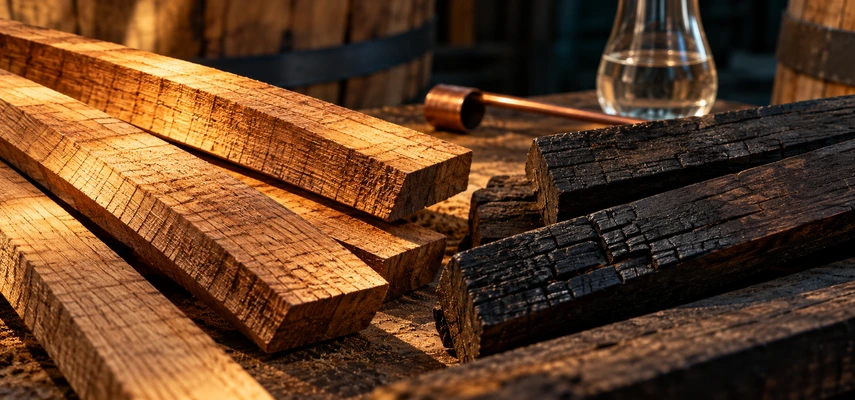
Oak ageing changes spirit through contact with the wood and through developments during storage. The cask contributes material that can affect aroma, flavour and colour. Vanilla, spice, toast and woody impressions are familiar associations, although their presence and intensity depend on the spirit and the barrel rather than following one universal script.
A useful analogy is cooking in a seasoned pan, with an extra warning: a cask is also a storage environment, not just a flavour dispenser. Its history matters. So do the wood’s preparation and the time spent in contact. The lesson isn’t that every barrel supplies the same ingredients more slowly or quickly.
The Cognac authority’s production account identifies oak origin, grain, barrel age and cellar conditions among the factors available to the producer. Those choices help explain why an age figure alone cannot give a complete sensory description. Two spirits matured for the same length of time may develop differently.
New oak and old oak
New oak generally offers more readily extractable wood-derived material than a cask used repeatedly. It can have a pronounced influence on colour and aroma. In this context, “new” concerns the cask’s use history. It doesn’t mean the trees were unusually young, or that the spirit will automatically be superior.
Old oak, meaning previously used oak in this comparison, often gives a gentler wood contribution. Previous contents and repeated use can affect what it contributes. A less assertive cask may allow more of a spirit’s existing character to remain prominent. Choosing it can be deliberate rather than a compromise made for lack of new barrels.
Used wood also comes with category restrictions. The Scotch Whisky Association’s cask guidance shows that not every container history is acceptable even when the vessel is made of oak. Learn the general mechanism here; apply the named category’s rules when evaluating a specific spirit.
Blending has two different ambitions
Blending for consistency aims to keep a recognisable style despite variation among components. Agricultural materials, fermentations and casks aren’t identical from one batch to the next. A blender can select and combine suitable stocks to maintain an intended profile. The recipe may adapt so that the result remains familiar.
Think of a choir balancing voices to produce the intended sound. Keeping the same effect doesn’t require every individual voice to be identical. In a spirit, one component may contribute fruit, another structure, another a particular oak impression. The blender considers the combination rather than treating each component as a complete miniature of the final drink.
Blending for complexity seeks a useful range and interaction of characteristics. Combining components can produce a broader sensory picture than one component alone. Consistency and complexity can be pursued together. Neither aim guarantees success, and the mere number of components doesn’t establish how good or complex the blend will be.
Blending is therefore a production tool, not a synonym for lowering quality. Nor is it permission to combine anything and retain the same legal name. What can be blended, and how the resulting beverage can be labelled, depends on the applicable category and jurisdiction.
Botanicals can reach spirit in different ways
Maceration means soaking flavouring material in liquid so that compounds are extracted. In spirits production, a suitable alcoholic liquid can extract characteristics from botanical material. The outcome depends on the material, the liquid and the conditions. It is an extraction process rather than another round of alcoholic fermentation.
Redistillation means distilling again. In botanical spirits, a spirit base may be distilled with natural plant material so that volatile flavour compounds are carried into the new distillate. Maceration may precede that operation, but the two terms describe different actions. Soaking and distilling shouldn’t be swapped casually in a production explanation.
A government-hosted botanical gin specification provides a concrete example of maceration and redistillation in one process. It illustrates what the methods can do; its particular recipe and settings aren’t universal requirements for all gin or all flavoured spirits.
Producers can also use purchased natural flavourings or other flavourings where allowed. These can provide flavour without the producer extracting every botanical directly on site. The method used and the legal category claimed are separate questions. A technique may be available in spirits production generally while being restricted in a particular named style.
The same caution applies to gin. Juniper defines its predominant flavour, but methods and permitted additions differ among gin classifications. A general lesson about flavouring operations cannot replace the specific requirements for a term such as London Dry Gin. Those distinctions receive their own category lesson later.
Sweetness needs a separate explanation
Added sugar increases sweetness. It can change the balance and texture of a finished drink as well as the obvious sweet taste. The permitted use and amount vary by category. Liqueurs require sweetening, while other categories impose different constraints. “All spirits can be sweetened” is therefore an unreliable generalisation.
An aroma associated with sweet food doesn’t prove added sugar. Vanilla, caramel-like or ripe-fruit impressions can encourage an expectation of sweetness before the drink is tasted. That expectation is a sensory association, not a laboratory result or a production record. Keep what you smell separate from what you know was added.
This also prevents a misunderstanding about raw materials. A cane-derived spirit doesn’t automatically retain the sugar of its starting material after fermentation and distillation. To explain actual finished sweetness, examine the completed production process and permitted adjustments. The word “sugar” in an ingredient’s history isn’t enough.
Colour can arrive through several doors
Oak-derived colour develops through maturation, but caramel colouring can also adjust appearance where permitted. Its use for colour doesn’t make a bottle an age statement. A darker liquid may reflect a different cask history or colouring practice rather than simply a longer period in storage.
Other natural colours and artificial colours are also relevant to spirits production in general. They belong in the syllabus as possible operations, not as additions permitted in every category. Always attach the legal qualification. A list of available techniques is a map of possibilities, not a universal recipe.
Colour, aroma and sweetness can therefore move independently. A spirit might become darker without receiving a longer maturation. Another might gain botanical aroma while remaining clear. A third might become sweeter through an addition without any necessary increase in age. Examinations often test precisely these distinctions between a change and its possible causes.
Water changes strength and perception
Dilution with pure water reduces alcoholic strength. It also changes the concentration and behaviour of aroma compounds in the mixture, which can alter what is perceived. Water isn’t simply an afterthought that makes the label’s ABV smaller. Producers use it as part of reaching the intended finished profile.
That doesn’t mean more dilution always improves aroma or flavour. The result depends on the spirit and the target. For this level, learn the direction of the alcoholic-strength change and recognise that aroma perception may change too. Avoid claiming a single ideal water addition for every bottle.
See these general adjustments applied to gin and liqueurs and vermouth.
What to remember
Work backwards from the feature you need to explain. Aroma may reflect raw material, fermentation, distillation strength, oak, blending, flavouring or dilution. Sweetness may be adjusted with added sugar where permitted. Colour may come from oak, caramel or other permitted colouring materials. Alcoholic strength can be adjusted with water.
Then add the second question: is the operation allowed for this category? That habit connects a general production mechanism to a particular label without confusing possibility with permission. It also makes the final spirit easier to understand as the result of linked decisions, rather than a collection of mysterious tasting words.
Knowledge check: 12 original practice questions
Independent TFE questions, not official WSET examination items. Choose one answer per question; explanations follow separately.
1. What can colour alone reliably establish?
- The exact age
- The distillation strength
- The absence of colouring
- The visible appearance
2. Which is a direct purpose of adding sugar where allowed?
- Increasing finished sweetness
- Increasing the minimum oak age
- Making the still continuous
- Changing grapes into barley
3. What is redistillation?
- Repeated barrel filling
- Distilling again
- Adding sugar to wort
- Changing the bottle label
4. Which statement about caramel colouring is accurate?
- It proves long maturation
- It is permitted in every spirit
- It can adjust appearance where category rules allow
- It must always make the drink taste sweet
5. Which statement properly qualifies flavouring methods?
- Every category allows all methods
- Natural flavourings always identify London Dry Gin
- Permitted methods depend on the category and jurisdiction
- Purchased flavourings mean fermentation never occurred
6. Why can an unaged spirit still have pronounced aroma?
- Age statements create aroma
- Raw materials, fermentation and distillation can already contribute character
- All unaged spirits contain botanicals
- Colourless spirits must be sweetened
7. Which operation directly adjusts alcoholic strength downwards?
- Adding dry botanicals only
- Dilution with water
- Printing an age statement
- Selecting darker glass
8. Compared with repeatedly used oak, new oak generally offers what?
- Guaranteed superior quality
- No possible colour contribution
- More readily available wood-derived material
- Proof of a long age
9. Which process can help develop complexity?
- Blending components with complementary characteristics
- Assuming all barrels are identical
- Reading only the liquid colour
- Removing all sensory differences
10. What does maceration involve?
- Distilling the same charge twice
- Turning starch into sugar
- Heating a barrel until charred
- Soaking material to extract compounds
11. What is a main aim of blending for consistency?
- Maintaining a recognisable style despite component variation
- Making every cask chemically identical
- Removing every aroma
- Replacing fermentation
12. What does a vanilla aroma establish about sugar additions?
- A fixed sugar amount
- Mandatory sweetening
- The liqueur category
- No definite conclusion without further evidence
Answers and explanations
1. D — The visible appearance. Appearance can be observed directly, while age and production history require other evidence. Mapping: LO1.
2. A — Increasing finished sweetness. Sweetening changes taste and may affect balance and texture, subject to category rules. Mapping: LO1.
3. B — Distilling again. Redistillation is a further distillation and can carry volatile botanical compounds into a new distillate. Mapping: LO1.
4. C — It can adjust appearance where category rules allow. Caramel may be used for colour in permitted categories; colour alone cannot establish age or sweetness. Mapping: LO1.
5. C — Permitted methods depend on the category and jurisdiction. A method available in spirits generally may be restricted by the particular category being produced. Mapping: LO1.
6. B — Raw materials, fermentation and distillation can already contribute character. Aroma can arise before maturation, so unaged and neutral are different descriptions. Mapping: LO1.
7. B — Dilution with water. Adding water reduces the proportion of ethanol by volume and may also change aroma perception. Mapping: LO1.
8. C — More readily available wood-derived material. New oak usually has more readily extractable material, although the final effect depends on multiple factors. Mapping: LO1.
9. A — Blending components with complementary characteristics. Blending can combine different characteristics into a broader sensory result, although success is not automatic. Mapping: LO1.
10. D — Soaking material to extract compounds. Maceration is extraction through soaking, which differs from the separate operation of redistillation. Mapping: LO1.
11. A — Maintaining a recognisable style despite component variation. Blenders select varying components to reach a consistent intended finished profile. Mapping: LO1.
12. D — No definite conclusion without further evidence. Vanilla is an aroma association that can occur without establishing that sugar was added. Mapping: LO1.












