










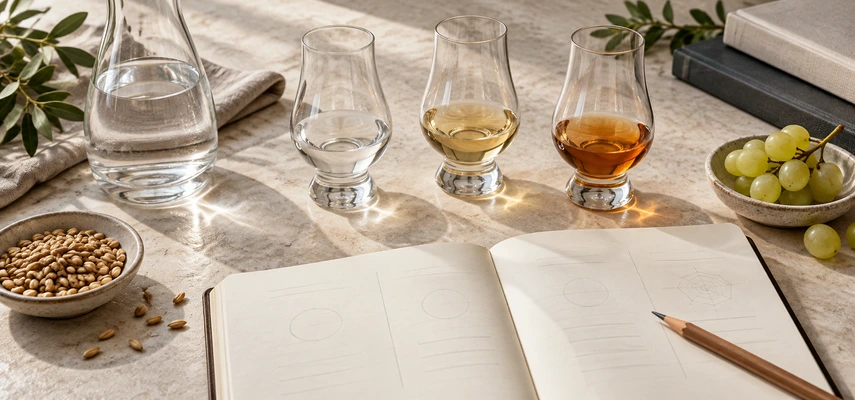

Grapes, barley and sugar cane don’t look like variations on one ingredient. Yet turn them into spirits and all three pass through a surprisingly familiar sequence. Prepare sugars, let yeast work, concentrate selected compounds in a still, then decide what happens before bottling. The shared machinery is only the beginning of the explanation.
To evaluate spirits well, follow the choices hidden behind the glass. A fragrant grape spirit and a restrained vodka can have similar bottled alcohol levels while delivering very different aromas. An amber whisky and an amber rum may share wood-derived notes without sharing a raw material. The interesting question is what happened along the way.
This is the opening lesson in TFE’s independent WSET Level 2 Spirits study series. You don’t need Level 1 first. We will build the essential ideas here, then give each production process and spirit family its own lesson. TFE is not affiliated with or endorsed by WSET; the explanations and questions are original.
Evaluate spirits by following four production decisions
Begin with a causal map: raw material → fermentation → distillation → maturation and finishing → style. It is a route through the subject, rather than a promise that every spirit spends time in a barrel. Some are bottled without wood maturation; others gain their defining character from botanicals added after their base spirit has been made.
Raw materials bring potential fermentable carbohydrate and characteristic compounds. Fruit may supply sugars directly. Grain needs its starch converted into suitable sugars; agave needs its fructans converted. The producer’s first task is therefore to prepare something yeast can use. A sack of barley cannot simply be poured into a still and expected to emerge as whisky.
During alcoholic fermentation, yeast converts fermentable sugar into ethanol, with carbon dioxide and heat also produced. Distillation works on the resulting alcoholic liquid. It separates and concentrates components through vaporisation and condensation. Keep those jobs distinct: fermentation makes the ethanol; distillation changes its concentration and the mixture travelling with it.
The final stage covers operations after distillation. Producers may mature, blend, dilute, filter, sweeten or flavour, subject to the category’s rules. Ask which operation explains the characteristic you observe. A vanilla association could point towards oak; a clear, juniper-led spirit invites a different investigation. Neither observation by itself proves an exact recipe.
Aroma has a history before the barrel
Congeners is a useful collective term for compounds other than the main ethanol-and-water components. The group includes substances relevant to aroma, such as esters, as well as other alcohols. Raw material, fermentation and subsequent processing influence the mixture. It isn’t a synonym for either delicious flavour or a fault: identity, amount and context matter.
Think about a fruity aroma. It might reflect compounds formed during fermentation rather than fruit added at the end. Likewise, an impression of toast does not prove that someone dropped toast into a vat. Sensory descriptions name resemblances. Ingredient statements describe production facts. Confusing those two jobs makes both tasting notes and examination answers less reliable.
The Scotch Whisky Association’s introduction starts with cereals, water and yeast. That modest ingredient list helps frame a richer question: how do processing choices make such a range of outcomes possible? Later whisky lessons follow the answers through grain preparation, fermentation, still operation and wood management.
When revising, build a short explanation instead of memorising a lone adjective. “This could smell fruity because fermentation produced aroma-active compounds that distillation retained” teaches more than “this spirit is fruity.” The longer version identifies a possible mechanism while leaving room for other influences. That restraint is a strength, not an evasion.
Two still types, many possible results
A pot still processes a charge in a batch. The collected distillate changes as the run progresses, so the producer chooses what to retain and what to separate. Pot distillation commonly produces a spirit with noticeable aroma character. Detailed still anatomy and heads, hearts and tails belong in the dedicated pot-still lesson.
A column still uses repeated contact between rising vapour and descending liquid. Appropriate arrangements can operate continuously. Greater separation can produce highly concentrated, relatively neutral alcohol, but a column is also capable of making characterful spirit. “Column distilled” isn’t a tasting note, just as “oven baked” doesn’t tell you whether dinner is bread or a potato.
Reflux means condensed liquid returning within the distillation system. Rectification describes the increasing separation achieved through repeated vapour-liquid interactions. Their influence depends on equipment and operation. For now, connect separation with the balance between ethanol concentration and the congeners retained. Don’t turn that relationship into a universal ranking of equipment or quality.
Maturation and finishing add further choices
Oak maturation can contribute colour and wood-derived aromas while the spirit changes over time. Cask history matters: new wood and a repeatedly used cask don’t offer identical resources. Conditions in storage also influence development. Age is therefore one part of a production account, rather than a complete sensory forecast.
Blending lets a producer combine components for a desired balance, consistency or complexity. Flavouring introduces another route, including extracting botanicals by maceration or carrying aromatic material through redistillation. Dilution changes bottled strength. Filtration can alter appearance or selected components. Whether a particular operation is permitted depends on the spirit being made and the applicable rules.
Be careful with finish, which has several jobs in spirits conversation. A cask finish is an additional maturation stage in another vessel. Broad finishing operations are preparations before bottling. The finish in a tasting note is what persists after the sip. The surrounding sentence tells you whether the writer means a production step or a sensory observation.
Learn the families without flattening their differences
The course covers fruit spirits, whisky, sugar-cane spirits, agave spirits and vodka, followed by flavoured spirits, liqueurs and aromatised wines. Fruit lessons distinguish Cognac, Armagnac, Calvados, Pisco and Grappa. Whisky lessons separate American, Scotch and other national traditions. Rum and cachaça share a cane connection without becoming interchangeable names.
Tequila and Mezcal need their own treatment. So do neutral and characterful vodka styles. Gin, aniseed spirits and bitter spirits show how botanicals create distinct drinks. Liqueurs bring sweetness into the classification; vermouth and other aromatised wines require attention to their wine base. Those are starting points for comparisons, not substitutes for the later legal detail.
Geographical names and labelling terms carry different kinds of information. A protected origin can specify where and how a drink is made; an age designation gives a particular maturation assurance. A broad style description may make no equivalent legal promise. In every case, ask what the term actually guarantees before using it to predict flavour.
Evaluate appearance, aroma and the palate separately
WSET’s current Level 2 tasting reference provides a consistent observation framework. This guide explains the approach in original language rather than reproducing the protected sheet. Begin by recording what you can see, then what you can smell, then what a permitted tasting reveals.
Appearance includes colour and clarity. Record the observation before explaining it: amber is a colour, whereas “aged for twelve years” is a production claim. Wood, colouring and filtration complicate deductions from appearance alone. A clear spirit can have considerable aroma, and a deeper-coloured spirit doesn’t automatically have greater age or quality.
For aroma, separate character from aroma intensity. “Citrus-like” identifies a resemblance; “pronounced” describes how strongly the aroma presents itself. A restrained sample isn’t automatically faulty, and an intense sample isn’t automatically balanced. Describe the particular glass rather than assigning a category the same adjectives every time.
On the palate, distinguish flavour from sweetness. Vanilla-like aroma can suggest sweet food without establishing a high sugar level. Consider alcohol sensation and texture too: warming, thin, rough or mouthfilling impressions describe different dimensions. Then assess the finish, including how long the flavours remain and whether their character changes. A long warming sensation alone doesn’t prove long-lasting flavour.
Use hypothetical comparisons if you don’t drink. One sample description might report subtle cereal aroma, little sweetness and a brief flavour finish. Another might report pronounced botanical aroma and persistent citrus character. You can practise separating those observations and proposing production explanations without consuming alcohol. Participation in tasting is not a prerequisite for preparing for the theory assessment.
Turn the exam blueprint into a study plan
The official Issue 2.1 specification sets four learning outcomes. In plain language: LO1 covers production; LO2 covers the main spirit categories; LO3 covers flavoured spirits and aromatised wines; LO4 covers cocktail balance and families. Their question distribution is 15/23/8/4.
Assessment is a 50-question, 60-minute closed-book theory exam, with one correct answer and one mark per question, and no negative marking. The published grade bands translate to pass from 28/50, merit from 35/50 and distinction from 43/50. There is no separately assessed practical tasting or written-answer paper. Confirm course arrangements with your provider.
Allocate revision accordingly, while keeping production connected to categories. If you forget a fact about a spirit, ask which stage it belongs to. If you confuse two categories, compare the same features in each: raw material, fermentation preparation, distillation, maturation and labels. The comparison gives isolated details somewhere useful to live.
What to remember
The most useful habit is to keep observation, mechanism and rule in separate sentences. Describe what the spirit is like. Explain which production choices could help produce that character. Then state what its category legally requires. Bring those three together and the drinks shelf starts to look less like a vocabulary test and more like a collection of understandable decisions.
Continue your study
To follow sugar preparation into fermentation, read How Spirits Begin: Raw Materials, Sugar Conversion, and Fermentation. To see how a batch still selects character, read Pot Still Distillation Explained: Heads, Hearts, Tails, and Double Distillation. To apply the framework to comparisons, read How to Taste and Compare Spirits: A WSET Level 2 Revision Guide.
Knowledge check: 12 original practice questions
Independent TFE questions, not official WSET examination items. Choose one answer per question; explanations follow separately.
1. Which result reaches the published distinction threshold on a 50-question paper?
- 35 correct answers
- 40 correct answers
- 43 correct answers
- 28 correct answers
2. What is a congener in this introductory context?
- A compulsory artificial flavouring
- A component other than the main ethanol-and-water components
- Another word for bottled alcohol strength
- A synonym for oak barrel
3. Which learning outcome addresses cocktail balance and families?
- LO3
- LO2
- LO1
- LO4
4. Which distribution matches the four learning outcomes in the exam?
- 20/20/5/5
- 15/23/8/4
- 15/20/10/5
- 10/25/10/5
5. Which statement about column stills is most accurate?
- They always produce flavourless spirit
- They necessarily work only in isolated batches
- They create ethanol from starch
- Their operation can produce neutral or characterful spirits
6. Which pair must be kept separate when evaluating a spirit?
- Aroma and smelling
- Fermentation and yeast activity
- Vanilla-like flavour and sugar sweetness
- Colour and visual observation
7. Which observation most directly describes texture?
- Amber
- Mouthfilling
- Juniper-like
- Colourless
8. Which process creates ethanol before spirit distillation?
- Oak maturation
- Alcoholic fermentation
- Activated charcoal filtration
- Dilution with water
9. What does a vanilla-like aroma alone establish?
- A sensory resemblance to vanilla
- Vanilla pods were added
- The spirit has a stated minimum age
- The spirit contains a legal minimum sugar level
10. What should a geographical designation prompt a learner to investigate?
- A universal promise of maximum aroma intensity
- The applicable origin and production rules
- A guaranteed identical flavour in every bottle
- The personal preference of the drinker
11. Which observation concerns aroma intensity rather than aroma character?
- Toasted
- Pronounced
- Citrus-like
- Herbal
12. Which broad group includes vermouth?
- Aromatised wines
- Grain whiskies
- Agave spirits
- Grape-pomace spirits
Answers and explanations
1. C — 43 correct answers. The distinction band begins at 85%; whole-question scores therefore reach it at 43 out of 50. Mapping: Exam framework.
2. B — A component other than the main ethanol-and-water components. Congeners include aroma-relevant compounds and other alcohols; their presence is not a universal verdict on quality. Mapping: LO1.
3. D — LO4. LO4 addresses balance and cocktail families; the other outcomes concern production and drink categories. Mapping: LO4.
4. B — 15/23/8/4. The official specification allocates 15 questions to LO1, 23 to LO2, eight to LO3 and four to LO4. Mapping: Exam framework.
5. D — Their operation can produce neutral or characterful spirits. Column configuration and operation affect separation and the compounds retained, allowing different styles. Mapping: LO1.
6. C — Vanilla-like flavour and sugar sweetness. Sweet-food associations in aroma do not establish a sugar level; flavour and sweetness require separate attention. Mapping: LO2.
7. B — Mouthfilling. Mouthfilling describes a palate sensation, while the other choices refer to aroma or appearance. Mapping: LO2.
8. B — Alcoholic fermentation. Yeast produces ethanol during alcoholic fermentation; distillation then works on that alcoholic liquid. Mapping: LO1.
9. A — A sensory resemblance to vanilla. An aroma description identifies resemblance; it does not by itself authenticate ingredients, sugar or age. Mapping: LO1.
10. B — The applicable origin and production rules. A protected origin may constrain place and production; those rules do not make every compliant example taste identical. Mapping: LO2.
11. B — Pronounced. Intensity concerns strength of aroma; citrus, herbs and toast describe the type of aroma perceived. Mapping: LO2.
12. A — Aromatised wines. Vermouth has a wine base and belongs with aromatised wines rather than the distilled categories listed. Mapping: LO3.












