










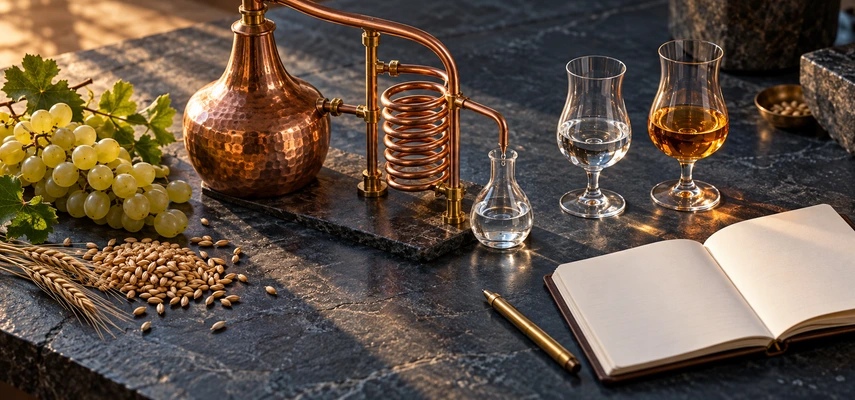

Put a clear gin beside an amber malt whisky. One may smell of juniper and citrus; the other might suggest cereal, fruit and vanilla. Both contain ethanol and water. That tells us remarkably little about why they taste different. A WSET Level 3 Spirits student learns to follow the decisions between the raw material and the glass.
The useful question is simple: why does this spirit look, smell and taste the way it does? This independent TFE Times collection develops that reasoning through original lessons and exercises. It follows WSET’s Issue 3 specification, valid from February 2025. Your course provider should confirm the version applicable to your sitting; TFE has no WSET affiliation or endorsement.
How a WSET Level 3 Spirits student builds an explanation
At a foundational level, you learn to recognize a process. At Level 3, you need to describe it accurately and explain relevant consequences. “This spirit was matured in oak” identifies a production fact. It doesn’t yet explain the vanilla aroma, the texture or whether the oak influence improves the drink.
Use a three-link chain: factor → mechanism → consequence for style or quality. A factor is the choice or condition that changes. The mechanism describes what happens because of that change. The consequence connects the process to something meaningful in the finished spirit. Leave out the middle link and an explanation becomes a slogan.
For example, compare new oak with a repeatedly used cask, keeping other conditions similar. A new vessel can provide more readily extractable wood compounds. Extraction can therefore create a stronger wood-derived contribution over a given period. That may suit a robust spirit, but could overwhelm a delicate one. More oak flavor isn’t automatically more quality.
Start with the raw material
Grapes contain fermentable sugars. Barley stores much of its useful carbohydrate as starch, which must be broken down into fermentable sugars before yeast can use it effectively. Agave stores fructans, another carbohydrate requiring appropriate conversion. These are different preparation problems. “Add yeast” is a plan with a rather important first chapter missing.
The processing method affects what reaches fermentation. Grain preparation combines access to starch with suitable conversion conditions; fruit processing must handle juice, solids and spoilage risks. Later lessons examine the details. For now, ask what the raw material supplies, what yeast can actually use, and what preparation makes that possible.
Avoid assuming that every aroma directly advertises an ingredient. A spirit smelling of pear needn’t contain pears. Fermentation can generate compounds associated with fruit, while wood can supply aromas associated with spices. Describe the sensory observation first. Treat the production explanation as a supported possibility unless the recipe or process is independently known.
Fermentation creates more than alcohol
Yeast converts available sugars into ethanol and carbon dioxide, releasing heat. It also produces other substances that can affect aroma and flavor. Congeners are compounds other than the principal ethanol and water components that contribute to a spirit’s chemical and sensory character. Some are welcome; others need careful management.
Esters can contribute fruity impressions, while higher alcohols and sulfur-containing compounds may influence character in other ways. The result depends on strain, nutrients, temperature and the wider fermentation environment. Lallemand’s fermentation discussion illustrates how environmental conditions change yeast flavor expression. Its brewing examples demonstrate biological relationships, rather than universal instructions for every distiller.
Here is a useful causal answer: changing fermentation conditions can alter yeast activity and the compounds available for distillation, which may change the finished spirit’s aroma. A weaker answer says “long fermentation makes better spirit.” Duration alone cannot establish the microbial activity, compounds produced or desirability of the result.
Distillation selects as well as concentrates
Distillation involves vapor formation and condensation. It concentrates ethanol while changing the proportions of other volatile compounds, meaning compounds that can enter the vapor phase. A fermented mixture doesn’t release one pure substance at a time according to a tidy list of boiling points. Water, ethanol and congeners interact in a changing mixture.
Reflux occurs when some vapor condenses and returns within the still. Further contact between rising vapor and returning liquid contributes to separation. Rectification describes repeated separation through vaporization and condensation. Still configuration and operation help control these effects, influencing strength and the balance of compounds reaching the collected spirit.
The Glasgow Distillery’s process account connects its equipment and operational choices with different new-make profiles. Use such examples to understand mechanisms, not to declare that every similar still produces the same flavor. A tall neck is one feature within a working system; it isn’t a tasting note printed in copper.
Likewise, don’t turn “pot” and “column” into quality grades. Pot stills run in batches, while many column systems operate continuously. Each offers different control possibilities. Selection of collected fractions, reflux and other operating decisions matter alongside equipment. A column can make a characterful spirit; a pot still can’t guarantee a balanced one.
Maturation and finishing change the evidence
Oak maturation combines extraction with reactions and evaporation. The vessel’s previous contents, size, condition and location influence development. Two spirits of equal age may therefore have very different wood influence. Time is part of the explanation, but the barrel and its environment deserve seats at the table too.
Blending can bring components together for consistency or complexity. Filtration can remove selected material. Water changes alcohol strength and can affect perception. Sweetening and coloring can alter the final presentation where permitted. Check the category’s rules before suggesting an addition: a technique available in one spirit may be prohibited in another.
These stages also limit reverse reasoning from the glass. Amber color can be consistent with wood maturation, but color alone doesn’t establish age, cask type or quality. Build an explanation from several observations and verified production information. Distinguish what you know from what you infer; the distinction makes an answer stronger.
Separate category, style and quality
A category places a spirit within an identified group, often shaped by production and legal definitions. Style describes its sensory character: perhaps light and floral, smoky, juniper-led or richly wood-influenced. Quality evaluates how successfully its components work together. A legal identity doesn’t prescribe one flavor, and a powerful aroma doesn’t settle quality.
Consider two hypothetical spirits. One has pronounced oak aroma, drying tannin and little remaining fruit; the other has gentler oak, clear fruit and a sustained, balanced finish. The first isn’t superior simply because it is darker or older. Explain your judgment using balance, integration, complexity and persistence, tied to the actual observations.
Laws constrain the producer’s available choices. They can establish origin, ingredients, methods or maturation requirements. Common practice is different: many producers may use a technique without being legally required to do so. When answering a question, label the distinction. “Often used” and “must be used” make very different claims.
Know what each learning outcome asks
The theory syllabus has three learning outcomes. Learning Outcome 1 covers production principles and their effects on style and quality. Learning Outcome 2 applies those principles to eleven selected principal categories, including their legal frameworks. Learning Outcome 3 covers other named global spirits, their characteristics, labeling terms and key production choices.
Unit 2 covers analytical tasting: describe the spirit, identify its type and category, and assess quality with supporting reasons. These are connected skills, but require different practice. Reading about reflux helps explain production. It cannot provide sensory calibration or reveal whether your description matches the sample served by an assessor.
Plan for all three assessments
The theory exam lasts 2 hours 10 minutes. Its 50-question multiple-choice section gives one mark per correct answer with no negative marking. The weighting is 10 questions for LO1, 15 for LO2 and 25 for LO3. Half the questions concern other named global spirits, so don’t let familiar whisky topics absorb the whole revision timetable.
The written section contains ten questions: six worth 5 marks, three worth 10 marks and one worth 20 marks, totaling 80. Only LO1 and LO2 are assessed here. Topic-level restrictions also apply; for example, agave-spirit distillation and oak species are excluded from explain-type questions. Descriptive coverage and explanation eligibility aren’t interchangeable.
WSET recommends about 40 minutes for multiple choice, 80 for written responses and 10 held for planning. The tasting exam lasts 30 minutes for two blind samples. Each carries 25 marks: appearance 2, nose 5, palate 10 and conclusions 8. Practice allocating attention according to the task, rather than spending half the session admiring the color.
You must pass each assessment separately: 28/50 for multiple choice, 44/80 for written answers and 28/50 across tasting. The final grade averages the three percentages equally. It does not combine raw marks into a single 180-mark score. Pass is 55–64%; Merit is 65–79%; Distinction needs a mean of at least 80% with no individual assessment below 65%.
Turn knowledge into useful revision
Build short answers around the command word. “State” calls for the requested fact; “describe” asks what happens or what something is like; “explain” requires the causal connection. For a production explanation, identify the factor, give the mechanism, then connect it to style or quality. Add conditions when the effect depends on other variables.
Try writing one chain from memory after each lesson. Check every link against a reliable source, then test whether an alternative explanation is possible. Pair theoretical study with structured tasting and trained feedback where you participate. Readers who don’t taste can study theory, but theory-only achievement doesn’t earn the complete qualification.
What to remember
Follow the spirit from raw material through fermentation, distillation and finishing. Distinguish observation from inference, legal rules from common practice, and intensity from quality. For revision, keep separate records of knowledge gaps, weak causal explanations and tasting calibration. Each needs a different remedy; reading the same paragraph three more times may solve none of them.
Check examination details with the official WSET specification and your provider. The exercises below are original TFE teaching materials. Their suggested marks support practice and do not reproduce an official examination or marking scheme.
Written practice: original TFE exercises
These suggested marks and indicative points are independent teaching guidance, not official WSET marking schemes.
Exercise 1: 5 suggested marks
Describe reflux and rectification, including the liquid and vapor movements involved. This is a describe-type exercise. Mapping: LO1, state/describe practice.
Indicative marking points:
- Some rising vapor condenses within the still.
- This condensed liquid returns within the equipment.
- Rising vapor can meet descending liquid.
- Repeated vaporization and condensation perform further separation.
- Rectification can change ethanol and congener proportions in collected spirit.
Model answer: Reflux is the return of liquid formed when some vapor condenses within a still. This returning liquid can meet rising vapor. Repeated vaporization and condensation provide further separation, described as rectification. The process changes the proportions of ethanol and other compounds in the collected spirit.
Why it works: The answer describes physical movements and repeated separation before naming the changing composition. It supplies the mechanism needed to develop a later explanation.
Common mistake: Saying that reflux simply removes every unwanted flavor overlooks mixture behavior and operating choices.
Exercise 2: 5 suggested marks
Describe five distinct post-distillation operations available across spirits production. Permission to use each operation depends on the category. Mapping: LO1, state/describe practice.
Indicative marking points:
- Maturation in a suitable vessel permits development over time.
- Blending combines selected spirit components.
- Filtration removes selected material.
- Water can adjust alcoholic strength.
- Sweetening adds permitted sweetness where category rules allow.
Model answer: After distillation, a producer may mature spirit in a suitable vessel, combine components by blending, remove selected material through filtration, adjust strength by adding water, or add sweetness where permitted. These are distinct operations. Category rules determine which are available for a particular spirit.
Why it works: Five separate operations answer the requested breadth. The legal qualification prevents a list of possible techniques becoming a claim that every category permits them.
Common mistake: Listing five types of cask describes variations of one operation rather than five different operations.
Knowledge check: 12 original practice questions
Independent TFE questions, not official WSET examination items. Choose one answer per question; explanations follow separately.
1. Which statement about reflux is correct?
2. What is the written-paper passing score?
3. How long is the two-spirit tasting examination?
4. Which written-paper structure is correct?
5. Why does barley require preparation before alcoholic fermentation?
6. Which statement correctly distinguishes law from practice?
7. How many MCQs assess other named global spirits?
8. Which theory outcomes are eligible for the written paper?
9. How is the final mean calculated?
10. Which answer best demonstrates causal reasoning?
11. Which evidence best supports a quality judgment?
12. What does pear aroma alone establish?
Answers and explanations
- A — Some vapor condenses and returns within the still.. Returning condensate can take part in further separation through contact with rising vapor. Mapping: LO1.
- C — 44/80. The written assessment requires at least 55%, which equals 44 of the available 80 marks. Mapping: Assessment overview.
- C — 30 minutes. The two blind samples share 30 minutes; WSET recommends roughly 15 minutes for each. Mapping: Unit 2 overview.
- C — Six 5-mark, three 10-mark and one 20-mark question. The ten questions total 80 marks: 30 plus 30 plus 20. Mapping: Assessment overview.
- A — Its starch must yield fermentable sugars.. Starch is a storage carbohydrate that requires conversion before yeast can use its sugars effectively. Mapping: LO1.
- B — A common production technique need not be legally mandatory.. Legal requirements constrain choices, while common practice describes what producers often choose within those constraints. Mapping: LO2.
- D — 25. LO3 receives 25 of the 50 multiple-choice questions, making its breadth a major revision priority. Mapping: Assessment overview.
- B — LO1 and LO2 only. Written assessment is confined to LO1 and LO2, with additional topic-level explanation restrictions. Mapping: Assessment overview.
- A — Average the three assessment percentages equally.. Each assessment percentage contributes one third of the final mean, and each part must separately pass. Mapping: Assessment overview.
- B — A new cask can supply extractable wood compounds, increasing wood-derived flavor.. It identifies a changed factor, the extraction mechanism and a potential sensory consequence. Mapping: LO1.
- A — Observed balance and integration with a sustained finish. Quality conclusions need sensory support rather than assumptions based on equipment, price, age or presentation. Mapping: Unit 2 overview.
- D — A sensory association, rather than proof of pear ingredients.. Fruit-associated aromas may arise through fermentation chemistry without the named fruit being an ingredient. Mapping: LO1.
Continue exploring this series
2. Carbohydrates Explained: How Sugar, Starch, and Fructans Become Fermentable
3. Alcoholic Fermentation Explained: Yeast, Nutrients, and Flavor Compounds
5. Distillation Science Explained: Volatility, Congeners, Reflux, and Rectification
6. Pot Still Distillation Explained: Design, Heating, Cuts, and Flavor
7. Column and Hybrid Stills Explained: Plates, Reflux, and Continuous Distillation
9. Oak Maturation Explained: Barrels, Oxygen, Evaporation, and Flavor Development
10. Spirits Finishing Explained: Blending, Filtration, Sweetening, Coloring, and Packaging
29. Spirits Quality Explained: How Production Decisions Affect Balance and Complexity
30. How to Explain Spirits Production: Advanced Cause-and-Effect Case Studies
46. The WSET Level 3 Systematic Approach to Tasting Spirits Explained
47. How to Assess Spirits Quality: Balance, Complexity, and Evidence
48. WSET Level 3 Blind Tasting Practice: Spirit Identification and Quality Assessment
49. How to Answer WSET Level 3 Spirits Written Questions: Structure, Reasoning, and Marks
50. WSET Level 3 Spirits Exam: Complete Revision Guide and Practice Examinations












