










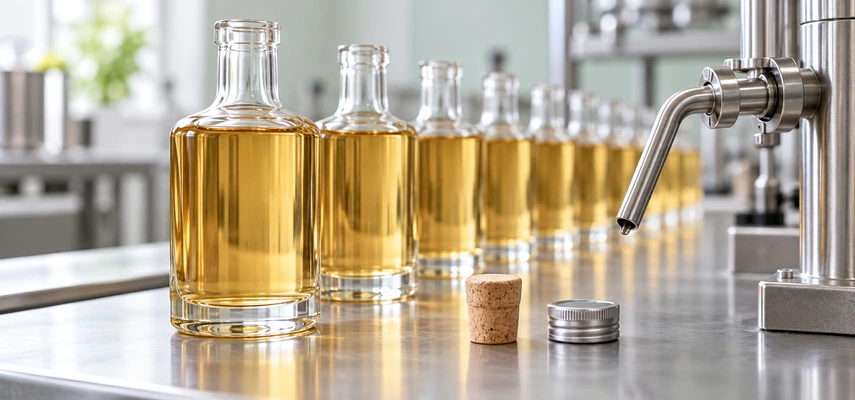

A spirit can leave its last cask with a compelling aroma and still face a long list of decisions before it reaches a shelf. Spirits finishing includes combining components, removing selected material, adjusting strength and making permitted additions. Containers and closures then help protect the result. The bottle is the end of a production chain, not merely a convenient pause after the exciting chemistry.
Here, “finishing” is used broadly for final production operations. A cask finish, covered in the previous lesson, is one particular later maturation choice. It isn’t a synonym for filtration or bottling. Clear terminology matters because similar marketing language can hide very different physical, chemical and legal actions.
Spirits finishing begins with an intended result
Before choosing a technique, identify what the producer wants to achieve. A recurring release may need a consistent sensory profile. A new blend may seek additional complexity. A bottling may need stable appearance under expected conditions. These objectives can overlap, but they aren’t the same problem and don’t necessarily require the same intervention.
Then distinguish style from quality. A producer can make a spirit sweeter, clearer or lower in alcohol without automatically making it better. Quality depends on the result: balance, integration, appropriate character and the absence of relevant faults. Technical control is valuable when it helps deliver that result, rather than as a collection of impressive processing claims.
Blending can manage natural variation
Components differ because raw materials, fermentation, distillation and maturation histories vary. Blending brings selected components together in suitable proportions. For consistency, the blender can adjust those proportions to maintain a target profile despite variation in the stocks available. Repeating a numerical recipe isn’t always the same as repeating the sensory result.
Johnnie Walker describes consistent flavor as one purpose of its blending. That is a useful producer example rather than proof that every blend tastes the same or every recurring release is chemically identical. Consistency means maintaining the intended experience within the producer’s controls, using selection and assessment to manage the changing material.
Imagine a component that is more smoky than in a previous batch. Simply using the same proportion could shift the blend. The blender may select or balance other stocks differently to reach the target. This is a worked production principle, not a claim about any named recipe. The key mechanism is controlling the mixture through component choice and proportion.
Blending can also create complexity
Components with complementary characters can produce a more varied or integrated sensory profile together. One might contribute fruit, another structure or a longer finish. Their combination isn’t a simple arithmetic sum of tasting notes, because perception and interaction within the mixture matter. Trial assessment determines whether the combination actually works.
More components don’t guarantee more complexity. A blend can become muddled, overly dominated by one contribution or less coherent than its parts. Conversely, a small number of well-chosen components may produce an expressive result. Counting casks or distilleries is a factual exercise; evaluating their combination requires tasting evidence.
Blending also doesn’t automatically mean combining different distilleries or legal categories. The exact identity depends on the applicable rules and the components used. Combining casks within a permitted category is a production action that must be distinguished from a legal label such as Blended Scotch Whisky. Don’t infer the label from the everyday verb alone.
Filtration removes selected material
Filtration is a broad family of removal processes. A filter may retain particles or interact with other material, depending on its medium and operating conditions. The target can include unwanted solids or haze-forming substances. It isn’t accurate to describe every filter as removing the same compounds or performing the same job.
The Pall technical case study distinguishes particulate and colloidal haze problems in spirits processing. Its practical point is that filtration must be selected for the actual material and desired outcome. The supplier’s product claims don’t establish that all filtration improves flavor, or that a clear appearance proves the absence of every possible problem.
Filtering can also affect material associated with sensory character. Producers balance appearance and stability objectives with the profile they want to retain. The useful question is what the chosen method removes under the stated conditions. “Filtered” and “unfiltered” are incomplete descriptions, not opposing quality grades.
Chill filtration responds to solubility changes
Some compounds are less soluble when a spirit is chilled or its ethanol-water balance changes through dilution. They can associate or come out of solution, producing haze. Chill filtration cools the spirit under managed conditions and removes appropriate haze-forming material. The temperature, strength, filter and target all influence the process.
Annandale’s technical note explains the role of fatty acids and esters in whisky haze. It also expresses the producer’s preference for its own bottlings. Separate the supported physical mechanism from a universal judgment: the fact that a process changes appearance doesn’t settle whether a particular taster will prefer the filtered or unfiltered result.
Haze itself also needs interpretation. A chill-related change in a suitable spirit is not the same observation as foreign particles or an unidentified stability problem. Nor can every cloudy bottle be diagnosed from a glance. Production assessment considers the cause, the intended presentation and appropriate checks, rather than treating all turbidity as one phenomenon.
Water changes strength and the sensory environment
Adding suitable water reduces alcoholic strength. It also changes the solvent mixture, which can affect solubility and the release or perception of aroma. A spirit at one strength may therefore present differently after reduction. The result isn’t captured by saying that water simply makes every existing flavor weaker in direct proportion.
Producers select and verify a bottling strength suited to the category and intended product. They also need suitable water quality and process control. A strength measurement answers a particular compositional question; it doesn’t independently establish integration or aromatic quality. Higher strength can offer one sensory presentation, but shouldn’t be used as a universal score.
For an examination explanation, follow the actual change. More water changes the ethanol-water balance, which changes the environment of dissolved compounds and sensory perception. Some effects depend on the original mixture. Avoid guaranteeing that dilution always releases a particular aroma or that the same addition produces identical results across all spirits.
Sweetening and coloring have different jobs
Sweetening changes the amount of permitted sweetening material and can influence taste, perceived balance and mouthfeel. Coloring changes appearance through a permitted coloring material. These operations have distinct purposes even when a finished product presents both a sweet impression and a dark color. One observation doesn’t establish that both techniques were used.
Sweet-associated aromas can occur without proving added sugar. Likewise, dark color can reflect wood influence, permitted coloring or a combination, depending on category and process. State what is observed, then verify the production facts before assigning a cause. The bottle’s appearance isn’t a laboratory analysis with unusually attractive typography.
Permissions vary. The Scotch Whisky technical file limits additions to water and plain caramel coloring within its requirements; this is not permission to sweeten Scotch. Other spirits have different frameworks. A general production lesson can describe a tool without authorizing its use in every named category.
Textural additives require the same precision
Textural additives are used to influence mouthfeel where permitted. Their function differs from simply changing alcoholic strength, although the perceived effects may interact. Naming the purpose doesn’t establish which substance was used, its amount or whether it is legal in a particular category. Those details require the relevant production and regulatory evidence.
It is equally inaccurate to infer an additive whenever a spirit feels rounded or viscous. Alcohol strength, sugars, retained compounds and other production choices can affect texture. A tactile observation supports description; it doesn’t uniquely identify a recipe. Treat additive claims with the same care as claims about cask type or yeast strain.
Containers protect the product through distribution
Packaging must be compatible with the liquid, filling process and expected handling. Containers need to contain the product reliably, while the chosen format can influence protection from light, breakage and other conditions. A decorative package may communicate style, but visual weight or price isn’t evidence that the spirit inside has greater sensory quality.
The producer also considers fill level, presentation and labeling within applicable requirements. These are practical final controls rather than an excuse to ignore what happened upstream. A well-designed bottle cannot repair an unbalanced blend; a carefully made spirit can still be poorly served by unsuitable packaging. Production quality extends through the final container.
Closures complete the containment system
A closure must fit and function with the container and product. Cork-based stoppers, screwcaps and other systems involve different materials and handling considerations. The appropriate choice depends on compatibility, seal performance and the intended use. One closure style doesn’t automatically indicate a higher-quality spirit or a more authentic maturation history.
After filling, the bottle is a different environment from a working oak cask. Don’t describe sealed glass storage as continued barrel maturation simply because more calendar years pass. The producer generally aims to preserve the intended presentation through distribution and use, while recognizing that storage and opening conditions can affect the product.
What to remember
Identify the target before explaining the technique. Blending can pursue consistency or complexity; filtration removes selected material; water and permitted additions change particular aspects of the product. Containers and closures help protect the finished result. Throughout, distinguish processing facts from legal labels and sensory judgments. A final operation earns its place by serving the intended spirit.
Written practice: original TFE exercises
These suggested marks and indicative points are independent teaching guidance, not official WSET marking schemes.
Exercise 1: 5 suggested marks
Explain why maintaining a consistent blend can require changing component proportions. Mapping: LO1 explain: blending consistency.
Indicative marking points:
- Components can vary between batches or casks.
- The same proportions of changed components can change the resulting profile.
- Assessment identifies the difference from the target.
- Selection or proportions can be adjusted.
- The goal is the intended sensory result rather than a fixed formula alone.
Model answer: Components can vary because their production and maturation histories differ. Repeating the same proportions of changed stocks can therefore shift the final profile. By assessing those components and the resulting trials, a blender can alter selection or proportions to maintain the intended sensory result. Consistency concerns the outcome, not the recipe in isolation.
Why it works: It connects variation to mixture change and then explains the corrective role of selection and proportion.
Common mistake: Assuming consistency means never changing a numerical recipe ignores variation in the material being combined.
Exercise 2: 5 suggested marks
Explain the principle of chill filtration and why it should not be treated as an automatic quality verdict. Mapping: LO1 explain: filtration.
Indicative marking points:
- Suitable compounds can become less soluble on cooling or dilution.
- They can associate or come out of solution.
- This can produce haze.
- Managed chilling and filtration remove targeted material.
- Sensory preference and balance still require assessment of the result.
Model answer: Cooling or dilution can reduce the solubility of relevant material, allowing it to associate or come out of solution and form haze. Chill filtration uses managed cooling and a selected filter to remove the target material. The appearance may become more stable, but that alone does not settle sensory quality or preference.
Why it works: The answer traces solubility into haze and removal, then separates a physical processing outcome from an unsupported overall judgment.
Common mistake: Saying filtered always means better, or unfiltered always means better, skips the actual method and sensory result.
Knowledge check: 10 original practice questions
Independent TFE questions, not official WSET examination items. Choose one answer per question; explanations follow separately.
1. Why might a blend recipe change between batches?
2. Which observation proves sweetening?
3. Why distinguish particulate and colloidal haze?
4. What is chill filtration intended to address?
5. Why is sealed glass storage different from cask maturation?
6. Which principle governs coloring permissions?
7. What makes a suitable closure?
8. What does a greater component count prove about quality?
9. What is the purpose of a textural additive where permitted?
10. What does adding water change beyond ABV?
Answers and explanations
- A — Component variation may require adjustment to preserve the target profile. Consistency can require adapting component selection and proportion rather than repeating one formula regardless of changing material. Mapping: LO1.
- D — None of these sensory impressions alone proves it. Sweet-associated aroma, texture and color can have other origins, so addition claims require production or analytical evidence. Mapping: LO1.
- B — They can require different removal approaches. The cause and physical form of haze help determine the suitable process rather than one universal filter setting. Mapping: LO1.
- A — Appropriate haze-forming material under managed cooling conditions. Cooling can reduce solubility of relevant material, allowing a chosen filtration process to remove it. Mapping: LO1.
- B — It lacks the same ongoing oak-vessel environment. A bottle is a different storage environment, so elapsed time cannot simply be reported as continued wood maturation. Mapping: LO1.
- D — Check the specific category and relevant rules. A technique available somewhere in spirits production is not automatically permitted in every named category. Mapping: LO1.
- C — Compatibility and reliable function with container and product. Closure choice is a containment decision; it does not independently rank the quality or authenticity of the spirit. Mapping: LO1.
- B — Nothing by itself about balance or complexity. Complexity and quality depend on how the components work together, not merely their number. Mapping: LO1.
- D — Influencing mouthfeel. The stated function concerns texture, while actual identity, amount and legal permission need separate verification. Mapping: LO1.
- A — The solvent mixture and potentially sensory expression. Reduction changes the ethanol-water environment, which can affect solubility and perception as well as strength. Mapping: LO1.
Continue exploring this series
9. Oak Maturation Explained: Barrels, Oxygen, Evaporation, and Flavor Development
13. Grain and Blended Scotch Whisky Explained: Production Choices, Laws, and Style
18. Cognac Classifications Explained: Crus, Age Statements, and Blending
26. Vodka Explained: Neutral Spirits, Raw Materials, and Production Choices
27. Gin Explained: Juniper, Botanicals, Distillation, and Quality
29. Spirits Quality Explained: How Production Decisions Affect Balance and Complexity
41. Flavored Vodka, Spiced Rum, and Flavored Whiskey Explained
44. Liqueurs and Non-Alcoholic Spirits Explained: Sweetness, Flavoring, and Production
11. How Grains Become Whisky: Malting, Mashing, Enzymes, and Starch Conversion
50. WSET Level 3 Spirits Exam: Complete Revision Guide and Practice Examinations












