










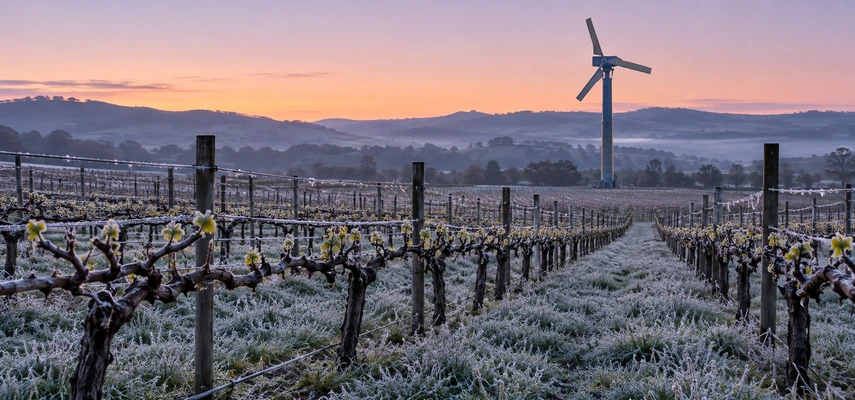

A vineyard can lose fruit in an hour and spend years repairing the consequences. Yet the same weather event does not produce the same damage everywhere. Vineyard weather hazards must be evaluated against the vine’s stage, the site, available protection and the wine the producer intends to make.
The useful sequence is hazard → vulnerable tissue or process → damage → production consequence → management choice. That prevents a common examination shortcut: naming a risk and immediately naming equipment, without explaining whether the equipment addresses the mechanism.
The official D1 specification includes drought, excess water, untimely rainfall, freeze, frosts, hail, sunburn, fire and smoke taint, together with management options. A complete answer considers both preventing damage and making sensible decisions after an event. Protection has costs and limits; it does not issue a weather exemption.
Vineyard weather hazards begin with exposure and timing
Risk combines the possibility of an event with the consequences if it occurs. A frost-prone hollow and a neighbouring slope can experience different tissue temperatures. A dormant bud and an expanding shoot can tolerate different conditions. A vineyard’s regional weather forecast is therefore useful information, rather than a direct measurement of every vine’s risk.
Separate three types of consequence. The current crop may be reduced or damaged. The vine’s framework or reserves may be impaired, affecting future production. Infrastructure and access may also be disrupted. An assessment restricted to this year’s bunch count can miss expensive longer-term damage.
Management follows the same distinction. Site selection and vineyard design alter exposure before an event. Active protection attempts to change conditions during it. Recovery responds to the damage actually found. Insurance may transfer part of a financial loss, but it does not preserve leaves, fruit or the producer’s supply relationships.
Winter freeze and spring frost are different problems
Winter freezing can injure dormant buds, canes, cordons or trunks. Tolerance changes with variety, tissue, vine condition and acclimation. A temperature reached after gradual hardening can have different consequences from a sudden drop after warmer conditions have reduced hardiness.
Ontario’s account of cold injury explains why wood and bud damage must be distinguished. Management begins with suitable varieties and sites, supported where appropriate by practices that protect vulnerable structures. Following an event, assessment of viable buds and wood helps guide pruning and renewal. Surviving roots do not establish that a normal crop will follow.
Spring frost commonly threatens tender growth after budburst. In a radiation frost, heat loss on clear, relatively calm nights can leave cold air near the ground with warmer air above. Terrain and barriers influence where that cold air accumulates. In an advective event, a cold air mass moves through the area, often with wind and without a useful warm layer above the vines.
Frost protection must match the mechanism
Wind machines can mix warmer upper air with colder vineyard air where a suitable inversion exists. They cannot manufacture warmth from an equally cold air mass. Heaters add heat but require fuel and resources, while protection using water depends on heat released as water freezes and on a correctly designed, continuously supplied system.
Wine Australia’s frost guidance distinguishes radiation and advection events and the limitations of active methods. Exact operating decisions require site-specific monitoring and system design; a generic air-temperature trigger would ignore tissue, humidity and equipment differences.
Passive options include avoiding frost pockets, facilitating cold-air drainage and considering practices that delay vulnerable development. Delayed pruning can shift budburst, but brings labour and scheduling tradeoffs. The AWRI frost factsheet connects management effectiveness with inversion conditions and site preparation.
After frost, new shoots can restore a canopy without replacing the original crop’s fruitfulness or timing. Assess damage before assuming that vigorous regrowth means full recovery. A smaller, later or uneven crop can change both quality potential and the economic case for further work.
Hail removes more than berries
Hail can tear leaves, damage shoots and buds, and bruise or remove clusters. Early damage may reduce the canopy or future fruiting potential; later damage may directly reduce the harvest and expose injured fruit to deterioration. Severity can vary sharply across a block.
The AWRI’s hail-damage guidance emphasises stage-specific assessment and the possibility of regrowth. Recovery depends on the remaining tissue and season, not merely the dramatic appearance immediately after the storm.
Where appropriate, protective netting offers a physical barrier but adds establishment, maintenance and operational costs. Distributing vineyards across sites may reduce the chance that one localised event affects the entire supply, although it cannot eliminate correlated regional risk. Following hail, map damage and evaluate crop health, labour needs and realistic maturity rather than assuming the usual harvest plan still applies.
Drought constrains the functioning vine
Drought reduces water supply relative to demand. Its effects depend on the root-zone reservoir, roots, canopy, variety and timing. Reduced growth may be one response; severe restriction can impair photosynthesis, berry development and vine survival. Shrivelled fruit is not proof that flavour ripeness has improved.
Options include selecting suitable sites and plant material, matching canopy and ground-cover management to conditions, and using irrigation where available and permitted. Water supply itself can be limited or costly. The New South Wales water-status guide supports combining soil and plant observations rather than judging supply from one reading or visual symptom.
The tradeoff is between the intended crop, long-term vine function and the resources available. A carefully controlled deficit in a particular setting is different from uncontrolled severe drought. Neither the lowest water input nor the smallest berry automatically defines the best management.
Excess water and untimely rain act through different routes
Excess water can saturate the root zone and displace the air roots need for respiration. Drainage, soil structure, restrictive layers and duration influence the consequences. The AWRI waterlogging factsheet explains why visible surface water disappearing may not mean root conditions have recovered.
Management can involve appropriate site and drainage design, reducing compaction and monitoring the profile. These decisions must address the cause of saturation. Adding nutrients cannot substitute for restoring root function when oxygen limitation is the primary problem.
Untimely rainfall concerns when rain occurs, even without waterlogging. Wet, cool conditions around flowering may reduce successful fruit set. Rain near harvest can affect berry condition and disease pressure or complicate access and picking. Conversely, rain can relieve a damaging deficit. Evaluate the event’s timing and intensity rather than calling every harvest-season shower disastrous.
The British Columbia development guide connects flowering conditions and crop formation. For grapes intended for sweet wines, rain also changes the feasibility of the chosen concentration method. Damaged or deteriorating fruit is not interchangeable with fruit deliberately concentrated under suitable conditions.
Heat and sunburn overlap, but are not identical
A heat event changes the thermal environment of the vine. Sunburn concerns damaging exposure and heating of tissues, especially exposed fruit. Berry temperature depends on radiation, shade, air conditions and water-related cooling; it may exceed the reported air temperature.
Wine Australia’s heat guidance identifies canopy shade, water availability and vineyard design among the relevant influences. Greater fruit exposure may be useful under cooler conditions but damaging during extreme heat. Sudden exposure after leaf removal can therefore create a different risk from gradual development under an established canopy.
Protective choices can include retaining appropriate shade, suitable row and trellis design, and managing water supply. Each depends on local conditions and resources. The aim is to prevent damaging temperatures while retaining adequate canopy function and fruit health, not to assume that every additional unit of sunlight improves quality.
Fire damage and smoke-taint risk need separate assessments
Fire can damage leaves, buds, wood and infrastructure through direct heat and burning. The severity of vine injury is not always clear immediately. Wine Australia’s recovery guidance stresses allowing time for a more reliable assessment before irreversible renewal decisions.
Risk planning includes site-specific fuel and infrastructure considerations, emergency arrangements and recovery resources. After an event, distinguish the survival of perennial tissues from the survival of the crop and from smoke exposure. A vineyard can avoid direct burning while its grapes encounter smoke.
Smoke taint involves compounds from smoke being taken up by grapes and later contributing undesirable wine characters. Volatile phenols can occur in free forms or become bound to sugars. Bound forms may not smell obviously smoky in the fruit; later release can contribute flavour in fermentation, ageing or consumption.
The AWRI smoke-taint resource describes that mechanism and the importance of exposure, variety and developmental stage. Seeing or smelling smoke does not by itself establish the finished wine’s condition. Analytical results need appropriate interpretation; evidence of exposure and a demonstrated sensory problem are related but different conclusions.
Representative sampling, laboratory assessment and appropriate winemaking trials can inform whether to harvest or use fruit. Neither washing the berries nor finding an apparently clean initial juice should be treated as a guaranteed cure. If a crop is not used, vineyard management still needs to protect future production. The economic decision concerns more than the cost of picking.
Explain quality and price consequences separately
Hazards can reduce yield per vine, impair aroma and flavour ripeness, alter grape component balance or compromise fruit health. Selection may remove damaged material and reduce saleable volume. Extra sorting or separate handling can add costs. None of these outcomes implies that all remaining fruit must make poor wine or that scarcity automatically creates a premium product.
The decision after damage should compare realistic returns with the cost and consequences of each option. Protecting long-term vine health can remain worthwhile when the current crop has little value. Equally, an expensive recovery action may not be justified if the season cannot mature the replacement crop.
For an evaluative answer, identify the limiting condition, explain what the intervention changes and state what it cannot solve. Include timing, resources and future effects. That structure is stronger than a list of hazards beside a shopping list of equipment.
Distinguish weather damage from vineyard pests and diseases before choosing a response. Use vineyard soil and water and irrigation and vine nutrition to explain water-related constraints, then consider vineyard establishment for decisions made before planting. Connect the timing of the hazard with harvest decisions to assess consequences for the fruit and picking options.
Original Diploma practice and outline answers
These hypothetical TFE exercises use indicative points and outline answers rather than official WSET questions or marks.
Question 1: evaluate a frost fan
A grower proposes the same wind-machine response to a calm radiation frost and a windy advective freeze. Explain the weakness in that plan.
Indicative points: Inversion mechanism; warm upper air; advective cold mass; equipment cannot create heat; monitoring and site-specific suitability.
Outline answer: A wind machine can help where warmer air above a radiation-cooled vineyard is available for mixing. A windy advective event may lack that useful inversion. Mixing equally cold air does not provide the same protection, so the event and temperature profile must be assessed before relying on the equipment. Owning a fan does not make every cold event the problem it can solve.
Question 2: distinguish fire from smoke
A vineyard has no visibly scorched vines after nearby fires. A buyer concludes that the fruit requires no smoke assessment. Evaluate that conclusion.
Indicative points: Direct heat versus airborne exposure; no visible injury does not exclude uptake; free and bound compounds; representative analysis and interpretation; sensory outcome not assumed.
Outline answer: Lack of scorching is evidence about visible direct damage, not proof that grapes avoided smoke exposure. Smoke-related compounds can be taken up without burning the vine, and bound forms may not reveal themselves through an obvious grape smell. Exposure history, representative testing and appropriate assessment are needed. Conversely, smoke in the area does not automatically prove the wine is tainted.
Question 3: evaluate recovery after hail
A badly damaged block produces vigorous new growth after hail. Explain why the grower should not immediately budget for the original harvest volume and quality.
Indicative points: Canopy regrowth differs from crop replacement; remaining fruit health; timing and maturity; future bud damage; selection and cost implications.
Outline answer: Regrowth shows that parts of the vine remain active but does not replace removed bunches or establish that surviving fruit is healthy. A replacement crop, if present, may develop later and unevenly. Assess actual crop, remaining season and tissue damage, then budget for realistic saleable yield and extra work. Future production may also matter to the recovery plan.
Match the response to the process
For each hazard, practise finishing this sentence: “This intervention could help because it changes…” Then add its limitation. A response that fits the physical or biological process is defensible; one chosen only because it appears beside the hazard in revision notes is not yet an explanation.












