











Learning how rum is made is a useful cure for judging a spirit by colour alone. A pale bottle may contain wood-aged rum that has been filtered. A dark one may owe some colour to caramel. A clear cane-juice rum can be intensely aromatic despite never developing a brown barrel colour.
Rum begins with sugar cane, but cane reaches the fermenter in several forms. Fermentation, distillation and finishing then create a wide range of styles. The interesting question is not simply whether a rum is white, gold or dark. It is which production decisions produced the liquid behind that appearance.
Follow the process in order and the apparent contradictions become much easier to explain. In this lesson, light and heavy describe broad differences in flavour intensity and character; they are not statements about calories or an automatic ranking of quality.
How rum is made starts with three sugary liquids
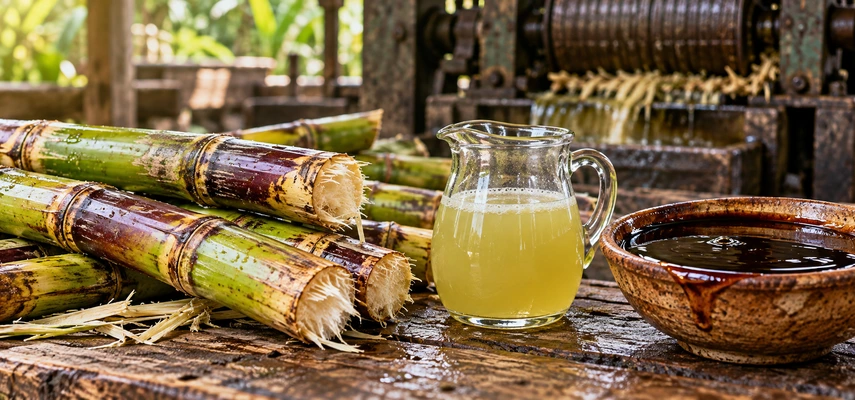
Fresh cane juice comes from crushing harvested stalks. Unlike barley starch, its sugars do not need a cereal-style mashing conversion before yeast can use them. The producer still needs sound raw material, appropriate liquid composition and controlled fermentation. Ready-made sugar is a useful starting point, not permission to ignore the process.
Juice is perishable, which makes the relationship between harvest, crushing and fermentation important. Fresh-juice production is closely tied to access to cane and the harvest season. Cane-juice rums can show grassy, herbal or fresh vegetal impressions, although fermentation and distillation still exert considerable influence on the result.
Cane syrup is concentrated juice. Evaporating water makes a more concentrated sugar source, which is diluted as required before fermentation. Terms such as cane honey can refer to this syrup; they do not necessarily mean bee honey was used. Nor should syrup automatically be treated as the same product as molasses.
Molasses remains after sugar crystallisation in cane-sugar manufacture. It retains fermentable sugar as well as other material from the processing of the juice. A producer dilutes it with water and adjusts the fermenting liquid to suit the yeast and intended production style.
The three routes therefore share a useful pattern: obtain a sugary raw material, prepare a fermentable liquid, then allow microorganisms to act. With juice the emphasis is fresh extraction; with syrup and molasses, concentration and subsequent dilution become important parts of the story.
Molasses does not make every rum taste sugary
The dark, sticky ingredient can encourage the mistaken idea that rum is simply liquid sugar with alcohol added. Fermentation consumes sugar to make alcohol and carbon dioxide. Distillation then separates volatile components from the fermented liquid; it does not carry the whole sticky molasses mixture into the receiver.
A finished rum can smell of toffee or caramel without that aroma proving a high sugar content. Conversely, a producer may sweeten a product where the relevant rules allow it. Raw material, aroma and measured sweetness are related questions, but they are not interchangeable answers.
Fermentation creates alcohol and a flavour foundation
Yeast converts fermentable sugar into ethanol while also generating compounds that contribute to aroma. Yeast selection, temperature, nutrients and fermentation time all matter. Distillers seeking a relatively light style may favour a controlled process that produces a cleaner, less intensely aromatic starting liquid.
Longer or microbiologically more complex fermentations can encourage greater concentrations of some flavour compounds and their precursors. High ester rum styles are an important example: fruity, sometimes strikingly pungent aromas can be developed through deliberate fermentation and distillation choices.
Time alone is not a flavour switch. Leaving any fermenter unattended for longer does not guarantee a desirable high-ester rum. The relevant microorganisms, acidity, raw materials and later distillation need to work together. Production control is still required when the intended result is exuberant rather than restrained.
E&A Scheer’s production account distinguishes dunder, the spent liquid from distillation, from muck, a separately managed material associated with particular Jamaican practices. Neither should be described as an ingredient required in all rum. They are also not two convenient names for live yeast.
For revision, connect a more aromatic fermenting liquid to the possibility of a more characterful distillate. Then add the qualification: the still must retain the relevant compounds. Fermentation establishes opportunities that distillation can preserve, reshape or substantially reduce.
Pot and column stills offer different routes
Pot still production operates in batches. Copper equipment, repeated distillation and the choice of collected fractions can shape a characterful rum. Some rum still systems use retorts, vessels through which vapour passes for further enrichment. A pot still therefore need not be a simple replica of a Scotch double-pot arrangement.
Heads, heart and tails decisions remain important. Collecting a fraction rich in desirable character is a selective task; retaining every compound does not necessarily produce a balanced spirit. Heavy describes a style, not a recommendation to abandon separation or quality control.
Column still production supplies repeated vapour-liquid contact within the equipment. Extensive rectification can produce a high-strength, relatively light spirit. Such components can be useful when a producer wants a restrained base for maturation or blending.
However, column does not always mean near-neutral. At Clément, cane-juice rhum is distilled in a single-column system at a comparatively moderate strength, retaining an expressive character. The equipment’s design and operating strength matter more than treating the word column as a complete tasting note.
Imagine two columns: one configured to retain cane-derived aroma and another using much more extensive rectification. They share an engineering principle but need not produce equivalent spirits. That is the same reason a supermarket description of tall stills cannot tell you everything about a rum’s eventual weight.
Marks give blenders a useful vocabulary
Distilleries can make different marks, identifiable production styles or specifications rather than merely different brand names. A mark may reflect the intended congener profile and the process used to produce it. Light and heavy marks can become separate tools in a blender’s inventory.
A small contribution from an intensely aromatic mark may noticeably change a blend. Another component can provide a quieter foundation. Combining those components is purposeful construction, rather than proof that the distiller failed to make a finished spirit in one run.
Blending can also combine different ages, still types or origins. Ask what is being combined and why. A blend of pot- and column-distilled rums answers a different question from a blend of several casks of the same mark, although a finished bottle may involve both decisions.
Unaged rum, oak and the place of ageing
Unaged rum can retain a direct expression of fermentation and distillation. Resting in stainless steel can allow time for settling, handling and strength adjustment without extracting wood compounds. Do not call that equivalent to acquiring oak-derived vanilla, tannin and colour during barrel maturation.
Oak ageing adds extraction, chemical change and evaporation. Previously used Bourbon casks are common, though other casks and histories exist. A heavily used cask may contribute differently from new wood or a recently emptied wine cask. Age alone does not describe how active that wood was.
Tropical ageing usually involves warmer conditions than continental ageing in a cooler warehouse. Temperature and humidity affect evaporation and the interaction with wood. Warm conditions can accelerate some changes and lead to substantial losses, but there is no reliable universal formula converting one tropical year into a fixed number of continental years.
Some rums spend time in more than one climate. A spirit may be distilled and initially matured in its producing country, then transferred for further storage or maturation elsewhere. An origin statement is not automatically a complete record of every warehouse in its history.
When comparing ages, therefore, ask about cask type, climate and the meaning of the label claim. A prominent number may require explanation, especially on a solera-style presentation; do not assume every number is a guaranteed youngest-component age under one worldwide rum rule.
Colour, charcoal, sweetness and strength
Activated charcoal can remove colour and affect some aroma compounds. Bacardi describes ageing and charcoal filtration as central tools in its rum tradition. This explains why clear appearance alone cannot establish that a rum has never touched wood.
Caramel colour can adjust appearance where permitted. It is not a reliable measure of maturation time, and its use as a colouring should be distinguished from sweetening. A very dark rum may be young, while a comparatively pale one may have spent meaningful time in older, less active wood.
Sugar addition is permitted under some category frameworks and restricted under others. Spices or other added flavours can also change the appropriate product description. Keep those questions tied to the relevant market and category rather than inventing a single rule shared by every rum-producing country.
Overproof indicates a comparatively high bottling strength in common usage, but the term should not be converted into one universal international ABV threshold. Higher strength changes alcohol intensity and the way a rum behaves when diluted. It does not by itself prove pot distillation, high ester content or long maturation.
What to remember
Fresh juice, concentrated syrup and molasses are different starting points from the same crop. Fermentation develops alcohol and character; pot and column systems then select and concentrate that character in different ways. Light and heavy marks can be blended deliberately rather than treated as opposing quality grades.
After distillation, distinguish neutral-vessel rest from oak ageing, and consider climate alongside time. Filtration, caramel, permitted sweetening and bottling strength can all change the finished presentation. Colour is the easiest detail to see and one of the least sufficient explanations on its own.
Continue your study
To revisit sugar preparation and fermentation, read How Spirits Begin: Raw Materials, Sugar Conversion, and Fermentation. To apply the mechanisms to rum regions, read Rum Regions Explained: The Caribbean, Central America, and South America. To compare the Brazilian cane-juice tradition, read Cachaça Explained: Brazil’s Distinctive Sugar Cane Spirit.
Knowledge check: 10 original practice questions
Independent TFE questions, not official WSET examination items. Choose one answer per question; explanations follow separately.
1. Which process actually produces the alcohol before rum distillation?
- Fermentation
- Caramel colouring
- Filtration
- Cask charring
2. A characterful cane-juice rum from a single column demonstrates what?
- All columns produce vodka
- Only molasses can retain flavour
- All cane juice is pot distilled
- A column still need not make near-neutral spirit
3. Why can a clear rum have oak-ageing history?
- Filtration may remove colour after ageing
- Every clear rum is unaged
- Ageing occurs only after bottling
- Oak never releases colour
4. Why is longer fermentation alone an insufficient explanation of high-ester rum?
- Fermentation cannot affect aroma
- All rum has identical fermentation
- Esters can form only in bottles
- Microorganisms, conditions and later distillation also matter
5. What can a rum mark identify?
- A distillery production style or specification
- A compulsory sugar dose
- Only the oldest barrel
- A universal national brand
6. What distinguishes molasses from fresh cane juice?
- It is distilled rum
- It is bee honey
- It remains after sugar crystallisation
- It is malted cane starch
7. Why is cane syrup normally diluted for fermentation?
- To make distillation unnecessary
- To remove all yeast nutrients
- To prepare an appropriate fermenting liquid from a concentrate
- To convert oak into sugar
8. What does dunder usually refer to in this production context?
- Spent liquid remaining after distillation
- Fresh oak sawdust
- Charcoal-filtered white rum
- A legal age statement
9. How should tropical and continental ageing be compared?
- Consider climate and cask rather than a fixed conversion factor
- One tropical year always equals three continental years
- Climate never affects maturation
- Only continental ageing involves evaporation
10. What does overproof alone establish about a rum?
- Mandatory high ester fermentation
- Comparatively high bottling strength in its usage context
- A fixed worldwide legal ABV
- A minimum ten-year age
Answers and explanations
1. A — Fermentation. Yeast produces ethanol during fermentation; the still subsequently separates and concentrates alcohol and other volatiles. Mapping: LO2.
2. D — A column still need not make near-neutral spirit. Operating strength and rectification influence character; the word column alone does not establish neutrality. Mapping: LO2.
3. A — Filtration may remove colour after ageing. Activated charcoal can remove colour, so visual clarity does not establish the absence of wood maturation. Mapping: LO2.
4. D — Microorganisms, conditions and later distillation also matter. Desired character depends on a controlled combination of organisms, conditions and selection during distillation. Mapping: LO2.
5. A — A distillery production style or specification. Different marks can give a blender components with distinct character, not merely alternative packaging names. Mapping: LO2.
6. C — It remains after sugar crystallisation. Molasses is a sugar-manufacturing by-product retaining fermentable sugar, rather than freshly pressed cane juice. Mapping: LO2.
7. C — To prepare an appropriate fermenting liquid from a concentrate. Evaporation concentrates juice into syrup; water adjustment helps prepare a suitable liquid for fermentation. Mapping: LO2.
8. A — Spent liquid remaining after distillation. Dunder refers to stillage and should not be confused with muck or described as universal to all rum production. Mapping: LO2.
9. A — Consider climate and cask rather than a fixed conversion factor. Temperature, humidity and wood history influence maturation without providing a universal age conversion formula. Mapping: LO2.
10. B — Comparatively high bottling strength in its usage context. Overproof concerns strength in context; it does not establish still type, maturation time or a universal threshold. Mapping: LO2.











