










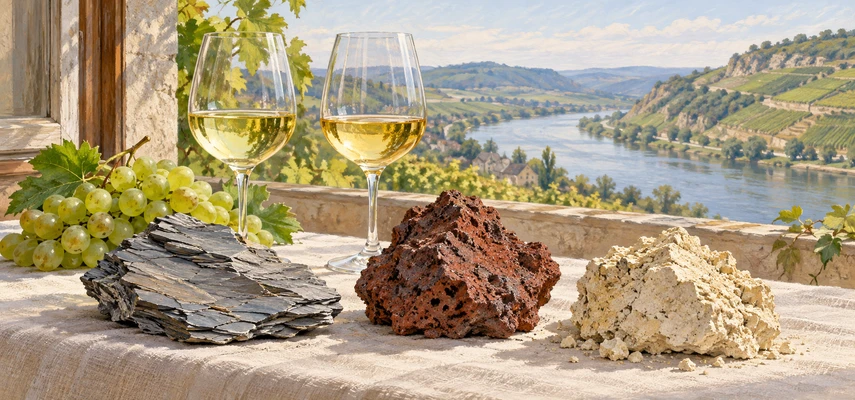

Two bottles say Riesling, both come from Germany, and both taste dry. One feels broad and firmly structured; the other seems lighter, with a particularly insistent line of acidity. It’s tempting to declare the first Rheingau and the second Nahe. That might work once. It isn’t a sound regional explanation.
Rheingau and Nahe offer a better lesson: use regional knowledge to ask useful questions, then let the wine answer them. Site, season, crop and cellar choices can strengthen or overturn a familiar stereotype. For Diploma study, connect those causes to style, quality and price while keeping origin, harvest ripeness and finished sweetness separate.
Put Rheingau and Nahe on different river systems
The Rheingau follows a distinctive stretch of the Rhine, with vineyards also around Hochheim near the Main. Near Wiesbaden the Rhine turns west before resuming its northerly course around Rüdesheim. That orientation helps explain the favourable southerly exposures of many vineyards on its right bank. The German Wine Institute’s Rheingau profile identifies Riesling as the principal grape and Assmannshausen as an important centre for Spätburgunder, or Pinot Noir.
The Nahe follows the Nahe river and tributaries including the Glan and Alsenz. Its regional profile describes shelter from the Hunsrück, relatively dry, sunny conditions and varied soils. Riesling leads, but Pinot varieties, Müller-Thurgau and Dornfelder broaden the picture. Neither region is exclusively Riesling, and neither has one uniform vineyard setting.
Temperature governs the pace of growth and ripening; sunlight supports photosynthesis and influences the bunch environment. Local exposure, elevation and air movement modify the regional setting. A warm Rheingau site may help achieve maturity in a cool year, while a cooler Nahe parcel may retain freshness in a hot one. These are conditional advantages, not permanent regional rankings.
Explain terroir through the vine
Water availability depends on rainfall, soil depth, rooting and drainage. Nutrient availability influences vigour, leaf function and crop balance. Two nearby parcels can therefore ripen differently without belonging to different climatic zones. A well-drained shallow site can become water-limited in a dry season; a deeper soil may sustain growth, although excessive vigour brings its own management needs.
The Nahe’s regional geology account describes a varied geological history, including slate, volcanic materials, marl, sand and gravel. Use those materials to investigate physical growing conditions. Don’t translate a red volcanic rock into an obligatory red-fruit flavour, or slate into a literal mineral ingredient in wine. Parent material, weathering and actual vineyard soil aren’t interchangeable descriptions.
Weather creates frost, hail, heat, drought and harvest-rain risks in both regions. Downy and powdery mildew and bunch rot require monitoring even in a comparatively dry district. A sheltered valley isn’t frost-proof; cold air may collect in particular positions. Likewise, the Rhine’s presence doesn’t guarantee every Rheingau slope the same temperature or water supply.
Match vineyard work to the parcel
Vineyard establishment must consider access, slope stability, row arrangement, training and permitted production. Planting materials should suit variety, soil, water conditions and the intended crop. Compare a steep parcel near Rüdesheim with an accessible Nahe site: both can produce serious wine, but their machinery options, labour requirements and costs may differ substantially.
Nutrient and water management should respond to observation and analysis, within applicable rules. Canopy management balances exposed leaf area, airflow and bunch protection. Opening a shaded canopy can improve fruit health in damp weather. Applying the same severe leaf removal to a hot, exposed parcel can increase sunburn. Management has to follow the season rather than the photograph in the sales brochure.
Harvest timing weighs flavour, sugar, acidity, health and intended style. Hazard management includes erosion control, secure access and appropriate frost precautions. Pest and disease management combines monitoring, canopy measures and justified interventions. For a retained-sugar wine, waiting may improve concentration, but deteriorating fruit or a poor forecast can make delay costly. Later isn’t automatically better.
Build Riesling style without hiding its balance
Winemaking approaches include dry, off-dry and sweeter wines in both Rheingau and Nahe. Riesling can combine pronounced acidity with citrus, orchard-fruit, floral or riper-fruit character, depending on maturity and other factors. A dry wine with substantial extract may feel broad without tasting overtly sweet. A wine with retained sugar can still feel lively when acidity is well integrated.
Careful grape transportation reduces crushing, heating and premature oxidation. Reception should separate origin, maturity and fruit condition. Processing and pressing affect juice yield, phenolics and the fractions available for different wines. Pre-fermentation clarification adjusts solids for the intended fermentation. More aggressive clarification doesn’t automatically produce a more expressive Riesling.
Must adjustments require analysis and legal permission. Alcoholic fermentation choices include vessel, yeast, temperature and nutrient management. Fermenting more sugar generally increases alcohol; retaining sugar changes balance and stability needs. Prädikatswein cannot be enriched, whereas permitted enrichment of Qualitätswein belongs to a different legal question from the finished wine’s sweetness.
Malolactic conversion may be avoided when preserving a particular acid profile is desirable. Lees maturation can develop texture without adding obvious new-oak flavour. Blending eligible lots can improve balance or consistency while retaining a valid origin claim. Tank and wood are tools: assess the wine’s integration rather than awarding a bonus for either vessel.
Consider two fictional dry lots from the same Nahe estate. One has concentrated fruit and firm acidity; the other has lighter fruit and a more phenolic finish. Longer lees contact might help the first develop texture, but it won’t necessarily rescue the second. Separate trials and careful fraction selection offer a better argument than one compulsory maturation recipe.
Leave room for red wines
Rheingau Pinot Noir deserves more than a footnote. The regional Spätburgunder account highlights Assmannshausen’s steep slate vineyards and a wider distribution elsewhere in the region. Nahe also grows Spätburgunder and Dornfelder. Their existence is another reason to avoid explaining an entire region through one white-wine template.
Extraction and pressing should suit skin and seed maturity, concentration and the desired drinking window. Destemming, any whole-bunch component, fermentation management and maceration influence tannin and aroma. A more forceful extraction can make a modest lot harsher without making it more complex. Colour alone is a particularly poor quality shortcut for Pinot Noir.
Malolactic conversion and maturation in tank, larger wood or smaller barrels can shape the red programme. New oak may complement sufficient fruit or dominate it. For a fresh Nahe Dornfelder and a structured Assmannshausen Pinot, identical treatment would need justification. Variety, material and intended style matter more than a universal regional cellar formula.
Keep origin, ripeness and sweetness apart
International and EU protection frameworks, national German law and local protected-origin specifications define different parts of a wine’s claim. A geographical indication links a place with specified production conditions. Qualitätswein and Prädikatswein occupy the PDO framework; Landwein illustrates PGI, while Deutscher Wein without GI makes another category of claim. Those categories don’t permit an otherwise ineligible wine to borrow Rheingau or Nahe identity.
The German Wine Institute’s current legal guidance explains the origin reforms applying mandatorily from the 2026 vintage, alongside transitional treatment of earlier vintages. Its origin hierarchy distinguishes broader, village and individual-site claims. Don’t present an older Rheingau labelling convention as the whole current national system.
Industry associations such as DWI provide information and promotion rather than replacing the authorities. The VDP classification is an association framework with its own requirements. Membership, site classification and dry Grosses Gewächs identity need to be distinguished from national law and from a sensory quality conclusion. A famous vineyard name cannot tell you whether a particular bottle is balanced.
The Prädikat guide concerns grape ripeness at harvest, with category conditions that vary by region and variety. Kabinett or Spätlese isn’t a fixed universal residual-sugar band. The sweetness terminology guide addresses a separate issue; feinherb has no fixed legal sweetness definition. Read the actual label and technical information before predicting the palate.
Preserve the wine that was made
Post-fermentation clarification removes unwanted suspended material. Stabilisation considers protein, tartrate and microbial risks as appropriate. Finishing adjustments, sulfur dioxide and filtration should suit the wine’s analysis and distribution. Retained sugar makes refermentation control particularly important; dry wines still face spoilage and oxidation risks.
Packaging and closures should protect the intended youthful character or development period. Wine transportation needs suitable temperature and handling, whether the wine is an accessible Nahe blend or an expensive Rheingau individual-site Riesling. Neither a prestigious origin nor an ambitious price protects a bottle from heat damage.
Connect vineyard reputation with a workable business
Supply depends on usable harvest, selection and the styles produced. Demand differs between accessible varietal wines, prestigious dry Riesling, specialist sweet wines and regional reds. Costs include vineyard labour, fruit selection, cellar work, maturation and stockholding. A limited parcel can be expensive to farm without producing enough demand to justify any asking price.
Legislation affects permitted production, claims and export compliance. Currency exchange can alter an importer’s landed cost without changing the wine. Importing adds freight and intermediary costs. Retail requires clear sweetness and origin information; HoReCa buyers need staff who can explain style and drinking context. Direct-to-consumer sales can retain more revenue but also require service, visitors, fulfilment and reliable stock.
A grower may sell grapes, an estate can coordinate vineyard and cellar, and a winery supplies production capacity. A merchant can source wine or fruit; a broker connects parties without necessarily owning stock. A virtual winery contracts production under its brand, while a custom crush facility provides agreed production services. These are business-model comparisons, not a claim that each model is equally prevalent in either region.
A cooperative can share equipment and market access. A conglomerate may coordinate several businesses and channels. Mature and emerging markets contain diverse customers, so neither scale nor destination establishes the desired sweetness. Wine brands can emphasise estate, place, variety or style, provided the promise matches the product.
Marketing concepts begin with a defined customer and a useful proposition. Marketing options include estate visits, comparative tastings, restaurant education and clear digital information. The five Ps connect product, price, place, people and promotion. A comparative Rheingau–Nahe tasting can make site diversity engaging; promising that every Nahe tastes delicate and every Rheingau tastes powerful merely replaces learning with a slogan.
Compare the evidence here with Germany’s other major regions as a regional case, then apply the regional comparison framework to the comparison. Compare growing conditions, production decisions, style, quality and the commercial reasons for price. Establish the differences rather than assuming that one familiar name must be better.
Original Diploma practice
These original exercises and indicative points are teaching material, not official WSET questions or marking allocations.
Question 1: explain two contrasting Rieslings
Two fictional dry Rieslings from one Nahe producer differ in body and acidity. Explain why regional origin alone cannot resolve the difference.
Indicative points: site, water, season, crop, harvest, fermentation and maturation.
Outline answer: Compare actual exposure, soil depth and water supply before assigning a soil-name flavour. Crop, harvest timing and season affect maturity; fermentation and maturation influence alcohol, texture and balance. A common regional name allows meaningful differences. Evaluate their quality separately rather than assuming the bigger wine is better.
Question 2: evaluate a prestigious label
A retailer claims a tightly defined Rheingau origin proves that a dry wine is outstanding and will improve for decades. Evaluate the reasoning.
Indicative points: legal claim, vintage, association, sensory evidence, quality and ageing.
Outline answer: Verify the actual category and operative vintage rules. A narrower origin establishes a regulated claim, not an automatic sensory grade. Assess balance, concentration, complexity and desirable persistence. Further ageing needs sufficient retained fruit and structure plus plausible positive development; price and reputation cannot replace that evidence.
Question 3: compare two red-wine programmes
A fictional winery proposes identical extraction and new-oak maturation for a fresh Nahe Dornfelder and a structured Rheingau Pinot Noir. Assess the plan.
Indicative points: material, tannin, extraction, vessel, integration and market.
Outline answer: Suit extraction to fruit and seed maturity and the intended drinking window. More oak and tannin could overwhelm the fresh wine; the Pinot’s concentration still needs assessment before a costly programme is justified. Trial different treatments and assess integration. Neither variety nor regional prestige makes one recipe appropriate for every lot.
Analytical tasting preparation: extend the German comparison
The official Diploma specification, PDF page 26, specifies a national German programme, not separate compulsory Rheingau and Nahe flights. For its dry-white contrast, propose a very good or outstanding Rheingau or Nahe Riesling alongside a suitable dry Riesling from a different region. The national Group 1 also includes an acceptable or good branded wine and very good Spätburgunder. These are proposed selections, not wines tasted here or automatic grades.
Group 2 compares the same region, producer and variety across Kabinett or Spätlese, Auslese, and Beerenauslese or Trockenbeerenauslese. A suitable Rheingau or Nahe producer could supply that sequence; don’t invent a different quality level for each row. Good Dornfelder and very good or outstanding Eiswein are optional additions. Frozen-grape concentration and noble-rot concentration need separate explanations.
Write full systematic descriptions before revealing the labels. Assess sweetness, acidity, alcohol, body, tannin where relevant, aroma, development and finish. Justify quality through balance, concentration, complexity and desirable persistence. Assess bottle-ageing suitability separately through remaining fruit, structural support and existing development. If a tasting contradicts the stereotype, investigate the wine instead of correcting the notes to fit the map.












