










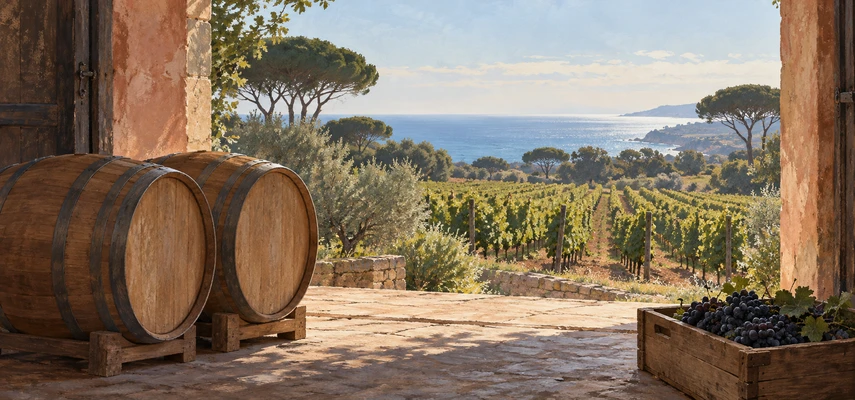

A Tuscan red doesn’t have to revolve around Sangiovese. Along the western coast, Cabernet Sauvignon, Cabernet Franc and Merlot have established identities of their own. Yet calling every ambitious example a Super Tuscan can obscure the most useful questions: where did the fruit grow, what does the label legally promise, and how was the wine made?
Bolgheri is a particularly clear place to investigate those questions. Keep it distinct from the broader coastal landscape and from inland wines that also use the informal Super Tuscan description. Then give the region’s whites a seat at the table. A coastal Cabernet comparison is interesting, but it isn’t the whole Tuscan syllabus.
Locate Bolgheri within coastal Tuscany
Tuscany stretches from inland hills to the Tyrrhenian coast. The Bolgheri consorzio’s geographical account places its production area in Castagneto Carducci, in Livorno province, excluding the coastal strip west of the old Via Aurelia. Much of the vineyard area occupies lower terrain below surrounding hills. A photograph of dramatic hilltops doesn’t mean every important parcel sits on a steep slope.
Maremma extends the coastal discussion farther south, with diverse local and international varieties. The Maremma Toscana consorzio describes a territory with several landscapes and wine identities. Bolgheri DOC, Maremma Toscana DOC and Morellino di Scansano aren’t interchangeable names for the entire Tuscan seaboard. The last of these also reminds us that coastal wine needn’t abandon Sangiovese.
Inland Tignanello provides another useful boundary. Antinori’s producer account locates the vineyard in the Chianti Classico area and describes a Sangiovese-led wine with Cabernet varieties. It belongs in the Super Tuscan discussion without becoming a Bolgheri wine. A commercial description can connect different stories without erasing their geography.
Explain the coastal vineyard’s opportunities and limits
Temperature affects growth, ripening and acid retention, with maritime influence modifying conditions relative to more continental inland settings. Sunlight supports photosynthesis, while aspect and canopy exposure change the fruit’s experience. Cabernet Sauvignon needs suitable ripening opportunities; Merlot’s different timing can spread picking decisions and seasonal risk. Neither variety becomes immune to heat or poor site selection because the sea is nearby.
Water availability depends on rainfall, soil depth, rooting and drainage. Nutrient availability influences vigour and crop balance. Bolgheri’s varied marine and alluvial materials don’t support a single gravel-only soil description. A deep soil may provide useful water reserves, while a shallower or freely draining parcel can face a different drought problem. Geological history doesn’t establish a compulsory salty flavour in the finished wine.
Weather creates frost, hail, heat, drought and harvest-rain risks. Downy and powdery mildew and bunch rot remain possible: airflow can help bunch conditions without abolishing fungal disease. Cabernet picked before sufficient maturity can retain unwelcome green character; waiting indefinitely for riper flavours can instead bring excessive sugar or deteriorating fruit. The sensible decision changes with the season.
Vineyard establishment considers access, drainage, exposure and the intended training system. Planting materials should match variety, vigour and water conditions, including rootstock suitability. Planting several varieties doesn’t automatically diversify risk if every parcel shares the same drainage or disease weakness. A blend starts with separately suitable fruit, not with a hopeful spreadsheet.
Nutrient and water management follows observation and analysis within applicable rules. Canopy management balances productive leaf area, airflow and bunch protection from heat. Harvest timing balances flavour, sugar, acidity, skin and seed maturity, health and the intended style. Hazard management includes erosion control, drainage and appropriate frost precautions. Pest and disease management combines monitoring, canopy work and justified interventions rather than relying on a general coastal reputation.
Separate Bolgheri’s wines from an informal nickname
The ministry’s Bolgheri specification provides the legal reference. Cabernet Sauvignon, Cabernet Franc and Merlot can each form the whole red blend within the applicable conditions; Bolgheri doesn’t require all three in every bottle. Syrah, Sangiovese and other authorised complements have separate limits. Check the category rather than assuming the phrase Bordeaux blend is its legal definition.
Bolgheri Rosso and Superiore also have different release and maturation requirements. The Superiore programme requires at least two years from the prescribed starting date, including at least one year in oak. That establishes a minimum production framework rather than a promise that the wine will taste more balanced than every Rosso. New oak, greater extraction and a higher price still require justification in the glass.
Bolgheri Sassicaia is a separate DOC, established independently in 2013 after its earlier subzone status. The consorzio’s appellation history makes that distinction explicit. It isn’t a generic category any Bolgheri producer may choose for a Cabernet blend. Tenuta San Guido’s wine information identifies Cabernet Sauvignon and Cabernet Franc in the producer’s wine; the producer’s actual blend and the appellation’s legal minimum aren’t the same kind of information.
Super Tuscan, meanwhile, is an informal description rather than a DOCG, fixed recipe or guaranteed quality grade. It can refer to wines with differing varietal combinations and legal identities. Some prominent examples use IGT; others have DOC identities. Consequently, neither all Super Tuscans are IGT nor all Toscana IGT wines are expensive collector reds is a reliable rule.
Make the red rather than copying its reputation
Winemaking approaches begin with the intended style and available fruit. Careful grape transportation limits crushing and unwanted oxidation. Reception should separate origin, variety, health and ripeness. Different picking dates can preserve useful components, but each lot needs suitable handling, identification and enough cellar capacity.
Processing and pressing affect yield and phenolic pickup. Destemming and crushing choices alter extraction; press fractions can contribute structure or excessive harshness. Must adjustments require analysis and legal permission. Alcoholic fermentation decisions include yeast, temperature, vessel and cap management. More pump-overs or a longer skin contact may increase extraction without improving the relationship between fruit and tannin.
Malolactic conversion and subsequent maturation should suit acidity and the desired integration. Extraction and pressing should suit skin condition and the intended drinking window. Oak vessel size, age and toast can change the sensory outcome, while separate lots allow blending trials. A soft component might improve one Cabernet lot and dilute another; commercial familiarity with Merlot doesn’t make every addition beneficial.
Finishing adjustments, sulfur dioxide and filtration should answer actual stability needs. Blending eligible lots can build balance without losing traceability or category entitlement. For an ambitious red, maturation can integrate tannin and develop complexity, but fruit must remain sufficient. An extra year of storage is an expense, not evidence that the wine improved during it.
Give Tuscan whites a separate production plan
Vermentino is an important coastal reference, alongside other authorised white varieties in particular appellations. The Maremma consorzio’s Vermentino account distinguishes several possible wine categories rather than a single mandatory style. Assess a producer’s actual wine before assuming every Vermentino is light, unoaked and designed for immediate drinking.
Healthy fruit, protected transport and selective pressing help retain a fresh white’s character. Pre-fermentation clarification adjusts solids for fermentation. Temperature, yeast and vessel choices affect fruit expression, while deliberately managed oxygen differs from accidental oxidation. A more textured white can use lees or wood without becoming a miniature version of the red programme.
Lees maturation can build texture; stirring may increase lees contact but also needs monitoring. Malolactic conversion changes the acid profile, so retaining freshness and increasing breadth can require a choice. Post-fermentation clarification removes unwanted suspended material. Stabilisation considers protein and tartrate risks, while microbiological safeguards should fit analysis, retained sugar and distribution. Packaging and closures should protect the intended drinking period, and wine transportation requires suitable temperature management.
Vernaccia di San Gimignano offers an inland white contrast rather than a coastal appellation. Its current consorzio specification centres on the local Vernaccia grape, with limited eligible complements, and allows a Riserva category with additional maturation. Don’t confuse it with unrelated wines sharing the Vernaccia name elsewhere. Compare fruit, acidity, texture and maturation evidence rather than demanding that all Tuscan whites taste alike.
Treat IGT as protected information
International and EU protection frameworks, national Italian law and local appellation specifications interact. Industry associations such as the consorzi communicate origin, support promotion and help producers understand changes. A geographical indication ties a place to defined production conditions. DOC and DOCG sit within the PDO framework, while PGI/IGT wines have their own protected specifications and traceability requirements.
Toscana IGT can offer different varietal and production possibilities from a narrower appellation. It isn’t permission to use fruit from anywhere or to disregard labelling rules. Wines without GI have a different entitlement and cannot borrow the protected geographical claim. A deliberate IGT choice can serve a producer’s preferred wine, while another IGT bottle can target a much more accessible market.
Current proposals also need careful reading. The ministry’s June 2026 Toscana file records transmission of a Union amendment application. That procedural step isn’t itself proof that every proposed change is already operative. Before making a shipment or revising labels, establish the applicable approved text and transition rather than turning a proposal into a study-table fact.
Connect production choices to a viable market
Supply depends on suitable vineyards, healthy fruit and the stock held for maturation. Demand differs between familiar international varieties, specialist coastal reds and fresh whites. Costs include land, sorting, barrels where used, storage and finance. Legislation affects production choices and labels; currency exchange changes export margins. A recognisable grape can help explain the product without cancelling competition from other countries growing it.
A grower may supply fruit, while an estate can coordinate production under one ownership. A virtual winery contracts production, and a custom crush facility supplies agreed production services. A cooperative can share equipment and market access; a conglomerate may coordinate several businesses. These are possible functions to evaluate, not claims that every model is equally common in Bolgheri. Contracts must establish quality, origin and responsibility whatever the ownership structure.
Marketing concepts begin with a target customer. A restaurant introducing a textured Tuscan white needs a different explanation from a merchant offering a recognised luxury red. Marketing options include transparent technical notes, comparative tastings and producer visits. The five Ps connect product, price, people, place and promotion: the wine, service, channel and promised experience should support the price rather than relying on a famous nickname alone.
For example, compare a fresh Vermentino sold for near-term restaurant service with a red retained for extended maturation. The first needs protected freshness and reliable replenishment; the second ties up cash and may need more explanation about drinking windows and provenance. Both require sound distribution. Neither becomes commercially successful simply because Tuscany is already familiar to customers.
Compare the evidence here with central Italy as a regional case, then apply the regional comparison framework to the comparison. Compare growing conditions, production decisions, style, quality and the commercial reasons for price. Establish the differences rather than assuming that one familiar name must be better.
Original Diploma practice
These original exercises practise explanation and evaluation. They aren’t official questions or marking schemes, and no actual bottle has been tasted for the examples below.
Question 1: test a Super Tuscan sales claim
A merchant describes Super Tuscan as a legal category requiring a coastal vineyard, Cabernet Sauvignon and Toscana IGT. Evaluate the description.
Reasoned outline: Identify the term as informal and distinguish geography, actual varietal composition and legal designation. Use inland Sangiovese-led Tignanello and coastal Bolgheri DOC identities as contrasting references. Check each label and specification instead of assuming a common recipe. The nickname can introduce a story, but it cannot establish protected origin or quality.
Question 2: compare two cellar plans
A producer proposes using identical extraction and new-oak maturation for every Cabernet, Merlot and Vermentino lot. Evaluate the plan.
Reasoned outline: Relate decisions to fruit condition, acidity, phenolic maturity and target style. Compare red fermentation on skins with pressing and juice clarification for a fresh white. Discuss cap management, press fractions, lees, malolactic conversion and oak integration. A consistent house style still needs different handling for different materials.
Question 3: assess an IGT commercial decision
A new brand wants to use Toscana IGT because it believes the designation removes origin controls and guarantees a premium price. Explain the weaknesses in its plan.
Reasoned outline: Explain protected PGI identity and compliance, distinguishing IGT from wine without GI. Establish the wine, customer, costs and route to sale before setting a price. Compare contract production, estate ownership and the working capital needed for maturation. Flexibility creates options rather than automatic exemption or demand.
Analytical tasting preparation: complete the Tuscan range
The official recommended-sample programme, printed page 22, includes any Tuscan white of very good quality and a Tuscan red, DOC or IGT, made from international varieties or a local/international blend, of very good or outstanding quality. A suitable Vermentino or Vernaccia and an appropriate Bolgheri or Toscana IGT red can meet the intended comparisons after their actual quality and identity are checked. The inland Sangiovese chapter covers the remaining essential Tuscan red rows.
The optional comparison is a red or white IGT of acceptable or good quality, not another compulsory expensive red. Write full systematic descriptions blind and compare fruit, acidity, body, tannin or phenolic texture, and maturation evidence. Justify quality through balance, length, intensity and complexity with actual observations. Assess bottle-ageing suitability separately, distinguishing fresh fruit intended for early drinking from fruit and structure that may develop together. Proposed selections don’t establish the quality of an untasted bottle, and a protected label doesn’t supply the missing sensory evidence.












