











Sparkling wine starts with a practical question: where will the carbon dioxide come from, and how will the producer keep it in the wine? The answer helps explain a great deal about flavour, texture, production time and cost. It doesn’t, by itself, tell you whether the bottle is good.
A tank can protect bright grape aromas. A bottle can hold wine against its yeast sediment for years. A different bottle might finish an interrupted fermentation and retain a little cloudiness. Understanding how sparkling wine is made means following those choices through to the glass, rather than arranging the methods on an imaginary podium.
Start with fruit and a suitable base
For many dry sparkling styles, grapes are picked with relatively modest sugar and useful acidity because another fermentation will add alcohol. Picking early isn’t a licence to use unripe, unhealthy fruit. The producer still needs flavour appropriate to the intended wine, and the right balance depends on grape, site and style.
Whole bunch pressing can limit extraction by keeping much of the skin material intact. Juice that drains freely and juice obtained at increasing pressure can differ in composition; separating fractions gives the winemaker choices. Press juice isn’t automatically waste, but later fractions can bring more phenolics and need different handling. Sparkling rosé or red production may deliberately use skin contact for colour and character.
These decisions interact. If a producer wants a pale, delicate wine from dark-skinned grapes, damaged berries and prolonged contact with skins work against that aim. If the aim is a coloured sparkling red, avoiding all extraction would miss the point. The useful answer starts with the product being made.
Shape the first fermentation
The primary alcoholic fermentation turns grape sugar into alcohol. Neutral vessels can preserve a relatively direct fruit profile. Oak changes the options: a small new barrel has a different influence from a large old one, so saying simply that a base wine was barrel-fermented leaves a lot unexplained.
Primary fermentation temperature and yeast choice influence aroma development, fermentation reliability and style. Cooler fermentation can help retain delicate aromatics, but temperature must suit the yeast and the process. Deliberately stopping primary fermentation is central to some sweet styles; it requires control of yeast activity and subsequent stability, rather than simply hoping the wine stays sweet.
Malolactic conversion is a separate bacterial process that changes malic acid into softer lactic acid. It may be encouraged, partially allowed or avoided according to the intended balance. The Comité Champagne’s fermentation explanation makes that optional status clear. A wine that avoids malolactic conversion isn’t automatically better, fresher in every sense or more expensive.
Blending can balance acidity, fruit, texture and colour, meet a volume requirement or maintain a recognisable style. Reserve wines are older base wines held for future blending; they can add continuity and development but also require storage, working capital and sound management. Not every sparkling wine uses them, and their presence isn’t a quality certificate.
Traditional method: bubbles inside the bottle
In the traditional method, a completed base wine receives a tirage addition containing sugar and yeast and undergoes a second alcoholic fermentation in bottle. The closed bottle retains the carbon dioxide produced. This is different from the later dosage, which adjusts the finished wine after sediment removal.
Second-fermentation yeast must cope with an already alcoholic, acidic wine and rising pressure. Temperature affects fermentation progress and the subsequent maturation environment. Cooler doesn’t mean indefinitely colder: the aim is controlled fermentation, not a stalled one. The Comité Champagne describes the bottle stage for Champagne; rules for other traditional-method regions must be checked separately.
After fermentation, the wine may spend an extended period with the yeast sediment, or lees. Riddling collects that sediment towards the closure. Disgorgement removes the collected deposit, commonly with the aid of freezing the neck. A finishing addition can replace lost wine and adjust sweetness before final closure.
The process creates opportunities for complexity and texture, along with costs for bottles, handling, cellar space and time. Those opportunities still need good execution. A poorly balanced traditional-method wine doesn’t become outstanding merely because its second fermentation happened in a bottle.
What time on lees can change
During autolysis, yeast cells break down and release components into the wine. Lees maturation can influence texture and the developed character associated with many bottle-fermented styles. Yet a bread-like aroma doesn’t tell you an exact number of months on lees, nor does it identify one biochemical cause with certainty.
The Tasmanian Institute of Agriculture’s sparkling-wine research investigates those relationships, including the difficulty of separating perceived autolytic character from more general ageing character. Its discussion is useful precisely because it makes the mechanism less simplistic than “more months equals more quality.”
Imagine two hypothetical wines held for the same period. One begins with clear fruit and balanced acidity; the other with weak fruit and awkward phenolics. Time doesn’t give them identical starting material. Evaluate the result through integration, identifiable flavour and persistence, alongside the intended style.
Transfer method: bottle fermentation, bulk clarification
The transfer method also uses a second fermentation in bottle and can include lees maturation. The important divergence comes afterwards: the wine is transferred under pressure into a tank, filtered to remove sediment, adjusted as needed and bottled into another set of bottles.
This avoids individual riddling and disgorgement in the standard transfer sequence. It preserves the possibility of bottle-fermentation and lees effects while changing the handling and finishing economics. It isn’t the same as creating the bubbles through a second fermentation in tank.
Wine Australia’s guide to sparkling production distinguishes these routes. When evaluating a producer’s choice, consider batch size, available equipment and intended price. Lower handling costs can help a business deliver a convincing wine at its target price; they don’t prove either inferior or superior sensory quality.
Tank method: a closed vessel creates the sparkle
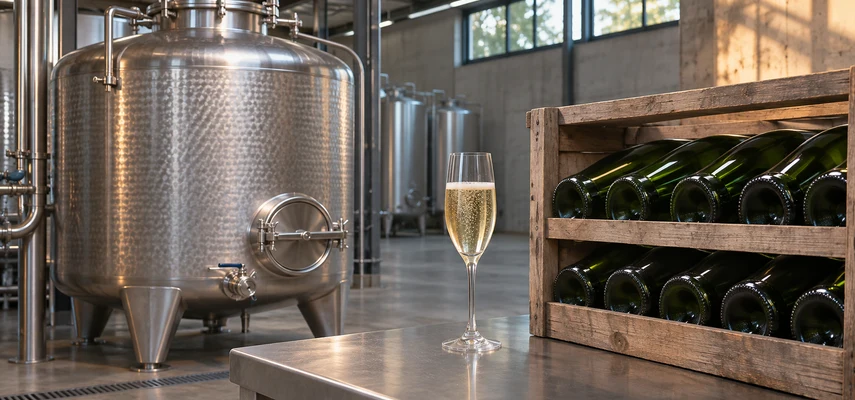
In the tank method, a base wine undergoes its second fermentation in a pressure-resistant tank after sugar and yeast are added. Clarification and bottling retain pressure so the dissolved gas isn’t simply lost. The OIV’s technical framework distinguishes this closed-tank process from bottle fermentation and describes pressure-controlled finishing operations.
A producer can use the method to prioritise fresh fruit and floral character with relatively short maturation. Tank capacity and efficient handling can support a lower unit cost at scale. Longer tank lees contact is also possible, so “tank method” doesn’t specify one exact flavour profile or production timetable.
Consider a hypothetical aromatic wine intended for early release. Paying for a long bottle-maturation programme might mute the character customers want while tying up cash. Choosing a suitable tank process is then a product decision, not an admission that the producer couldn’t afford to make “real” sparkling wine.
Asti method: retain sweetness during one fermentation
The classic sweet Asti-method sequence starts with grape must, rather than taking a dry base wine through a separate second fermentation. Must can be held cold, then fermented under controlled conditions. Gas is initially allowed to escape before pressure is retained; fermentation is arrested at the desired balance, and yeast removal helps stabilise the remaining sugar.
That links three outcomes: retained grape sweetness, relatively modest alcohol and fermentation-derived sparkle. Cooling slows yeast activity; filtration and hygienic handling matter because residual sugar remains available for renewed fermentation. This isn’t the same as adding dosage to a dry, disgorged traditional-method wine.
Gancia’s Asti production notes illustrate cold-held Moscato must and a Martinotti approach intended to retain aromatic character. Its individual analytical values describe that product, not every Asti. The broader current official Asti production specification also needs to be distinguished from this teaching shorthand: Asti has more than one permitted production expression.
Pétillant naturel and carbonation
Pétillant naturel commonly captures gas as an initial fermentation finishes in bottle, rather than beginning with a dry base and a new tirage fermentation. Depending on the producer’s choices, sediment may remain or be removed. Cloudiness therefore isn’t compulsory, and the name doesn’t establish an organic certification, a sugar level or freedom from faults.
Carbonation introduces carbon dioxide into a wine directly instead of generating the sparkle through a further fermentation. It can provide an economical route to a deliberately straightforward style. The correct label depends on the jurisdiction and category; don’t assume every country uses “sparkling” and “carbonated” interchangeably.
For either approach, assess the actual wine. A cloudy appearance calls for observation and context, not an automatic deduction of poor condition. A clear wine also needs a sound nose and palate. A method name won’t do the tasting for you.
Finish, package and assess the result
Fining can address selected unwanted components; filtering can remove suspended material or microorganisms according to the operation used. In a pressurised wine, finishing and transfer need equipment that retains carbon dioxide. Stopping a second fermentation for a particular style likewise requires a planned stability strategy, not just a sweet taste at the moment of sampling.
Dosage is a finishing decision, not a synonym for the sugar that created the bubbles. Its effect depends on the base wine’s acidity, flavour and intended balance. Packaging must withstand the relevant pressure, while closures must suit retention, handling and the intended life of the wine. Cork and cage are familiar, but crown caps and other permitted systems also exist.
For analytical study, note clarity, colour depth and hue, plus visible bubbles or sediment. Check nose condition before strength and specific aroma character. On the palate separate sweetness, acidity, alcohol warmth and body; assess tannin amount and texture where relevant, especially in sparkling reds. Distinguish flavour strength from flavour identity, and consider mousse or other tactile features before following the persistence of flavour on the finish.
Use the official Level 4 tasting resources for scale instructions: make one choice where requested, while treating illustrative descriptors as prompts rather than a compulsory list. Explain quality through observed balance, definition and persistence. Explain bottle-ageing suitability separately through the development expected and the support available. Bubble size alone can’t establish either conclusion.
Connect Champagne’s vineyards with white winemaking when testing the explanation: trace a production choice into the wine’s sensory evidence, then distinguish its contribution to style from its implications for quality and cost.
Original Diploma practice
These independent exercises have indicative points and outline answers, not official questions or marks. The proposed comparisons aren’t actual tastings or verified bottle grades. They supplement the official sample programme.
Question 1: choose between traditional and transfer methods
A hypothetical producer wants bottle-fermented character at a competitive mid-market price. Compare traditional and transfer methods through fermentation, sediment removal, equipment, labour, style and commercial risk.
Indicative points: both use bottle second fermentation; both allow lees contact; finishing differs; scale matters; quality needs separate evidence. Outline answer: Transfer changes clarification and packaging economics while retaining bottle fermentation. Its suitability depends on the desired wine, available equipment and viable volume, rather than a universal quality ranking.
Question 2: explain sweetness without confusing the additions
Compare a classic sweet Asti-method wine with a dry-base traditional-method wine receiving dosage. Explain where fermentable sugar comes from, when fermentation occurs, how gas is retained and why stability matters.
Indicative points: must versus dry base; one fermentation versus two; arrested fermentation; yeast removal; tirage versus dosage; final balance. Outline answer: Asti-method sweetness can remain from the original must, whereas dosage adjusts a finished traditional-method wine. Both require controlled handling, but the sequence and role of sugar differ.
Question 3: evaluate a maturation proposal
A producer wants to double lees time and double the selling price. Evaluate the proposal without assuming an exact flavour gain or an equal increase in demand.
Indicative points: starting material; sensory trials; storage; cash tied up; customer willingness; competitive positioning. Outline answer: More time creates additional costs and possible development, while price still needs market support. Trial wines and a costed business case provide stronger evidence than a method-based prestige claim.
Analytical tasting preparation: compare process clues cautiously
Ask an organiser to source a New World traditional or transfer-method wine targeting good quality and a New World non-traditional-method wine targeting good quality, reflecting essential study categories. If available, add a pét-nat targeting good-to-very-good quality from the optional programme. Conceal production information before writing notes.
Indicative points: condition before identity; sweetness and acidity separately; mousse and texture; supported quality; independent ageing judgement; reveal process last. Outline answer: Use observed fruit, development, texture and balance to test method hypotheses. A convincing explanation admits where several processes could produce similar sensations and doesn’t turn a production clue into a guaranteed origin or quality grade.












