










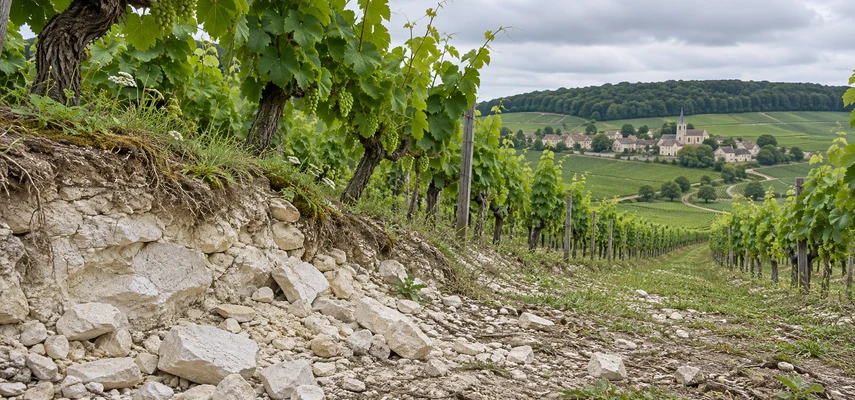

Champagne’s vineyards do something rather demanding: supply grapes with enough flavour for a finished wine while retaining the acidity and moderate potential alcohol needed for another fermentation. Then the producer may ask those grapes to support years of maturation. The bubbles arrive later; the balancing act starts outside.
For Diploma study, connect the region’s northerly position, varied slopes and soils, grape choices and vineyard work with style, quality and price. Champagne is a protected origin with a distinctive business structure, not a single vineyard recipe. A chalk photograph and a famous village name are useful starting points, but neither explains the whole bottle.
Locate Champagne’s contrasting vineyard areas
Champagne lies in northeastern France, with major centres including Reims and Épernay. Its vineyards extend across separated districts rather than forming one continuous carpet. The Comité Champagne’s regional guide distinguishes the Montagne de Reims, Vallée de la Marne, Côte des Blancs and Côte des Bar, alongside areas such as the Côte de Sézanne.
The Montagne de Reims is strongly associated with Pinot Noir, though grape plantings and exposures vary. The Vallée de la Marne is important for Meunier, particularly farther west. Chardonnay is closely associated with the Côte des Blancs and Côte de Sézanne. Pinot Noir also has a major role in the more southerly Côte des Bar.
Treat those associations as a framework for locating evidence, not a complete specification of flavour. A district includes different slopes, soils and producers. Even before winemaking, a sheltered parcel and an exposed one can face different ripening and disease pressures. After winemaking, blending may deliberately combine their contributions.
Explain the climate through benefits and risks
The region has both oceanic and continental influences. Relatively cool growing conditions can help retain acidity and limit sugar accumulation, useful attributes for sparkling base wine. Rainfall supports growth, while cold episodes, spring frost, storms and variable ripening create risks. The official climate account describes those influences and increasingly early harvests.
Don’t turn “cool climate” into “the colder the better.” Insufficient ripening can leave thin flavour and awkward acidity. A grower needs a suitable balance for the intended base wine, not maximum tartness. Nor does a northerly latitude prevent heat or drought. The weather experienced during a particular season matters more than a tidy adjective in a revision table.
Aspect changes the receipt of sunlight, and slope can affect both exposure and cold-air movement. A favourable position can help ripen fruit, yet frost risk still depends on local terrain and conditions. Compare a low-lying frost pocket with a slope where cold air can drain away. They need different risk assessments even within the same village.
Use a causal answer: weather changes vine growth or fruit condition; the grower adjusts management or harvest; those decisions affect composition, yield and cost. A vintage description that jumps directly from warm weather to high quality leaves several important steps unexplained.
Use soil as a mechanism, not a tasting shortcut
Chalk is important in Champagne, but it isn’t the only substrate. Marl, other limestone, clay and sand also occur. Porous chalk can combine drainage with water storage, influencing the water available to roots. The Comité’s soil explanation also links contrasting soils with the region’s grape distribution.
Water storage doesn’t make drought impossible. The outcome depends on rooting, soil depth, water demand and the season. Likewise, good drainage doesn’t mean the vine should receive no water. Both waterlogging and excessive stress can interfere with the production of suitable fruit.
Nutrient availability affects growth and crop balance, while soil management can influence competition, access and erosion. On a slope, a management decision may need to protect the land as well as the harvest. Evaluate a proposed intervention against the actual problem rather than declaring one soil-management approach best for every parcel.
Avoid claiming that a chalky subsoil must produce a chalk flavour. The soil can help explain growing conditions; the sensory note still has to come from the glass. The same distinction applies to every attractive geological word on a back label.
Choose grapes for the site and intended blend
Pinot Noir, Chardonnay and Meunier dominate the vineyard. Pinot Noir is commonly associated with structure and body in blends; Chardonnay with freshness and a different aromatic contribution; Meunier with fruit and suppleness. These are tendencies shaped by site, ripeness and production choices, not fixed measurements attached to the grape name.
Meunier’s later budburst can be useful in frost-prone conditions, but it doesn’t make the vine immune to frost or guarantee a short-lived wine. The current grape guide also makes clear that the three dominant grapes aren’t the entire authorised range.
The approved 2025 rules include Chardonnay rose alongside other established varieties and distinguish Voltis within a controlled adaptation framework. Read its planting and blending conditions separately; it isn’t an unrestricted replacement for the dominant grapes. The approved Champagne production specification is the appropriate reference for those conditions.
A July 2026 INAO notice opens an opposition procedure on proposed amendments. A proposal isn’t proof that new rules have entered force. When revising, record the approved text’s date and distinguish it from consultation material. That small habit prevents very confident answers about rules that haven’t actually been adopted.
Connect vineyard work with the wine
Vine establishment commits the grower to a site, planting material and an arrangement that must work within the appellation’s controls. Pruning systems include Chablis, Cordon de Royat and Guyot forms under specified conditions. The important analytical question is how crop, canopy and vine balance support healthy fruit suitable for the intended wine.
Canopy management can help improve exposure and air movement, but excessive exposure can bring a different problem in hot conditions. Managing fungal disease requires attention to weather and fruit health; a later cellar process can’t be assumed to remove every consequence of compromised grapes. Water and nutrient decisions likewise need to match actual supply and vine demand.
Hand harvesting adds coordination and labour requirements while supporting the delivery of whole bunches for controlled pressing. Harvest timing needs to balance flavour, acidity, sugar and condition. Picking a threatened parcel earlier can reduce a particular risk, but it may sacrifice ripeness; waiting can reverse that trade-off. Explain the choice rather than congratulating either date in isolation.
In the cellar, gentle pressing, fraction selection, fermentation choices, blending and bottle fermentation connect these vineyard differences with the finished wine. A producer can blend parcels, grapes and years to pursue consistency, or give a narrower origin and harvest a more visible role. Either approach still needs good raw material and a coherent objective.
Understand crus without inventing a price formula
In Champagne, cru terminology is connected with village origins. The approved specification identifies communes eligible for grand cru and premier cru mentions. This differs from treating a famous vineyard parcel as a Burgundian grand cru. The historic échelle des crus also shouldn’t be presented as a current compulsory table that mechanically fixes every grape contract price.
A label mention establishes an origin claim under its conditions. It doesn’t guarantee that every bottle from that origin has identical balance, complexity or ageing potential. Vineyards within a village can differ, and producers can handle their fruit differently. Prestige can influence demand and commercial positioning without replacing sensory evidence.
For a written comparison, separate three questions: what origin does the claim establish, what production choices were made, and what evidence supports the quality judgement? Combining them into “grand cru, therefore outstanding” is convenient but unconvincing. A good answer can recognise a valuable reputation while still testing the actual conclusion.
Follow the economics from grapes to market
Growers may sell grapes, produce their own wine or work through a co-operative. An estate model can retain control of vineyard decisions while taking on production and selling responsibilities. A merchant house can assemble supplies and blends across origins, while a co-operative can share equipment and services among members. A conglomerate can provide capital and distribution resources; that ownership form doesn’t make every wine follow one sensory style.
Each arrangement distributes cost, control and risk differently. Selling grapes avoids some cellar and marketing commitments but leaves the grower exposed to the economics of grape contracts. Selling a finished bottle can retain more of its value while requiring stock finance, skills, packaging, customer access and time. Revenue and profit aren’t interchangeable rewards for doing more stages yourself.
Supply, demand and stocks also interact. The Comité’s January 2026 review reports about 266 million bottles shipped during 2025. Shipments measure movement from producers into markets, not every final consumer purchase, and shouldn’t be confused with that year’s harvest volume.
The 2026 harvest decision set a marketable yield of 8,800 kg/ha as part of stock and market management. That dated decision isn’t an eternal yield for the appellation or a promise that every vineyard physically produced the same crop. Annual marketable yield, actual harvest and longer-term stock planning need separate labels in your notes.
Connect collective identity with a producer’s proposition
The Comité Champagne brings growers and houses into a shared regional framework, including collective work on the appellation and its markets. It shouldn’t be confused with the Consejo Regulador del Cava or South Africa’s Cap Classique Association. Shared use of bottle fermentation doesn’t make these organisations, origins or production rules interchangeable.
For an individual brand, marketing still requires a defined customer and proposition. Product decisions include blend, style, packaging and release. Price positioning must cover a viable cost structure and make sense against alternatives. People include vineyard and cellar staff, sales teams and the trade professionals explaining the bottle. Placement concerns where customers can find it; promotion concerns how they learn why it suits them.
A hypothetical small grower might prioritise specialist retailers and direct visits, while a larger house might need wider distribution. Neither route automatically offers a better margin after all costs. Compare reach, selling effort, inventory, payment terms and the control retained over the customer relationship.
Taste the result independently
Use the official Level 4 tasting resources to organise observations. Record clarity, colour depth and hue, plus visible gas or sediment. Check nose condition, then aroma strength and specific character. Separate sweetness and acidity, alcohol warmth and body; consider tannin amount and texture where relevant, especially in rosé styles with extraction.
Distinguish flavour strength from flavour character, note mousse and other texture, and follow the persistence of identifiable flavour on the finish. Make a single scale choice where instructed; illustrative descriptors are prompts, not a compulsory inventory. Explain quality through observed integration and sustained flavour. Explain ageing suitability separately through the development expected and the support present.
A label reveal can help investigate vineyard and cellar choices. It can’t retrospectively turn a short finish into a long one. That is a particularly useful discipline when the village name is famous.
Connect Champagne production with sparkling production methods when testing the explanation: trace a production choice into the wine’s sensory evidence, then distinguish its contribution to style from its implications for quality and cost.
Original Diploma practice
These original exercises have indicative points and outline answers, not official questions or marks. Suggested bottles are procurement targets, not actual tastings or verified quality grades.
Question 1: evaluate two vineyard risks
Compare a frost-prone lower parcel with a better-exposed slope during a season that later becomes hot and dry. Explain potential benefits, hazards, management responses, fruit composition and costs without assuming one site wins every year.
Indicative points: budburst; cold-air movement; exposure; water supply; canopy; harvest trade-offs. Outline answer: A site’s advantage depends on the hazard and the season. A useful evaluation follows management decisions through ripening, condition, yield and cost rather than assigning a permanent quality score to the slope.
Question 2: assess an origin and price claim
A merchant argues that a grand cru label proves both outstanding quality and a fixed higher grape cost. Evaluate the argument using origin, vineyard variation, producer choices, contracts and demand.
Indicative points: eligible origins; village versus parcel; historical pricing; current negotiation; sensory evidence. Outline answer: The origin mention has defined conditions, but neither a universal sensory grade nor a compulsory modern contract price follows from it. Prestige can affect demand without settling the other questions.
Question 3: interpret marketable yield
Explain why the 2026 figure of 8,800 kg/ha can’t be substituted for actual crop, bottle shipments or an undated permanent rule. Discuss how stock adjustment could affect different businesses.
Indicative points: date; units; permitted marketing; physical yield; inventories; growers and houses. Outline answer: Marketable yield is one dated management decision within a longer production and sales cycle. Its implications depend on a business’s crop, contracts, reserves, stocks and market access.
Analytical tasting preparation: test reputation against the glass
Ask an organiser to source a non-vintage Champagne targeting acceptable-to-good quality and another targeting very good quality, reflecting two essential study selections. Conceal labels, write full notes, and justify quality and ageing separately before revealing producer and origin information.
Indicative points: condition; balance; fruit and development; mousse; finish; independent ageing conclusion. Outline answer: The comparison should rest on the recorded wines rather than the price or cru mention. If the intended quality contrast doesn’t appear, investigate condition, service and calibration instead of rewriting the note to suit the label.












